
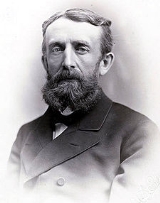
Andrew Dickson White (November 7, 1832 – November 4, 1918) was a U.S.
diplomatA diplomat is a person appointed by a state to conduct diplomacy with another state or international organisation. The main functions of diplomats revolve around the representation and protection of the interests and nationals of the sending state, as well as the promotion of information and...
, historian, and educator, best known as the co-founder of
Cornell UniversityCornell University is a private university located in Ithaca, New York, USA, that is a member of the Ivy League.Cornell counts more than 255,000 living alumni, 28 Rhodes Scholars and 41 Nobel laureates affiliated with the university as faculty or students...
.
Family and personal life
Andrew Dickson White was born on November 7, 1832 in
HomerHomer, New York may refer to either:*Homer , New York, located in Cortland County*Homer , New York, located within the Town of Homer...
,
New YorkNew York is a state in the Mid-Atlantic and Northeastern regions of the United States and is the nation's third most populous. The state is bordered by New Jersey and Pennsylvania to the south, and Connecticut, Massachusetts and Vermont to the east...
to Clara (née Dickson) and Horace White. Clara was the daughter of Andrew Dickson, a
New York State AssemblyThe New York State Assembly is the lower house of the New York Legislature, the state legislature of the U.S. state of New York. The Assembly is composed of 150 members representing an equal number of districts, with each district having an average population of 128,652...
man, and Horace was the son of Asa White, a farmer from
MassachusettsThe Commonwealth of Massachusetts is a state in the New England region of the northeastern United States. It is bordered by Rhode Island and Connecticut to the south, New York to the west, and Vermont and New Hampshire to the north; at its east lies the Atlantic Ocean. Most of its population of...
whose once successful farm was ruined by a fire when Horace was 13. Horace, despite little formal education and an impoverished background, became a wealthy merchant and, in 1839, opened a successful bank in
SyracuseSyracuse is a city in and the county seat of Onondaga County, New York, United States, and the fifth most populous city in the state. At the 2000 census, the city population was 147,306, and its metropolitan area had a population of 732,117. It is the economic and educational hub of Central New...
. Andrew Dickson White thus entered the world, never to experience the poverty his father and grandfather had. He was baptized in 1835 at the Calvary Episcopal Church on the town green in Homer.
White married twice. He first married Mary Amanda Outwater (February 10, 1836 - June 8, 1887) on September 27, 1857 and they remained married until her death in 1887. Together, they had three children: Frederick Davies White, who committed suicide in 1901 after a prolonged series of illnesses while A.D. White was in Germany, Clara (White) Newbury, whom Andrew also outlived, and Ruth (White) Ferry. Following Mary's death in 1887, White went on a lecture tour and traveled in Europe with his close friend, Cornell's librarian, Daniel Willard Fiske. In 1890, White married
Helen MagillHelen Magill White was the first woman in the United States to earn a Ph.D. She earned her doctoral degree in Greek from Boston University in 1877. She attended high school at Boston Latin School and was the first woman to graduate.
...
, the daughter of
Swarthmore CollegeSwarthmore College is a private, independent, liberal arts college in the United States with an enrollment of about 1,500 students. The college is located in the borough of Swarthmore, Pennsylvania, 11 miles southwest of Philadelphia....
's second president, Edward Magill She holds the distinction of being the first female Ph.D. recipient in the United States. Like her husband, Helen was a successful social scientist and educator and the two met at a conference where she was presenting. Together, Helen and Andrew had one daughter, Karin White.
His cousin was
Edwin WhiteEdwin White was an American painter who studied in Paris, Rome, and Florence and later taught at the National Academy of Design, in New York....
, an artist of the
LuminismLuminism can refer to*A Professional Photography Studio in Egypt, see The Official website *A current in North American painting, see Luminism *A neo-impressionist style in painting, see Luminism...
/
Hudson River schoolThe Hudson River School was a mid-19th century American art movement embodied by a group of landscape painters whose aesthetic vision was influenced by romanticism...
s, , and his nephew was
Horace WhiteHorace White was an American lawyer and politician from New York...
, governor of New York.
Education
Beginning in the fall of 1849, White spent his first year of college at Geneva College (known today as Hobart and William Smith College) at the insistence of his father. He was inducted as member of
Sigma PhiThe Sigma Phi Society was founded on 4 March, 1827, on the campus of Union College as a part of the Union Triad in Schenectady, New York.it is the second oldest Greek social fraternal organization in the United States...
. In his autobiography, he recalled that he had felt that his time at Geneva was "wasted" at the small
EpiscopalianThe Episcopal Church , also known as the Protestant Episcopal Church in the United States of America , is the Province of the Anglican Communion in the United States, Honduras, Taiwan, Colombia, Ecuador, Haiti, the Dominican Republic, Venezuela, the British Virgin Islands and parts of Europe...
school, instead of "one of the larger New England universities". Rather than continue "wasting" his time, White dropped out in 1850. After a resulting period estrangement from his father, White successfully convinced his father to allow him to transfer to
Yale UniversityYale University is a private research university in New Haven, Connecticut, and a member of the Ivy League. Founded in 1701 in the Colony of Connecticut, the university is the third-oldest institution of higher education in the United States. Yale has produced many notable alumni, including five...
.
At Yale, he was a classmate of
Daniel Coit GilmanDaniel Coit Gilman was an American educator and academician, who was instrumental in founding the Sheffield Scientific School at Yale College, and who subsequently served as one of the earliest presidents of the University of California, the first president of Johns Hopkins University, and as...
, who would later serve as first president of
Johns Hopkins UniversityThe Johns Hopkins University, commonly referred to as Johns Hopkins, JHU, or simply Hopkins, is a private research university located in Baltimore, Maryland, United States. Johns Hopkins also maintains full-time campuses elsewhere in Maryland, Washington, D.C., Italy, China, and Singapore...
. The two were members of the
Skull and BonesSkull and Bones is a secret society at Yale University in New Haven, Connecticut. The society's alumni organization, which owns the society's real property and oversees the organization, is the Russell Trust Association, named for General William Huntington Russell, who co-founded Skull and Bones...
secret society and would remain close friends, traveling together in Europe after graduation and serving together on the Venezuela Boundary Commission (1895-96). His roommate was Thomas Frederick Davies, third bishop of the
Episcopal Diocese of MichiganThe Episcopal Diocese of Michigan is the Episcopal diocese in the southeast part of Michigan.The diocese traces its roots to the founding of St. Paul's, Detroit in 1824. It became a diocese of the Episcopal Church in 1836, one year before Michigan became a state.St...
, 1889–1905. Other members of White's graduating year included
Edmund Clarence StedmanEdmund Clarence Stedman , American poet, critic, and essayist was born at Hartford, Connecticut, United States.-Biography:...
, the poet and essayist,
Wayne MacVeaghIsaac Wayne MacVeagh was an American politician and diplomat.-Biography:Born in Phoenixville, Pennsylvania, he attended Yale University, where he was a brother of the Delta Kappa Epsilon fraternity , and graduated 10th in his class in 1853...
, Attorney General of the United States and
U.S. Ambassador to ItalySince 1840, the United States has had diplomatic representation in the nation of Italy and its predecessor nation, the Kingdom of Sardinia, with a break in relations from 1941 to 1944 while Italy and the U.S. were at war during World War II. The U.S. Mission to Italy is headed by the Embassy of...
, and
Hiram Bingham IIHiram Bingham, formally Hiram Bingham II , was a Protestant Christian missionary to Hawaii and the Gilbert Islands....
, the missionary, collectively comprising the so-called "famous class of '53". According to White, a great influence on his academic career was Professor
Noah PorterNoah Porter , American academic, philosopher, author, lexicographer and President of Yale College ....
(later, Yale's president), who personally instructed him in rhetoric and remained a close personal friend until Porter's death.
Alpha Sigma PhiAlpha Sigma Phi Fraternity is a social fraternity with 68 active chapters, colonies, and interest groups. Founded at Yale in 1845, it is the 10th oldest fraternity in the United States....
inducted White as a member in 1850 and he served as editor of the fraternity's publication,
The Tomahawk. White remained active in the fraternity for the rest of his life, founding the Cornell chapter and serving as the national president from 1913-1915. He also served as an editor of The Lit., known today as the
Yale Literary MagazineThe Yale Literary Magazine, founded in 1836, is the oldest literary review in the United States, and publishes poetry and fiction by Yale undergraduates twice per academic year....
and belonged to
Linonia-History:Linonia was founded in 1753 as Yale University's second literary and debating society. By the late eighteenth century, all incoming freshmen at Yale College became members either of Linonia or its rival society, Brothers in Unity, which was founded in 1768...
, a literary and debating society. As a junior, White won the Yale literary prize for the best essay, writing on the topic "The Greater Distinctions in Statesmanship", a great shock to the campus as a senior traditionally wrote the winning essay. Also as a junior, he joined the junior society
Psi UpsilonPsi Upsilon is the fifth oldest college fraternity in the United States, founded at Union College in 1833. It has chapters at colleges and universities throughout North America. For most of its history, Psi Upsilon, like most social fraternities, limited its membership to only men...
. In his senior year, White won the Clark Prize for English
disputationIn the scholastic system of education of the Middle Ages, disputations offered a formalized method of debate designed to uncover and establish truths in theology and in sciences...
and the De Forest prize for public oratory, speaking on the topic "The Diplomatic History of Modern Times". A medal valued at $100, the De Forest prize was, at the time, the largest prize of its kind at any educational institution American or otherwise. In White's honor, an anonymous donor later gave money endowing a prize for the best senior essay in American,
EuropeanThe history of Europe describes the history of humans inhabiting Europe to the present day. For convenience, historians divide long periods into more manageable eras....
, or
Third WorldThe term Third World arose during the Cold War to define countries that remained non-aligned or neutral with either capitalism and NATO or communism and the Soviet Union...
history to be awarded in his name annually. In addition to academic pursuits, White was on the Yale
crewRowing is a sport in which athletes race against each other on rivers, on lakes or on the ocean, depending upon the type of race and the discipline. The boats are propelled by the reaction forces on the oar blades as they are pushed against the water...
team and competed in the first running of the Harvard–Yale Regatta in 1852.
After graduation, White left with his classmate Daniel Coit Gilman to travel and study further in
EuropeEurope is, by convention, one of the world's seven continents. Comprising the westernmost peninsula of Eurasia, Europe is generally divided from Asia to its east by the water divide of the Ural Mountains, the Ural River, the Caspian Sea, the Caucasus Mountains , and the Black Sea to the southeast...
. Between 1853 and 1854, he studied at the
SorbonneThe name Sorbonne is commonly used to refer to the historic University of Paris in Paris, France or one of its successor institutions , but this is a recent usage, and "Sorbonne" has actually been used with different meanings over the centuries...
, the
College de FranceThe Collège de France is a higher education and research establishment located in Paris, France, in the 5th arrondissement, or Latin Quarter, across the street from the historical campus of La Sorbonne at the intersection of Rue Saint-Jacques and Rue des Ecoles...
, and the University of Berlin. Following his time in Europe, White returned to Yale to earn an
M.A.A Master of Arts is a postgraduate academic master degree awarded by universities in many countries. The degree is typically studied for in English, Fine Arts, History, Nursing, Humanities, Geography, Philosophy, Social Sciences or Theology and can be either fully-taught, research-based, or a...
in History and be inducted into Phi Beta Kappa in 1856.
Earned degrees
- Yale
Yale University is a private research university in New Haven, Connecticut, and a member of the Ivy League. Founded in 1701 in the Colony of Connecticut, the university is the third-oldest institution of higher education in the United States. Yale has produced many notable alumni, including five...
- A.B. (1853)
- Yale
Yale University is a private research university in New Haven, Connecticut, and a member of the Ivy League. Founded in 1701 in the Colony of Connecticut, the university is the third-oldest institution of higher education in the United States. Yale has produced many notable alumni, including five...
- M.A. History (1856)
Honorary degrees
- University of Michigan
The University of Michigan, Ann Arbor is a public research university located in the state of Michigan in the United States. It is the state's oldest university, the flagship campus of the University of Michigan, and one of the top public universities in the world...
- LL.D. (1867)
- Cornell
Cornell University is a private university located in Ithaca, New York, USA, that is a member of the Ivy League.Cornell counts more than 255,000 living alumni, 28 Rhodes Scholars and 41 Nobel laureates affiliated with the university as faculty or students...
- LL.D. (1886)
- Yale
Yale University is a private research university in New Haven, Connecticut, and a member of the Ivy League. Founded in 1701 in the Colony of Connecticut, the university is the third-oldest institution of higher education in the United States. Yale has produced many notable alumni, including five...
- LL.D. (1887)
- Columbia
Columbia University in the City of New York is a private university in the United States and a member of the Ivy League. Columbia's main campus lies in the Morningside Heights neighborhood in the borough of Manhattan, in New York City...
- L.H.D. (1887)
- University of Jena - Ph.D. (1889)
- St. Andrew's
, also known as St Andrew's University, is a private, coeducational university located in Izumi, Osaka, Japan.-External links:* – official website...
- LL.D. (1902)
- Johns Hopkins - LL.D. (1902)
- Oxford - D.C.L. (1902)
- Dartmouth
Dartmouth College is a private, coeducational university located in Hanover, New Hampshire, USA. Incorporated as "Trustees of Dartmouth College," it is a member of the Ivy League and one of the nine Colonial Colleges founded before the American Revolution...
- LL.D. (1906)
Early professional life
In 1858, White accepted a position as a Professor of History and English literature at the
University of MichiganThe University of Michigan, Ann Arbor is a public research university located in the state of Michigan in the United States. It is the state's oldest university, the flagship campus of the University of Michigan, and one of the top public universities in the world...
, where he remained on faculty until 1863. White made his lasting mark on the grounds of the university by enrolling students to plant
elmElm leaves are alternate, with simple, single- or, most commonly, doubly-serrate margins, usually asymmetric at the base and acuminate at the apex. The genus is hermaphroditic, having perfect flowers which, being wind-pollinated, are apetalous. The fruit is a round wind-dispersed samara...
s along the walkways on
The DiagAt the University of Michigan in Ann Arbor, the Diag is a large open space in the middle of the university's Central Campus. The Diag derives its name from the many sidewalks running near or through it in diagonal directions. It is arguably the busiest site on the university campus, hosting a...
.
Cornell University
In 1863, White returned to reside in Syracuse for business reasons and, in November, was elected to the
New York State SenateThe New York State Senate is one of two houses in the New York State Legislature and has members each elected to two-year terms. There are no limits on the number of terms one may serve...
running on the
Union PartyThe National Union Party was a political party in the United States from 1864 to 1868. It was an alliance between members of the Republican Party who backed incumbent President Abraham Lincoln and Northern Democrats during and after the Civil War.-Establishment:The National Union Party was...
ticket. In the senate, White made the acquaintance of fellow
upstateUpstate New York is the region of New York State north of the core of the New York metropolitan area.-Definition:There is no clear or official boundary between Upstate New York and Downstate New York, but the term "Upstate" is sometimes used to refer to the whole of the state besides New York City...
senator
Ezra CornellEzra Cornell was an American businessman and, with Andrew Dickson White, was the founder of Cornell University.- Birth and early life :...
, a self-taught Quaker farmer from Ithaca who had made a modest fortune in the telegraph industry. Around this time, the task came upon the senators to decide how to best use the higher education funding provided by the
Morrill Land-Grant Colleges ActThe Morrill Land-Grant Acts are United States statutes that allowed for the creation of land-grant colleges, including the Morrill Act of 1862 and the Morrill Act of 1890...
, which allocated money in the form of timber land in the
midwestThe Midwestern United States is one of the four geographic regions within the United States of America that are officially recognized by the United States Census Bureau....
that could be sold as states saw fit. Through effective management by Cornell, New York generated about $2.5 million (~$43 million in 2008 dollars) from its allotted scrip, a greater yield per acre than any state, except, perhaps,
CaliforniaCalifornia is the most populous state in the United States, and the third largest by area. California is the second most populous sub-national entity in the Americas, behind only São Paulo, Brazil...
. The initial push in the senate was to divvy the funds amongst the numerous, small state colleges. White fervently opposed this proposal, arguing that the money would be more effectively used if it endowed only one university. Ezra Cornell agreed, telling White "I have about half a million dollars more than my family will need: what is the best thing I can do with it for the State?" To which, White immediately replied "The best thing you can do with it is to establish or strengthen some institution of higher learning." The two thus combined their efforts to form a new university.
White pressed that the university should located on the hill in
SyracuseSyracuse is a city in and the county seat of Onondaga County, New York, United States, and the fifth most populous city in the state. At the 2000 census, the city population was 147,306, and its metropolitan area had a population of 732,117. It is the economic and educational hub of Central New...
(the current location of
Syracuse UniversitySyracuse University is a private research university located in Syracuse, New York, U.S.A.. It was founded as a university in 1870, but its roots can be traced back to a seminary founded by the Methodist Episcopal Church in 1832 which eventually became Genesee College...
) due to the city's attractive transportation hub, which would ease the recruitment of faculty, students, and other persons of note. Cornell, however, insisted that the university be located in
IthacaThe city of Ithaca, , sits on the southern shore of Cayuga Lake, in Central New York, USA. It is best known for being home to Cornell University, an Ivy League school with almost 20,000 students...
on his large farm on East Hill, overlooking the town and
Cayuga LakeCayuga Lake is the longest of western New York's glacial Finger Lakes, and is the largest in surface area and second largest in volume . It is just under 40 miles long. Its average width is 1.7 miles , and it is 3.5 miles wide at its widest point near Aurora...
. White ultimately relented and convinced Cornell to give his name to the university "in accordance with [the] time-honored American usage" of naming universities after their largest initial benefactors. On February 7, 1865, White introduced a bill "to establish the Cornell University" and, on April 27, 1865, after a many month long debate, Governor Reuben E. Fenton signed into law the bill endowing Cornell University as the state's
Land-Grant institution.
White became the school's first president and served as a professor in the
Department of History|- valign="top" ! style="border-top: solid 1px #aaaaaa;" | College | style="border-top: solid 1px #aaaaaa;" | Arts and Sciences |- valign="top" ! style="border-top: solid 1px #aaaaaa;" | Department Chair | style="border-top: solid 1px #aaaaaa;" | Barry Strauss...
. He commissioned Cornell's first
architecture studentThe College of Architecture, Art, and Planning at Cornell University was established in 1871 as the School of Architecture with the hiring of Charles Babcock as the first Professor creating the first four-year course of study in architecture in the United States...
William Henry MillerWilliam Henry Miller was an American architect and the first graduate of the architecture school at Cornell University in Ithaca, New York....
to build
his mansionThe Andrew Dickson White House, commonly referred to as the "A.D. White House," is a Second Empire house on the campus of Cornell University, designed by William Henry Miller and Charles Babcock...
on campus.
Diplomatic career and later work
While at Cornell, in 1871, White took leave to serve as a Commissioner to Santo Domingo along with
Benjamin WadeBenjamin Franklin "Bluff" Wade was a U.S. lawyer and United States Senator. In the Senate, he was associated with the Radical Republicans of that time.-Early life:...
and Samuel Howe at the request of President
GrantUlysses S. Grant was general-in-chief of the Union Army from 1864 to 1869 during the American Civil War and the 18th President of the United States from 1869 to 1877....
in order to determine the feasibility of an American annexation of the
Dominican RepublicThe Dominican Republic is a nation on the island of Hispaniola, part of the Greater Antilles archipelago in the Caribbean region. The western third of the island is occupied by the nation of Haiti, making Hispaniola one of two Caribbean islands that are occupied by two countries...
. Though their report (
available here) supported the annexation, Grant failed to gain political support to take further action. Later, White was the first U.S. Minister to Germany (1879-1881), and first president of the
American Historical AssociationThe American Historical Association is the oldest and largest society of historians and teachers of history in the United States. Founded in 1884, the association promotes historical studies, the teaching of history, and the preservation of and access to historical materials...
(1884-1886). Upstate
New York RepublicansThe New York Republican State Committee is the affiliate of the Republican Party in New York. Joseph N. Mondello is the party Chairman.The NYRSC is headquartered at 315 State Street, Albany, NY 12210.-External links:*****...
unsuccessfully attempted to nominate him for
governor in 1876 and for congress in 1886. Following his resignation as Cornell's President in 1885, White served as Minister to Russia (1892-1894), President of the American delegation to
The Hague Peace Conference (1899)The Hague Conventions were international treaties negotiated at the First and Second Peace Conferences at The Hague, Netherlands in 1899 and 1907, respectively, and were, along with the Geneva Conventions, among the first formal statements of the laws of war and war crimes in the nascent body of...
, and as the first U.S. Ambassador to Germany (1897-1902).
While serving in Russia, White—a noted bibliophile—made the acquaintance of author
Leo TolstoyLeo Tolstoy, or Count Lev Nikolayevich Tolstoy , was a Russian writer widely regarded as among the greatest of novelists. His masterpieces War and Peace and Anna Karenina represent in their scope, breadth and vivid depiction of 19th-century Russian life and attitudes, the peak of realist...
. Tolstoy's fascination with Mormonism sparked a similar interest in White, who had previously regarded the Latter-Day Saints (LDS) as a dangerous, deviant
cultCult may popularly refer to a religious group with relatively few adherents whose beliefs or practices are regarded by others as strange or sinister.The term "cult" was originally used to denote a system of ritual practices...
. Upon his return to the United States, White took advantage of Cornell's proximity to the original Mormon heartland near
RochesterRochester is a city in Monroe County, New York, south of Lake Ontario in the United States. The Rochester metropolitan area is the second largest economy in New York State, behind the New York City metropolitan area. Known as The World's Image Centre, it was also once known as The Flour City, and...
to amass a collection of LDS memorabilia (including many original copies of the
Book of MormonThe Book of Mormon is a sacred text of the Latter Day Saint movement. It was first published in March 1830 by Joseph Smith, Jr. as The Book of Mormon: An Account Written by the Hand of Mormon upon Plates Taken from the Plates of Nephi...
) unmatched by any other institution save the church itself and its university,
Brigham Young UniversityBrigham Young University , located in Provo, Utah, United States, is a private, coeducational research university owned by The Church of Jesus Christ of Latter-day Saints...
.
In 1891,
LelandAmasa Leland Stanford was an American tycoon, politician and founder of Stanford University.-Early years:Stanford was born in the town of Watervliet, New York on March 9, in 1824; in what is now the town of Colonie. He was one of eight children of Josiah and Elizabeth Phillips Stanford...
and Jane Stanford asked White to serve as the first president of the university they had founded in Palo Alto, CA,
Stanford UniversityThe Leland Stanford Junior University, commonly referred to as Stanford University or Stanford, is a private research university located in Stanford, California, United States...
. Although he refused their offer, he did recommend his former student
David Starr JordanDavid Starr Jordan, Ph.D., LL.D. was a leading eugenicist, ichthyologist , educator and peace activist. He was president of Indiana University and Stanford University....
.
Death
On October 26, 1918, White suffered a slight paralytic stroke following a severe illness of several days. On the morning of Monday, November 4, White died at home in Ithaca. Three days later, on November 7, on what would have been White's 86th birthday, White was interred at
Sage ChapelSage Chapel is the non-denominational chapel on the campus of Cornell University in Ithaca, New York State and serves as the final resting place of the university's founders, Ezra Cornell and Andrew Dickson White, and their wives...
on the Cornell campus. The chapel was filled to capacity by faculty, trustees, and other well-wishers. White's body resides in the Memorial Room with other people deemed influential in the founding and early years of the university, including co-founder
Ezra CornellEzra Cornell was an American businessman and, with Andrew Dickson White, was the founder of Cornell University.- Birth and early life :...
and benefactor
Jennie McGraw-FiskeJennie McGraw was born in Dryden, NY in 1840 and died in Ithaca, New York on September 30, 1881. She was the daughter of John McGraw, millionaire philanthropist to Cornell. After her father's death in 1877, McGraw inherited his large fortune...
. The
Art NouveauArt Nouveau is an international movement and style of art, architecture and applied art—especially the decorative arts—that peaked in popularity at the turn of the 20th century . The name 'Art nouveau' is French for 'new art'...
marble
sarcophagusA sarcophagus is a funeral receptacle for a corpse, most commonly carved or cut from stone. The word "sarcophagus" comes from the Greek σαρξ sarx meaning "flesh", and φαγειν phagein meaning "to eat", hence sarkophagus means "flesh-eating"; from the phrase lithos sarkophagos the word came to refer...
that holds his body features crests of countries and institutions that played important roles in White's life. For example, the picture on the right shows the crests of the two countries where White was an ambassador; the coat of arms of Imperial Germany is on left and
Saint GeorgeSaint George was, according to tradition, a Roman soldier in the Guard of Diocletian, who is venerated as a Christian martyr. In hagiography Saint George is one of the most venerated saints in the Roman Catholic Church, Anglican Church, Eastern Orthodox Church, Oriental Orthodox Church, and the...
, a variation on the
coat of arms of MoscowThe Coat of Arms of Moscow depicts a horseman with a spear in his hand slaying a basilisk and is often identified with Saint George and the Dragon. The heraldic emblem of Moscow has been an integral part of the Coat of Arms of Russia since the 16th century...
, representing Russia, is on the right.
In his will, White left $500,000 (over $7 million in 2008 dollars) to Cornell University. White had already donated considerable sums to Cornell earlier in his life.
Conflict thesis
At the time of Cornell's founding, White announced that it would be "an asylum for
Science—where truth shall be sought for truth's sake, not stretched or cut exactly to fit Revealed Religion". Up to that time, America's private universities were exclusively religious institutions, and generally focused on the
liberal artsLiberal arts are the skills derived from the Classical education curriculum.-Definition:The term liberal arts denotes a curriculum that imparts general knowledge and develops the student’s rational thought and intellectual capabilities, unlike the professional, vocational, technical curricula...
and religious training (though they were not explicitly antagonistic to science).
In 1869 White gave a lecture on "The Battle-Fields of Science", arguing that history showed the negative outcomes resulting from any attempt on the part of
religionA religion is a system of human thought which usually includes a set of narratives, symbols, beliefs and practices that give meaning to the practitioner's experiences of life through reference to a higher power, deity or deities, or ultimate truth...
to interfere with the progress of
scienceScience is in its broadest sense to any systematic knowledge-base or prescriptive practice that is capable of resulting in a prediction or predictable type of outcome...
. Over the next 30 years he refined his analysis, expanding his case studies to include nearly every field of science over the entire history of Christianity, but also narrowing his target from "religion" through "ecclesiasticism" to "dogmatic theology."
The final result was the two-volume
History of the Warfare of Science with Theology in Christendom (1896), whose primary contention was the
conflict thesisConflict thesis is the theoretical premise of an intrinsic conflict between science and religion. The term was originally used in a historical context: its proponents claim the historical record is evidence of religion's perpetual opposition to science. Later uses of the term may refer to an...
. Initially less popular than
John William DraperJohn William Draper was an American scientist, philosopher, physician, chemist, historian, and photographer.-Early life:...
's
History of the Conflict between Religion and Science (1874), White's book became an extremely influential text on the
relationship between religion and scienceThe relationship between religion and science has been a focus of the demarcation problem. Statements about the world made by science and religion rely on different methodologies. Religions rely on revelation while science relies on observable, repeatable experiences...
.
Cornell University
Selected works by White
- Outlines of a Course of Lectures on History (1861).
- Syllabus of Lectures on Modern History (1876).
- A History of the Warfare of Science with Theology in Christendom, 2 vols. (1896), online at Gutenberg text file.
- Seven Great Statesmen in the Warfare of Humanity with Unreason (1910).
- The Autobiography of Andrew Dickson White (1911), online at Autobiography of Andrew Dickson White: Vol. 1, Vol. 2
- "Fiat Money Inflation in France" (1912), Free E-Text available at LibertarianPress.com: http://www.libertarianpress.com/fiatmoneyinflation/
Works about White
- Altschuler, Glenn C. (1979), Andrew D. White — Educator, Historian, Diplomat, Ithaca, NY: Cornell University Press
- Drechsler, Wolfgang
Wolfgang Drechsler is a Public Administration, Political Philosophy and Innovation Policy scholar. He is Professor and Chair of Governance, and one of the founders and directors of the Technology Governance program, at the Tallinn University of Technology, Tallinn, Estonia.Drechsler holds degrees...
(1989), Andrew D. White in Germany. The Representative of the United States in Berlin, 1879-1881 and 1897-1902, Stuttgart: Heinz
- Lindberg, David C., and Ronald L. Numbers (1986), "Introduction" to God & Nature: Historical Essays on the Encounter between Christianity and Science, ed. Lindberg and Numbers, Berkeley: University of California Press
- Lindberg and Numbers (1987), "Beyond War and Peace: A Reappraisal of the Encounter between Christianity and Science", Perspectives on Science and Christian Faith 39:140-149 (accessible through an external link http://www.asa3.org/ASA/PSCF/1987/PSCF9-87Lindberg.html)
- Engst, Elaine D. and Dimunation, Mark. A Legacy of Ideas: Andrew Dickson White and the Founding of the Cornell University Library (Ithaca: Cornell University Library, 1996) (accessible through an external link http://ecommons.library.cornell.edu/handle/1813/5416)
External links
Cornell University links Brief history of White
Other links Book with footnotes, in an easy-to-read format History of White [Ezra Cornell, Andrew Dickson White and the Establishment of Cornell University] Addresses White's scholarship.