


Anantarika-karma

Encyclopedia
Buddhism
Buddhism is a religion and philosophy encompassing a variety of traditions, beliefs and practices, largely based on teachings attributed to Siddhartha Gautama, commonly known as the Buddha . The Buddha lived and taught in the northeastern Indian subcontinent some time between the 6th and 4th...
is a heinous crime, which through karmic process
Karma
Karma in Indian religions is the concept of "action" or "deed", understood as that which causes the entire cycle of cause and effect originating in ancient India and treated in Hindu, Jain, Buddhist and Sikh philosophies....
brings immediate disaster. Traditionally there are five such crimes:
- patricidePatricidePatricide is the act of killing one's father, or a person who kills his or her father. The word patricide derives from the Latin word pater and the Latin suffix -cida...
- matricideMatricideMatricide is the act of killing one's mother. As for any type of killing, motives can vary significantly.- Known or suspected matricides :* Amastris, queen of Heraclea, was drowned by her two sons in 284 BC....
- killing an arahant
- wounding a buddhaBuddhahoodIn Buddhism, buddhahood is the state of perfect enlightenment attained by a buddha .In Buddhism, the term buddha usually refers to one who has become enlightened...
- creating a schism in the sanghaSanghaSangha is a word in Pali or Sanskrit that can be translated roughly as "association" or "assembly," "company" or "community" with common goal, vision or purpose...
Devadatta
DevadattaDevadatta
Devadatta was by tradition a Buddhist monk, cousin and brother-in-law of Gautama Siddārtha, the Śākyamuni Buddha, and brother of Ānanda, a principal student of the Buddha...
is noted for attempting to kill the Gautama Buddha
Gautama Buddha
Siddhārtha Gautama was a spiritual teacher from the Indian subcontinent, on whose teachings Buddhism was founded. In most Buddhist traditions, he is regarded as the Supreme Buddha Siddhārtha Gautama (Sanskrit: सिद्धार्थ गौतम; Pali: Siddhattha Gotama) was a spiritual teacher from the Indian...
on several occasions including:
- Throwing a large rock at him. Devadatta missed, but a splinter from the rock drew blood from the Buddha's foot.
- Inciting an elephant to charge at the Buddha. The Buddha was able to pacify the elephant by directing mettaMettaMettā or maitrī is loving-kindness, friendliness, benevolence, amity, friendship, good will, kindness, love, sympathy, close mental union , and active interest in others. It is one of the ten pāramīs of the Theravāda school of Buddhism, and the first of the four sublime states...
to it.
According to Suttapitaka, after trying to kill Sakyamuni a number of times, Devadatta set up his own Buddhist monastic order by splitting the (sangha
Sangha
Sangha is a word in Pali or Sanskrit that can be translated roughly as "association" or "assembly," "company" or "community" with common goal, vision or purpose...
). During his efforts to become the leader of his own Sangha, he proposed five extra-strict rules for monks, which he knew Buddha would not allow. Devadatta's reasoning was that after he had proposed those rules and Buddha had not allowed them, Devadatta could claim that he did follow and practice these five rules, making him a better and more pure monk. One of these five extra rules required monks to be vegetarian. In the Contemplation Sutra
Contemplation Sutra
The Amitāyurdhyāna Sūtra , is one of the three major Buddhist sūtras found within the Pure Land branch of Mahāyāna Buddhism. Amitāyus is another name for the buddha Amitābha, the preeminent figure in Pure Land Buddhism, and this sūtra focuses mainly on meditations involving complex visualization...
, Devadatta is said to have convinced Prince Ajatasattu
Ajatashatru
Ajatasatru was a king of the Magadha empire in north India. He was the son of King Bimbisara, the Great Monarch of Magadha. He was contemporary to Mahavira and Buddha. He took over the kingdom of Magadha from his father forcefully by imprisoning him...
to murder his father King Bimbisara
Bimbisara
Bimbisara was a King, and later, Emperor of the Magadha empire from 543 BC to his death and belonged to the Hariyanka dynasty.-Career:There are many accounts of Bimbisara in the Jain texts and the Buddhist Jatakas, since he was a contemporary of Mahavira and Gautama Buddha. He was the king of...
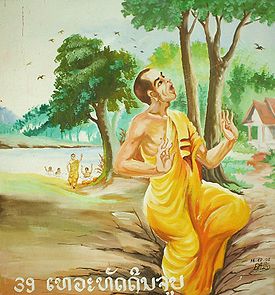
and ascend the throne. Ajatasattu follows the advice, and this action prevents him from attaining enlightenment at a later time, when listening to some teaching of Buddha. Devadatta is the only individual from the early Buddhist tradition to have committed three anantarika-karmas.
King Suppabuddha
King Suppabuddha was the father of Devadatta and YashodharaYashodhara
Princess Yasodharā was the wife of Prince Siddhārtha Gautama, the founder of Buddhism.She later entered the order of Buddhist nuns and is considered an Arahant.-Life:...
and the father-in-law of Prince Siddhattha. One day Suppabuddha blocked the Buddha's path, he refused to make way, and sent a message saying, 'I cannot give way to the Buddha, who is so much younger than I.' Finding the road blocked, the Buddha and the bhikkhus turned back. As the Buddha turned back, he said to Ananda, 'Because the king has refused to give way to a Buddha, he has committed a bad kamma
Kamma
Kamma may refer to:*Kamma , a caste or social group found largely in Southern India*The Pali and Ardhamagadhi term for karma*Bava Kamma, a traditional Jewish civil law procedure dealing largely with damages and compensation....
and before long he will have to face the consequences.' It is said that the king died on the seventh day after that event had taken place. He fell down the stairs, collapsed and died and was born in a suffering state, being unable to escape the effects of his evil kamma (according to buddhist belief).. According to the Buddha's prediction the earth swallowed him. It is said, "So the king went down the stairs and as soon as he stepped on the earth, it opened and swallowed him up and dragged him right down to Avici
Avici
In Buddhism, ' is the lowest level of the Naraka or "hell" realm, into which the dead who have committed grave misdeeds may be reborn...
Niraya." .
Karma
Anyone who commits an anantarika-karma will go to hell, the 5 different actions which each constitute an anantarika-karma, are the only actions which can produce a definite resultAccounts claim that towards the end of Devadatta's life, he was struck by a severe remorse caused by his past misdeeds and did indeed manage to approach the Buddha and retook refuge in the Triple Gem, dying shortly afterwards.. Because of gravity of his sins, he was condemned to suffer for several hundred millennia in Avici. However, it was also said that he would eventually be admitted into the heavens as a Pratyekabuddha due to his past merits prior to his corruption.
In the Samaññaphala Sutta
Samaññaphala Sutta
The Samaññaphala Sutta is the second discourse of all 34 Digha Nikaya discourses. The title means, "The Fruit of Contemplative Life Discourse."...
, Gautama Buddha said that if Ajatasattu hadn't killed his father, he would have attained sotapannahood, a degree of enlightenment. But because he had killed his father he could not attain it.
In the Contemplation Sutra
Contemplation Sutra
The Amitāyurdhyāna Sūtra , is one of the three major Buddhist sūtras found within the Pure Land branch of Mahāyāna Buddhism. Amitāyus is another name for the buddha Amitābha, the preeminent figure in Pure Land Buddhism, and this sūtra focuses mainly on meditations involving complex visualization...
, Lord Buddha taught Ajatasattu's mother, Queen Vaidehi, those who attain birth on the lowest level of the lowest grade are the sentient beings who commit such evils as the five gravest offenses, the ten evil acts and all kinds of immorality, when he is about to die, he may meet a good teacher, who consoles him in various ways, teaching him the wonderful Dharma and urging him to be mindful of the Buddha; but he is too tormented by pain to do so, The good teacher then advises him say Namo Amitabha
Amitabha
Amitābha is a celestial buddha described in the scriptures of the Mahāyāna school of Buddhism...
ya Buddhaya ten times. Because he calls the Buddha's Name, with each repetition, the evil karma which he has committed during eighty kotis of kalpas of Samsara is extinguished. When he comes to die, he sees before him a golden lotus-flower like the disk of the sun, and in an instant he is born within a lotus-bud in the Land of Utmost Bliss.
In the Buddha Say Extinguish Five Grave Offenses Big Tantra Sutra, buddha taught a tantra extinguish five grave offences.
See also
- DevadattaDevadattaDevadatta was by tradition a Buddhist monk, cousin and brother-in-law of Gautama Siddārtha, the Śākyamuni Buddha, and brother of Ānanda, a principal student of the Buddha...
- Karma in BuddhismKarma in BuddhismKarma means "action" or "doing"; whatever one does, says, or thinks is a karma. In Buddhism, the term karma is used specifically for those actions which spring from the intention of an unenlightened being.These bring about a fruit or result Karma (Sanskrit, also karman, Pāli: Kamma) means...
- Merit (Buddhism)Merit (Buddhism)Merit is a concept in Buddhism. It is that which accumulates as a result of good deeds, acts or thoughts and that carries over to later in life or to a person's next life. Such merit contributes to a person's growth towards liberation. Merit can be gained in a number of ways...
- Samsara (Buddhism)Samsara (Buddhism)or sangsara is a Sanskrit and Pāli term, which translates as "continuous movement" or "continuous flowing" and, in Buddhism, refers to the concept of a cycle of birth , and consequent decay and death , in which all beings in the universe participate, and which can only be escaped through...
- Twelve NidanasTwelve NidanasThe Twelve Nidānas are the best-known application of the Buddhist concept of pratītyasamutpāda , identifying the origins of dukkha to be in tanha and avijja...
- Pratitya-samutpadaPratitya-samutpadaDependent origination or dependent arising is a cardinal doctrine of Buddhism, and arguably the only thing that holds every Buddhist teaching together from Theravada to Dzogchen to the extinct schools. As a concept and a doctrine it has a general and a specific application, both being integral to...