


Anammox

Encyclopedia
Nitrogen cycle
The nitrogen cycle is the process by which nitrogen is converted between its various chemical forms. This transformation can be carried out by both biological and non-biological processes. Important processes in the nitrogen cycle include fixation, mineralization, nitrification, and denitrification...
. The bacteria mediating this process were identified in 1991, and at the time were a great surprise for the scientific community . It takes place in many natural environments and anammox is also the trademarked name for an ammonium removal technology that was developed by the Delft University of Technology
Delft University of Technology
Delft University of Technology , also known as TU Delft, is the largest and oldest Dutch public technical university, located in Delft, Netherlands...
.
Process background
In this biological process, nitriteNitrite
The nitrite ion has the chemical formula NO2−. The anion is symmetric with equal N-O bond lengths and a O-N-O bond angle of ca. 120°. On protonation the unstable weak acid nitrous acid is produced. Nitrite can be oxidised or reduced, with product somewhat dependent on the oxidizing/reducing agent...
and ammonium
Ammonium
The ammonium cation is a positively charged polyatomic cation with the chemical formula NH. It is formed by the protonation of ammonia...
are converted directly into dinitrogen gas. This process contributes up to 50% of the dinitrogen gas produced in the oceans. It is thus a major sink for fixed nitrogen and so limits oceanic primary productivity. The overall catabolic reaction is:
- NH4+ + NO2− → N2 + 2H2O.
The bacteria that perform the anammox process belong to the bacterial phylum Planctomycetes
Planctomycetes
Planctomycetes are a phylum of aquatic bacteria and are found in samples of brackish, and marine and fresh water. They reproduce by budding. In structure, the organisms of this group are ovoid and have a holdfast, called the stalk, at the nonreproductive end that helps them to attach to each other...
, of which Planctomyces and Pirellula are the best known genera. Currently four genera of anammox bacteria have been (provisionally) defined: Brocadia
Brocadia anammoxidans
"Candidatus Brocadia anammoxidans" is a bacterial member of the order Planctomycetes and therefore lacks peptidoglycan in its cell wall, has a compartmentalized cytoplasm....
, Kuenenia, Anammoxoglobus, Jettenia (all fresh water species), and Scalindua (marine species). The anammox bacteria are characterized by several striking properties: they all possess one anammoxosome, a membrane bound compartment inside the cytoplasm
Cytoplasm
The cytoplasm is a small gel-like substance residing between the cell membrane holding all the cell's internal sub-structures , except for the nucleus. All the contents of the cells of prokaryote organisms are contained within the cytoplasm...
which is the locus of anammox catabolism. Further, the membranes of these bacteria mainly consist of ladderane
Ladderane
A ladderane is an organic molecule containing two or more fused rings of cyclobutane. The name is a portmanteau because the serial cyclobutane rings look like a ladder and are singly bonded like alkanes. The chemical formula for a ladderane with n rings is C2n+2H2n+6...
lipids so far unique in Biology
Biology
Biology is a natural science concerned with the study of life and living organisms, including their structure, function, growth, origin, evolution, distribution, and taxonomy. Biology is a vast subject containing many subdivisions, topics, and disciplines...
.
Of special interest is the conversion to hydrazine
Hydrazine
Hydrazine is an inorganic compound with the formula N2H4. It is a colourless flammable liquid with an ammonia-like odor. Hydrazine is highly toxic and dangerously unstable unless handled in solution. Approximately 260,000 tons are manufactured annually...
(normally used as a high-energy rocket fuel, and poisonous to most living organisms) as an intermediate.
A final striking feature of the organism is the extremely slow growth rate. The doubling time
Doubling time
The doubling time is the period of time required for a quantity to double in size or value. It is applied to population growth, inflation, resource extraction, consumption of goods, compound interest, the volume of malignant tumours, and many other things which tend to grow over time...
is nearly two weeks. The anammox process was originally found to occur only from 20 °C to 43 °C but more recently, anammox has been observed at temperatures from 36 °C to 52 °C in hot springs and 60 °C to 85 °C at hydrothermal vents located along the Mid-Atlantic Ridge.
History
For a long time the general consensus was that ammonium could only be oxidised under aerobic conditions. The Austrian theoretical chemistTheoretical chemistry
Theoretical chemistry seeks to provide theories that explain chemical observations. Often, it uses mathematical and computational methods that, at times, require advanced knowledge. Quantum chemistry, the application of quantum mechanics to the understanding of valency, is a major component of...
Engelbert Broda
Engelbert Broda
Engelbert Broda was a KGB spy and the main Soviet source of information on American and British nuclear research. He was a physicist and a chemist.- Life :...
was the first to recognise the possibility of anaerobic ammonium oxidation in 1977. The simultaneous removal of ammonium and production of nitrogen gas was observed in an industrial wastewater treatment
Wastewater Treatment
Wastewater treatment may refer to:* Sewage treatment* Industrial wastewater treatment...
in The Netherlands in 1986.
Application
The application of the anammox process lies in the removal of ammoniumAmmonium
The ammonium cation is a positively charged polyatomic cation with the chemical formula NH. It is formed by the protonation of ammonia...
in wastewater treatment and consists of two separate processes. The first step is partial nitrification
Nitrification
Nitrification is the biological oxidation of ammonia with oxygen into nitrite followed by the oxidation of these nitrites into nitrates. Degradation of ammonia to nitrite is usually the rate limiting step of nitrification. Nitrification is an important step in the nitrogen cycle in soil...
(nitritation) of half of the ammonium to nitrite by ammonia oxidizing bacteria
Nitrification
Nitrification is the biological oxidation of ammonia with oxygen into nitrite followed by the oxidation of these nitrites into nitrates. Degradation of ammonia to nitrite is usually the rate limiting step of nitrification. Nitrification is an important step in the nitrogen cycle in soil...
:
- 4NH4+ + 3O2 → 2NH4+ + 2NO2- + 4H+ + 2H2O
The resulting ammonium and nitrite are converted in the anammox process to dinitrogen gas and circa 15% nitrate (not shown) by anammox bacteria
- NH4+ + NO2- → N2 + 2 H2O.
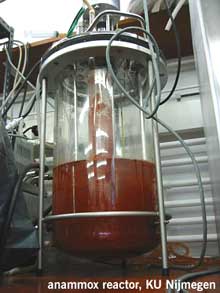
Both processes can take place in 1 reactor where two guilds of bacteria form compact granules .
For the enrichment of the anammox organisms a granular biomass or biofilm system seems to be especially suited in which the necessary sludge age of more than 20 days can be ensured. Possible reactors are sequencing batch reactor
Sequencing batch reactor
Sequencing batch reactors or sequential batch reactors are industrial processing tanks for the treatment of wastewater. SBR reactors treat waste water such as sewage or output from anaerobic digesters or mechanical biological treatment facilities in batches...
s (SBR), moving bed reactors or gas-lift-loop reactors. The cost reduction compared to conventional nitrogen removal is considerable; the technique is still young but proven in several fullscale installations. The first full scale reactor intended for the application of anammox bacteria was built in the Netherlands in 2002. Other wastewater treatment plants, such as the one in in Germany (Hattingen), where anammox activity is coincidentally observed were not purpose built. As of 2006 there are three full scale processes in The Netherlands. One on a municipal wastewater treatment plant (in Rotterdam
Rotterdam
Rotterdam is the second-largest city in the Netherlands and one of the largest ports in the world. Starting as a dam on the Rotte river, Rotterdam has grown into a major international commercial centre...
), and two on industrial effluent. One is a tannery, the other a potato processing plant.