

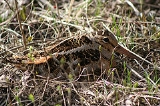
American Woodcock

Encyclopedia
The American Woodcock sometimes colloquially referred to as the Timberdoodle, is a small chunky shorebird
species
found primarily in the eastern half of North America
. Woodcock spend most of their time on the ground in brushy, young-forest habitats, where the birds' brown, black, and gray plumage provides excellent camouflage
.
Because of the male Woodcock's unique, beautiful courtship flights, the bird is welcomed as a harbinger of spring in northern areas. It is also a popular game bird, with about 540,000 killed annually by some 133,000 hunters in the U.S.
The American Woodcock is the only species of Woodcock inhabiting North America. Although classified with the sandpipers and shorebirds in Family Scolopacidae, the American Woodcock lives mainly in upland settings. Its many folk names include timberdoodle, bogsucker, night partridge, brush snipe, hokumpoke, and becasse.
The population of the American Woodcock has fallen by an average of slightly more than 1 percent annually since the 1960s. Most authorities attribute this decline to a loss of habitat caused by forest maturation and urban development.
In 2008 wildlife biologists and conservationists released an American Woodcock Conservation Plan presenting figures for the acreage of young forest that must be created and maintained in the U.S. and Canada to stabilize the Woodcock population at current levels, and to return it to 1970s densities.
The plumage is a cryptic mix of different shades of browns, grays, and black. The chest and sides vary from yellowish white to rich tans. The nape of the head is black, with three or four crossbars of deep buff or rufous. The feet and toes, which are small and weak, are brownish gray to reddish brown.
Woodcock have large eyes located high in the head, and their visual field is probably the largest of any bird, 360° in the horizontal plane and 180° in the vertical plane.
The Woodcock uses its long bill to probe in the soil for food, mainly invertebrates and especially earthworms. A unique bone-and-muscle arrangement lets the bird open and close the tip of its upper bill, or mandible, while it is sunk in the ground. Both the underside of the upper mandible and the long tongue are rough-surfaced for grasping slippery prey.
results, winter concentrations are highest in the northern half of Alabama
.
, being most active at dawn and dusk.
In the North, Woodcock begin to shift southward before ice and snow seal off their ground-based food supply. Cold fronts may prompt heavy southerly flights in autumn. Most Woodcock start to migrate in October, with the major push from mid-October to early November. Most individuals arrive on the wintering range by mid-December. The birds head north again in February. Most have returned to the northern breeding range by mid-March to mid-April.
Migrating birds' arrival at and departure from the breeding range is highly irregular. In Ohio
, for example, the earliest birds are seen in February, but the bulk of the population does not arrive until March and April. Birds start to leave for winter by September, but some remain until mid-November.
produces a melodious twittering sound as air rushes through the male's outer primary wing feathers.
Males may continue with their courtship flights for as many as four months running – sometimes continuing even after females have already hatched their broods and left the nest.
Females, known as hens, are attracted to the males' displays. A hen will fly in and land on the ground near a singing male. The male courts the female by walking stiff-legged and with his wings stretched vertically, and by bobbing and bowing. A male may mate with several females. The male Woodcock plays no role in selecting a nest site, incubating eggs, or rearing young. In the primary northern breeding range, the Woodcock may be the earliest ground-nesting species to breed.
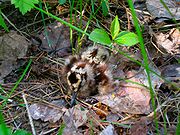 The down-covered young are precocial
and leave the nest within a few hours of hatching. The female broods her young and feeds them. When threatened, the chicks usually take cover and remain motionless, attempting to escape detection by relying on their cryptic coloration. Some observers suggest that frightened young may cling to the body of their mother, who will then take wing and carry the young to safety.
Woodcock chicks begin probing for worms on their own a few days after hatching. They develop quickly and can make short flights after two weeks, can fly fairly well at three weeks, and are independent after about five weeks.
The Woodcock population remained high during the early and mid-twentieth century, after many family farms were abandoned as people moved to urban areas, and cropfields and pastures grew up in brush. In recent decades, those formerly brushy acres have become middle-aged and older forest, where Woodcock rarely venture, or they have been covered with buildings and other human developments. Because its population has been declining, the American Woodcock is considered a "species of greatest conservation need" in many states, triggering research and habitat-creation efforts in an attempt to boost Woodcock populations.
Population trends have been measured through springtime Breeding Bird Surveys and, in the northern breeding range, springtime singing-ground surveys. Data suggest that the Woodcock population has fallen rangewide by an average of 1.1 percent yearly over the last four decades.
than other woodcock
s and snipe
s; as long as some sheltered woodland remains for breeding, it can thrive even in regions that are mainly used for agriculture
. The estimated population is 5 million, so it is the most common sandpiper in North America.
The American Woodcock Conservation Plan presents regional action plans linked to Bird Conservation Regions (BCRs), fundamental biological units recognized by the U.S. North American Bird Conservation Initiative. The Wildlife Management Institute (WMI) oversees regional habitat initiatives intended to boost the American Woodcock’s population by protecting, renewing, and creating habitat throughout the species’ range.
Creating young-forest habitat for American Woodcock helps more than 50 other species of wildlife that need young forest during part or all of their life cycles. These include relatively common animals such as white-tailed deer, snowshoe hare, moose, bobcat, wild turkey, and ruffed grouse, and animals whose populations have also declined in recent decades, such as the golden-winged warbler, whip-poor-will, willow flycatcher, indigo bunting, and New England cottontail.
margret alabama (2004)
Wader
Waders, called shorebirds in North America , are members of the order Charadriiformes, excluding the more marine web-footed seabird groups. The latter are the skuas , gulls , terns , skimmers , and auks...
species
Species
In biology, a species is one of the basic units of biological classification and a taxonomic rank. A species is often defined as a group of organisms capable of interbreeding and producing fertile offspring. While in many cases this definition is adequate, more precise or differing measures are...
found primarily in the eastern half of North America
North America
North America is a continent wholly within the Northern Hemisphere and almost wholly within the Western Hemisphere. It is also considered a northern subcontinent of the Americas...
. Woodcock spend most of their time on the ground in brushy, young-forest habitats, where the birds' brown, black, and gray plumage provides excellent camouflage
Camouflage
Camouflage is a method of concealment that allows an otherwise visible animal, military vehicle, or other object to remain unnoticed, by blending with its environment. Examples include a leopard's spotted coat, the battledress of a modern soldier and a leaf-mimic butterfly...
.
Because of the male Woodcock's unique, beautiful courtship flights, the bird is welcomed as a harbinger of spring in northern areas. It is also a popular game bird, with about 540,000 killed annually by some 133,000 hunters in the U.S.
The American Woodcock is the only species of Woodcock inhabiting North America. Although classified with the sandpipers and shorebirds in Family Scolopacidae, the American Woodcock lives mainly in upland settings. Its many folk names include timberdoodle, bogsucker, night partridge, brush snipe, hokumpoke, and becasse.
The population of the American Woodcock has fallen by an average of slightly more than 1 percent annually since the 1960s. Most authorities attribute this decline to a loss of habitat caused by forest maturation and urban development.
In 2008 wildlife biologists and conservationists released an American Woodcock Conservation Plan presenting figures for the acreage of young forest that must be created and maintained in the U.S. and Canada to stabilize the Woodcock population at current levels, and to return it to 1970s densities.
Physical characteristics
The American Woodcock has a plump body, short legs, a large, rounded head, and a long, straight bill. Adults are 10 to 12 in (25.4 to 30.5 cm) long and weigh 5 to 8 oz (141.7 to 226.8 g). Females are considerably larger than males. The bill is 2.5 to 2.75 in (6.4 to 7 cm) long.The plumage is a cryptic mix of different shades of browns, grays, and black. The chest and sides vary from yellowish white to rich tans. The nape of the head is black, with three or four crossbars of deep buff or rufous. The feet and toes, which are small and weak, are brownish gray to reddish brown.
Woodcock have large eyes located high in the head, and their visual field is probably the largest of any bird, 360° in the horizontal plane and 180° in the vertical plane.
The Woodcock uses its long bill to probe in the soil for food, mainly invertebrates and especially earthworms. A unique bone-and-muscle arrangement lets the bird open and close the tip of its upper bill, or mandible, while it is sunk in the ground. Both the underside of the upper mandible and the long tongue are rough-surfaced for grasping slippery prey.
Distribution
Woodcock inhabit forested and mixed forest-agricultural-urban areas east of the 98th Meridian. Woodcock have been sighted as far north as York Factory, Manitoba, east to Labrador and Newfoundland. In winter, they migrate as far south as the Gulf Coast States.Breeding range
The primary breeding range extends from Atlantic Canada (Nova Scotia, Prince Edward Island, and New Brunswick) west to southeastern Manitoba, and south to northern Virginia, western North Carolina, Kentucky, northern Tennessee, northern Illinois, Missouri, and eastern Kansas. A limited number of Woodcock breed as far south as Florida and Texas. The species may be expanding its distribution northward and westward.Wintering range
After migrating south in autumn, most Woodcock spend the winter in the Gulf Coast and southeastern Atlantic Coast states. Some may remain as far north as southern Maryland, eastern Virginia, and southern New Jersey. The core of the wintering range centers on Louisiana, Mississippi, Alabama, and Georgia. Based on the Christmas Bird CountChristmas Bird Count
The Christmas Bird Count is a census of birds in the Western Hemisphere, performed annually in the early Northern-hemisphere winter by volunteer birders...
results, winter concentrations are highest in the northern half of Alabama
Alabama
Alabama is a state located in the southeastern region of the United States. It is bordered by Tennessee to the north, Georgia to the east, Florida and the Gulf of Mexico to the south, and Mississippi to the west. Alabama ranks 30th in total land area and ranks second in the size of its inland...
.
Food
Woodcock eat mainly invertebrates, particularly earthworms (Oligochaeta). They do most of their feeding in places where the soil is moist. They forage by probing in soft soil in thickets, where they usually remain well-hidden from sight. Other items in the diet include insect larvae, snails, centipedes, millipedes, spiders, snipe flies, beetles, and ants. A small amount of plant food is eaten, mainly seeds. Woodcock are crepuscularCrepuscular
Crepuscular animals are those that are active primarily during twilight, that is during dawn and dusk. The word is derived from the Latin word crepusculum, meaning "twilight." Crepuscular is, thus, in contrast with diurnal and nocturnal behavior. Crepuscular animals may also be active on a bright...
, being most active at dawn and dusk.
Migration
Woodcock migrate at night. They fly at low altitudes, individually or in small, loose flocks. Flight speeds of migrating birds have been clocked at 16 to 28 miles per hour (26 to 45 kilometers per hour). However, the slowest flight speed ever recorded for a bird, 5 miles per hours (8 kilometers per hour), was recorded for this species. It is believed that Woodcock orient visually using major physiographic features such as coastlines and broad river valleys. Both the autumn and spring migrations are leisurely compared with the swift, direct migrations of many passerine birds.In the North, Woodcock begin to shift southward before ice and snow seal off their ground-based food supply. Cold fronts may prompt heavy southerly flights in autumn. Most Woodcock start to migrate in October, with the major push from mid-October to early November. Most individuals arrive on the wintering range by mid-December. The birds head north again in February. Most have returned to the northern breeding range by mid-March to mid-April.
Migrating birds' arrival at and departure from the breeding range is highly irregular. In Ohio
Ohio
Ohio is a Midwestern state in the United States. The 34th largest state by area in the U.S.,it is the 7th‑most populous with over 11.5 million residents, containing several major American cities and seven metropolitan areas with populations of 500,000 or more.The state's capital is Columbus...
, for example, the earliest birds are seen in February, but the bulk of the population does not arrive until March and April. Birds start to leave for winter by September, but some remain until mid-November.
Breeding
In Spring, males occupy individual singing grounds, openings near brushy cover from which they call and perform display flights at dawn and dusk, and if the light levels are high enough on moonlit nights. The male's ground call is a short, buzzy peent. After sounding a series of ground calls, the male takes off and flies from 50 to 100 yards into the air. He descends, zigzagging and banking while singing a liquid, chirping song. This high spiralling flightSkylarking (birds)
Skylarking refers to the aerial displays including song made by various species of birds, such as Cassin's Sparrow . Many skylarking displays are in courtship. Some are referred to as territorial displays by the male...
produces a melodious twittering sound as air rushes through the male's outer primary wing feathers.
Males may continue with their courtship flights for as many as four months running – sometimes continuing even after females have already hatched their broods and left the nest.
Females, known as hens, are attracted to the males' displays. A hen will fly in and land on the ground near a singing male. The male courts the female by walking stiff-legged and with his wings stretched vertically, and by bobbing and bowing. A male may mate with several females. The male Woodcock plays no role in selecting a nest site, incubating eggs, or rearing young. In the primary northern breeding range, the Woodcock may be the earliest ground-nesting species to breed.
Nesting and young
The hen makes a shallow, rudimentary nest on the ground in the leaf and twig litter, in brushy or young-forest cover usually within 150 yards (137.2 m) of a singing ground. Most hens lay four eggs, sometimes one to three. Incubation takes 20 to 22 days.Precocial
In biology, the term precocial refers to species in which the young are relatively mature and mobile from the moment of birth or hatching. The opposite developmental strategy is called "altricial," where the young are born or hatched helpless. Extremely precocial species may be called...
and leave the nest within a few hours of hatching. The female broods her young and feeds them. When threatened, the chicks usually take cover and remain motionless, attempting to escape detection by relying on their cryptic coloration. Some observers suggest that frightened young may cling to the body of their mother, who will then take wing and carry the young to safety.
Woodcock chicks begin probing for worms on their own a few days after hatching. They develop quickly and can make short flights after two weeks, can fly fairly well at three weeks, and are independent after about five weeks.
Habitats
American Woodcock live in wet thickets, moist woods, and brushy swamps. Ideal habitats feature young forest and abandoned farmland mixed with forest. In late summer, some Woodcock roost on the ground at night in large openings among sparse, patchy vegetation.- Courtship/Breeding habitats include forest openings, roadsides, pastures, and old fields from which males call and launch courtship flights in springtime.
- Nesting habitats include thickets, shrubland, and young to mid age forest interspersed with openings.
- Feeding habitats have moist soil and feature densely growing young trees such as aspen (Populus sp.), birch (Betula sp.), and mixed hardwoods less than 20 years of age, and shrubs, particularly alder (Alnus sp.).
- Roosting habitats are semi-open sites with short, sparse plant cover, such as blueberry barrens, pastures, and recently heavily logged forest stands.
Population status
It is not known how many Woodcock were present in eastern North America before European settlement. Colonial agriculture, with its patchwork of family farms and open-range livestock grazing, probably supported healthy Woodcock populations.The Woodcock population remained high during the early and mid-twentieth century, after many family farms were abandoned as people moved to urban areas, and cropfields and pastures grew up in brush. In recent decades, those formerly brushy acres have become middle-aged and older forest, where Woodcock rarely venture, or they have been covered with buildings and other human developments. Because its population has been declining, the American Woodcock is considered a "species of greatest conservation need" in many states, triggering research and habitat-creation efforts in an attempt to boost Woodcock populations.
Population trends have been measured through springtime Breeding Bird Surveys and, in the northern breeding range, springtime singing-ground surveys. Data suggest that the Woodcock population has fallen rangewide by an average of 1.1 percent yearly over the last four decades.
Conservation
The American Woodcock is not considered globally threatened by the IUCN. It is more tolerant of deforestationDeforestation
Deforestation is the removal of a forest or stand of trees where the land is thereafter converted to a nonforest use. Examples of deforestation include conversion of forestland to farms, ranches, or urban use....
than other woodcock
Woodcock
The woodcocks are a group of seven or eight very similar living species of wading birds in the genus Scolopax. Only two woodcocks are widespread, the others being localized island endemics. Most are found in the Northern Hemisphere but a few range into Wallacea...
s and snipe
Snipe
A snipe is any of about 25 wading bird species in three genera in the family Scolopacidae. They are characterized by a very long, slender bill and crypsis plumage. The Gallinago snipes have a nearly worldwide distribution, the Lymnocryptes Jack Snipe is restricted to Asia and Europe and the...
s; as long as some sheltered woodland remains for breeding, it can thrive even in regions that are mainly used for agriculture
Agriculture
Agriculture is the cultivation of animals, plants, fungi and other life forms for food, fiber, and other products used to sustain life. Agriculture was the key implement in the rise of sedentary human civilization, whereby farming of domesticated species created food surpluses that nurtured the...
. The estimated population is 5 million, so it is the most common sandpiper in North America.
The American Woodcock Conservation Plan presents regional action plans linked to Bird Conservation Regions (BCRs), fundamental biological units recognized by the U.S. North American Bird Conservation Initiative. The Wildlife Management Institute (WMI) oversees regional habitat initiatives intended to boost the American Woodcock’s population by protecting, renewing, and creating habitat throughout the species’ range.
Creating young-forest habitat for American Woodcock helps more than 50 other species of wildlife that need young forest during part or all of their life cycles. These include relatively common animals such as white-tailed deer, snowshoe hare, moose, bobcat, wild turkey, and ruffed grouse, and animals whose populations have also declined in recent decades, such as the golden-winged warbler, whip-poor-will, willow flycatcher, indigo bunting, and New England cottontail.
Further reading
- Choiniere, Joe (2006): Seasons of the Woodcock: The secret life of a woodland shorebird. Sanctuary 45(4): 3-5.
- Sepik, Greg F.; Owen, Roy & Coulter, Malcolm (1981): A Landowner's Guide to Woodcock Management in the Northeast, Misc. Report 253, Maine Agricultural Experiment Station, University of Maine.
margret alabama (2004)
External links
- American Woodcock Species Account - Cornell Lab of Ornithology
- American Woodcock - Scolopax minor - USGS Patuxent Bird Identification Infocenter
- American Woodcock Bird Sound
- American Woodcock Information - South Dakota Birds and Birding
- Rite of Spring - Illustrated account of the phenomenal courtship flight of the male American Woodcock
- American Woodcock videos on the Internet Bird Collection
- Photo-High Res; Article – www.fws.gov–"Moosehorn National Wildlife Refuge", photo gallery and analysis

- American Woodcock Conservation Plan A Summary of and Recommendations for Woodcock Conservation in North America
- Timberdoodle.org: the Woodcock Management Plan
- Landowner's Guide to Woodcock Management in the Northeast