


Upper West Side

Encyclopedia
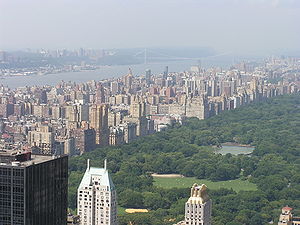
Borough (New York City)
New York City, one of the largest cities in the world, is composed of five boroughs. Each borough now has the same boundaries as the county it is in. County governments were dissolved when the city consolidated in 1898, along with all city, town, and village governments within each county...
of Manhattan
Manhattan
Manhattan is the oldest and the most densely populated of the five boroughs of New York City. Located primarily on the island of Manhattan at the mouth of the Hudson River, the boundaries of the borough are identical to those of New York County, an original county of the state of New York...
, New York City
New York City
New York is the most populous city in the United States and the center of the New York Metropolitan Area, one of the most populous metropolitan areas in the world. New York exerts a significant impact upon global commerce, finance, media, art, fashion, research, technology, education, and...
, that lies between Central Park
Central Park
Central Park is a public park in the center of Manhattan in New York City, United States. The park initially opened in 1857, on of city-owned land. In 1858, Frederick Law Olmsted and Calvert Vaux won a design competition to improve and expand the park with a plan they entitled the Greensward Plan...
and the Hudson River
Hudson River
The Hudson is a river that flows from north to south through eastern New York. The highest official source is at Lake Tear of the Clouds, on the slopes of Mount Marcy in the Adirondack Mountains. The river itself officially begins in Henderson Lake in Newcomb, New York...
and between West 59th Street
59th Street (Manhattan)
59th Street in the New York City borough of Manhattan runs east-west, from York Avenue to the West Side Highway, with a discontinuity between Ninth Avenue/Columbus Avenue and Eighth Avenue/Central Park West for the Time Warner Center. Although it is bi-directional for most of its length, the...
and West 125th Street
125th Street (Manhattan)
125th Street is a two-way street that runs east-west in the New York City borough of Manhattan, considered the "Main Street" of Harlem; It is also called Martin Luther King, Jr...
. It encompasses the neighborhood of Morningside Heights.
Like the Upper East Side
Upper East Side
The Upper East Side is a neighborhood in the borough of Manhattan in New York City, between Central Park and the East River. The Upper East Side lies within an area bounded by 59th Street to 96th Street, and the East River to Fifth Avenue-Central Park...
, the Upper West Side is an upscale, primarily residential, area, with many of its residents working in more commercial areas in Midtown
Midtown Manhattan
Midtown Manhattan, or simply Midtown, is an area of Manhattan, New York City home to world-famous commercial zones such as Rockefeller Center, Broadway, and Times Square...
and Lower Manhattan
Lower Manhattan
Lower Manhattan is the southernmost part of the island of Manhattan, the main island and center of business and government of the City of New York...
. While these distinctions were never hard-and-fast rules and now mean little, it has the reputation of being home to New York City's cultural and artistic workers, while the Upper East Side
Upper East Side
The Upper East Side is a neighborhood in the borough of Manhattan in New York City, between Central Park and the East River. The Upper East Side lies within an area bounded by 59th Street to 96th Street, and the East River to Fifth Avenue-Central Park...
is traditionally perceived to be home to commercial and business types.
Geography
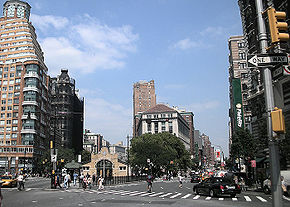
Central Park
Central Park is a public park in the center of Manhattan in New York City, United States. The park initially opened in 1857, on of city-owned land. In 1858, Frederick Law Olmsted and Calvert Vaux won a design competition to improve and expand the park with a plan they entitled the Greensward Plan...
to the east, and the Hudson River
Hudson River
The Hudson is a river that flows from north to south through eastern New York. The highest official source is at Lake Tear of the Clouds, on the slopes of Mount Marcy in the Adirondack Mountains. The river itself officially begins in Henderson Lake in Newcomb, New York...
to the west. Its northern boundary is somewhat less obvious. Although it has historically been cited as 110th Street
110th Street (Manhattan)
110th Street is a street in the New York City borough of Manhattan. It is commonly known as the boundary between Harlem and Central Park, along which it is known as Central Park North. In the west, it is also known as Cathedral Parkway....
, which fixes the neighborhood alongside Central Park, it is now sometimes considered to be 125th Street
125th Street (Manhattan)
125th Street is a two-way street that runs east-west in the New York City borough of Manhattan, considered the "Main Street" of Harlem; It is also called Martin Luther King, Jr...
, encompassing Morningside Heights
Morningside Heights, Manhattan
Morningside Heights is a neighborhood of the Borough of Manhattan in New York City and is chiefly known as the home of institutions such as Columbia University, Teachers College, Barnard College, the Manhattan School of Music, Bank Street College of Education, the Cathedral of Saint John the...
. This reflects demographic shifts in Morningside Heights, as well as the tendency of real estate brokers to co-opt the tony Upper West Side name when listing Morningside Heights and Harlem apartments. The area north of West 96th Street and east of Broadway is also identified as Manhattan Valley
Manhattan Valley
Manhattan Valley is a neighborhood on the Upper West Side of Manhattan in New York City, bounded by West 110th Street to the north, Central Park West to the east, West 96th Street to the south, and Broadway to the west...
. The overlapping area west of Amsterdam Avenue to Riverside Park was once known as the Bloomingdale District.
From west to east, the avenues of the Upper West Side are Riverside Drive
Riverside Drive (Manhattan)
Riverside Drive is a scenic north-south thoroughfare in the Manhattan borough of New York City. The boulevard runs on the west side of Manhattan, generally parallel to the Hudson River from 72nd Street to near the George Washington Bridge at 181st Street...
(12th Avenue), West End Avenue
Eleventh Avenue (Manhattan)
Eleventh Avenue is a north-south thoroughfare on the far West Side of the borough of Manhattan in New York City, not far from the Hudson River. It carries downtown traffic only, south of West 44th Street, and two-way traffic north of it....
(11th Avenue), Broadway
Broadway (New York City)
Broadway is a prominent avenue in New York City, United States, which runs through the full length of the borough of Manhattan and continues northward through the Bronx borough before terminating in Westchester County, New York. It is the oldest north–south main thoroughfare in the city, dating to...
, Amsterdam Avenue
Tenth Avenue (Manhattan)
Tenth Avenue, known as Amsterdam Avenue north of 59th Street, is a north-south thoroughfare on the West Side of Manhattan in New York City. It carries uptown traffic as far as West 110th Street, also known as Cathedral Parkway for the Cathedral Church of St. John the Divine...
(10th Avenue), Columbus Avenue
Ninth Avenue (Manhattan)
Ninth Avenue / Columbus Avenue is a southbound thoroughfare on the West Side of Manhattan in New York City. Traffic runs downtown along its full length...
(9th Avenue) and Central Park West
Central Park West
Central Park West is an avenue that runs north-south in the New York City borough of Manhattan, in the United States....
(8th Avenue). The 66-block stretch of Broadway forms the spine of the neighborhood and runs diagonally, north / south across the avenues at the south end of the neighborhood and above 72nd Street moves parallel to the avenues. Broadway enters the neighborhood at its juncture with Central Park West at Columbus Circle
Columbus Circle
Columbus Circle, named for Christopher Columbus, is a major landmark and point of attraction in the New York City borough of Manhattan, located at the intersection of Eighth Avenue, Broadway, Central Park South , and Central Park West, at the southwest corner of Central Park. It is the point from...
(59th Street), crosses Columbus Ave. at Lincoln Square
Lincoln Square, New York
Lincoln Square is the name of both a square and the surrounding neighborhood within the Upper West Side of the New York City borough of Manhattan...
(65th Street), crosses Amsterdam Ave. at Verdi Square
Verdi Square
Verdi Square is a small triangle of land enclosed by a railing, located on Manhattan's Upper West Side, between 72nd Street and 73rd Street on the south and north, and Broadway and Amsterdam Avenue on the west and east. On the south the square fronts West 72nd Street; across the street to the...
(72nd Street), and then merges with West End at Straus Park
Straus Park
Straus Park is a small landscaped park in Morningside Heights, Manhattan, at the intersection of Broadway, West End Avenue, and 106th Street....
(aka Bloomingdale Square, at 107th Street).
Morningside Heights
Morningside Heights, Manhattan
Morningside Heights is a neighborhood of the Borough of Manhattan in New York City and is chiefly known as the home of institutions such as Columbia University, Teachers College, Barnard College, the Manhattan School of Music, Bank Street College of Education, the Cathedral of Saint John the...
, just west of Harlem
Harlem
Harlem is a neighborhood in the New York City borough of Manhattan, which since the 1920s has been a major African-American residential, cultural and business center. Originally a Dutch village, formally organized in 1658, it is named after the city of Haarlem in the Netherlands...
, is the site of the Cathedral of Saint John the Divine, Columbia University
Columbia University
Columbia University in the City of New York is a private, Ivy League university in Manhattan, New York City. Columbia is the oldest institution of higher learning in the state of New York, the fifth oldest in the United States, and one of the country's nine Colonial Colleges founded before the...
, Barnard College
Barnard College
Barnard College is a private women's liberal arts college and a member of the Seven Sisters. Founded in 1889, Barnard has been affiliated with Columbia University since 1900. The campus stretches along Broadway between 116th and 120th Streets in the Morningside Heights neighborhood in the borough...
, Bank Street College of Education
Bank Street College of Education
Bank Street College of Education is located in Manhattan, New York City.-History:Bank Street was founded in 1916 by Lucy Sprague Mitchell as the "Bureau of Educational Experiments"....
, the National Council of Churches
National Council of Churches
The National Council of the Churches of Christ in the USA is an ecumenical partnership of 37 Christian faith groups in the United States. Its member denominations, churches, conventions, and archdioceses include Mainline Protestant, Orthodox, African American, Evangelical, and historic peace...
, Union Theological Seminary
Union Theological Seminary in the City of New York
Union Theological Seminary in the City of New York is a preeminent independent graduate school of theology, located in Manhattan between Claremont Avenue and Broadway, 120th to 122nd Streets. The seminary was founded in 1836 under the Presbyterian Church, and is affiliated with nearby Columbia...
, Manhattan School of Music
Manhattan School of Music
The Manhattan School of Music is a major music conservatory located on the Upper West Side of New York City. The school offers degrees on the bachelors, masters, and doctoral levels in the areas of classical and jazz performance and composition...
, Teachers College
Teachers College, Columbia University
Teachers College, Columbia University is a graduate school of education located in New York City, New York...
and Jewish Theological Seminary of America
Jewish Theological Seminary of America
The Jewish Theological Seminary of America is one of the academic and spiritual centers of Conservative Judaism, and a major center for academic scholarship in Jewish studies.JTS operates five schools: Albert A...
, as well as Grant's Tomb
Grant's Tomb
General Grant National Memorial , better known as Grant's Tomb, is a mausoleum containing the bodies of Ulysses S. Grant , American Civil War General and 18th President of the United States, and his wife, Julia Dent Grant...
and Riverside Church
Riverside Church
The Riverside Church in the City of New York is an interdenominational church in New York City, famous for its elaborate Neo-Gothic architecture—which includes the world's largest tuned carillon bell...
.
Traditionally the neighborhood ranged from the former village of Harsenville, centered on the old Bloomingdale Road (now Broadway
Broadway (New York City)
Broadway is a prominent avenue in New York City, United States, which runs through the full length of the borough of Manhattan and continues northward through the Bronx borough before terminating in Westchester County, New York. It is the oldest north–south main thoroughfare in the city, dating to...
) and 65th Street, west to the railroad yards along the Hudson, then north to 110th Street, where the ground rises to Morningside Heights. With the building of Lincoln Center, its name, though perhaps not the reality, was stretched south to 58th Street. With the arrival of the corporate headquarters and expensive condos of the Time Warner Center
Time Warner Center
The Time Warner Center is a mixed-use skyscraper developed by AREA Property Partners and The Related Companies in New York City. Its design, by David Childs of Skidmore, Owings & Merrill, consists of two 750 ft towers bridged by a multi-story atrium containing upscale retail shops...
at Columbus Circle, and the Riverside South apartment complex built by Donald Trump
Donald Trump
Donald John Trump, Sr. is an American business magnate, television personality and author. He is the chairman and president of The Trump Organization and the founder of Trump Entertainment Resorts. Trump's extravagant lifestyle, outspoken manner and role on the NBC reality show The Apprentice have...
, the area from 58th Street to 65th Street is increasingly referred to as Lincoln Square by realtors who acknowledge a different tone and ambiance than that typically associated with the Upper West Side. This is a reversion to the neighborhood's historical name.
History
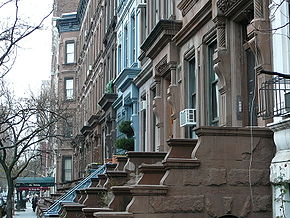
Hudson River
The Hudson is a river that flows from north to south through eastern New York. The highest official source is at Lake Tear of the Clouds, on the slopes of Mount Marcy in the Adirondack Mountains. The river itself officially begins in Henderson Lake in Newcomb, New York...
was little used or traversed by the Lenape
Lenape
The Lenape are an Algonquian group of Native Americans of the Northeastern Woodlands. They are also called Delaware Indians. As a result of the American Revolutionary War and later Indian removals from the eastern United States, today the main groups live in Canada, where they are enrolled in the...
people. A combination of the stream valleys, such as that in which 96th Street
96th Street (Manhattan)
96th Street is a major two-way street in East Harlem and the Upper West Side, which is a part of the New York City borough of Manhattan, running from the East River at the FDR Drive to the Henry Hudson Parkway at the Hudson River...
runs, and wetlands to the northeast and east, may have protected a portion of the Upper West Side from the Lenape's controlled burns; lack of periodic ground fires results in a denser understory and more fire-intolerant trees, such as American Beech
American Beech
Fagus grandifolia, also known as American Beech or North american beech, is a species of beech native to eastern North America, from Nova Scotia west to southern Ontario in southeastern Canada, west to Wisconsin and south to eastern Texas and northern Florida in the United States. Trees in the...
.
The Dutch applied the name Bloemendaal, Anglicized
Anglicisation
Anglicisation, or anglicization , is the process of converting verbal or written elements of any other language into a form that is more comprehensible to an English speaker, or, more generally, of altering something such that it becomes English in form or character.The term most often refers to...
to "Bloomingdale" or "the Bloomingdale District
Bloomingdale District
Bloomingdale is a part of Manhattan's Upper West Side between 96th and 110th Streets and bounded on the east by Amsterdam Avenue and on the west by Riverside Drive, Riverside Park and the Hudson River.-History:...
", to the west side of Manhattan from about 23rd Street
23rd Street (Manhattan)
23rd Street is a broad thoroughfare in the New York City borough of Manhattan. It is one of few two-way streets in the gridiron of the borough. As with Manhattan's other "crosstown" streets, it is divided at Fifth Avenue, in this case at Madison Square Park, into its east and west sections. Since...
up to the Hollow Way (modern 125th Street
125th Street (Manhattan)
125th Street is a two-way street that runs east-west in the New York City borough of Manhattan, considered the "Main Street" of Harlem; It is also called Martin Luther King, Jr...
), and by the 18th century it contained numerous farms and country residences of many of the city's well-off, a major parcel of which was the Apthorp Farm
Apthorp Farm
The Apthorp Farm that lay on Manhattan's Upper West Side straddled the old Bloomingdale Road, laid out in 1728, which was re-surveyed as The "Boulevard" – now Upper Broadway. It was the largest block of real estate remaining from the "Bloomingdale District", a rural suburb of 18th-century New...
. The main artery of this area was the Bloomingdale Road, which began north of where Broadway and the Bowery Lane (now Fourth Avenue)
Bowery
Bowery may refer to:Streets:* The Bowery, a thoroughfare in Manhattan, New York City* Bowery Street is a street on Coney Island in Brooklyn, N.Y.In popular culture:* Bowery Amphitheatre, a building on the Bowery in New York City...
join (at modern Union Square
Union Square (New York City)
Union Square is a public square in the Manhattan borough of New York City, New York.It is an important and historic intersection, located where Broadway and the former Bowery Road – now Fourth Avenue – came together in the early 19th century; its name celebrates neither the...
) and wended its way northward up to about modern 116th Street in Morningside Heights, where the road further north was known as the Kingsbridge Road. Within the confines of the modern-day Upper West Side, the road passed through areas known as Harsenville, Strycker's Bay, and Bloomingdale Village.
In the eighteenth and early nineteenth century, the Upper West Side-to-be contained some of colonial New York's most ambitious houses, spaced along Bloomingdale Road. It became increasingly infill
Infill
Infill in its broadest meaning is material that fills in an otherwise unoccupied space. The term is commonly used in association with construction techniques such as wattle and daub, and civil engineering activities such as land reclamation.-Construction:...
ed with smaller, more suburban villas in the first half of the nineteenth century, and in the middle of the century, parts had become decidedly lower class.
Much of the riverfront of the Upper West Side was a shipping, transportation, and manufacturing corridor. The Hudson River Railroad line right-of-way
Right-of-way (railroad)
A right-of-way is a strip of land that is granted, through an easement or other mechanism, for transportation purposes, such as for a trail, driveway, rail line or highway. A right-of-way is reserved for the purposes of maintenance or expansion of existing services with the right-of-way...
was granted in the late 1830s to connect New York City to Albany, and soon ran along the riverbank. One major non-industrial development, the creation of the Central Park in the 1850s and 60s caused many squatters to move their shacks into the UWS. Parts of the neighborhood became a ragtag collection of squatters' housing, boarding houses, and rowdy taverns.
As this development occurred, the old name of Bloomingdale Road was being chopped away and the name Broadway was progressively applied further northward to include what had been lower Bloomingdale Road. In 1868, the city began straightening and grading the section of the Bloomingdale Road from Harsenville north, and it became known as "The Boulevard". It retained that name until the end of the century, when the name Broadway finally supplanted it.
Development of the neighborhood lagged even while Central Park was being laid out in the 1860s and 70s, then was stymied by the Panic of 1873
Panic of 1873
The Panic of 1873 triggered a severe international economic depression in both Europe and the United States that lasted until 1879, and even longer in some countries. The depression was known as the Great Depression until the 1930s, but is now known as the Long Depression...
. Things turned around when the elevated train's rapid transit was extended up Ninth Avenue (renamed Columbus Avenue in 1890), and with Columbia University
Columbia University
Columbia University in the City of New York is a private, Ivy League university in Manhattan, New York City. Columbia is the oldest institution of higher learning in the state of New York, the fifth oldest in the United States, and one of the country's nine Colonial Colleges founded before the...
's relocation to Morningside Heights in the 1890s, using lands once held by the Bloomingdale Insane Asylum
Bloomingdale Insane Asylum
The Bloomingdale Insane Asylum was a private hospital for the care of the mentally ill founded by New York Hospital. It occupied the land in the Morningside Heights neighborhood of Manhattan where Columbia University is now located....
. The Upper West Side experienced a building boom from 1885 to 1910, thanks in large part to the 1904 opening of the city's first subway line, the IRT Broadway – Seventh Avenue Line, with subway stations at 59th, 66th, 72nd, 79th, 86th, 91st, 96th, 103rd, 110th, 116th and Manhattan (now 125th) streets. This followed upon the opening of the now demolished IRT Ninth Avenue Line
IRT Ninth Avenue Line
The IRT Ninth Avenue Line, often called the Ninth Avenue El, was the first elevated railway in New York City. It opened in 1868 as the West Side and Yonkers Patent Railway, a cable-hauled line. It ceased operation in 1940....
– the city's first elevated railway – which opened in the decade following the American Civil War
American Civil War
The American Civil War was a civil war fought in the United States of America. In response to the election of Abraham Lincoln as President of the United States, 11 southern slave states declared their secession from the United States and formed the Confederate States of America ; the other 25...
.

San Juan Hill, Manhattan
San Juan Hill was a predominantly African American neighborhood of tenements on the West Side of the borough of Manhattan in New York City, which was largely razed as part of urban renewal to make way for Lincoln Center for the Performing Arts....
" in commemoration of African-American soldiers who were a major part of the assault
Battle of San Juan Hill
The Battle of San Juan Hill , also known as the battle for the San Juan Heights, was a decisive battle of the Spanish-American War. The San Juan heights was a north-south running elevation about two kilometers east of Santiago de Cuba. The names San Juan Hill and Kettle Hill were names given by the...
on Cuba
Cuba
The Republic of Cuba is an island nation in the Caribbean. The nation of Cuba consists of the main island of Cuba, the Isla de la Juventud, and several archipelagos. Havana is the largest city in Cuba and the country's capital. Santiago de Cuba is the second largest city...
's San Juan Hill in the Spanish-American War
Spanish-American War
The Spanish–American War was a conflict in 1898 between Spain and the United States, effectively the result of American intervention in the ongoing Cuban War of Independence...
. By 1960, it was a rough neighborhood of tenement housing, the demolition of which was delayed to allow for exterior shots in the movie musical West Side Story
West Side Story (film)
West Side Story is a 1961 musical film directed by Robert Wise and Jerome Robbins. The film is an adaptation of the 1957 Broadway musical of the same name, which in turn was adapted from William Shakespeare's play Romeo and Juliet. It stars Natalie Wood, Richard Beymer, Russ Tamblyn, Rita Moreno,...
. Thereafter, urban renewal
Urban renewal
Urban renewal is a program of land redevelopment in areas of moderate to high density urban land use. Renewal has had both successes and failures. Its modern incarnation began in the late 19th century in developed nations and experienced an intense phase in the late 1940s – under the rubric of...
brought the construction of the Lincoln Center for the Performing Arts
Lincoln Center for the Performing Arts
Lincoln Center for the Performing Arts is a complex of buildings in the Lincoln Square neighborhood of New York City's Upper West Side. Reynold Levy has been its president since 2002.-History and facilities:...
and Lincoln Towers
Lincoln Towers
Lincoln Towers is an apartment complex on the Upper West Side of the New York City borough of Manhattan that consists of six buildings with eight addresses on a campus.-Location and description:...
apartments during 1962–1968.
Riverside Park
Riverside Park (Manhattan)
Riverside Park is a scenic waterfront public park on the Upper West Side of the borough of Manhattan in New York City, operated and maintained by the New York City Department of Parks and Recreation. The park consists of a narrow four-mile strip of land between the Hudson River and the gently...
was conceived in 1866 and formally approved by the state legislature through the efforts of city parks commissioner Andrew Haswell Green
Andrew Haswell Green
Andrew Haswell Green was a New York lawyer, city planner, civic leader and agitator for reform. Called by some historians a hundred years later "the 19th century Robert Moses," he held several offices and played important roles in many projects, including Riverside Drive, Morningside Park, Fort...
. The first segment of park was acquired through condemnation in 1872, and construction soon began following a design created by the firm of Frederick Law Olmsted
Frederick Law Olmsted
Frederick Law Olmsted was an American journalist, social critic, public administrator, and landscape designer. He is popularly considered to be the father of American landscape architecture, although many scholars have bestowed that title upon Andrew Jackson Downing...
, who also designed the adjacent, gracefully curving Riverside Drive
Riverside Drive (Manhattan)
Riverside Drive is a scenic north-south thoroughfare in the Manhattan borough of New York City. The boulevard runs on the west side of Manhattan, generally parallel to the Hudson River from 72nd Street to near the George Washington Bridge at 181st Street...
. In 1937, under the administration of commissioner Robert Moses
Robert Moses
Robert Moses was the "master builder" of mid-20th century New York City, Long Island, Rockland County, and Westchester County, New York. As the shaper of a modern city, he is sometimes compared to Baron Haussmann of Second Empire Paris, and is one of the most polarizing figures in the history of...
, 132 acre (0.53418552 km²) of land were added to the park, primarily by creating a promenade that covered the tracks of the Hudson River Railroad. Moses, working with landscape architect Gilmore D. Clarke also added playgrounds, and distinctive stonework and the 79th Street Boat Basin
79th Street Boat Basin
The 79th Street Boat Basin is a marina located in the Hudson River on the Upper West Side of the New York City borough of Manhattan, on Riverside Park at the foot of West 79th Street...
, but also cut pedestrians off from direct access to most of the riverfront by building the Henry Hudson Parkway
Henry Hudson Parkway
The Henry Hudson Parkway is an long parkway in New York City. The southern terminus is at West 72nd Street in Manhattan, where the parkway continues south as the West Side Highway. It is often erroneously referred to as the West Side Highway throughout its entire course in Manhattan...
by the river's edge. According to Robert Caro
Robert Caro
Robert Allan Caro is an American journalist and author known for his celebrated biographies of United States political figures Robert Moses and Lyndon B. Johnson...
's book, The Power Broker on Moses, Riverside Park was designed with most of the amenities located in predominately white neighborhoods, with the neighborhoods closer to Harlem getting shorter shrift. Riverside Park, like Central Park, has undergone a revival late in the 20th century, largely through the efforts of The Riverside Park Fund, a citizen's group. Largely through their efforts and the support of the city, much of the park has been improved. The Hudson River Greenway along the river-edge of the park is a popular route for pedestrians and bicycle commuters, and offers spectacular vistas. A dramatic improvement is the $15.7 million "Riverwalk" extension to the park's greenway constructed between 83rd and 91st Streets on a promenade in the river itself, completed in May 2010.
The Upper West Side is a significant Jewish neighborhood, populated with both German Jews
Ashkenazi Jews
Ashkenazi Jews, also known as Ashkenazic Jews or Ashkenazim , are the Jews descended from the medieval Jewish communities along the Rhine in Germany from Alsace in the south to the Rhineland in the north. Ashkenaz is the medieval Hebrew name for this region and thus for Germany...
who moved in at the turn of the century, and Jewish refugees escaping Hitler's
Adolf Hitler
Adolf Hitler was an Austrian-born German politician and the leader of the National Socialist German Workers Party , commonly referred to as the Nazi Party). He was Chancellor of Germany from 1933 to 1945, and head of state from 1934 to 1945...
Europe in the 1930s. Today the area between 85th Street and 100th Street is home to the largest community of young Modern Orthodox singles outside of Israel. However, the Upper West Side also features a substantial number of non-Orthodox Jews.
From the post-WWII years until the AIDS epidemic the neighborhood, especially below 86th Street, had a substantial gay population. As the neighborhood had deteriorated it was affordable to working class gay men, and those just arriving in NYC and looking for their first white collar jobs. Its ethnically mixed gay population, mostly Hispanic and white, with a mixture of income levels and occupations patronized the same gay bars in the neighborhood, making it markedly different from most gay enclaves elsewhere in the city. The influx of white gay men in the Fifties and Sixties is often credited with accelerating the gentrification of the Upper West Side, and by the mid and late '70s, the gay male population had become predominantly white.
Another component that brought about the eventual gentrification of the neighborhood were the recent college graduates in the late '70s and early '80s who moved in, drawn to the neighborhood's relatively large apartments and cheap housing.
In a subsequent phase of urban renewal, the rail yards which had formed the Upper West Side's southwest corner were replaced by the Riverside South
Trump Place
Riverside South is an apartment complex originated by Donald Trump and six civic partners on the Upper West Side of Manhattan, in New York City.The $3 billion project on a site between 59th Street and 72nd...
residential project and a southward extension of Riverside Park. The evolution of Riverside South had a 40-year history, often extremely bitter, beginning in 1962 when the New York Central Railroad
New York Central Railroad
The New York Central Railroad , known simply as the New York Central in its publicity, was a railroad operating in the Northeastern United States...
, in partnership with the Amalgamated Lithographers Union
Amalgamated Lithographers of America
The Amalgamated Lithographers of America is a labor union formed in 1882 to represent professional lithographers.- History :The ALA was formed on April 18, 1882 by eighteen journeymen lithographers calling themselves the "Romar Fishing Club". This name was used to conceal their true intentions...
, proposed a mixed-use development with 12,000 apartments, Litho City, to be built on platforms over the tracks. The subsequent bankruptcy of the enlarged, but short-lived Penn Central Railroad brought other proposals and prospective developers. The one generating the most opposition was Donald Trump
Donald Trump
Donald John Trump, Sr. is an American business magnate, television personality and author. He is the chairman and president of The Trump Organization and the founder of Trump Entertainment Resorts. Trump's extravagant lifestyle, outspoken manner and role on the NBC reality show The Apprentice have...
's "Television City" concept of 1985, which would have included a 152-story office tower and six 75-story residential buildings. In 1991, a coalition of prominent civic organizations proposed a purely residential development of about half that size, and then reached a deal with Trump. As of 2008, construction is well underway, but still to be resolved is the future of the West Side Highway viaduct over the park area.
The Bloomingdale district was the site for several long-established charitable institutions: their unbroken parcels of land have provided suitably scaled sites for Columbia University
Columbia University
Columbia University in the City of New York is a private, Ivy League university in Manhattan, New York City. Columbia is the oldest institution of higher learning in the state of New York, the fifth oldest in the United States, and one of the country's nine Colonial Colleges founded before the...
and the Cathedral of Saint John the Divine, as well as for some vanished landmarks, such as the Schwab Mansion
Riverside (house)
Riverside was an extravagant private residence on the Upper West Side of New York City that existed in the first half of the 20th century. It was built for steel magnate Charles M. Schwab, and was the grandest and most ambitious house ever built on the island of Manhattan...
on Riverside Drive
Riverside Drive (Manhattan)
Riverside Drive is a scenic north-south thoroughfare in the Manhattan borough of New York City. The boulevard runs on the west side of Manhattan, generally parallel to the Hudson River from 72nd Street to near the George Washington Bridge at 181st Street...
, the most ambitious free-standing private house ever built in Manhattan.
The name Bloomingdale is still used in reference to a part of the Upper West Side, essentially the location of old Bloomingdale Village, the area from about 96th Street up to 110th Street and from Riverside Park east to Amsterdam Ave. The triangular block bound by Broadway, West End Avenue, 106th Street and 107th Street, although generally known as Straus Park (named for Isidor Straus
Isidor Straus
Isidor Straus —a German Jewish American—was co-owner of the Macy's department store with his brother Nathan. He also served briefly as a member of the United States House of Representatives...
and his wife Ida), was officially designated Bloomingdale Square in 1907. The neighborhood also includes the Bloomingdale School of Music
Bloomingdale School of Music
Bloomingdale School of Music is a nonprofit community music school on the Upper West Side of New York City. It is housed in a five-story, 102-year-old brownstone and was founded in 1964 by David D. Greer, organist and choirmaster of the West End Presbyterian Church...
and Bloomingdale neighborhood branch of the New York Public Library
New York Public Library
The New York Public Library is the largest public library in North America and is one of the United States' most significant research libraries...
. Adjacent to the Bloomingdale neighborhood is a more diverse and less affluent subsection of the Upper West Side called Manhattan Valley
Manhattan Valley
Manhattan Valley is a neighborhood on the Upper West Side of Manhattan in New York City, bounded by West 110th Street to the north, Central Park West to the east, West 96th Street to the south, and Broadway to the west...
, focused on the downslope of Columbus Avenue and Manhattan Avenue from about 102nd Street up to 110th Street.
The community's links to the events 9/11 were evinced in the Upper West Side, Pulitzer Prize
Pulitzer Prize
The Pulitzer Prize is a U.S. award for achievements in newspaper and online journalism, literature and musical composition. It was established by American publisher Joseph Pulitzer and is administered by Columbia University in New York City...
winner David Halberstam
David Halberstam
David Halberstam was an American Pulitzer Prize-winning journalist, author and historian, known for his early work on the Vietnam War, his work on politics, history, the Civil Rights Movement, business, media, American culture, and his later sports journalism.-Early life and education:Halberstam...
's paean to the men of Ladder Co 40/Engine Co 35, just a few blocks from his home, in Firehouse.
Transportation
Two subway lines serve the Upper West Side. The IRT Broadway – Seventh Avenue Line ( trains) runs along the Broadway making stops at 59th, 66th, 72nd, 79th, 86th, 96th, 103rd, 110th, and 116th streets. The IND Eighth Avenue LineIND Eighth Avenue Line
The Eighth Avenue Line is a rapid transit line in New York City, United States, and is part of the B Division of the New York City Subway...
( trains) runs along Central Park West
Central Park West
Central Park West is an avenue that runs north-south in the New York City borough of Manhattan, in the United States....
stopping at 59th, 72nd
72nd Street (IND Eighth Avenue Line)
72nd Street is a local station on the IND Eighth Avenue Line of the New York City Subway. Located at 72nd Street and Central Park West on the Upper East Side of Manhattan, it is served by the C train at all times except late nights, when the A train replaces it...
, 81st, 86th
86th Street (IND Eighth Avenue Line)
86th Street is a local station on the IND Eighth Avenue Line of the New York City Subway, located at Central Park West and 86th Street. It is served by the C train at all times except late nights, when it is replaced by the A train...
, 96th
96th Street (IND Eighth Avenue Line)
96th Street is a local station on the IND Eighth Avenue Line of the New York City Subway. It is served by the C train at all except late nights when the A train replaces it...
, 103rd
103rd Street (IND Eighth Avenue Line)
103rd Street is a local station on the IND Eighth Avenue Line of the New York City Subway. Located at West 103rd Street and Central Park West on the Upper West Side, it is served by the C train at all times except late nights, when the A train replaces it...
, and 110th streets.
There are five different bus routes that go up and down the Upper West Side, as well as crosstown buses at every major intersection.
- M5: Up and down Riverside Drive to/from 72nd Street and from there south, up and down Broadway
- M104: Up and down Broadway
- M7 & M11: Up Amsterdam and down Columbus
- M10: Up and down Central Park West
Landmarks and institutions

Organization headquarters
- American Bible SocietyAmerican Bible SocietyThe American Bible Society is an interconfessional, non-denominational, nonprofit organization, founded in 1816 in New York City, which publishes, distributes and translates the Bible and provides study aids and other tools to help people engage with the Bible.It is probably best known for its...
- American Broadcasting CompanyAmerican Broadcasting CompanyThe American Broadcasting Company is an American commercial broadcasting television network. Created in 1943 from the former NBC Blue radio network, ABC is owned by The Walt Disney Company and is part of Disney-ABC Television Group. Its first broadcast on television was in 1948...
– KPFKohn Pedersen FoxKohn Pedersen Fox Associates , an architectural firm responsible for several world-renowned buildings, provides architectural, interior and urban design as well as programming and master planning services for clients in both the public and private sectors...
-designed headquarters located at 77 West 66th Street at Columbus Avenue. - Time WarnerTime Warner CenterThe Time Warner Center is a mixed-use skyscraper developed by AREA Property Partners and The Related Companies in New York City. Its design, by David Childs of Skidmore, Owings & Merrill, consists of two 750 ft towers bridged by a multi-story atrium containing upscale retail shops...
– SOMSkidmore, Owings and MerrillSkidmore, Owings and Merrill LLP is an American architectural and engineering firm that was formed in Chicago in 1936 by Louis Skidmore and Nathaniel Owings; in 1939 they were joined by John O. Merrill. They opened their first branch in New York City, New York in 1937. SOM is one of the largest...
-designed headquarters located on Columbus CircleColumbus CircleColumbus Circle, named for Christopher Columbus, is a major landmark and point of attraction in the New York City borough of Manhattan, located at the intersection of Eighth Avenue, Broadway, Central Park South , and Central Park West, at the southwest corner of Central Park. It is the point from...
, at the site of the old New York ColiseumNew York ColiseumThe New York Coliseum was a convention center that stood on Columbus Circle in New York City from 1956 to 2000. It was designed by architects Leon and Lionel Levy in a modified international style, and included both a low building with exhibition space and a 26-story office block.-History:The...
. - Two primary music licensingMusic licensingMusic licensing is the licensed use of copyrighted music. Music licensing is intended to ensure that the creators of musical works get paid for their work. A purchaser of recorded music owns the media on which the music is stored, not the music itself...
organizations are located in the neighborhood, ASCAP and BMIBroadcast Music IncorporatedBroadcast Music, Inc. is one of three United States performing rights organizations, along with ASCAP and SESAC. It collects license fees on behalf of songwriters, composers, and music publishers and distributes them as royalties to those members whose works have been performed...
. - The College Board, a national non-profit examination body launched in 1900, has its headquarters on Columbus Avenue, across from Fordham University.
- The Jewish Guild for the Blind – This non-sectarian, non-profit organization serving the visually impaired, blind and those with multiple disabilities, has its national headquarters on West 65th Street just off Central Park West.
Cultural
- American Folk Art MuseumAmerican Folk Art MuseumThe American Folk Art Museum is a museum devoted to American folk art, as well as the work of international self-taught artists. It has branches at 45 West 53rd Street, between Fifth and Sixth Avenues, in Midtown Manhattan .In May 2011 the Museum of Modern Art bought its 53rd Street location...
- Eva and Morris Feld Gallery
- American Museum of Natural HistoryAmerican Museum of Natural HistoryThe American Museum of Natural History , located on the Upper West Side of Manhattan in New York City, United States, is one of the largest and most celebrated museums in the world...
- Hayden PlanetariumHayden PlanetariumThe Hayden Planetarium is a public planetarium, part of the Rose Center for Earth and Space of the American Museum of Natural History in New York City, currently directed by astrophysicist Dr. Neil deGrasse Tyson....
- Hayden Planetarium
- Ballet Hispanico Tina RamirezTina RamirezTina Ramirez is an American dancer and choreographer, best known as the Founder and Artistic Director of Ballet Hispanico, the leading Hispanic dance company in the United States.-Biography:...
- Bard Graduate CenterBard Graduate CenterThe Bard Graduate Center: Decorative Arts, Design History, Material Culture is a graduate institute affiliated with Bard College, located in Annandale-on-Hudson, New York....
Gallery - Beacon Theater
- Children's Museum of ManhattanChildren's Museum of ManhattanThe Children’s Museum of Manhattan was founded by Bette Korman, under the name GAME , in 1973. With New York City in a deep fiscal crisis, and school art, music, and cultural programs eliminated, a loosely organized, group of artists and educators set up a basement storefront to serve Harlem and...
- Lincoln Center – A total of 12 performing arts companies hosted in a variety of theater and recital spaces
- Metropolitan OperaMetropolitan OperaThe Metropolitan Opera is an opera company, located in New York City. Originally founded in 1880, the company gave its first performance on October 22, 1883. The company is operated by the non-profit Metropolitan Opera Association, with Peter Gelb as general manager...
- Avery Fisher HallAvery Fisher HallAvery Fisher Hall is a concert hall, in New York City and is part of the Lincoln Center for the Performing Arts complex. It is the home of the New York Philharmonic, with a capacity of 2,738 seats.-History:...
, home of the New York PhilharmonicNew York PhilharmonicThe New York Philharmonic is a symphony orchestra based in New York City in the United States. It is one of the American orchestras commonly referred to as the "Big Five"... - New York State Theater, home of the New York City OperaNew York City OperaThe New York City Opera is an American opera company located in New York City.The company, called "the people's opera" by New York Mayor Fiorello La Guardia, was founded in 1943 with the aim of making opera financially accessible to a wide audience, producing an innovative choice of repertory, and...
and the New York City BalletNew York City BalletNew York City Ballet is a ballet company founded in 1948 by choreographer George Balanchine and Lincoln Kirstein. Leon Barzin was the company's first music director. Balanchine and Jerome Robbins are considered the founding choreographers of the company... - Juilliard School of Music
- Jazz at Lincoln CenterJazz at Lincoln CenterJazz at Lincoln Center is part of Lincoln Center for the Performing Arts. JALC's performing arts complex, Frederick P. Rose Hall, is located at West 60th Street and Broadway in New York City, slightly south of the main Lincoln Center campus and directly adjacent to Columbus Circle. Frederick P....
- Alice Tully HallAlice Tully HallAlice Tully Hall is a concert hall at the Lincoln Center for the Performing Arts in New York City. It is named for Alice Tully, a New York performer and philanthropist whose donations assisted in the construction of the hall...
- Film Society of Lincoln CenterFilm Society of Lincoln CenterThe Film Society of Lincoln Center based in New York City, United States, is one of the world's most prominent film presentation organizations. Founded in 1969 by three Lincoln Center executives - William F. May, Martin E. Segal and Schuyler G...
- School of American BalletSchool of American BalletThe School of American Ballet is one of the most famous classical ballet schools in the world and is the associate school of the New York City Ballet, a leading international ballet company based at the Lincoln Center for the Performing Arts in New York City. The school trains students from the...
- Vivian Beaumont Theater
- Mitzi Newhouse Theater http://www.lct.org/
- Damrosch Parkhttp://www.lincolncenter.org/load_screen.asp?screen=visitorinfo_hallinfo_dp
- New York Public Library for the Performing ArtsNew York Public Library for the Performing ArtsThe New York Public Library for the Performing Arts, Dorothy and Lewis B. Cullman Center houses one of the world's largest collections of materials relating to the performing arts. It is one of the four research centers of the New York Public Library's Research library system, and it is also one...
- Bruno Walter Auditorium
- Metropolitan Opera
- Museum of Biblical ArtMuseum of Biblical ArtThe Museum of Biblical Art is a museum in the United States dedicated to the exploration of the Bible's legacy in Jewish and Christian art...
- Merkin Concert HallMerkin Concert HallMerkin Concert Hall is a 449-seat concert hall in Manhattan, New York City. The hall, named in honor of Hermann and Ursula Merkin, is part of the Kaufman Center, a complex that includes the Lucy Moses School, a community arts school, and the Special Music School , a New York City public school for...
- New-York Historical SocietyNew-York Historical SocietyThe New-York Historical Society is an American history museum and library located in New York City at the corner of 77th Street and Central Park West in Manhattan. Founded in 1804 as New York's first museum, the New-York Historical Society presents exhibitions, public programs and research that...
- Nicholas Roerich MuseumNicholas Roerich MuseumThe Nicholas Roerich Museum is dedicated to the works of Nicholas Roerich, a Russian-born artist whose work focused on nature scenes from the Himalayas. The museum is located in a brownstone at 319 West 107th Street on Manhattan's Upper West Side...
- Symphony SpaceSymphony SpaceSymphony Space is a multi-disciplinary performing arts organization at 2537 Broadway on the Upper West Side of Manhattan. Performances take place in the 760-seat Peter Jay Sharp Theatre or the 160-seat Leonard Nimoy Thalia theater. Programs include music, dance, theater, film, and literary readings...
- Thalia Theater
- El Taller Latinoamericano
PK + K-12
- Abraham Joshua Heschel SchoolAbraham Joshua Heschel SchoolThe Abraham Joshua Heschel School is a pluralistic pre-K to 12 Jewish day school in New York City. Its two central values, pluralism and egalitarianism, create a tightly-knit yet diverse community...
- Lower School – West 89th Street
- Middle School – West 91st Street
- High School – West End Ave and W. 60th Street
- Alexander Robertson School – West 95th Street off Central Park West
- The Anderson SchoolThe Anderson SchoolSystem: NYC DOEOversight: Empowerment CEOAccreditation: USNYLeadershipJodi Hyde, PrincipalDenise Jordan, Asst. Prin.Rob Schliessman, Asst Prin...
PS 334 – (K-5 & 6–8), 77th & Columbus - Ascension School – (Pre-K3–8), 220 West 108th Street (between Broadway and Amsterdam) http://www.ascensionschoolnyc.org/
- The Beacon SchoolThe Beacon SchoolThe Beacon School is a formerly alternative assessment, now "performance-based assessment" public high school on the Upper West Side of Manhattan, near Lincoln Center and Columbus Circle. The initial founding of Beacon in 1993 was intended as an alternative to the Regents Exam-based testing system...
– an alternative, non testing public high school on west 61st. - Beit Rabban Day School - an innovative, non-denominational day school combining intellectual rigor, serious Jewish learning, and a progressive educational approach
- Bloomingdale School of Music
- MS 54 Booker T. Washington Middle School – 103 West 107th Street, between Amsterdam and Columbus Avenues
- Calhoun SchoolCalhoun schoolThe Calhoun School is an independent, coeducational college preparatory school located in New York City's Upper West Side. Classes are offered for preschool through 12th grade...
- Main Building – 433 West End Avenue at 81st Street.
- Robert L. Beir Lower School – 160 West 74th Street, between Amsterdam & Columbus avenues.
- The Cathedral School of the Cathedral of St. John the Divine - in Morningside Heights
- The Center SchoolThe Center School (Manhattan)The Center School is a public magnet middle school located in the Upper West Side of Manhattan, New York City, United States.This school was founded by Elaine Schwartz in 1982, and as of 2011 she is still serving as the Director. This is a small school with 221 students from the 5th to 8th grades....
– 70th between Amsterdam and West End - The Collegiate SchoolThe Collegiate SchoolCollegiate School is an independent school for boys in New York City and is one of the oldest schools in the United States. It is located on the Upper West Side of Manhattan and is a member of both the New York Interschool and the Ivy Preparatory School League.-History:Collegiate was founded in the...
- Columbia Grammar and Preparatory School
- Columbus Academy
- MS 44
- The Computer School (MS 245)
- Corpus Christi School – next to Columbia University and Teachers College http://www.corpus-christi-nyc.org/School.htm
- De la salle academy
- Dwight SchoolDwight SchoolThe Dwight School is an independent, college preparatory school located on Manhattan’s Upper West Side. Dwight offers the International Baccalaureate curriculum to students ages two through grade twelve. Approximately forty countries are represented among its student body.-History:Founded in 1872...
- Ethical Culture Fieldston School Central Park West and 63rd Street
- Fiorello H. LaGuardia High School of Music & Art and Performing ArtsFiorello H. LaGuardia High School of Music & Art and Performing ArtsFiorello H. LaGuardia High School of Music & Art and Performing Arts is a high school specializing in teaching visual arts and performing arts, located near Lincoln Center and the Juilliard School in the Lincoln Center district of Manhattan, on Amsterdam Avenue...
– behind Lincoln Center - Lucy Moses SchoolLucy Moses SchoolKaufman Center's Lucy Moses School is a community arts school located on the Upper West Side of Manhattan in New York City. Founded in 1952 as The Hebrew Arts School for Music and Dance, it is now part of Kaufman Center, a performing arts complex that houses the Special Music School and Merkin...
- The Mandell School
- Manhattan Day SchoolManhattan Day SchoolManhattan Day School, often called MDS, is a Modern Orthodox Jewish yeshiva elementary school located on the Upper West Side of Manhattan. It was founded in 1943. The school has an early childhood department in addition to serving students grades K-8...
- Martin Luther King, Jr Campus SchoolsMartin Luther King, Jr. High School (New York)The Martin Luther King, Jr. Educational Campus is a five-story public school facility at 122 Amsterdam Avenue between West 65th and 66th Streets in the Lincoln Square neighborhood of Manhattan, New York City, near Lincoln Center. The campus is faced on Amsterdam Avenue by a wide elevated plaza...
- PS 75 Emily Dickinson School
- PS 199
- PS 87, on 78th Street between Amsterdam Avenue and Columbus Avenue.
- PS 97
- PS 9 – 84th and Columbus
- PS 163 (aka the Alfred E. Smith School) – West 97th Street, between Amsterdam and Columbus Avenues
- PS 166PS 166 (Manhattan)PS 166, the Richard Rodgers School of Arts & Technology, is a public school located on 89th Street in Manhattan, between Amsterdam and Columbus Avenues.- History :...
- PS/IS 187
- Rodeph Sholom School
- Solomon Schechter School of ManhattanSolomon Schechter School of ManhattanThe Solomon Schechter School of Manhattan is a K-8 Jewish day school located in Manhattan, New York City. It is a member of the Solomon Schechter Day School Association.It is one of the very few non-Orthodox Jewish day schools in New York City.-History:...
(2-8 West 89th) - Special Music SchoolSpecial Music SchoolThe Special Music School , or SMS, is a unique New York public school for musically gifted children. The school is run as a public/private partnership between the New York City Department of Education and Kaufman Center, a not-for-profit, multi-arts organization...
- St. Agnes Boys High SchoolSt. Agnes Boys High SchoolSaint Agnes Boys High School is a small private Catholic high school in New York City run by the Marist Brothers in conjunction with the Archdiocese of New York. This school has just over 400 students during a given semester. The tuition cost is roughly $6,000 a year, with tuition assistance...
- St. Hilda's and St. Hugh's School – in Morningside Heights
- The Studio School
- Trevor Day School
- Trinity School
- Twin Parks Montessori Schools
- Central Park Montessori – 1 West 91st Street
- Park West Montessori – 435 Central Park West
- Riverside Montessori – 202 Riverside Drive
- Yeshiva Ketana of Manhattan occupies Herts & Tallent's 1903 beaux arts Rice Mansion at 346 West 89th Street and Riverside Drive.
- York Preparatory SchoolYork Preparatory SchoolYork Preparatory School is an independent university-preparatory school in the Lincoln Center area of New York City.The coeducational school provides instruction to approximately 340 students between 6th and 12th grades...
– near Lincoln Center
Degree granting
- American Museum of Natural History The Richard Gilder Graduate School – Central Park West & West 79th Street
- The American Musical and Dramatic Academy – 211 W 61st Street, between Amsterdam & West End Avenues.
- Columbia UniversityColumbia UniversityColumbia University in the City of New York is a private, Ivy League university in Manhattan, New York City. Columbia is the oldest institution of higher learning in the state of New York, the fifth oldest in the United States, and one of the country's nine Colonial Colleges founded before the...
– in Morningside Heights - Bank Street College of EducationBank Street College of EducationBank Street College of Education is located in Manhattan, New York City.-History:Bank Street was founded in 1916 by Lucy Sprague Mitchell as the "Bureau of Educational Experiments"....
and School for Children – in Morningside Heights - Bard Graduate CenterBard Graduate CenterThe Bard Graduate Center: Decorative Arts, Design History, Material Culture is a graduate institute affiliated with Bard College, located in Annandale-on-Hudson, New York....
at 86th and Columbus. - Barnard CollegeBarnard CollegeBarnard College is a private women's liberal arts college and a member of the Seven Sisters. Founded in 1889, Barnard has been affiliated with Columbia University since 1900. The campus stretches along Broadway between 116th and 120th Streets in the Morningside Heights neighborhood in the borough...
– one of the Seven SistersSeven Sisters (colleges)The Seven Sisters are seven liberal arts colleges in the Northeastern United States that are historically women's colleges. They are Barnard College, Bryn Mawr College, Mount Holyoke College, Radcliffe College, Smith College, Vassar College, and Wellesley College. All were founded between 1837 and...
in Morningside Heights - Fordham UniversityFordham UniversityFordham University is a private, nonprofit, coeducational research university in the United States, with three campuses in and around New York City. It was founded by the Roman Catholic Diocese of New York in 1841 as St...
Lincoln Center campus – Schools of Law, Business, Social Service and Education - Jewish Theological Seminary of AmericaJewish Theological Seminary of AmericaThe Jewish Theological Seminary of America is one of the academic and spiritual centers of Conservative Judaism, and a major center for academic scholarship in Jewish studies.JTS operates five schools: Albert A...
– in Morningside Heights - Lander College for Women, a division of Touro CollegeTouro CollegeTouro College is a sponsored independent institution of higher and professional education, in New York City, New York, United States. Founded by Dr. Bernard Lander, the College was established primarily to enrich the Jewish heritage, and to serve the larger American community...
, West 60th Street between Amsterdam and West End Avenues. - New York Institute of TechnologyNew York Institute of TechnologyNew York Institute of Technology is a private, non-sectarian, co-educational research university in New York City. NYIT has five schools and two colleges, all with a strong emphasis on technology and applied scientific research...
– in the Columbus Circle proximity - New York Theological SeminaryNew York Theological SeminaryThe New York Theological Seminary was established as a non-denominational institution in 1900 with the founding of the Bible Teachers’ College in Montclair, New Jersey by Wilbert Webster White. President White moved the school to New York City in 1902, when it was renamed the Bible Teachers’...
– in Morningside Heights - William E. Macaulay Honors CollegeWilliam E. Macaulay Honors CollegeWilliam E. Macaulay Honors College, commonly referred to as Macaulay Honors College, or simply Macaulay, is a flagship program for 1,400 high achieving students at The City University of New York, U.S.A....
– this collaborative endeavor of CUNY's senior colleges occupies the 92nd St Y's92nd Street Y92nd Street Y is a multifaceted cultural institution and community center located on the Upper East Side of Manhattan in New York City, United States, at the corner of E. 92nd Street and Lexington Avenue. Its full name is 92nd Street Young Men's and Young Women's Hebrew Association...
former Makor/Steinhardt Building on West 67th Street, east of Columbus Avenue, the latter having relocated to TribecaTriBeCaTribeca is a neighborhood in Lower Manhattan, New York in the United States. Its name is an acronym based on the words "Triangle below Canal Street", and is properly bounded by Canal Street, West Street, Broadway, and Vesey Street...
. - Manhattan School of MusicManhattan School of MusicThe Manhattan School of Music is a major music conservatory located on the Upper West Side of New York City. The school offers degrees on the bachelors, masters, and doctoral levels in the areas of classical and jazz performance and composition...
– in Morningside Heights - Mannes College The New School for Music, a division of The New SchoolThe New SchoolThe New School is a university in New York City, located mostly in Greenwich Village. From its founding in 1919 by progressive New York academics, and for most of its history, the university was known as the New School for Social Research. Between 1997 and 2005 it was known as New School University...
, on 85th Street between Amsterdam and Columbus - Teachers CollegeTeachers College, Columbia UniversityTeachers College, Columbia University is a graduate school of education located in New York City, New York...
of Columbia University, in Morningside Heights - Union Theological SeminaryUnion Theological Seminary in the City of New YorkUnion Theological Seminary in the City of New York is a preeminent independent graduate school of theology, located in Manhattan between Claremont Avenue and Broadway, 120th to 122nd Streets. The seminary was founded in 1836 under the Presbyterian Church, and is affiliated with nearby Columbia...
– in Morningside Heights
Restaurants and gourmet groceries
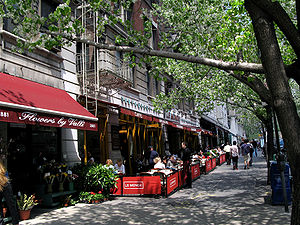
- Barney GreengrassBarney GreengrassBarney Greengrass is a restaurant and appetizing store on the Upper West Side of Manhattan that was started in 1908. They specialize in sturgeon, Nova Scotia salmon, and whitefish. They were the winner of the 2006 James Beard Foundation Award for Excellence....
, specializing in fish, Amsterdam Avenue and 86th Street. Alec BaldwinAlec BaldwinAlexander Rae "Alec" Baldwin III is an American actor who has appeared on film, stage, and television.Baldwin first gained recognition through television for his work in the soap opera Knots Landing in the role of Joshua Rush. He was a cast member for two seasons before his character was killed off...
and other Upper West Siders and others marked its centenary in June 2008. - The Howard Chandler Christie murals of Café des ArtistesCafé des ArtistesCafé des Artistes was a fine restaurant at One West 67th Street in Manhattan and was owned by George Lang. He closed the restaurant for vacation at the beginning of August 2009 and decided to keep it closed permanently while away, announcing the close on August 28, 2009...
, a now-closed French restaurant on West 67th Street off Central Park West, are being incorporated into a new restaurant on the site. - Community Food and JuiceClinton St. Baking Company & RestaurantClinton St. Baking Company & Restaurant is an American bakery and restaurant. It is located at 4 Clinton Street , on the Lower East Side in New York City....
, an eco-conscious restaurant that serves American food and uses only cage-free eggs, organic flour, wild fish, and grass-fed beef is located at 2893 BroadwayBroadway (New York City)Broadway is a prominent avenue in New York City, United States, which runs through the full length of the borough of Manhattan and continues northward through the Bronx borough before terminating in Westchester County, New York. It is the oldest north–south main thoroughfare in the city, dating to...
between 112th and 113th Streets. - Two rival gourmet grocery stores, FairwayFairway MarketFairway Market is a grocery chain. It is one of the United States' highest grossing food retailers per square foot with 14 million customers per year. It was founded in the early 1930s. The stores are known for vast selections of fresh products and every day groceries at a good value. The Fairway...
and Citarella are located on Broadway between West 74th and 75th Streets. - Gray's PapayaGray's PapayaGray's Papaya is a hot dog restaurant with two locations on the West Side of Manhattan, open 24 hours a day year-round. The two locations of Gray's Papaya in Manhattan are:* 402 Sixth Avenue at 8th Street and* 2090 Broadway at 72nd Street....
– specializing in hot dogs, at Broadway and 72nd Street. - Zabar'sZabar'sZabar's is a specialty food store at 2245 Broadway and 80th Street, on the Upper West Side of Manhattan in New York City, founded by Louis Zabar. It is one of the best known commercial landmarks of the neighborhood, and is known for its selection of bagels, smoked fish, olives, and cheeses...
– specialty food and housewares store on Broadway at 80th Street.
Other historical sites
- American Youth Hostel – the transformation of this abandoned Richard Morris HuntRichard Morris HuntRichard Morris Hunt was an American architect of the nineteenth century and a preeminent figure in the history of American architecture...
landmark into the flagship of Hostelling International USA was propelled forward by the federal Community Development Block GrantCommunity Development Block GrantThe Community Development Block Grant , one of the longest-running programs of the U.S. Department of Housing and Urban Development, funds local community development activities such as affordable housing, anti-poverty programs, and infrastructure development...
funded, Manhattan ValleyManhattan ValleyManhattan Valley is a neighborhood on the Upper West Side of Manhattan in New York City, bounded by West 110th Street to the north, Central Park West to the east, West 96th Street to the south, and Broadway to the west...
Neighborhood Strategy Area designation. - Apple Bank – former Central Savings Bank – a Florentine palazzo at Broadway and 73rd, with a magnificent Roman banking hall, one of New York's classic interior spaces, York & Sawyer, architects, ironwork by Samuel YellinSamuel YellinSamuel Yellin , American master blacksmith, was born in Galicia Poland where at the age of eleven he was apprenticed to an iron master. By the age of sixteen he had completed his apprenticeship. During that period he gained the nickname of "Devil," both for his work habits and his sense of humor...
, 1928. Upper floors converted to luxury condominium apartments. - Claremont Riding AcademyClaremont Riding AcademyThe Claremont Riding Academy, also known as Claremont Stables, the last riding stable in Manhattan, was located at 175 West 89th Street between Columbus and Amsterdam Avenues in New York City. It was designed by Frank A. Rooke and built in 1892. It was listed on the National Register of Historic...
– In 2007, after 115 years of use, the last public stables in Manhattan, this National Register building on 89th Street, just east of Amsterdam, closed its doors for good . The subsequent interior gutting for conversion to residential use has halted. - Columbus CircleColumbus CircleColumbus Circle, named for Christopher Columbus, is a major landmark and point of attraction in the New York City borough of Manhattan, located at the intersection of Eighth Avenue, Broadway, Central Park South , and Central Park West, at the southwest corner of Central Park. It is the point from...
– Traffic circle at the intersection of BroadwayBroadway (New York City)Broadway is a prominent avenue in New York City, United States, which runs through the full length of the borough of Manhattan and continues northward through the Bronx borough before terminating in Westchester County, New York. It is the oldest north–south main thoroughfare in the city, dating to...
, Central Park WestCentral Park WestCentral Park West is an avenue that runs north-south in the New York City borough of Manhattan, in the United States....
, Central Park SouthCentral Park SouthCentral Park South is the portion of 59th Street that forms the southern border of Central Park in the borough of Manhattan in New York City. It runs from Columbus Circle at Eighth Avenue on the west to Grand Army Plaza at Fifth Avenue on the east...
and Eighth Avenue. Its centerpiece is a statue of the explorer Christopher ColumbusChristopher ColumbusChristopher Columbus was an explorer, colonizer, and navigator, born in the Republic of Genoa, in northwestern Italy. Under the auspices of the Catholic Monarchs of Spain, he completed four voyages across the Atlantic Ocean that led to general European awareness of the American continents in the...
erected in 1906. Two other similarly financed monuments on Broadway include those to writer Dante Aligheri in Dante ParkDante ParkDante Park or Dante Square is a park in front of Lincoln Center in New York City, New York.The park was established by Italian-Americans in honor of the Italian poet Dante Alighieri. Carlo Barsotti, editor of the paper Il Progresso Italo-Americano, originally wanted to gather funds for a much more...
between 63rd and 64th Streets at Columbus AvenueNinth Avenue (Manhattan)Ninth Avenue / Columbus Avenue is a southbound thoroughfare on the West Side of Manhattan in New York City. Traffic runs downtown along its full length...
, now heralds Lincoln Center; and composer Giuseppe VerdiGiuseppe VerdiGiuseppe Fortunino Francesco Verdi was an Italian Romantic composer, mainly of opera. He was one of the most influential composers of the 19th century...
anchors Verdi SquareVerdi SquareVerdi Square is a small triangle of land enclosed by a railing, located on Manhattan's Upper West Side, between 72nd Street and 73rd Street on the south and north, and Broadway and Amsterdam Avenue on the west and east. On the south the square fronts West 72nd Street; across the street to the...
, girded by 72nd and 73rd Streets at Amsterdam Avenue. The square which actually was a triangle, was expanded to allow for a new subway head houseHead houseA head house is a part of a train station.-Rail terminals:In the context of rail transport, head house refers to that portion of a passenger terminal not housing the tracks and platforms themselves. Typically, the head house contains ticket counters, toilets and baggage facilities, if there are...
and a plaza which appropriately has become the setting for summer concerts. The aforementioned Apple Bank is across from the statue and the Ansonia HotelAnsonia HotelThe Ansonia is a building on the Upper West Side of New York City, located at 2109 Broadway, between 73rd and 74th Streets. It was originally built as a hotel by William Earle Dodge Stokes, the Phelps-Dodge copper heir and share holder in the Ansonia Clock Company, and it was named for his...
is catty corner to the northwest. - The DakotaThe DakotaThe Dakota, constructed from October 25, 1880 to October 27, 1884, is a co-op apartment building located on the northwest corner of 72nd Street and Central Park West in the Upper West Side of Manhattan in New York City...
- an apartment building on 72nd Street and Central Park West where musician John LennonJohn LennonJohn Winston Lennon, MBE was an English musician and singer-songwriter who rose to worldwide fame as one of the founding members of The Beatles, one of the most commercially successful and critically acclaimed acts in the history of popular music...
was murdered in 1980. - The former East River Savings Bank at Amsterdam and 96th Street (Walker & GilletteWalker & GilletteWalker & Gillette was an architectural firm based in New York City, the partnership of A. Stewart Walker and Leon N. Gillette , active from 1906 through 1945.- Biography :...
, 1927) is a classical temple now housing a drugstore, locally termed "The Aspirineum" and "The First National Bank of CVS"

- Firemen's Memorial – this 1913 monument on Riverside DriveRiverside Drive (Manhattan)Riverside Drive is a scenic north-south thoroughfare in the Manhattan borough of New York City. The boulevard runs on the west side of Manhattan, generally parallel to the Hudson River from 72nd Street to near the George Washington Bridge at 181st Street...
at 100th Street has been the scene of somber gatherings and spontaneous gestures, such as a display of flowers and children's teddy bears on 9/11. The Piccirilli Brothers'Piccirilli BrothersThe Piccirilli Brothers were a family of renowned marble carvers who carved a large number of the most significant marble sculptures in the United States, including Daniel Chester French’s colossal Abraham Lincoln in the Lincoln Memorial, Washington, D.C.-History:In 1888, Giuseppe Piccirilli , a...
female model for this work, Audrey MunsonAudrey MunsonAudrey Munson was an American artist's model and film actress, known variously as "Miss Manhattan," "the Exposition Girl," and "American Venus." She was the model or inspiration for more than 15 statues in New York City and appeared in four silent films.-Life and career:Audrey Marie Munson was...
, sat for the nearby Straus Memorial and for their Maine Monument, as well. - Grant's TombGrant's TombGeneral Grant National Memorial , better known as Grant's Tomb, is a mausoleum containing the bodies of Ulysses S. Grant , American Civil War General and 18th President of the United States, and his wife, Julia Dent Grant...
– in Morningside Heights - Joan of Arc Monument – a monument to the 15th century French heroine bestrides a horse on a crest of Riverside Drive at 93rd Street.
- St Agnes Branch Library – this Carnegie Endowment financed New York Public LibraryNew York Public LibraryThe New York Public Library is the largest public library in North America and is one of the United States' most significant research libraries...
branch on Amsterdam Avenue, just north of 81st St – which completed a restoration and modernization – housed the system's original Library for the Blind. - Soldiers' & Sailors' MonumentSoldiers' and Sailors' Monument (New York)The Soldiers' and Sailors' Memorial Monument commemorates Union Army soldiers and sailors who served in the American Civil War. It is located at 89th Street and Riverside Drive in Riverside Park in the Upper West Side of New York City. It was dedicated on Memorial Day, 1902.The white marble...
– this Civil WarAmerican Civil WarThe American Civil War was a civil war fought in the United States of America. In response to the election of Abraham Lincoln as President of the United States, 11 southern slave states declared their secession from the United States and formed the Confederate States of America ; the other 25...
memorial dominating Riverside Drive at 89th Street, is the setting for annual Memorial DayMemorial DayMemorial Day is a United States federal holiday observed on the last Monday of May. Formerly known as Decoration Day, it originated after the American Civil War to commemorate the fallen Union soldiers of the Civil War...
commemorations. - Isidor and Ida Straus MemorialIsidor StrausIsidor Straus —a German Jewish American—was co-owner of the Macy's department store with his brother Nathan. He also served briefly as a member of the United States House of Representatives...
– remembers Isidor StrausIsidor StrausIsidor Straus —a German Jewish American—was co-owner of the Macy's department store with his brother Nathan. He also served briefly as a member of the United States House of Representatives...
, co-owner of Macy's, and his wife, who lived in a mansion on West End Avenue and 105th Street, and died on the RMS Titanic, in triangular Straus ParkStraus ParkStraus Park is a small landscaped park in Morningside Heights, Manhattan, at the intersection of Broadway, West End Avenue, and 106th Street....
at Broadway, West End Avenue and West 106th Street. The model for the sculpture, was also the muse for the Maine Monument, 57 blocks south on Broadway, at the Columbus Circle entrance to Central Park.
Religious
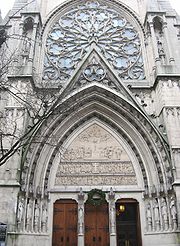
- Advent Lutheran Church/Broadway United Church of ChristBroadway United Church of ChristBroadway United Church of Christ is a Congregationalist Church at Broadway and 93rd Street on the Upper West Side of Manhattan.- Finney's Broadway Tabernacle :...
– Broadway and 93rd Street - http://www/http://www.americanbible.org/ American Bible Society – 1865 Broadway, New York, NY 10023
- Blessed Sacrament Roman Catholic Church – 71st Street, between Broadway and Columbus Avenue. Interesting tapestries on display, modeled on 14th century French Gothic Sainte Chapelle in Paris.
- The Carlebach Shul – 305 West 79th Street, off West End Avenue
- Lincoln Square Synagogue – Modern Orthodox congregation, 200 Amsterdam Avenue at 69th Street.
- Cathedral of Saint John the Divine – in Morningside Heights, the largest Gothic cathedral in the world, or at least it will be, when it's finished. Suffered significant fire damage to the South transept in December 2001. The church was originally to follow a Romanesque design, but the builders switched to a Gothic design along the way. The church plans to replace the great dome with a massive Gothic tower, but this major construction project is likely to take decades, if it is ever completed.
- First Baptist Church in the City of New YorkFirst Baptist Church in the City of New YorkThe First Baptist Church in the City of New York is a Christian congregation based in a sanctuary built in 1891 at the intersection of Broadway and West 79th Street in the Upper West Side of Manhattan, New York at the 79th Street subway station...
79th Street at BroadwayBroadway (New York City)Broadway is a prominent avenue in New York City, United States, which runs through the full length of the borough of Manhattan and continues northward through the Bronx borough before terminating in Westchester County, New York. It is the oldest north–south main thoroughfare in the city, dating to... - First Church of Christ Scientist, New York, (formerly Second Church of Christ ScientistSecond Church of Christ, Scientist (New York, New York)The former Second Church of Christ, Scientist is an historic Christian Science church building located at Central Park West and West 68th Street on the Upper West Side of Manhattan, New York City, within the Central Park West Historic District. The Beaux-Arts building was designed by architect...
) Central Park West at 68th Street. Architect-F.R.Comstock. 1899 - The Church of St. Gregory the Great – Roman Catholic parish and school on West 90th Street between Amsterdam and Columbus avenues. During the Vietnam War, it was the sanctuary for celebrated fugitive priest, Philip BerriganPhilip BerriganPhilip Francis Berrigan was an internationally renowned American peace activist, Christian anarchist and former Roman Catholic priest...
, who with his fellow priest brother DanielDaniel BerriganDaniel Berrigan, SJ is an American Catholic priest, peace activist, and poet. Daniel and his brother Philip were for a time on the FBI Ten Most Wanted Fugitives list for their involvement in antiwar protests during the Vietnam war....
was then one of the FBI's "10 most wanted." More recently, Irish author Colm TóibínColm TóibínColm Tóibín is a multi-award-winning Irish novelist, short story writer, essayist, playwright, journalist, critic, and, most recently, poet.Tóibín is Leonard Milberg Lecturer in Irish Letters at Princeton University in New Jersey and succeeded Martin Amis as professor of creative writing at the...
wrote of the church's choir. - United Methodist Church of St. Paul & St. Andrew - West End Avenue and 86th Street. Center of strong community outreach programs to the disaffected.
- Church of the Ascension (Catholic), a Romanesque Revival sanctuary on 107th Street, between Broadway and Amsterdam, fitted with serious pipes, offers a Sunday Jazz mass
- Ansche ChesedAnsche ChesedAnsche Chesed is a synagogue on the Upper West Side of the New York City borough of Manhattan.-History:The congregation was founded in 1828 by a group of German, Dutch and Polish Jews who split off from Congregation B'nai Jeshurun...
- Minyan Ma'at
- West Side Minyan
- B'nai Jeshurun – In 1825, Ashkenazi members left the city's first Jewish house of worship, the Sephardic Congregation Shearith Israel, beginning a trek up Manhattan that would land them on West 88th Street between West End Avenue and Broadway. The 1919 building designed by Broadway theater architect Henry B. HertsHenry Beaumont HertsHenry Beaumont Herts was an American architect.Herts was born in New York City, attended, but did not graduate from, Columbia University, and apprenticed under Bruce Price...
with fellow congregant Walter S. Schneider, became a must see for boards of other synagogues then seeking to build new homes. A spiritual and demographic renaissance began in 1985, with the arrival of Rabbi Marshall MeyerMarshall MeyerRabbi Marshall T. Meyer was an American-born Conservative rabbi and a recognized international human rights activist. Marshall Theodore Meyer was born in New York City and raised in Norwich, Conn. He attended Dartmouth College, graduating in 1952...
. - Congregation Habonim – founded by refugees on the first anniversary of the Kristalnacht, this congregation occupies a classic post-World War II suburban style synagogue at 44 West 66th Street just off of Central Park West.
- Congregation Shaare Zedek (New York City)Congregation Shaare Zedek (New York City)Congregation Shaare Zedek is a Conservative synagogue located on West 93rd Street in Manhattan.-History:Founded in 1837, by Polish Jews, Shaare Zedek is the third oldest Jewish congregation in New York City. The congregation originally met at 38 Henry Street on Manhattan's Lower East Side...
Congregation Shaare Zedek West 93rd Street, between Broadway and Amsterdam. - Congregation Shearith IsraelCongregation Shearith IsraelCongregation Shearith Israel, often called The Spanish and Portuguese Synagogue, is the oldest Jewish congregation in the United States. It was established in 1654....
– oldest Jewish congregation in what is now the United States was launched in 1655. Its landmark, 1897 building on Central Park West at West 70th Street was designed by Arnold BrunnerArnold BrunnerArnold William Brunner was an American architect who was born and died in New York City. Brunner was educated in New York and in Manchester, England. He attended Massachusetts Institute of Technology, where he studied under William R. Ware. Early in his career, he worked in the architectural...
and Thomas TryonThomas TryonThomas Tryon was an English merchant, author of popular self-help books, and early advocate of vegetarianism.-Life:...
and incorporated elements of its first New AmsterdamNew AmsterdamNew Amsterdam was a 17th-century Dutch colonial settlement that served as the capital of New Netherland. It later became New York City....
sanctuary in its small chapel. - Congregation Rodeph SholomCongregation Rodeph Sholom (Manhattan, New York)Congregation Rodeph Sholom is a Reform synagogue in New York City. Founded in 1842 by immigrants form the German lands, it is one of the oldest synagogues in the United States.- History :...
83rd Street/Central Park.
- Congregation Ohav Sholom
- Corpus Christi Church near Columbia University
- Holy Name of Jesus R.C. ChurchHoly Name of Jesus R.C. ChurchThe Holy Name of Jesus Roman Catholic Church stands at 96th Street and Amsterdam Avenue, New York City.It was taken over by the Franciscans in 1990. The parish has an attached elementary and middle school, as well as a community center on West 97th Street....
– 207 West 96th Street, NW corner of Amsterdam. Built 1892–1900; restored 1998–2000. - Darkhei Noam
- Holy Trinity Roman Catholic Church 82nd Street betw. Broadway/Amsterdam, a fine example of Byzantine architecture with mosaics in the ceilings.
- Holy Trinity Lutheran Church Central Park West and 65th Street
- Islamic Center of New York, a Sunni mosqueMosqueA mosque is a place of worship for followers of Islam. The word is likely to have entered the English language through French , from Portuguese , from Spanish , and from Berber , ultimately originating in — . The Arabic word masjid literally means a place of prostration...
, occupies the c. 1900 C.P.H. GilbertC.P.H. GilbertCharles Pierrepont Henry Gilbert , most often referred to as C. P. H. Gilbert, was an American architect of the late-19th and early-20th centuries best known for designing townhouses and mansions....
-designed townhouse at 1 Riverside DriveRiverside Drive (Manhattan)Riverside Drive is a scenic north-south thoroughfare in the Manhattan borough of New York City. The boulevard runs on the west side of Manhattan, generally parallel to the Hudson River from 72nd Street to near the George Washington Bridge at 181st Street...
.

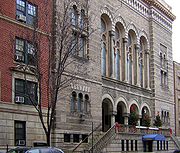
- The Jewish Center – the very first "shul with a pool," now a more circumspect Modern Orthodox congregation on West 86th Street between Amsterdam and Columbus avenues.
- Kehilat Hadar
- Congregation Ohab ZedekCongregation Ohab ZedekOhab Zedek, sometimes abbreviated as OZ, is an Orthodox Jewish synagogue in Manhattan, New York City noted for its lively, youthful congregation. Founded in 1873, it moved to it current location on West 95th Street in 1926...
(OZ) - Kehilat Orach Eliezer
- Kol ZimrahKol ZimrahKol Zimrah is an independent minyan or chavurah founded in 2002, based in New York City and meeting primarily on Manhattan's Upper West Side. Its motto is "meaningful prayer through music"....
- Kollel Yisroel V'Shimshon of the West Side
- Manhattan New York TempleManhattan New York TempleThe Manhattan New York Temple is the 119th operating temple of The Church of Jesus Christ of Latter-day Saints . It is the second "high rise" LDS temple to be constructed, after the Hong Kong China Temple, and the third LDS temple converted from an existing building...
of The Church of Jesus Christ of Latter-day Saints. 65th Street and Columbus/Broadway, across the street from Lincoln Center. - National Council of ChurchesNational Council of ChurchesThe National Council of the Churches of Christ in the USA is an ecumenical partnership of 37 Christian faith groups in the United States. Its member denominations, churches, conventions, and archdioceses include Mainline Protestant, Orthodox, African American, Evangelical, and historic peace...
– prime ecumenical tenant of the Interchurch CenterInterchurch CenterThe Interchurch Center is a 19-story granite-clad office building located at 475 Riverside Drive and West 120th Street in New York City. Besides renting to many secular non-profits, it is the headquarters for the National Council of Churches USA and its sister humanitarian organization Church...
, 120th St. and Riverside Drive. - New York Buddhist Church – A statue of the 12th century Japanese Buddhist monk ShinranShinranwas a Japanese Buddhist monk, who was born in Hino at the turbulent close of the Heian Period and lived during the Kamakura Period...
stands in front of the building on Riverside Drive between 105th and 106th streets. - Rabbi Besser's Shtiebel
- Riverside ChurchRiverside ChurchThe Riverside Church in the City of New York is an interdenominational church in New York City, famous for its elaborate Neo-Gothic architecture—which includes the world's largest tuned carillon bell...
– in Morningside Heights - Rutgers Presbyterian ChurchRutgers Presbyterian ChurchRutgers Presbyterian Church is a Presbyterian house of worship in New York City.The church's origins date to 1798 in Lower Manhattan. The first church building was erected on a plot of ground donated by Colonel Henry Rutgers at the corner of what would become Henry Street and Rutgers Street....
http://rutgerschurch.com/– "More Light" Presbyterian Congregation just off Verdi Square and 72nd Subway Station on 236 W. 73rd Street - St. Michael'sSt. Michael's Church, New York CitySt. Michael's Church is a historic Episcopal church at 225 W. 99th Street in New York City. It was founded in January 1807; the present Romanesque building was built in 1890 and added to the National Register of Historic Places in 1996....
Traditional Anglican and emerging churchEmerging ChurchThe emerging church is a Christian movement of the late 20th and early 21st century that crosses a number of theological boundaries: participants can be described as evangelical, Protestant, Catholic, post-evangelical, anabaptist, adventist, liberal, post-liberal, reformed, charismatic,...
/Seeker worship services at Amsterdam Ave and W 99th Street - St. Ignatius of Antioch Episcopal ChurchSt. Ignatius of Antioch Church (New York City)St. Ignatius of Antioch Episcopal Church is a historic Episcopal church, located at 552 West End Avenue, on the southeast corner of 87th Street, in Manhattan's Upper West Side neighborhood. It was built in 1903 and added to the National Register of Historic Places in 1999.-History:The congregation...
– Excellent example of Anglican "high church" architecture at 87th Street and West End Avenue - Society for Ethical Culture Also a classical music venue
- Trinity Lutheran Church – 100st/Am&Col
- The Greek Orthodox Church of the Annuciation – 302 West 91st Street at West End Avenue
- Crenshaw Christian Center – east coast branch of west coast megachurch, occupied the former First Church of Christ, Scientist, (Carrère and HastingsCarrère and HastingsCarrère and Hastings, the firm of John Merven Carrère and Thomas Hastings , located in New York City, was one of the outstanding Beaux-Arts architecture firms in the United States. The partnership operated from 1885 until 1911, when Carrère was killed in an automobile accident...
, 1903). - Society for the Advancement of JudaismSociety for the Advancement of JudaismThe Society for the Advancement of Judaism is a synagogue and Jewish organization in New York City, on Manhattan's Upper West Side. Founded in 1922 by Rabbi Mordecai M...
- Stephen Wise Free SynagogueStephen Wise Free SynagogueThe Stephen Wise Free Synagogue is a synagogue located at 30 West 68th Street in the New York City borough of Manhattan.In 1905, Rabbi Stephen Samuel Wise then serving a congregation in Portland, Oregon, was under consideration as Rabbi of Temple Emanu–El in New York City, but withdrew his name...
- West-Park Presbyterian ChurchWest-Park Presbyterian ChurchWest-Park Presbyterian Church is a Romanesque Revival Presbyterian church located on the corner of Amsterdam Avenue at 86th Street on Manhattan's Upper West Side, New York City, consisting of a main sanctuary and chapel.-Congregation history:...
, designed by Leopold EidlitzLeopold EidlitzLeopold Eidlitz was a prominent New York architect best known for his work on the New York State Capitol , as well as "Iranistan" , P. T. Barnum's house in Bridgeport, Connecticut; St. Peter's Church, on Westchester Avenue at St... - Young Israel of the West Side
Residences
The apartment buildings along Central Park WestCentral Park West
Central Park West is an avenue that runs north-south in the New York City borough of Manhattan, in the United States....
, facing the park, are some of the most desirable apartments in New York. The Dakota
The Dakota
The Dakota, constructed from October 25, 1880 to October 27, 1884, is a co-op apartment building located on the northwest corner of 72nd Street and Central Park West in the Upper West Side of Manhattan in New York City...
at 72nd St. has been home to numerous celebrities including John Lennon
John Lennon
John Winston Lennon, MBE was an English musician and singer-songwriter who rose to worldwide fame as one of the founding members of The Beatles, one of the most commercially successful and critically acclaimed acts in the history of popular music...
, Leonard Bernstein
Leonard Bernstein
Leonard Bernstein August 25, 1918 – October 14, 1990) was an American conductor, composer, author, music lecturer and pianist. He was among the first conductors born and educated in the United States of America to receive worldwide acclaim...
and Lauren Bacall
Lauren Bacall
Lauren Bacall is an American film and stage actress and model, known for her distinctive husky voice and sultry looks.She first emerged as leading lady in the Humphrey Bogart film To Have And Have Not and continued on in the film noir genre, with appearances in The Big Sleep and Dark Passage ,...
. Other famous buildings on CPW include the Art Deco Century Apartments (Irwin Chanin, 1931) and The Majestic (building) also by Chanin. The San Remo
The San Remo
The San Remo is a luxury, 27-floor, co-operative apartment building in New York City located between 74th and 75th streets, about 1/10 of a mile north of the Dakota building The San Remo is described by Glen Justice of the New York Times as "a dazzling two-tower building with captivating views...
, The Eldorado
The Eldorado
The Eldorado at 300 Central Park West, on the Upper West Side of New York City, is the northernmost of four twin-towered luxury housing cooperatives that face the west side of Central Park...
(300 C.P.W., with the highest sum of Democratic presidential campaign contributions by address in 2004; the home of Herman Wouk's fictional Marjorie Morningstar
Marjorie Morningstar (novel)
Marjorie Morningstar is a 1955 novel by Herman Wouk, about a woman who wants to become an actress. In 1958, the book was made into a Hollywood feature movie starring Natalie Wood, also titled Marjorie Morningstar.-Plot:...
), and The Beresford
The Beresford
The Beresford, at 211 Central Park West, between 81st and 82nd Streets, is an upscale, 23-floor apartment building in New York City. The architect, Emery Roth, was famous for building luxury apartments and hotels throughout the city...
were all designed by Emery Roth
Emery Roth
Emery Roth was an American architect who designed many of the definitive New York City hotels and apartment buildings of the 1920s and 30s, incorporating Beaux-Arts and Art Deco details...
, as was 41 West 96th Street (completed in 1926). His first commission, the Belle Époque
Belle Époque
The Belle Époque or La Belle Époque was a period in European social history that began during the late 19th century and lasted until World War I. Occurring during the era of the French Third Republic and the German Empire, it was a period characterised by optimism and new technological and medical...
Belleclaire, is on Broadway, while the moderne
Streamline Moderne
Streamline Moderne, sometimes referred to by either name alone or as Art Moderne, was a late type of the Art Deco design style which emerged during the 1930s...
Normandie holds forth on Riverside at 86th Street. Along Broadway are several Beaux-Arts apartment houses: The Belnord
The Belnord
The Belnord is an apartment building on West 86th Street on the Upper West Side of Manhattan in New York City.It was designed in 1908 by the noted architectural firm of Hiss and Weekes. It is 13 stories tall and features Italian Renaissance style decorative elements...
(1908) – the fronting block of which was co-named in honor of longtime resident I.B. Singer, plus The Apthorp
The Apthorp
The Apthorp is a historic condominium apartment building in New York City, New York. The Renaissance Revival building designed by architects Clinton & Russell for absentee landowner William Waldorf Astor was built between 1906 and 1908; it occupies the full block between Broadway and West End...
(1908), The Ansonia (1902), The Dorilton
The Dorilton
The Dorilton is a luxury residential housing cooperative in Manhattan, New York City. Construction began in 1900 and was completed by 1902.- Architecture :...
and the Manhasset . All are individually designated New York City landmarks. Curvilinear Riverside Drive also has many beautiful pre-war houses and larger buildings, including the graceful curving apartment buildings—The Paterno
The Paterno
The Paterno is a Manhattan apartment building located at 116th Street and Riverside Drive and also known as 440 Riverside Drive. The building is noted for its curved facade, impressive marble lobby with a stained-glass ceiling, and substantial porte-cochère. Across 116th Street, The Paterno faces...
and The Colosseum (apartment building)
The Colosseum (apartment building)
The Colosseum is a Manhattan apartment building located at 116th Street and Riverside Drive.The building is noted for its curved façade and impressive marble lobby. Across 116th Street, The Colosseum faces The Paterno, another building with a similar curved facade...
by Schwartz & Gross—at 116th St and Riverside Drive. West End Avenue, a grand residential boulevard lined with pre-war Beaux-Arts apartment buildings and townhouses dating from the late-19th and early 20th centuries, is closed to commercial traffic. Columbus Avenue north of 87th Street was the spine for major post-World War II urban renewal. Broadway is lined with such architecturally notable apartment buildings as The Ansonia, The Apthorp
The Apthorp
The Apthorp is a historic condominium apartment building in New York City, New York. The Renaissance Revival building designed by architects Clinton & Russell for absentee landowner William Waldorf Astor was built between 1906 and 1908; it occupies the full block between Broadway and West End...
, The Belnord
The Belnord
The Belnord is an apartment building on West 86th Street on the Upper West Side of Manhattan in New York City.It was designed in 1908 by the noted architectural firm of Hiss and Weekes. It is 13 stories tall and features Italian Renaissance style decorative elements...
, the Astor Court Building
Astor Court Building
The Astor Court building is an apartment house in New York City. It is located on the Upper West Side on Broadway between 89th Street and 90th Street. It was designed by architect Charles A. Platt for developer Vincent Astor....
, and The Cornwall
The Cornwall
The Cornwall, at 255 West 90th Street, is a luxury residential cooperative apartment building in Manhattan, New York City. Located on the northwest corner of Broadway and 90th Street, it was designed by Neville & Bagge and erected in 1909. The developers were Arlington C. Hall and Harvey M. Hall...
, which features an Art nouveau
Art Nouveau
Art Nouveau is an international philosophy and style of art, architecture and applied art—especially the decorative arts—that were most popular during 1890–1910. The name "Art Nouveau" is French for "new art"...
cornice..Newly constructed 15 Central Park West
15 Central Park West
15 Central Park West, located at the corner of West 61st Street and Central Park West, is an apartment building built in 2006-8 and designed by the architect Robert A.M. Stern....
and 535 West End Avenue
535 West End Avenue
535 West End Avenue is an apartment building on West End Avenue at 86th Street in Upper Westside neighborhood of Manhattan in New York City. Designed by Lucien Lagrange Architects, the building has 22 half and full floor residences, ranging from 3,744 to...
are known to be some of the prestigious residential addressess in Manhattan.
In media
The Upper West Side has been a setting for many movies and television shows because of its pre-War architecture, colorful community and rich cultural life. Ever since Edward R. MurrowEdward R. Murrow
Edward Roscoe Murrow, KBE was an American broadcast journalist. He first came to prominence with a series of radio news broadcasts during World War II, which were followed by millions of listeners in the United States and Canada.Fellow journalists Eric Sevareid, Ed Bliss, and Alexander Kendrick...
went "Person-to-Person" live, the length of Central Park West in the 1950s, West Siders scarcely pause to gape at on-site trailers, and jump their skateboards over coaxial cables and it seems that one or another of the various Law & Order
Law & Order
Law & Order is an American police procedural and legal drama television series, created by Dick Wolf and part of the Law & Order franchise. It aired on NBC, and in syndication on various cable networks. Law & Order premiered on September 13, 1990, and completed its 20th and final season on May 24,...
shows is taking up all the available parking spaces in the neighborhood. Woody Allen
Woody Allen
Woody Allen is an American screenwriter, director, actor, comedian, jazz musician, author, and playwright. Allen's films draw heavily on literature, sexuality, philosophy, psychology, Jewish identity, and the history of cinema...
's film Hannah and Her Sisters
Hannah and Her Sisters
Hannah and Her Sisters is a 1986 American comedy-drama film which tells the intertwined stories of an extended family over two years that begin and end with a family Thanksgiving dinner...
captures that quintessential Upper West Side flavor of rambling high-ceilinged apartments bursting at the seams with books and other cultural artifacts.
Movies
- American PsychoAmerican Psycho (film)American Psycho is a 2000 cult thriller film directed by Mary Harron based on Bret Easton Ellis's novel of the same name. Though predominantly a psycho thriller, the film also blends elements of horror, satire, and black comedy...
(2000) The main character, played by Christian Bale, named Patrick Bateman, apparently lives in the American Gardens Building on West 81st street. - The ApartmentThe ApartmentThe Apartment is a 1960 American comedy-drama film produced and directed by Billy Wilder, and starring Jack Lemmon, Shirley MacLaine, and Fred MacMurray. It was Wilder's follow-up to the enormously popular Some Like It Hot and, like its predecessor, was a commercial and critical hit, grossing $25...
(1960) - Black and WhiteBlack and White (1999 film)Black and White is a 1999 American film directed by James Toback, starring Robert Downey, Jr., Gaby Hoffmann, Allan Houston, Jared Leto, Scott Caan, Claudia Schiffer, Brooke Shields and a number of rap musicians, namely members of the Wu-Tang Clan and Onyx .The...
(1999), has scenes of Central Park and Columbia University - Black SwanBlack Swan (film)Black Swan is a 2010 American psychological thriller film directed by Darren Aronofsky and starring Natalie Portman, Vincent Cassel and Mila Kunis. Its plot revolves around a production of Tchaikovsky's Swan Lake ballet by a prestigious New York City company. The production requires a ballerina to...
(2010) The main character, Nina, played by Natalie Portman, states that she lives on Manhattan's upper west side. - Borat: Cultural Learnings of America for Make Benefit Glorious Nation of KazakhstanBorat: Cultural Learnings of America for Make Benefit Glorious Nation of KazakhstanBorat: Cultural Learnings of America for Make Benefit Glorious Nation of Kazakhstan, often referred to simply as Borat, is a 2006 mockumentary comedy film directed by Larry Charles and distributed by 20th Century Fox...
(2006) Early on in his trip to America, Borat is seen in Columbus Circle in front of the Trump International Hotel and Tower - Die Hard with a Vengeance (1995), includes a scene set outside the subway station at 72nd Street and Broadway, featuring a public phone that was in fact only a prop.
- Eyes Wide ShutEyes Wide ShutEyes Wide Shut is a 1999 drama film based upon Arthur Schnitzler's 1926 novella Traumnovelle . The film was directed, produced and co-written by Stanley Kubrick, and was his last film. The story, set in and around New York City, follows the sexually-charged adventures of Dr...
(1999) The characters played by Tom Cruise and Nicole Kidman live in an apartment on Central Park West. - Fools Rush In (1997) Several scenes, including the 72nd St. & Broadway Subway station and CPW
- Fatal AttractionFatal AttractionFatal Attraction is a 1987 American thriller blended with horror, directed by Adrian Lyne and stars Michael Douglas, Glenn Close and Anne Archer. The film centers around a married man who has a weekend affair with a woman who refuses to allow it to end, resulting in emotional blackmail, stalking...
(1987) In the movie, Michael DouglasMichael DouglasMichael Kirk Douglas is an American actor and producer, primarily in movies and television. He has won three Golden Globes and two Academy Awards; first as producer of 1975's Best Picture, One Flew Over the Cuckoo's Nest, and as Best Actor in 1987 for his role in Wall Street. Douglas received the...
' character lives in a building on 100th and West End Avenue - GhostbustersGhostbustersGhostbusters is a 1984 American science fiction comedy film directed by Ivan Reitman and written by Dan Aykroyd and Harold Ramis. The film stars Bill Murray, Dan Aykroyd, Sigourney Weaver, Harold Ramis, and Rick Moranis and follows three eccentric parapsychologists in New York City, who start a...
(1984) At the opening the title characters shown being ousted professors on the Columbia University campus, and Sigourney Weaver's character lives in 55 Central Park West55 Central Park WestThe building at 55 Central Park West, also known as the Ghostbusters Building, is a 19-floor housing cooperative located in Manhattan, New York City, U.S.A. The building was built in 1929 and designed by the firm Schwartz and Gross. Both the interior and the exterior possess unique architectural...
, at 66th St. - Ghostbusters IIGhostbusters IIGhostbusters II is a 1989 science fiction comedy film produced and directed by Ivan Reitman. It is the sequel to the 1984 film Ghostbusters and follows the further adventures of a group of parapsychologists and their organization which combats paranormal activities...
(1989) Janosz says he's from the Upper West Side. - Hannah and Her SistersHannah and Her SistersHannah and Her Sisters is a 1986 American comedy-drama film which tells the intertwined stories of an extended family over two years that begin and end with a family Thanksgiving dinner...
(1986) Hannah's parents' apartment is shown on Riverside and 86th Street, and near the end of the film Woody AllenWoody AllenWoody Allen is an American screenwriter, director, actor, comedian, jazz musician, author, and playwright. Allen's films draw heavily on literature, sexuality, philosophy, psychology, Jewish identity, and the history of cinema...
's character is seen walking along Broadway between 92nd and 93rd Streets and then entering the Metro Theatre at Broadway between 100th and 101st Streets. - HeartburnHeartburnHeartburn, also known as pyrosis or acid indigestion is a burning sensation in the chest, just behind the breastbone or in the epigastrium...
(1986), finds Meryl Steep's character taking refuge in her father's spacious apartment at the ApthorpThe ApthorpThe Apthorp is a historic condominium apartment building in New York City, New York. The Renaissance Revival building designed by architects Clinton & Russell for absentee landowner William Waldorf Astor was built between 1906 and 1908; it occupies the full block between Broadway and West End...
on 79th Street and Broadway after her marriage fails; author Nora EphronNora EphronNora Ephron is an American film director, producer, screenwriter, novelist, playwright, journalist, author, and blogger.She is best known for her romantic comedies and is a triple nominee for the Academy Award for Writing Original Screenplay; for Silkwood, When Harry Met Sally... and Sleepless in...
, on whose novel the film was based, was an Apthorp resident at the time. - Home Alone 2: Lost in New YorkHome Alone 2: Lost in New YorkHome Alone 2: Lost in New York is a 1992 American Christmas comedy film written and produced by John Hughes and directed by Chris Columbus. It is the second film in the Home Alone series and the direct sequel to Home Alone. The film stars Macaulay Culkin in the lead role as Kevin McCallister, while...
(1992), takes place in Central Park, and in a townhouse on 95th St. as well as other locations throughout New York. - The House on 92nd StreetThe House on 92nd StreetThe House on 92nd Street is a 1945 black-and-white spy film directed by Henry Hathaway. The film, shot mainly in New York City, was released shortly after the end of World War II. The House on 92nd Street was made with the full cooperation of the Federal Bureau of Investigation , and its head, J....
(1945), though set on the UES at 92nd/Madison, the movie is based on the true story of Nazi spies operating out of an Upper West Side boarding house on 90th Street between Amsterdam/Columbus. - Keeping the FaithKeeping the FaithKeeping the Faith is a 2000 American romantic comedy film, written by Stuart Blumberg and directed by Edward Norton. This film was released by Touchstone Pictures and Spyglass Entertainment, in association with Triple Threat Talent on April 14, 2000....
(2000), various church and synagogue locations http://www.imdb.com/title/tt0171433/locations - Kissing Jessica SteinKissing Jessica SteinKissing Jessica Stein is a 2001 independent romantic comedy film, written and co-produced by the film's stars, Jennifer Westfeldt and Heather Juergensen. The film also stars Tovah Feldshuh and is directed by Charles Herman-Wurmfeld...
(2002) - Little ManhattanLittle ManhattanLittle Manhattan is a 2005 romantic comedy film directed and written by husband and wife Mark Levin and Jennifer Flackett. Though Levin is credited as the director and Flackett as the writer, in the film's DVD commentary the two reveal that they collaborated on both tasks.Little Manhattan depicts...
(2005), includes scenes from the American Museum of Natural History, Central Park West, Broadway / 72nd Street, and Septuagesimo Uno (the smallest NYC public park, on West 71st street between Amsterdam Ave and West End Ave). - I Am LegendI Am Legend (film)I Am Legend is a 2007 post-apocalyptic science fiction film directed by Francis Lawrence and starring Will Smith. It is the third feature film adaptation of Richard Matheson's 1954 novel of the same name, following 1964's The Last Man on Earth and 1971's The Omega Man. Smith plays virologist Robert...
(2007), Will SmithWill SmithWillard Christopher "Will" Smith, Jr. , also known by his stage name The Fresh Prince, is an American actor, producer, and rapper. He has enjoyed success in television, film and music. In April 2007, Newsweek called him the most powerful actor in Hollywood...
, the now demolished Red Cross building on 66th and Amsterdam was used for many indoor "zombie" scenes. - Margaret (2006) with Matt DamonMatt DamonMatthew Paige "Matt" Damon is an American actor, screenwriter, and philanthropist whose career was launched following the success of the film Good Will Hunting , from a screenplay he co-wrote with friend Ben Affleck...
, yet to be released. - Men in Black IIMen in Black IIMen in Black II is a 2002 science fiction action comedy starring Will Smith and Tommy Lee Jones. The film also stars Lara Flynn Boyle, Johnny Knoxville, Rosario Dawson and Rip Torn...
(2002), with Tommy Lee JonesTommy Lee JonesTommy Lee Jones is an American actor and film director. He has received three Academy Award nominations, winning one as Best Supporting Actor for the 1993 thriller film The Fugitive....
and Will SmithWill SmithWillard Christopher "Will" Smith, Jr. , also known by his stage name The Fresh Prince, is an American actor, producer, and rapper. He has enjoyed success in television, film and music. In April 2007, Newsweek called him the most powerful actor in Hollywood...
, outside in front of Hayden PlanetariumHayden PlanetariumThe Hayden Planetarium is a public planetarium, part of the Rose Center for Earth and Space of the American Museum of Natural History in New York City, currently directed by astrophysicist Dr. Neil deGrasse Tyson....
at the American Museum of Natural HistoryAmerican Museum of Natural HistoryThe American Museum of Natural History , located on the Upper West Side of Manhattan in New York City, United States, is one of the largest and most celebrated museums in the world...
. - The Mirror Has Two FacesThe Mirror Has Two FacesThe Mirror Has Two Faces is a 1996 American romance film produced and directed by Barbra Streisand, who also stars. The screenplay by Richard LaGravenese is based on the 1958 French film Le Miroir à deux faces written by André Cayatte and Gérard Oury, which focused on a homely woman who becomes a...
(1996) – a romantic comedy by Barbra StreisandBarbra StreisandBarbra Joan Streisand is an American singer, actress, film producer and director. She has won two Academy Awards, eight Grammy Awards, four Emmy Awards, a Special Tony Award, an American Film Institute award, a Peabody Award, and is one of the few entertainers who have won an Oscar, Emmy, Grammy,...
was set in an apartment at 505 West End Avenue. - Music and LyricsMusic and LyricsMusic and Lyrics is a 2007 American romantic comedy film written and directed by Marc Lawrence. It focuses on the relationship that evolves between a former pop music idol and an aspiring writer as they struggle to compose a song for the reigning pop diva.-Plot:Alex Fletcher enjoyed...
(2007), with Hugh GrantHugh GrantHugh John Mungo Grant is an English actor and film producer. He has received a Golden Globe Award, a BAFTA, and an Honorary César. His films have earned more than $2.4 billion from 25 theatrical releases worldwide. Grant achieved international stardom after appearing in Richard Curtis's...
and Drew BarrymoreDrew BarrymoreDrew Blyth Barrymore is an American actress, film director, screenwriter, producer and model. She is a member of the Barrymore family of American actors and granddaughter of John Barrymore. She first appeared in an advertisement when she was 11 months old. Barrymore made her film debut in Altered...
. All set around 72nd Street which forms the backdrop for Hugh GrantHugh GrantHugh John Mungo Grant is an English actor and film producer. He has received a Golden Globe Award, a BAFTA, and an Honorary César. His films have earned more than $2.4 billion from 25 theatrical releases worldwide. Grant achieved international stardom after appearing in Richard Curtis's...
's apartment. The restaurant scene was shot at La Fenice at 69th and Broadway - New York MinuteNew York Minute (film)New York Minute is a 2004 American teen comedy film starring Mary-Kate Olsen, Ashley Olsen and Eugene Levy. It was directed by Dennie Gordon and released on May 7, 2004. In the film Mary-Kate and Ashley play twins with opposing personalities who have a series of misadventures around New York City...
(2004) features Ashley OlsenAshley OlsenAshley Fuller Olsen is an American actress, fashion designer, producer, and author. She co-founded luxury fashion brand The Row and the more affordable line Olsenboye with her twin sister Mary-Kate Olsen and started her own fashion company called Elizabeth and James...
's character making a speech at Columbia. - Night at the MuseumNight at the MuseumNight at the Museum is a 2006 fantasy adventure-comedy film based on the 1993 children's book The Night at the Museum by Milan Trenc. It follows a divorced father trying to settle down, impress his son, and find his destiny...
(2006) is set in the Museum of Natural HistoryMuseum of Natural HistoryA museum of natural history is a museum with exhibits about natural history, including such topics as animals, plants, ecosystems, geology, paleontology, and climatology. Some museums feature natural-history collections in addition to other collections, such as ones related to history, art and...
and areas adjoining it. - Panic RoomPanic RoomPanic Room is a 2002 American thriller film directed by David Fincher and written by David Koepp. The film stars Jodie Foster, Forest Whitaker, Jared Leto, Dwight Yoakam, Kristen Stewart, and Patrick Bauchau...
(2002) takes place on West 94th Street - The Panic in Needle ParkThe Panic in Needle ParkThe Panic in Needle Park is a 1971 American film directed by Jerry Schatzberg and starring Al Pacino in his second film appearance. The screenplay was written by Joan Didion and John Gregory Dunne, adapted from the book by James Mills....
(1971), starring Al PacinoAl PacinoAlfredo James "Al" Pacino is an American film and stage actor and director. He is famous for playing mobsters, including Michael Corleone in The Godfather trilogy, Tony Montana in Scarface, Alphonse "Big Boy" Caprice in Dick Tracy and Carlito Brigante in Carlito's Way, though he has also appeared...
, is set in Sherman Square, at Broadway and 70th Street. - The PawnbrokerThe PawnbrokerThe Pawnbroker is a novel by Edward Lewis Wallant which tells the story of Sol Nazerman, a concentration camp survivor who suffers flashbacks of his past Nazi imprisonment as he tries to cope with his daily life operating a pawn shop in East Harlem...
(1964), One of the final scenes is at Geraldine Fitzgerald's character's apartment in Lincoln Towers. - PrimePrime (film)Prime is a 2005 American romantic comedy film starring Uma Thurman, Meryl Streep and Bryan Greenberg. It was written and directed by Ben Younger...
(2005), with Uma ThurmanUma ThurmanUma Karuna Thurman is an American actress and model. She has performed in leading roles in a variety of films, ranging from romantic comedies and dramas to science fiction and action movies. Among her best-known roles are those in the Quentin Tarantino films Pulp Fiction and Kill Bill...
and Meryl StreepMeryl StreepMary Louise "Meryl" Streep is an American actress who has worked in theatre, television and film.Streep made her professional stage debut in 1971's The Playboy of Seville, before her screen debut in the television movie The Deadliest Season in 1977. In that same year, she made her film debut with...
. Uma Thurman gets her nails done at Pinky's on 89th Street. - Romancing the StoneRomancing the StoneRomancing the Stone is a 1984 American action-adventure romantic comedy. Directed by Robert Zemeckis, it stars Michael Douglas, Kathleen Turner and Danny DeVito. The film was followed by a 1985 sequel, The Jewel of the Nile....
(1984) Kathleen TurnerKathleen TurnerMary Kathleen Turner is an American actress. She came to fame during the 1980s, after roles in the Hollywood films Body Heat, Peggy Sue Got Married, Romancing the Stone, The War of the Roses, Who Framed Roger Rabbit and Prizzi's Honor...
's character lives on West End Avenue. - Rosemary's BabyRosemary's Baby (film)Rosemary's Baby is a 1968 American horror film written and directed by Roman Polanski, based on the bestselling 1967 novel Rosemary's Baby by Ira Levin...
(1968), apartment building is The DakotaThe DakotaThe Dakota, constructed from October 25, 1880 to October 27, 1884, is a co-op apartment building located on the northwest corner of 72nd Street and Central Park West in the Upper West Side of Manhattan in New York City...
. - Single White FemaleSingle White FemaleSingle White Female is a 1992 American erotic thriller based on John Lutz's novel SWF Seeks Same. The film stars Bridget Fonda and Jennifer Jason Leigh and is directed by Barbet Schroeder.-Plot:...
(1992), apartment building in movie is The Ansonia - Spider-ManSpider-Man (film)Spider-Man is a 2002 American superhero film, the first in the Spider-Man film series based on the fictional Marvel Comics character Spider-Man. It was directed by Sam Raimi and written by David Koepp...
(2002) Low Library and College Walk of Columbia University - Spider-Man 2Spider-Man 2Spider-Man 2 is a 2004 American superhero film directed by Sam Raimi, written by Alvin Sargent and developed by Alfred Gough, Miles Millar, and Michael Chabon. It is the second film in the Spider-Man film franchise based on the fictional Marvel Comics character Spider-Man...
(2004) Planetarium at the American Museum of Natural HistoryAmerican Museum of Natural HistoryThe American Museum of Natural History , located on the Upper West Side of Manhattan in New York City, United States, is one of the largest and most celebrated museums in the world... - Take the Money and RunTake the Money and RunTake the Money and Run is a 1969 comedy film written by Woody Allen and Mickey Rose, and directed by and starring Woody Allen. It is an early mockumentary, chronicling the life of Virgil Starkwell, a bungling petty thief...
(1969) Virgil and Louise are seen at the fountain in Lincoln Center - Up the SandboxUp the SandboxUp The Sandbox is a 1972 American comedy film directed by Irvin Kershner.Paul Zindel's screenplay, based on the novel by Anne Roiphe, focuses on Margaret Reynolds, a young New York City wife and mother who, neglected by her husband and bored with her daily existence, slips into increasingly bizarre...
(1972) In the Columbia University neighboorhood and in Riverside Park. - Vanilla SkyVanilla SkyVanilla Sky is a 2001 American psychological thriller film directed, co-produced and co-written by Cameron Crowe. The film is an English-language remake of the 1997 Spanish movie Abre los ojos , the screenplay for which was written by Alejandro Amenábar and Mateo Gil...
(2001), car accident at center of movie happens in Riverside Park, near 96th Street http://www.imdb.com/title/tt0259711/locations - Wall Street (1987) In one of the final scenes, after being punched in Central Park by Michael DouglasMichael DouglasMichael Kirk Douglas is an American actor and producer, primarily in movies and television. He has won three Golden Globes and two Academy Awards; first as producer of 1975's Best Picture, One Flew Over the Cuckoo's Nest, and as Best Actor in 1987 for his role in Wall Street. Douglas received the...
for being unloyal, Charlie SheenCharlie SheenCarlos Irwin Estevez , better known by his stage name Charlie Sheen, is an American film and television actor. He is the youngest son of actor Martin Sheen....
walks into the Tavern on the GreenTavern on the GreenTavern on the Green was a privately owned American cuisine restaurant located in Central Park on the Upper West Side of Manhattan, in New York City. It remained in operation from 1934 to 2009 under various owners...
where he provides evidence implicating Douglas in federal security fraud. Bud Fox Charlie SheenCharlie SheenCarlos Irwin Estevez , better known by his stage name Charlie Sheen, is an American film and television actor. He is the youngest son of actor Martin Sheen....
's initial small apartment is described as being on the Upper West Side. - You've Got MailYou've Got MailYou've Got Mail is a 1998 American romantic comedy film directed by Nora Ephron, starring Tom Hanks and Meg Ryan. It was written by Nora and Delia Ephron based on the play Parfumerie by Miklós László. The film is about two letter-writing lovers who are completely unaware that their sweetheart is in...
(1998) Meg Ryan and Tom Hanks characters live in the Upper West Side and various locations were used in the film - The Warriors (1979) The Warriors emerge from the 72nd street subway station (Baseball Furie's Turf) and run to Riverside Park, where they easily defeat The Baseball Furies. The meeting at the beginning of the film is also conducted in Riverside Park, though it is mislabeled as Van Cortlandt ParkVan Cortlandt ParkVan Cortlandt Park is a park located in the Bronx in New York City. It is the fourth largest park in New York City, behind Pelham Bay Park, Flushing Meadows Park and Staten Island Greenbelt....
. - West Side StoryWest Side Story (film)West Side Story is a 1961 musical film directed by Robert Wise and Jerome Robbins. The film is an adaptation of the 1957 Broadway musical of the same name, which in turn was adapted from William Shakespeare's play Romeo and Juliet. It stars Natalie Wood, Richard Beymer, Russ Tamblyn, Rita Moreno,...
(1961), takes place in tenements where Lincoln Center is today, around 66th Street
Television
- 30 Rock30 Rock30 Rock is an American television comedy series created by Tina Fey that airs on NBC. The series is loosely based on Fey's experiences as head writer for Saturday Night Live...
- Tina Fey's character Liz Lemon lives at 160 Riverside Drive. - Ryan's HopeRyan's HopeRyan's Hope is an American soap opera, revolving around 13 years of trials and tribulations within a large Irish American family in the Riverside district of New York City. It aired from July 7, 1975 to January 13, 1989 on ABC...
- The series' principal family, the Ryans, lived and owned a bar in the Upper West Side. - SeinfeldSeinfeldSeinfeld is an American television sitcom that originally aired on NBC from July 5, 1989, to May 14, 1998, lasting nine seasons, and is now in syndication. It was created by Larry David and Jerry Seinfeld, the latter starring as a fictionalized version of himself...
– Jerry in the seriesJerry Seinfeld (character)Jerome "Jerry" Seinfeld is the main protagonist of the American television sitcom Seinfeld . The straight man among his group of friends, this semi-fictionalized version of comedian Jerry Seinfeld was named after, co-created by, based on, and played by Seinfeld himself.The series revolves around...
lived at 129 West 81st St., though the establishing exterior shots were of a building in Los Angeles; the series used authentic exteriors from locations such as Tom's Restaurant and H&H BagelsH&H BagelsH&H Bagels is a popular bagel company in New York City, It is the largest bagel manufacturer in New York City and one of the largest bagel manufacturers in the world, producing about 80,000 bagels a day....
. Jerry SeinfeldJerry SeinfeldJerome Allen "Jerry" Seinfeld is an American stand-up comedian, actor, writer, and television and film producer, known for playing a semi-fictional version of himself in the situation comedy Seinfeld , which he co-created and co-wrote with Larry David, and, in the show's final two seasons,...
himself is an owner of an apartment in The BeresfordThe BeresfordThe Beresford, at 211 Central Park West, between 81st and 82nd Streets, is an upscale, 23-floor apartment building in New York City. The architect, Emery Roth, was famous for building luxury apartments and hotels throughout the city...
at 81st Street and Central Park West. - Sex and the CitySex and the CitySex and the City is an American television comedy-drama series created by Darren Star and produced by HBO. Broadcast from 1998 until 2004, the original run of the show had a total of ninety-four episodes...
– used many locations, including Gray's PapayaGray's PapayaGray's Papaya is a hot dog restaurant with two locations on the West Side of Manhattan, open 24 hours a day year-round. The two locations of Gray's Papaya in Manhattan are:* 402 Sixth Avenue at 8th Street and* 2090 Broadway at 72nd Street....
, Zabar'sZabar'sZabar's is a specialty food store at 2245 Broadway and 80th Street, on the Upper West Side of Manhattan in New York City, founded by Louis Zabar. It is one of the best known commercial landmarks of the neighborhood, and is known for its selection of bagels, smoked fish, olives, and cheeses...
, and Charlotte's (275 CPW) and Miranda's (250 W. 85th) apartments. - Will & GraceWill & GraceWill & Grace was an American television sitcom that was originally broadcast on NBC from September 21, 1998 to May 18, 2006 for a total of eight seasons. Will & Grace remains the most successful television series with gay principal characters...
– Will lives in 155 Riverside Drive, Apartment 9C. Jack lives in 155 Riverside Drive, Apartment 9A. - How I Met Your MotherHow I Met Your MotherHow I Met Your Mother is an American sitcom that premiered on CBS on September 19, 2005, created by Craig Thomas and Carter Bays.As a framing device, the main character, Ted Mosby with narration by Bob Saget, in the year 2030 recounts to his son and daughter the events that led to his meeting...
- Ted Mosby's Apartment is located in Upper West Side, at the cross streets of 75th and Amsterdam according to the episode Zip, Zip, ZipZip, Zip, Zip"Zip, Zip, Zip" is the 14th episode in the first season of the television series How I Met Your Mother. It originally aired on February 6, 2006.-Plot:...
. - Gossip girlGossip GirlGossip Girl is an American young adult novel series written by Cecily von Ziegesar and published by Little, Brown and Company, a subsidiary of the Hachette Group. The series revolves around the lives and romances of the privileged teenagers at the Constance Billard School for Girls, an elite...
.
Music
- "Classical Rap" – This parody by Peter SchickelePeter SchickeleJohann Peter Schickele is an American composer, musical educator, and parodist. He is best known for his comedy music albums featuring his music that he presents as music written by the fictional composer P. D. Q...
, on his album P. D. Q. BachP. D. Q. BachP. D. Q. Bach is a fictitious composer invented by musical satirist "Professor" Peter Schickele. In a gag that Schickele has developed over a five-decade-long career, he performs "discovered" works of this forgotten member of the Bach family...
: Oedipus Tex & Other Choral CalamitiesOedipus Tex and Other Choral CalamitiesOedipus Tex and Other Choral Calamities was released in 1990 by Telarc Records. The album contains works by Peter Schickele under his alter-ego of P. D. Q. Bach...
, describes the travails of living on the Upper West Side, as a Yuppie chants hip-hop lyrics to a classical instrumental background. - Tom's DinerTom's Diner"Tom's Diner" is an a cappella pop song written in 1981 by American singer-songwriter Suzanne Vega. It was first released as a track on the January 1984 issue of Fast Folk Musical Magazine. When first featured on one of her own studio albums, it appeared as the first track of her Solitude Standing...
– A song by Suzanne VegaSuzanne VegaSuzanne Nadine Vega is an American songwriter and singer known for her eclectic folk-inspired music.Two of Vega's songs reached the top 10 of various international chart listings: "Luka" and "Tom's Diner"...
focusing on a woman on a rainy morning at Tom's RestaurantTom's Restaurant (Manhattan)Tom's Restaurant is a diner located at 2880 Broadway on the corner of 112th Street in the Morningside Heights neighborhood of Manhattan in New York City...
at 112th and BroadwayBroadway (New York City)Broadway is a prominent avenue in New York City, United States, which runs through the full length of the borough of Manhattan and continues northward through the Bronx borough before terminating in Westchester County, New York. It is the oldest north–south main thoroughfare in the city, dating to...
. - "Lazy SundayLazy Sunday"Lazy Sunday" is a song and short video by American comedy troupe The Lonely Island, released on December 17, 2005, broadcast on Saturday Night Live as the second Digital Short...
" – A parody rap on the late-night sketch comedySketch comedyA sketch comedy consists of a series of short comedy scenes or vignettes, called "sketches," commonly between one and ten minutes long. Such sketches are performed by a group of comic actors or comedians, either on stage or through an audio and/or visual medium such as broadcasting...
show Saturday Night LiveSaturday Night LiveSaturday Night Live is a live American late-night television sketch comedy and variety show developed by Lorne Michaels and Dick Ebersol. The show premiered on NBC on October 11, 1975, under the original title of NBC's Saturday Night.The show's sketches often parody contemporary American culture...
(December 2005), performed by Andy SambergAndy SambergDavid Andrew "Andy" Samberg is an American actor, comedian, rapper and writer best known as a member of the comedy group The Lonely Island and as a cast member on Saturday Night Live...
and Chris ParnellChris ParnellThomas Christopher "Chris" Parnell is an American comic actor best known as a cast member on Saturday Night Live from 1998–2006 and currently for his recurring role as Dr. Leo Spaceman on NBC's Emmy Award-winning comedy series 30 Rock. Parnell also voices Cyril Figgis on the FX animated comedy...
about their day going to see The Chronicles of Narnia: The Lion, the Witch and the WardrobeThe Chronicles of Narnia: The Lion, the Witch and the WardrobeThe Chronicles of Narnia: The Lion, the Witch and the Wardrobe is a 2005 epic fantasy adventure film directed by Andrew Adamson and based on The Lion, the Witch and the Wardrobe, the first published and second chronological novel in C. S. Lewis's children's epic fantasy series, The Chronicles of...
and getting cupcakes (at Magnolia BakeryMagnolia BakeryMagnolia Bakery is a bakery opened in 1996 at 401 Bleecker Street, on the corner of West 11th Street in the West Village neighborhood of Manhattan, New York City. An uptown shop opened at 200 Columbus Avenue, on the corner of West 69th Street on the Upper West Side of Manhattan, in January 2008...
, the original of which is in Greenwich Village but there is also one at Columbus Ave at 69th St.). The song's lyrics mention that they see the movie at a theater on 68th Street and BroadwayBroadway (New York City)Broadway is a prominent avenue in New York City, United States, which runs through the full length of the borough of Manhattan and continues northward through the Bronx borough before terminating in Westchester County, New York. It is the oldest north–south main thoroughfare in the city, dating to...
. While there is indeed an AMCAMC TheatresAMC Theatres , officially known as AMC Entertainment, Inc., is the second largest movie theater chain in North America with 5,325 screens, second only to Regal Entertainment Group, and one of the United States's four national cinema chains AMC Theatres (American Multi-Cinema), officially known as...
movie theater on that corner, the video shows them at a ticket booth for an entirely different theater (on 84th and Broadway).
Famous comedian George Carlin
George Carlin
George Denis Patrick Carlin was an American stand-up comedian, social critic, actor and author, who won five Grammy Awards for his comedy albums....
grew up on 121st, and heavily drew upon his New York City roots on a number of his comedy albums, perhaps most memorably on Occupation: Foole
Occupation: Foole
Occupation: Foole is the fourth album released by United States comedian George Carlin. It was recorded on March 2 and 3, 1973 at the Circle Star Theater in San Carlos, California, and released in October of that year...
, where he and his friends called their neighborhood "White Harlem... because it sounded tough. Its real name was Morningside Heights."
Electronic music
Electronic music
Electronic music is music that employs electronic musical instruments and electronic music technology in its production. In general a distinction can be made between sound produced using electromechanical means and that produced using electronic technology. Examples of electromechanical sound...
pioneer Wendy Carlos
Wendy Carlos
Wendy Carlos is an American composer and electronic musician. Carlos first came to notice in the late 1960s with recordings made on the Moog synthesizer, then a relatively new and unknown instrument; most notable were LPs of synthesized Bach and the soundtrack for Stanley Kubrick's film A...
made her classic 1968 album Switched-On Bach
Switched-On Bach
-Details:The album consists of pieces by Johann Sebastian Bach, performed on a Moog synthesizer, a modular synthesizer system, one of which can be seen at the back of the room on the album cover. "Switched-On Bach," or "S-OB" as Carlos referred to it, was recorded on a custom-built 8 track recorder...
in her West End Avenue
West End Avenue
West End Avenue is a north-south thoroughfare on the West Side of the borough of Manhattan in New York City, not far from the Hudson River.West End Avenue originates at West 59th Street; the continuation of the street below 59th Street is called Eleventh Avenue. It runs from 59th Street to its...
apartment, which she had converted into a makeshift home recording studio
Recording studio
A recording studio is a facility for sound recording and mixing. Ideally both the recording and monitoring spaces are specially designed by an acoustician to achieve optimum acoustic properties...
.
Lynn Oliver had his recording studio sandwiched next to the New Yorker Bookshop http://osw.com/photo/pages/New_Yorker_Bookshop.htm and Benny's http://www.osw.com/photo/pages/Benny_Sarfati.htm on 89th and B'way. The likes of Sonny Rollins, Chet Baker, and Stan Getz could be seen ducking into his alley-like studio to practice and hangout. An arranger and drummer, Oliver's credits are found on more than a few classic cuts from the 60's.
The Beastie Boys
Beastie Boys
Beastie Boys are an American hip hop trio from New York City. The group consists of Mike D who plays the drums, MCA who plays the bass, and Ad-Rock who plays the guitar....
played their first gig in a loft at 100th and Broadway, and recorded some tracks for the EP Polywog Stew there in 1981.
Further reading
- Birmingham, Steven, Life at the Dakota: New York's Most Unusual Address, 1996, ISBN 0-8156-0338-X.
- Goldberg, Jeffrey, "The Decline and Fall of the Upper West Side: How The Poverty Industry Is Ripping Apart A Great New York Neighborhood", New YorkNew York (magazine)New York is a weekly magazine principally concerned with the life, culture, politics, and style of New York City. Founded by Milton Glaser and Clay Felker in 1968 as a competitor to The New Yorker, it was brasher and less polite than that magazine, and established itself as a cradle of New...
magazine, April 25, 1994 - Mott, Hopper Striker, The New York of Yesterday: A Descriptive Narrative of Old Bloomingdale, 1908.
- Salwen, Peter, Upper West Side Story 1989, www.upperwestsidestory.net.
External links
- Broadway Mall Association
- Columbus/Amsterdam BID
- Landmark West!
- NYCvisit Upper West Side map
- NYSite Upper West Site Guide including the block by block guide
- NYU – Historical Architecture of the Upper West Side
- Riverside Park Fund This nonprofit maintains an informative page on the history of Riverside Park and its environs.
- Memoir & history of Upper West Side