

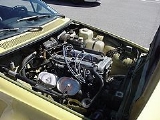
Alfa Romeo Twin Cam engine

Encyclopedia
The all alloy Alfa Romeo Twin Cam engine series was an inline-4 cylinder engine produced by Alfa Romeo
from 1954 to 1994. For earlier Alfa Romeo engines featuring twin camshafts, refer to the main Alfa Romeo
page. For the later 8 or 16-valve Twin Spark engines which also feature twin camshafts, please refer to the Alfa Romeo Twin Spark engine
page.
of 1954. The features of the Giulietta engine included:
This made the Alfa Romeo Twin Cam engine an advanced design for a production car of the mid 1950s. These design features, with minor variations, would form the basis of all future versions of the engine. The capacity was increased to 1570 cc with the introduction of the Giulia
in 1962. Racing versions of the Giulia engine, include the twin plug engine used in the GTA
which featured a cylinder head with two spark plugs per cylinder.
The twin cam engine was later increased to 1779 cc for the 1750 GTV and Berlina in 1968. The 1962 cc engine was introduced in 1971 for the 2000 GTV and Berlina 2000. Twin spark plug versions of the 1750 and 2000 were used for racing and there were a limited number of racing engines fitted with a 16 valve cylinder head.
In 1986, a turbocharged version of the 1779 cc single plug engine was fitted to the Alfa Romeo 75
, providing 155 PS in standard form and a potential for a power output of 300 bhp in Group A
touring car racing
form.
In 1987, the Alfa Romeo 75
was fitted with a twin spark plug per cylinder head design, which provides improved fuel ignition and allows an improved combustion chamber shape with narrower angle between intake and exhaust valve. This was combined with variable valve timing
and electronic fuel injection to give a power output of 148 PS.
The last examples of this engine are the pre 1994 1750 cc, 1770 cc and 1995 cc 8V Twinspark engines featured in the 155
and 164
. Post-1994 versions of these models featured the 16-valve Twinspark, which although sharing features with the previous engine, is a new design.
Production of the Alfa Romeo Twin Cam ended in 1994, by which time it had been superseded by the newer 16 valve Twin Spark
engine.
Alfa Romeo
Alfa Romeo Automobiles S.p.A. is an Italian manufacturer of cars. Founded as A.L.F.A. on June 24, 1910, in Milan, the company has been involved in car racing since 1911, and has a reputation for building expensive sports cars...
from 1954 to 1994. For earlier Alfa Romeo engines featuring twin camshafts, refer to the main Alfa Romeo
Alfa Romeo
Alfa Romeo Automobiles S.p.A. is an Italian manufacturer of cars. Founded as A.L.F.A. on June 24, 1910, in Milan, the company has been involved in car racing since 1911, and has a reputation for building expensive sports cars...
page. For the later 8 or 16-valve Twin Spark engines which also feature twin camshafts, please refer to the Alfa Romeo Twin Spark engine
Alfa Romeo Twin Spark engine
Alfa Romeo Twin Spark technology was used first time in Alfa Romeo Grand Prix car in 1914. In the early 1960s it was used in their race cars to enable it to achieve a higher power output from its engines...
page.
History
The Alfa Romeo Twin Cam engine was introduced in the 1290 cc GiuliettaAlfa Romeo Giulietta
The Alfa Romeo Giulietta was a subcompact automobile manufactured by the Italian car maker Alfa Romeo from 1954 to 1965. The Giulietta was introduced at the Turin Motor Show in 1954 and almost 132,000 were built in the Portello factory in Milan.The first Giulietta model was a coupé, the Giulietta...
of 1954. The features of the Giulietta engine included:
- AluminiumAluminiumAluminium or aluminum is a silvery white member of the boron group of chemical elements. It has the symbol Al, and its atomic number is 13. It is not soluble in water under normal circumstances....
alloyAlloyAn alloy is a mixture or metallic solid solution composed of two or more elements. Complete solid solution alloys give single solid phase microstructure, while partial solutions give two or more phases that may or may not be homogeneous in distribution, depending on thermal history...
engine block with cast-iron cylinder liners - Aluminium alloy cylinder head with hemisphericalSphereA sphere is a perfectly round geometrical object in three-dimensional space, such as the shape of a round ball. Like a circle in two dimensions, a perfect sphere is completely symmetrical around its center, with all points on the surface lying the same distance r from the center point...
combustionCombustionCombustion or burning is the sequence of exothermic chemical reactions between a fuel and an oxidant accompanied by the production of heat and conversion of chemical species. The release of heat can result in the production of light in the form of either glowing or a flame...
chambers - ForgedForgedForged is a book written by biblical scholar, Bart D. Ehrman which attempts to analyze the historical accuracy of the Christian Bible. The book posits that 11 or more books out of the 27 books of the Christian New Testament canon were written as certain types of forgeries related to the politics...
steelSteelSteel is an alloy that consists mostly of iron and has a carbon content between 0.2% and 2.1% by weight, depending on the grade. Carbon is the most common alloying material for iron, but various other alloying elements are used, such as manganese, chromium, vanadium, and tungsten...
crankshaftCrankshaftThe crankshaft, sometimes casually abbreviated to crank, is the part of an engine which translates reciprocating linear piston motion into rotation...
running in five main bearingMain bearingIn a piston engine, the main bearings are the bearings on which the crankshaft rotates, usually plain or journal bearings.All engines have a minimum of two main bearings, one at each end of the crankshaft, and they may have as many as one more than the number of crank pins...
s - Double overhead camshafts driven by a double row timing chain
- Camshafts directly actuate valves via bucket tappets
- Two inclined valves per cylinder with near central located spark plugSpark plugA spark plug is an electrical device that fits into the cylinder head of some internal combustion engines and ignites compressed fuels such as aerosol, gasoline, ethanol, and liquefied petroleum gas by means of an electric spark.Spark plugs have an insulated central electrode which is connected by...
- Inlet and exhaust valves separated by an angle of 80 degrees
This made the Alfa Romeo Twin Cam engine an advanced design for a production car of the mid 1950s. These design features, with minor variations, would form the basis of all future versions of the engine. The capacity was increased to 1570 cc with the introduction of the Giulia
Alfa Romeo Giulia
The Alfa Romeo Giulia is an Alfa Romeo automobile. Alfa was one of the first manufacturers to put a powerful engine in a light-weight car for mainstream production. The Giulia weighed about . The car was equipped with a light alloy twin overhead camshaft four-cylinder engine, similar to that of...
in 1962. Racing versions of the Giulia engine, include the twin plug engine used in the GTA
Alfa Romeo GTA
The GTA 1300 Junior had a 1300 cc engine that was based on the 1600 engine but with a short stroke crankshaft. The GTA Junior in stradale form did not have many of the light weight features of the 1600 GTA, such as the plastic windows, magnesium engine components and alloy wheels. At start...
which featured a cylinder head with two spark plugs per cylinder.
The twin cam engine was later increased to 1779 cc for the 1750 GTV and Berlina in 1968. The 1962 cc engine was introduced in 1971 for the 2000 GTV and Berlina 2000. Twin spark plug versions of the 1750 and 2000 were used for racing and there were a limited number of racing engines fitted with a 16 valve cylinder head.
In 1986, a turbocharged version of the 1779 cc single plug engine was fitted to the Alfa Romeo 75
Alfa Romeo 75
The Alfa Romeo 75, sold in North America as the Milano, was a compact sports saloon / compact executive car produced by the Italian automaker Alfa Romeo between 1985 and 1992...
, providing 155 PS in standard form and a potential for a power output of 300 bhp in Group A
Group A
In relation to motorsport governed by the FIA, Group A referred to a set of regulations providing production-derived vehicles for outright competition. In contrast to the short-lived Group B and Group C, the Group A referred to production-derived vehicles limited in terms of power, weight, allowed...
touring car racing
Touring car racing
Touring car racing is a general term for a number of distinct auto racing competitions in heavily-modified street cars. It is notably popular in Argentina, Australia, Brazil, Germany, Japan, Scandinavia and Britain.-Characteristics of a touring car:...
form.
In 1987, the Alfa Romeo 75
Alfa Romeo 75
The Alfa Romeo 75, sold in North America as the Milano, was a compact sports saloon / compact executive car produced by the Italian automaker Alfa Romeo between 1985 and 1992...
was fitted with a twin spark plug per cylinder head design, which provides improved fuel ignition and allows an improved combustion chamber shape with narrower angle between intake and exhaust valve. This was combined with variable valve timing
Variable valve timing
In internal combustion engines, variable valve timing , also known as Variable valve actuation , is a generalized term used to describe any mechanism or method that can alter the shape or timing of a valve lift event within an internal combustion engine...
and electronic fuel injection to give a power output of 148 PS.
The last examples of this engine are the pre 1994 1750 cc, 1770 cc and 1995 cc 8V Twinspark engines featured in the 155
Alfa Romeo 155
The Alfa Romeo 155 is a compact executive car produced under the Italian Alfa Romeo marque between 1992 and 1998.-Design:Built to replace the 75 and based on the parent Fiat Group's Type Three platform, the 155 was somewhat larger in dimension than the 75 but evolved its styling from that of its...
and 164
Alfa Romeo 164
The Alfa Romeo 164 is an executive car with saloon body, produced by the Italian automaker Alfa Romeo from 1987 to 1998.The 164 was re-badged as the 168 for the Hong Kong and Malaysian markets, as the number "164" had a very negative connotation , and "168" has quite the opposite The Alfa Romeo 164...
. Post-1994 versions of these models featured the 16-valve Twinspark, which although sharing features with the previous engine, is a new design.
Production of the Alfa Romeo Twin Cam ended in 1994, by which time it had been superseded by the newer 16 valve Twin Spark
Alfa Romeo Twin Spark engine
Alfa Romeo Twin Spark technology was used first time in Alfa Romeo Grand Prix car in 1914. In the early 1960s it was used in their race cars to enable it to achieve a higher power output from its engines...
engine.
Applications
- Alfa Romeo RomeoAlfa Romeo RomeoThe first Alfa Romeo lorry was built in 1914 using the 20/30HP chassis. The company built also other commercial vehicles during the early days of the company, in 1954 a new small van family was created, the "Autotutto" .- Alfa Romeo Romeo :...
- Alfa Romeo Disco VolanteAlfa Romeo Disco VolanteThe Alfa Romeo Disco Volante known also as 1900 C52, is a concept car series with production starting from 1952. The cars were racing car concepts with mechanics from the Alfa Romeo 1900 and made in collaboration with Milan based coachbuilder Touring. The engine was a slightly tuned 1900 engine ...
- Alfa Romeo GiuliettaAlfa Romeo GiuliettaThe Alfa Romeo Giulietta was a subcompact automobile manufactured by the Italian car maker Alfa Romeo from 1954 to 1965. The Giulietta was introduced at the Turin Motor Show in 1954 and almost 132,000 were built in the Portello factory in Milan.The first Giulietta model was a coupé, the Giulietta...
- Alfa Romeo GiuliaAlfa Romeo GiuliaThe Alfa Romeo Giulia is an Alfa Romeo automobile. Alfa was one of the first manufacturers to put a powerful engine in a light-weight car for mainstream production. The Giulia weighed about . The car was equipped with a light alloy twin overhead camshaft four-cylinder engine, similar to that of...
- Alfa Romeo SpiderAlfa Romeo SpiderThe Alfa Romeo Spider is a roadster produced by the Italian manufacturer Alfa Romeo from 1966 to 1993 . Widely regarded as a design classic, it remained in production for almost three decades with only minor aesthetic and mechanical changes...
- Alfa Romeo GTAAlfa Romeo GTAThe GTA 1300 Junior had a 1300 cc engine that was based on the 1600 engine but with a short stroke crankshaft. The GTA Junior in stradale form did not have many of the light weight features of the 1600 GTA, such as the plastic windows, magnesium engine components and alloy wheels. At start...
- Alfa Romeo TZ
- Alfa Romeo Gran Sport QuattroruoteAlfa Romeo Gran Sport QuattroruoteThe Alfa Romeo Gran Sport Quattroruote is a two-seater roadster constructed between 1965 and 1967 by the Italian car manufacturer Alfa Romeo. The car is a "retro" replica of the 1930s 1750 Gran Sport model , and was inspired by an article published in the Milan-based car magazine Quattroruote...
- Alfa Romeo Giulietta (Nuova)Alfa Romeo Giulietta (nuova)The Alfa Romeo Giulietta is an automobile manufactured by the Italian car maker Alfa Romeo. The car was introduced in November 1977 and while it took its name from the original Giulietta of 1954 to 1965, it was a new design based on the Alfa Romeo Alfetta chassis .-History:At the beginning, two...
- Alfa Romeo 75Alfa Romeo 75The Alfa Romeo 75, sold in North America as the Milano, was a compact sports saloon / compact executive car produced by the Italian automaker Alfa Romeo between 1985 and 1992...
- Alfa Romeo 1750Alfa Romeo 1750The Alfa Romeo 1750/2000 is a medium-priced range of cars presented in 1967 by Alfa Romeo.The 1750 Berlina sedan was introduced in 1967, together with the 1750 GTV coupe and 2000 Spider. The 1750 models replaced the earlier 2600 Berlina, Sprint and Spider at the top of the Alfa Romeo range...
- Alfa Romeo 2000Alfa Romeo 2000Alfa Romeo 2000 is a car produced by the Italian automobile manufacturing company Alfa Romeo as a successor to the 1900.First shown in 1957 on the Turin autosalon, the car was produced in two models, the Berlina with and the Spider with since 1958. In 1960, the Sprint was added...
- Alfa Romeo AlfettaAlfa Romeo AlfettaAlfa Romeo GTV redirects here. For 916 series GTV see Alfa Romeo GTV & SpiderThe Alfa Romeo Alfetta is an Italian rear-wheel drive executive saloon car and fastback coupé produced from 1972 until 1987 by Alfa Romeo...
- Alfa Romeo 90Alfa Romeo 90The Alfa Romeo 90 is an executive car produced by the Italian automaker Alfa Romeo between 1984 and 1987.Designed by Bertone and introduced at the 1984 Turin Motor Show, the 90 was pitched between the Alfa Romeo Alfetta and the Alfa Romeo Alfa 6, both of which were soon discontinued after the 90's...
- Alfa Romeo 164Alfa Romeo 164The Alfa Romeo 164 is an executive car with saloon body, produced by the Italian automaker Alfa Romeo from 1987 to 1998.The 164 was re-badged as the 168 for the Hong Kong and Malaysian markets, as the number "164" had a very negative connotation , and "168" has quite the opposite The Alfa Romeo 164...
(early 8V T/spark, modified cyl. head) - Alfa Romeo 155Alfa Romeo 155The Alfa Romeo 155 is a compact executive car produced under the Italian Alfa Romeo marque between 1992 and 1998.-Design:Built to replace the 75 and based on the parent Fiat Group's Type Three platform, the 155 was somewhat larger in dimension than the 75 but evolved its styling from that of its...
(early 8V T/spark, modified cyl. head)