
Home      Discussion      Topics      Dictionary      Almanac
Signup       Login
Alfa Romeo 75

Alfa Romeo 75

Overview
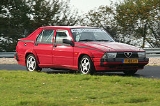
The Alfa Romeo 75, sold in North America
North America
North America is a continent wholly within the Northern Hemisphere and almost wholly within the Western Hemisphere. It is also considered a northern subcontinent of the Americas...

 as the Milano, was a compact
Compact car
A compact car , or small family car , is a classification of cars which are larger than a supermini but smaller than or equal to a mid-size car...

 sports saloon
Sports sedan
A sports sedan or a sports saloon is a descriptive term applied to a sedan automobile that is designed to look and feel "sporty", offering the motorist more connection with the driving experience, while providing the comfort and amenities expected of a luxury sedan. A wider definition that includes...

 / compact executive car
Compact executive car
Compact executive car is a car classification term applied to premium cars smaller than executive cars. In European classification, compact executive cars are part of the D-segment. In North American terms, close equivalents are compact premium car, compact luxury car, entry-level luxury car and...

 produced by the Italian
Italy
Italy , officially the Italian Republic languages]] under the European Charter for Regional or Minority Languages. In each of these, Italy's official name is as follows:;;;;;;;;), is a unitary parliamentary republic in South-Central Europe. To the north it borders France, Switzerland, Austria and...

 automaker Alfa Romeo
Alfa Romeo
Alfa Romeo Automobiles S.p.A. is an Italian manufacturer of cars. Founded as A.L.F.A. on June 24, 1910, in Milan, the company has been involved in car racing since 1911, and has a reputation for building expensive sports cars...

 between 1985 and 1992. The 75 was commercially quite successful; in just three years, 236,907 cars were produced and by the end of production in 1992, around 386,767 had been built.
Discussion
Ask a question about 'Alfa Romeo 75'
Start a new discussion about 'Alfa Romeo 75'
Answer questions from other users
Full Discussion Forum
 
Unanswered Questions
Encyclopedia
The Alfa Romeo 75, sold in North America
North America
North America is a continent wholly within the Northern Hemisphere and almost wholly within the Western Hemisphere. It is also considered a northern subcontinent of the Americas...

 as the Milano, was a compact
Compact car
A compact car , or small family car , is a classification of cars which are larger than a supermini but smaller than or equal to a mid-size car...

 sports saloon
Sports sedan
A sports sedan or a sports saloon is a descriptive term applied to a sedan automobile that is designed to look and feel "sporty", offering the motorist more connection with the driving experience, while providing the comfort and amenities expected of a luxury sedan. A wider definition that includes...

 / compact executive car
Compact executive car
Compact executive car is a car classification term applied to premium cars smaller than executive cars. In European classification, compact executive cars are part of the D-segment. In North American terms, close equivalents are compact premium car, compact luxury car, entry-level luxury car and...

 produced by the Italian
Italy
Italy , officially the Italian Republic languages]] under the European Charter for Regional or Minority Languages. In each of these, Italy's official name is as follows:;;;;;;;;), is a unitary parliamentary republic in South-Central Europe. To the north it borders France, Switzerland, Austria and...

 automaker Alfa Romeo
Alfa Romeo
Alfa Romeo Automobiles S.p.A. is an Italian manufacturer of cars. Founded as A.L.F.A. on June 24, 1910, in Milan, the company has been involved in car racing since 1911, and has a reputation for building expensive sports cars...

 between 1985 and 1992. The 75 was commercially quite successful; in just three years, 236,907 cars were produced and by the end of production in 1992, around 386,767 had been built.

The Alfa Romeo 75 was the last model that the manufacturer developed before being acquired by Fiat.

Overview


The 75 was introduced in May 1985 to replace the Giulietta
Alfa Romeo Giulietta (nuova)
The Alfa Romeo Giulietta is an automobile manufactured by the Italian car maker Alfa Romeo. The car was introduced in November 1977 and while it took its name from the original Giulietta of 1954 to 1965, it was a new design based on the Alfa Romeo Alfetta chassis .-History:At the beginning, two...

 (with which it shared many components), and was named to celebrate Alfa's 75th year of production. The body, designed by head of Alfa Romeo Centro Stile Ermanno Cressoni
Ermanno Cressoni
Ermanno Cressoni was an Italian car designer who worked for both Alfa Romeo and Fiat during his career. He designed or directed the design of a number of significant cars such as the Alfa Romeo 75 and the Fiat Coupe. He was often referrered to as 'Arch'...

, was styled in a striking wedge shape, tapering at the front with square headlights and a matching grille (similar features were applied to the Cressoni-designed 33).

At the 1986 Turin
Turin
Turin is a city and major business and cultural centre in northern Italy, capital of the Piedmont region, located mainly on the left bank of the Po River and surrounded by the Alpine arch. The population of the city proper is 909,193 while the population of the urban area is estimated by Eurostat...

 Auto Salon, a prototype 75 estate was to be seen, an attractive forerunner of the later 156 Sportwagon. This version was, however, never listed for sale, being cancelled after Fiat
Fiat
FIAT, an acronym for Fabbrica Italiana Automobili Torino , is an Italian automobile manufacturer, engine manufacturer, financial, and industrial group based in Turin in the Italian region of Piedmont. Fiat was founded in 1899 by a group of investors including Giovanni Agnelli...

 took control of Alfa Romeo. The car, dubbed the 75 Turbo Wagon, was made by Italian coachbuilder Rayton Fissore using a 75 Turbo as the basis. Two estate versions were to be found at the later 1987 Geneva
Geneva
Geneva In the national languages of Switzerland the city is known as Genf , Ginevra and Genevra is the second-most-populous city in Switzerland and is the most populous city of Romandie, the French-speaking part of Switzerland...

 Motor Show; one was this Turbo Wagon and the other was a 2.0 litre version named the Sportwagon.

Technical features


The 75 featured some unusual technical features, most notably the fact that it was almost perfectly balanced from front to rear. This was achieved by using transaxle
Transaxle
In the automotive field, a transaxle is a major mechanical component that combines the functionality of the transmission, the differential, and associated components of the driven axle into one integrated assembly....

 schema — mounting the standard five-speed gearbox in the rear connected to the rear differential (rear-wheel drive). The front suspension was a torsion bar and shock absorber combination and the rear an expensive de Dion tube
De Dion tube
A de Dion tube is an automobile suspension technology. It is a sophisticated form of non-independent suspension and is a considerable improvement over the alternative swing axle and Hotchkiss drive types. A de Dion suspension uses universal joints at both the wheel hubs and differential, and uses a...

 assembled with shock absorbers; these designs were intended to optimize the car's handling; moreover the rear brake discs were fitted at the centre of the rear axle, near the gearbox-differential group. The engine crankshaft
Crankshaft
The crankshaft, sometimes casually abbreviated to crank, is the part of an engine which translates reciprocating linear piston motion into rotation...

 was bolted directly to the two-segment driveshaft
Driveshaft
A drive shaft, driveshaft, driving shaft, propeller shaft, or Cardan shaft is a mechanical component for transmitting torque and rotation, usually used to connect other components of a drive train that cannot be connected directly because of distance or the need to allow for relative movement...

 which ran the length of the underside from the engine block to the gearbox, and rotated at the speed of the engine. The shaft segments were joined with elastomeric 'doughnuts' to prevent vibration and engine/gearbox damage. The 2.0 L Twin Spark and the 3.0 Litre V6 were equipped with limited slip differential
Limited slip differential
A limited slip differential is a type of differential gear arrangement that allows for some difference in angular velocity of the output shafts, but imposes a mechanical bound on the disparity...

.

The 75 featured a then advanced dashboard-mounted diagnostic computer, called Alfa Romeo Control, capable of monitoring the engine systems and alerting the drivers of potential faults.

The 75 engine range at launch featured four-cylinder 1.6, 1.8 and 2.0 litre petrol carbureted engines, a 2.0 litre intercooled turbodiesel
Turbodiesel
Turbodiesel refers to any diesel engine with a turbocharger. Turbocharging is the norm rather than the exception in modern car and truck diesel engines...

 made by VM Motori
VM Motori
VM Motori S.p.A. is a diesel engine manufacturing company in Cento, Italy, in Emilia-Romagna, an Italian region which is also home to Ferrari, Lamborghini, Maserati and Ducati.- History :...

, and a 2.5 litre fuel injected V6. In 1986 was introduced 75 Turbo, which featured fuel injected 1779 cc twin cam engine using Garrett
Garrett AiResearch
Garrett AiResearch was a manufacturer of turboprop engines and turbochargers, and a pioneer in numerous aerospace technologies. It was previously known as Aircraft Tool and Supply Company, Garrett Supply Company, AiResearch Manufacturing Company, or simply AiResearch...

 T3 turbocharger
Turbocharger
A turbocharger, or turbo , from the Greek "τύρβη" is a centrifugal compressor powered by a turbine that is driven by an engine's exhaust gases. Its benefit lies with the compressor increasing the mass of air entering the engine , thereby resulting in greater performance...

, intercooler
Intercooler
An intercooler , or charge air cooler, is an air-to-air or air-to-liquid heat exchange device used on turbocharged and supercharged internal combustion engines to improve their volumetric efficiency by increasing intake air charge density through nearly isobaric cooling, which removes...

 and oil cooler.

In 1987, a 3.0 litre V6 was added to the range and the 2.0 L Alfa Romeo Twin Cam engine
Alfa Romeo Twin Cam engine
The all alloy Alfa Romeo Twin Cam engine series was an inline-4 cylinder engine produced by Alfa Romeo from 1954 to 1994. For earlier Alfa Romeo engines featuring twin camshafts, refer to the main Alfa Romeo page...

 was redesigned to have now two spark plug
Spark plug
A spark plug is an electrical device that fits into the cylinder head of some internal combustion engines and ignites compressed fuels such as aerosol, gasoline, ethanol, and liquefied petroleum gas by means of an electric spark.Spark plugs have an insulated central electrode which is connected by...

s per cylinder, the engine was named as Twin Spark
Alfa Romeo Twin Spark engine
Alfa Romeo Twin Spark technology was used first time in Alfa Romeo Grand Prix car in 1914. In the early 1960s it was used in their race cars to enable it to achieve a higher power output from its engines...

. With fuel injection and variable valve timing
Variable valve timing
In internal combustion engines, variable valve timing , also known as Variable valve actuation , is a generalized term used to describe any mechanism or method that can alter the shape or timing of a valve lift event within an internal combustion engine...

 this engine produced 148 PS. This engine arguably founded modern engines of today as it was the first production engine to use variable valve timing. In North America, where the car was known as the Milano, only the 2.5 and 3.0 V6s were available, from 1987 to 1989.

The USA-2.5-litres were fundamentally different from their European counterparts. Due to USA regulations, some modifications were required. Most noticeable from the outside were the 'America' bumpers, with the typical rubber accordions in them. Furthermore, these bumpers had thick (and heavy) shock-absorbing material inside them and in addition, they were mounted to the vehicle on shock absorbers. To accommodate these shock absorbers, the 'America'-bodies were slightly different from the European ones. Other changes relative to the European model were:
  • A 67-litre fuel tank which was located behind the rear seats, reducing the boot capacity from 500 l (17.7 cu ft) to 300 l (10.6 cu ft).
  • Side-markers in the bumpers
  • Exhaust silencer sticking out from under the bumper at the r/h side of the vehicle instead of the centre
  • Reinforcements in the doors and boot lid
  • Hooks underneath the bonnet, to keep the bonnet in position in a crash

The USA-cars also had different equipment levels (depending on the version: Milano Silver, Milano Gold or Milano Platinum). L/h and r/h electrically adjustable outside mirrors, electrically reclining seats and cruise control were usually optional in Europe. The car was also available with a 3-speed ZF automatic gearbox option for the 2.5 V6. Other, more common options such as electrically operated rear windows and an A/C system were standard in the USA. The USA-cars also had different upholstery styles and of course different dashboard panels also indicating speed in mph, oil pressure in psi and coolant temperature in degrees F, and as a final touch the AR control was different, including a seat belt warning light.

The European-spec 2.5 V6 (2.5 6V Iniezione or 2.5QV) was officially sold only between 1985 and 1987, although some of them were not registered until 1989. Relatively few of them were sold (about 2800 units), especially when the 155 PS 1.8 Turbo got launched, which in some countries was cheaper in taxes because of its lower displacement. To create a bigger space between the V6 and the inline fours, the 2.5 was bored out to 2959 cc's to deliver 188 PS and this new engine was introduced as the 3.0 America in 1987. As its type designation suggests, the 3.0 only came in the US-specification, with the impact-bumpers and in-boot fuel tank. However, the European 'America's' were not equipped with side-markers or the door, bonnet and boot lid fortifications. Depending on the country of delivery, the 3.0 America could be equipped with a catalytic converter.

In 1988 engines were updated again, the 1.8 L carburetor
Carburetor
A carburetor , carburettor, or carburetter is a device that blends air and fuel for an internal combustion engine. It is sometimes shortened to carb in North America and the United Kingdom....

 version was replaced with fuel injected 1.8 i.e and new bigger diesel engine was added to the range. In the end of 1989 the 1.6 L carburetor version was updated to have fuel injection and 1990 the 1.8 L turbo and 3.0i V6 got some more power and updated suspension. The 3.0 V6 was now equipped with a Motronic system instead of an L-Jetronic. The 1.8L turbo was now also available in 'America'-spec, but strangely enough not available for the USA market. The 3.0 V6 did make it to the United States, and was sold as Milano Verde.

Turbo Evoluzione


500 examples of the Turbo Evoluzione were produced in spring 1987 to meet Group A requirements. The car had many modifications compared to the normal
turbo model. The engine was 1762 cc (normal 1779 cc) and claimed power was the same as in the standard turbo, but the engine is better suited for power upgrades than the standard 75 Turbo engine.

Engines

  • Launch, May 1985
    • 1.6 (1570 cc) Carb with 110 PS @ 5800 rpm and 146 N·m (108 ft·lbf) @ 4000 rpm
    • 1.8 (1779 cc) Carb with 120 PS @ 5300 rpm and 170 N·m (125 ft·lbf) @ 4000 rpm
    • 2.0 (1962 cc) Carb with 128 PS @ 5400 rpm and 183 N·m (135 ft·lbf) @ 4000 rpm
    • 2.0 (1995 cc) TD with 95 PS @ 4300 rpm and 192 N·m (142 ft·lbf) @ 2300 rpm (left hand drive markets only).
    • 2.5 (2492 cc) Injected V6 with 156 PS @ 5600 rpm and 206 N·m (152 ft·lbf) @ 3200 rpm
  • 1986
    • 1.8 (1779 cc) Injected Turbo 155 PS @ 5,800 rpm and 226 N·m (167 ft·lbf) @ 2600 rpm
  • 1987
    • 2.0 (1962 cc) TS
      Alfa Romeo Twin Spark engine
      Alfa Romeo Twin Spark technology was used first time in Alfa Romeo Grand Prix car in 1914. In the early 1960s it was used in their race cars to enable it to achieve a higher power output from its engines...

      with 148 PS @ 5800 rpm and 186 N·m (137 ft·lbf) @ 4000 rpm (upgrade of existing 2.0 engine)
    • 3.0 (2959 cc) V6
      Alfa Romeo V6 engine
      Alfa Romeos in-house V6 engine design made its initial début in 1979 in the Alfa 6. Introduced in 2.5 L guise, production engines would eventually range from 2.0 L to 3.2 L displacement. With modifications it is possible to increase engine displacement to...

      with 188 PS @ 5800 rpm and 250 N·m (184 ft·lbf) @ 3000 rpm ('Milano' in US markets only)
  • 1988
    • 1.6 catalytic with 105 PS @ 6000 rpm
    • 1.8 i.e with 122 PS @ 5500 rpm and 157 N·m (116 ft·lbf) @ 4000 rpm (replacing existing 1.8)
    • 2.4 (2393 cc) TD with 112 PS @ 4200 rpm and 235 N·m (173 ft·lbf) @ 2400 rpm
    • 3.0 V6 AMERICA catalytic with 188 PS @ 5800 rpm and 250 N·m (184 ft·lbf) @ 3000 rpm (Europe market only)
  • 1990
    • 1.6 i.e with 107 PS @ 6000 rpm and 137 N·m (101 ft·lbf) @ 4000 rpm
    • 1.8 Turbo Quadrifoglio Verde with 165 PS @ 5800 rpm
    • 2.0 TS catalytic with 148 PS @ 5800 rpm (replacing existing 2.0)
    • 3.0 V6 QV @ 192 PS @ 5800 rpm and 250 N·m (184 ft·lbf) @ 3000 rpm (replacing existing 3.0, the motor from the 164 featuring a Motronic system as opposed to the earlier 3.0 V6-es which were equipped with the L-Jetronic. This model was known as the "Potenziata")

Motorsports


Alfa Romeo and its racing department Alfa Corse
Alfa Corse
Alfa Corse is the name of Alfa Romeo's factory racing team. Throughout the years, Alfa Corse has competed in various forms of motorsport, from Grand Prix motor racing to touring car racing....

 raced the 75 Turbo Group A in the World Touring Car Championship
World Touring Car Championship
For the video game, known as World Touring Car Championship in Japan, see TOCA World Touring CarsThe FIA World Touring Car Championship is an international Touring Car championship sanctioned by the FIA.-History:...

 in 1987 season
1987 World Touring Car Championship season
The 1987 World Touring Car Championship season was the inaugural World Touring Car Championship season. It commenced on March 22, 1987 and ended on November 15 after eleven races. The championship was open to Touring Cars complying with FIA Group A regulations.-Drivers and teams:Fifteen registered...

. Team
drivers included such names as Nicola Larini
Nicola Larini
Nicola Larini is a racing driver from Italy. He participated in 75 Formula One Grands Prix, debuting on September 6, 1987. He finished second in the tragic 1994 San Marino Grand Prix on a substitute outing for Ferrari, but only scored points once more in his career...

, Gabriele Tarquini
Gabriele Tarquini
Gabriele Tarquini is a racing driver from Italy. He participated in 78 Formula One Grands Prix, debuting on May 3, 1987. He scored 1 championship point, and holds the record for the most failed attempts to qualify...

, Sandro Nannini, Jacques Laffite
Jacques Laffite
Jacques-Henri Laffite is a French former racing driver who competed in Formula One from to . He achieved six grand prix wins, all while driving for the Ligier team. He is now a TV commentator on French television TF1....

 and Mario Andretti
Mario Andretti
Mario Gabriele Andretti is a retired Italian American world champion racing driver, one of the most successful Americans in the history of the sport. He is one of only two drivers to win races in Formula One, IndyCar, World Sportscar Championship and NASCAR...

. With no success and the whole season being a farce Alfa Romeo left the series before the overseas races.

Gianfranco Brancatelli
Gianfranco Brancatelli is a former racing driver from Italy. His racing career began in 1973, in the Formula Abarth series. In 1975, he advanced to Italian Formula 3 racing...

 won the 1988 ITC serie with Alfa 75 Turbo and Giorgio Francia
Giorgio Francia
Giorgio Francia is a former racing driver from Italy. He was the German Formula Three champion in 1974.Francia unsuccessfully entered two Formula One Grands Prix. The first was in a works Brabham BT45B, in Martini Racing colours, at the 1977 Italian Grand Prix. He was withdrawn during practice...

 placed second in the 1991 ITC. The 9th Giro d'Italia in 1988 was won by the team of Miki Biasion, Tiziano Siviero and Riccardo Patrese
Riccardo Patrese
Riccardo Gabriele Patrese is an Italian former racing driver, who raced in Formula One from to .He became the first Formula One driver to achieve 200 Grand Prix starts when he appeared at the 1990 British Grand Prix, and the first to achieve 250 starts at the 1993 German Grand Prix...

with a 75 Turbo Evoluzione IMSA.

External links