
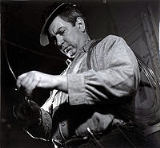
Alexander Calder was an American
sculptorSculpture is three-dimensional artwork created by shaping or combining hard materials—typically stone such as marble—or metal, glass, or wood. Softer materials can also be used, such as clay, textiles, plastics, polymers and softer metals...
and artist most famous for inventing
mobile sculpturesA mobile is a type of kinetic sculpture constructed to take advantage of the principle of equilibrium. It consists of a number of rods, from which weighted objects or further rods hang. The objects hanging from the rods balance each other, so that the rods remain more or less horizontal...
. In addition to mobile and stable sculpture, Alexander Calder also created paintings,
lithographsLithography is a method for printing using a stone or a metal plate with a completely smooth surface...
, toys,
tapestryTapestry is a form of textile art, traditionally woven on a vertical loom, however it can also be woven on a floor loom as well. It is composed of two sets of interlaced threads, those running parallel to the length and those parallel to the width ; the warp threads are set up under tension on a...
, jewelry and household objects.
Childhood
Alexander "Sandy" Calder was born in
LawntonLawnton is a census-designated place in Swatara Township, Dauphin County, Pennsylvania, United States. The population was 3,787 at the 2000 census...
, Pennsylvania, on July 22, 1898. His father,
Alexander Stirling CalderAlexander Stirling Calder was an American sculptor and teacher; son of the sculptor Alexander Milne Calder, and father of the sculptor Alexander Calder...
, was a well-known sculptor who created many public installations, a majority of them in Philadelphia. Calder’s grandfather, sculptor
Alexander Milne CalderAlexander Milne Calder was an American sculptor best known for the architectural sculpture of Philadelphia City Hall. Both his son, Alexander Stirling Calder, and grandson, Alexander "Sandy" Calder, were to become significant sculptors in the 20th century.-Biography:Alexander Milne Calder was...
, was born in Scotland and immigrated to Philadelphia in 1868. He is best known for the colossal statue of
William PennWilliam Penn was an English real estate entrepreneur, philosopher, and founder of the Province of Pennsylvania, the English North American colony and the future Commonwealth of Pennsylvania. He was an early champion of democracy and religious freedom, notable for his good relations and successful...
on top of Philadelphia's City Hall tower. Calder’s mother, Nanette Lederer Calder, was a professional portrait painter who studied at the
Académie JulianThe Académie Julian was an art school in Paris, France.Rodolphe Julian established the Académie Julian in 1868 at the Passage des Panoramas, as a private studio school for art students. The Académie Julian not only prepared students to the exams at the prestigious École des Beaux-Arts, but offered...
and the
SorbonneThe Sorbonne is an edifice of the Latin Quarter, in Paris, France, which has been the historical house of the former University of Paris...
in Paris from around 1888 until 1893. She then moved to Philadelphia where she met Alexander Stirling Calder while studying at the
Pennsylvania Academy of the Fine ArtsThe Pennsylvania Academy of the Fine Arts is a museum and art school in Philadelphia, Pennsylvania. It was founded in 1805 and is the oldest art museum and school in the United States. The academy's museum is internationally known for its collections of 19th and 20th century American paintings,...
. Calder’s parents were married on 22 February 1895. His sister, Margaret "Peggy" Calder, was born in 1896. Her married name was Margaret Calder Hayes, and she was instrumental in the development of the UC Berkeley Art Museum.
In 1902, Calder posed nude for his father’s sculpture
The Man Cub, which is now located in the
Metropolitan Museum of ArtThe Metropolitan Museum of Art is a renowned art museum in New York City. Its permanent collection contains more than two million works, divided into nineteen curatorial departments. The main building, located on the eastern edge of Central Park along Manhattan's Museum Mile, is one of the...
in New York City. That year, he completed his earliest sculpture, a clay elephant.
Three years later, Stirling Calder contracted
tuberculosisTuberculosis, MTB, or TB is a common, and in many cases lethal, infectious disease caused by various strains of mycobacteria, usually Mycobacterium tuberculosis. Tuberculosis usually attacks the lungs but can also affect other parts of the body...
and Calder’s parents moved to a ranch in
Oracle, Arizona- Geology :Oracle and the surrounding area sit largely on a slab of granite called "Oracle granite" that is visible as red or grey-and-white speckled "boulders" rising over the scrub and grass. It is mostly porphyritic biotite Precambrian granite with large microcline phenocrysts, and has...
, leaving the children in the care of family friends for a year. The children were reunited with their parents in late March 1906 and stayed at the ranch in Arizona until fall of the same year.
After Arizona, the Calder family moved to
PasadenaPasadena is a city in Los Angeles County, California, United States. Although famous for hosting the annual Rose Bowl football game and Tournament of Roses Parade, Pasadena is the home to many scientific and cultural institutions, including the California Institute of Technology , the Jet...
, California. The windowed cellar of the family home became Calder's first studio and he received his first set of tools. He used scraps of copper wire that he found in the streets to make jewelry and beads for his sister’s dolls. On January 1, 1907, Calder’s mother took him to the
Tournament of Roses ParadeThe Tournament of Roses Parade, better known as the Rose Parade, is "America's New Year Celebration", a festival of flower-covered floats, marching bands, equestrians and a college football game on New Year's Day , produced by the non-profit Pasadena Tournament of Roses Association.The annual...
in Pasadena, where he observed a four-horse-chariot race. This style of event later became the finale of Calder’s wire circus shows.
In 1909, when Calder was in the fourth grade, he sculpted a dog and a duck out of sheet brass as Christmas gifts for his parents. The sculptures were three dimensional and the duck was kinetic because it rocked when gently tapped. These sculptures are frequently cited as early examples of Calder’s skill.
In 1910, the Calder family moved back to Philadelphia, where Alexander briefly attended the
Germantown AcademyGermantown Academy is America's oldest nonsectarian day school, founded on December 6, 1759 . Germantown Academy is now a K-12 school in the Philadelphia suburb of Fort Washington, having moved from its original Germantown campus in 1965...
, and then to Croton-on-Hudson in New York State. In Croton, during his early high school years, Calder was befriended by painter
Everett ShinnEverett Shinn was an American realist painter and member of the Ashcan School, also known as 'the Eight.' He was the youngest member of the group of modernist painters who explored the depiction of real life...
with whom he built a gravity powered system of mechanical trains. Calder described
We ran the train on wooden rails held by spikes; a chunk of iron racing down the incline speeded the cars. We even lit up some cars with candle lights.
After Croton, the Calders moved to
Spuyten DuyvilSpuyten Duyvil is the name of a subsection of the Riverdale section of the Bronx in New York City. The area is named after Spuyten Duyvil Creek, a Dutch name with various historical spellings and meanings, the most plausible of which is "Spinning Devil", "Devil's Whirlpool", or "Devil's Spate"...
to be closer to the
Tenth Street Studio BuildingThe Tenth Street Studio Building, constructed in New York City in 1857, was the first modern facility designed solely to serve the needs of artists...
in New York City, where Stirling Calder rented a studio. While living in Spuyten Duyvil, Calder attended
Yonkers HighYonkers Public Schools is a school district that serves all of Yonkers, New York, USA. It is governed by a mayorally appointed Board of Trustees.-Organization:...
.
In 1912, Stirling Calder was appointed acting chief of the Department of Sculpture of the Panama Pacific International Exposition in San Francisco. He began work on sculptures for the exposition that was held in 1915. During Alexander Calder’s high school years between 1912 and 1915, the Calder family moved back and forth between New York and California. In each new location Calder’s parents reserved cellar space as a studio for their son. Toward the end of this period, Calder stayed with friends in California while his parents moved back to New York so that he could graduate from
Lowell High School in San FranciscoLowell High School is a public magnet school in San Francisco, California. The school opened in 1856 as the Union Grammar School and attained its current name in 1896. Lowell moved to its current location in the Merced Manor neighborhood in 1962....
. Calder graduated in the class of 1915.
Life and career
In the summer of 1916, Calder spent five weeks training at the Plattsburg Civilian Military Training Camp. In 1918, he joined the Student’s Army Training Corps, Naval Section, at Stevens and was made guide of the battalion. In 1919, Calder decided to study mechanical engineering and enrolled at the
Stevens Institute of TechnologyStevens Institute of Technology is a technological university located on a campus in Hoboken, New Jersey, USA – founded in 1870 with an 1868 bequest from Edwin A. Stevens. It is known for its engineering, science, and technological management curricula.The institute has produced leading...
in
HobokenHoboken is a city in Hudson County, New Jersey, United States. As of the 2010 United States Census, the city's population was 50,005. The city is part of the New York metropolitan area and contains Hoboken Terminal, a major transportation hub for the region...
, New Jersey. He was a member of the
Delta Tau DeltaDelta Tau Delta is a U.S.-based international secret letter college fraternity. Delta Tau Delta was founded in 1858 at Bethany College, Bethany, Virginia, . It currently has around 125 student chapters nationwide, as well as more than 25 regional alumni groups. Its national community service...
fraternity and excelled in mathematics.
- I learned to talk out of the side of my mouth and have never been quite able to correct it since.
Calder received a degree from Stevens in 1919. For the next several years, he held a variety of engineering jobs, including working as a hydraulics engineer and a draughtsman for the New York Edison Company. In June 1922, Calder found work as a mechanic on the passenger ship
H. F. Alexander. While the ship sailed from San Francisco to New York City, Calder worked on deck off the
Guatemalan CoastGuatemala is a country in Central America bordered by Mexico to the north and west, the Pacific Ocean to the southwest, Belize to the northeast, the Caribbean to the east, and Honduras and El Salvador to the southeast...
and witnessed both the sun rising and the moon setting on opposite horizons. He described in his autobiography "It was early one morning on a calm sea, off
GuatemalaGuatemala is a country in Central America bordered by Mexico to the north and west, the Pacific Ocean to the southwest, Belize to the northeast, the Caribbean to the east, and Honduras and El Salvador to the southeast...
, when over my couch—a coil of rope—I saw the beginning of a fiery red sunrise on one side and the moon looking like a silver coin on the other."
The
H.F. Alexander docked in San Francisco and Calder traveled up to Aberdeen, Washington, where his sister lived with her husband, Kenneth Hayes. Calder took a job as a timekeeper at a logging camp. The mountain scenery inspired him to write home to request paints and brushes. Shortly after this, Calder decided to move back to New York to pursue a career as an artist.
Calder moved to New York and enrolled at the
Art Students' LeagueThe Art Students League of New York is an art school located on West 57th Street in New York City. The League has historically been known for its broad appeal to both amateurs and professional artists, and has maintained for over 130 years a tradition of offering reasonably priced classes on a...
, studying briefly with
Thomas Hart BentonThomas Hart Benton was an American painter and muralist. Along with Grant Wood and John Steuart Curry, he was at the forefront of the Regionalist art movement. His fluid, almost sculpted paintings showed everyday scenes of life in the United States...
and John Sloan, among others. While a student, he worked for the
National Police Gazette where, in 1925, one of his assignments was sketching the Ringling Brothers and Barnum and Bailey Circus. Calder became fascinated with the circus, a theme that would reappear in his later work.
In 1926, Calder moved to Paris where he established a studio at 22 rue Daguerre in the
Montparnasse QuarterMontparnasse is an area of Paris, France, on the left bank of the river Seine, centred at the crossroads of the Boulevard du Montparnasse and the Rue de Rennes, between the Rue de Rennes and boulevard Raspail...
. In June 1929, while traveling by boat from Paris to New York, Calder met his future wife, Louisa James, grandniece of author
Henry JamesHenry James, OM was an American-born writer, regarded as one of the key figures of 19th-century literary realism. He was the son of Henry James, Sr., a clergyman, and the brother of philosopher and psychologist William James and diarist Alice James....
and philosopher
William JamesWilliam James was a pioneering American psychologist and philosopher who was trained as a physician. He wrote influential books on the young science of psychology, educational psychology, psychology of religious experience and mysticism, and on the philosophy of pragmatism...
. They married in 1931. While in Paris, Calder met and became friends with a number of
avant-gardeAvant-garde means "advance guard" or "vanguard". The adjective form is used in English to refer to people or works that are experimental or innovative, particularly with respect to art, culture, and politics....
artists, including
Joan MiróJoan Miró i Ferrà was a Spanish Catalan painter, sculptor, and ceramicist born in Barcelona.Earning international acclaim, his work has been interpreted as Surrealism, a sandbox for the subconscious mind, a re-creation of the childlike, and a manifestation of Catalan pride...
,
Jean ArpJean Arp / Hans Arp was a German-French, or Alsatian, sculptor, painter, poet and abstract artist in other media such as torn and pasted paper....
, and
Marcel DuchampMarcel Duchamp was a French artist whose work is most often associated with the Dadaist and Surrealist movements. Considered by some to be one of the most important artists of the 20th century, Duchamp's output influenced the development of post-World War I Western art...
. Calder and Louisa returned to America in 1933 to settle in a farmhouse they purchased in
Roxbury, ConnecticutRoxbury is a town in Litchfield County, Connecticut, United States. The population was 2,136 at the 2000 census.-History:Roxbury, whose Indian name was "Shepaug", a Mahican name signifiying "rocky water", was settled about the year 1713...
, where they raised a family (first daughter, Sandra born 1935, second daughter, Mary, in 1939).
In 1962, Calder settled into his new workshop
Carroi, which was of a futuristic design and overlooked the valley of the Lower Chevrière to Saché in
Indre-et-LoireIndre-et-Loire is a department in west-central France named after the Indre and the Loire rivers.-History:Indre-et-Loire is one of the original 83 départements created during the French Revolution on 4 March 1790...
(France). He did not hesitate to offer his
gouacheGouache[p], also spelled guache, the name of which derives from the Italian guazzo, water paint, splash or bodycolor is a type of paint consisting of pigment suspended in water. A binding agent, usually gum arabic, is also present, just as in watercolor...
s and small mobiles to his friends in the country, he even donated to the town a
stabile trônant, which since 1974 in situated front of the church: an anti-sculpture free from gravity.
In 1966, Calder published his
Autobiography with Pictures with the help of his son-in-law, Jean Davidson. Calder died on November 11, 1976, shortly after opening a major retrospective show at the
Whitney MuseumThe Whitney Museum of American Art, often referred to simply as "the Whitney", is an art museum with a focus on 20th- and 21st-century American art. Located at 945 Madison Avenue at 75th Street in New York City, the Whitney's permanent collection contains more than 18,000 works in a wide variety of...
in New York. He had been working on a third plane, entitled
Salute to Mexico, when he died.
Artistic work
In 1929, Calder had his first solo show of wire sculpture in Paris at Galerie Billiet. The painter Jules Pascin, a friend of Calder's from the cafes of
MontparnasseMontparnasse is an area of Paris, France, on the left bank of the river Seine, centred at the crossroads of the Boulevard du Montparnasse and the Rue de Rennes, between the Rue de Rennes and boulevard Raspail...
, wrote the preface. A visit to
Piet MondrianPieter Cornelis "Piet" Mondriaan, after 1906 Mondrian , was a Dutch painter.He was an important contributor to the De Stijl art movement and group, which was founded by Theo van Doesburg. He evolved a non-representational form which he termed Neo-Plasticism...
's studio in 1930 "shocked" him into embracing
abstract artAbstract art uses a visual language of form, color and line to create a composition which may exist with a degree of independence from visual references in the world. Western art had been, from the Renaissance up to the middle of the 19th century, underpinned by the logic of perspective and an...
.
Cirque Calder and toys
In 1926, at the suggestion of a
SerbiaSerbia , officially the Republic of Serbia , is a landlocked country located at the crossroads of Central and Southeast Europe, covering the southern part of the Carpathian basin and the central part of the Balkans...
n toy merchant in Paris, Calder began to make toys. At the urging of fellow sculptor
Jose de CreeftJosé De Creeft was a Spanish-born American sculptor and teacher.-Life and work:...
, he submitted them to the Salon des Humoristes. Later that fall, Calder began to create his
Cirque CalderCirque Calder is an artistic rendering of a circus created by the American artist Alexander Calder. It involves wire models rigged to perform the various functions of the circus performers they represent, from contortionists to sword eaters to lion tamers. The models are made of various items,...
, a miniature circus fashioned from wire, string, rubber, cloth, and other found objects. Designed to fit into suitcases (it eventually grew to fill five), the circus was portable, and allowed Calder to hold performances on both sides of the Atlantic. He gave improvised shows, recreating the performance of a real circus. Soon, his "
Cirque CalderCirque Calder is an artistic rendering of a circus created by the American artist Alexander Calder. It involves wire models rigged to perform the various functions of the circus performers they represent, from contortionists to sword eaters to lion tamers. The models are made of various items,...
" (usually on view at the
Whitney Museum of American ArtThe Whitney Museum of American Art, often referred to simply as "the Whitney", is an art museum with a focus on 20th- and 21st-century American art. Located at 945 Madison Avenue at 75th Street in New York City, the Whitney's permanent collection contains more than 18,000 works in a wide variety of...
) became popular with the Parisian avant-garde. In 1927, Calder returned to the United States. He designed several kinetic wooden push and pull toys for children, which were mass-produced by the Gould Manufacturing Company, in Oshkosh, WI. His originals, as well as playable replicas, are on display in the
Berkshire MuseumThe Berkshire Museum is a museum of natural history, art and ancient civilization that is located in Pittsfield, Berkshire County, Massachusetts, United States....
in
PittsfieldPittsfield is the largest city and the county seat of Berkshire County, Massachusetts, United States. It is the principal city of the Pittsfield, Massachusetts Metropolitan Statistical Area which encompasses all of Berkshire County. Its area code is 413. Its ZIP code is 01201...
, Massachusetts. Throughout the 1930s, Calder continued to give Cirque Calder performances but also worked with
Martha GrahamMartha Graham was an American modern dancer and choreographer whose influence on dance has been compared with the influence Picasso had on modern visual arts, Stravinsky had on music, or Frank Lloyd Wright had on architecture.She danced and choreographed for over seventy years...
, designing stage sets for her ballets and created a moving stage construction to accompany Eric Satie's
SocrateSocrate is a work for voice and piano by Erik Satie. First published in 1919 for voice and piano, in 1920 a different publisher reissued the piece "revised and corrected". A third version of the work exists, for small orchestra and voice, for which the manuscript has disappeared and which is...
in 1936.
Sculpture
The Cirque Calder can be seen as the start of Calder's interest in both
wire sculptureWire sculpture refers to the creation of sculpture or jewelry out of wire. The medium was experimented with by Alexander Calder....
and
kinetic artKinetic art is art that contains moving parts or depends on motion for its effect. The moving parts are generally powered by wind, a motor or the observer. Kinetic art encompasses a wide variety of overlapping techniques and styles.-Kinetic sculpture:...
. He maintained a sharp eye with respect to the engineering balance of the sculptures and utilized these to develop the kinetic sculptures Duchamp would ultimately dub as "
mobilesA mobile is a type of kinetic sculpture constructed to take advantage of the principle of equilibrium. It consists of a number of rods, from which weighted objects or further rods hang. The objects hanging from the rods balance each other, so that the rods remain more or less horizontal...
," a French pun meaning both "mobile" and "motive." He designed some of the characters in the circus to perform suspended from a thread. However, it was the mixture of his experiments to develop purely abstract sculpture following his visit with
MondrianPieter Cornelis "Piet" Mondriaan, after 1906 Mondrian , was a Dutch painter.He was an important contributor to the De Stijl art movement and group, which was founded by Theo van Doesburg. He evolved a non-representational form which he termed Neo-Plasticism...
in 1930 that lead to his first truly kinetic sculptures, manipulated by means of cranks and pulleys, that would become signature artworks. Calder’s kinetic sculptures are regarded as being amongst the earliest manifestations of an art that consciously departed from the traditional notion of the art work as a static object and integrated the ideas of motion and change as aesthetic factors.
By the end of 1931, he moved on to more delicate sculptures which derived their motion from the air currents in the room, using cutout shapes reminiscent of natural forms (birds, fish, falling leaves). Dating from 1932, Calder’s first hanging sculptures of discrete movable parts powered by the wind were christened “mobiles” by Marcel Duchamp. They were followed from 1934 by pieces which were set in motion by air currents. At the same time, Calder was also experimenting with self-supporting, static, abstract sculptures, dubbed "stabiles" by Arp in 1932 to differentiate them from mobiles. In 1935-1936 he produced a number of works made largely of carved wood.
The small metal maquette -- the first step in the production of a monumental sculpture -- was already for Calder a sculpture in its own right. During World War II, Calder attempted to join the
MarinesThe United States Marine Corps is a branch of the United States Armed Forces responsible for providing power projection from the sea, using the mobility of the United States Navy to deliver combined-arms task forces rapidly. It is one of seven uniformed services of the United States...
as a camofleur, but was rejected. Instead, he continued to sculpt, but a scarcity of metal led to him again producing work in
carved woodWood carving is a form of working wood by means of a cutting tool in one hand or a chisel by two hands or with one hand on a chisel and one hand on a mallet, resulting in a wooden figure or figurine, or in the sculptural ornamentation of a wooden object...
. Once the war was over, Calder began to cut shapes from sheet metal into evocative forms and would hand-paint them in his
characteristicallyIn art, signature artwork refers to works by popular and well-established artists that are easily recognized as theirs because of unique characteristics in style, medium, or subject matter. A parallel to the recognition of a person's signature on a work is drawn indicating that the work itself may...
pure hues of black, red, blue, and white.
In 1951, Calder devised a new kind of mobile/stabile combination, related structurally to his constellations. These "towers," affixed to the wall with a nail, consist of wire struts and beams that jut out from the wall, with moving objects suspended from their armatures. After 1965, an intermediate maquette, usually about one-fifth the final size, was often fabricated to test the wind resistance and to refine the structure.
Monumental works
In the 1930s the
Berkshire MuseumThe Berkshire Museum is a museum of natural history, art and ancient civilization that is located in Pittsfield, Berkshire County, Massachusetts, United States....
gave Calder his first public commission, a pair of mobiles designed for the Museum's new theater. In the 1950s, Calder increasingly concentrated his efforts on producing monumental sculptures. Notable examples are
.125 for JFK Airport in 1957,
La Spirale for
UNESCOThe United Nations Educational, Scientific and Cultural Organization is a specialized agency of the United Nations...
in Paris 1958 and
Man (L'Homme), commissioned for
Expo 67The 1967 International and Universal Exposition or Expo 67, as it was commonly known, was the general exhibition, Category One World's Fair held in Montreal, Quebec, Canada, from April 27 to October 29, 1967. It is considered to be the most successful World's Fair of the 20th century, with the...
in Montreal. Calder's largest sculpture until that time, 20.5 meters high, was "El Sol Rojo," constructed outside the Aztec Stadium for the
1968 Summer OlympicsThe 1968 Summer Olympics, officially known as the Games of the XIX Olympiad, were an international multi-sport event held in Mexico City, Mexico in October 1968. The 1968 Games were the first Olympic Games hosted by a developing country, and the first Games hosted by a Spanish-speaking country...
in Mexico City.
The stabiles and mobiles were manufactured at factory Biémont Tours (France), including "the Man," a stainless steel 24 meters tall, commissioned by Canada's International Nickel (Inco) for the Exposition Universelle de Montréal in 1967. All products were made from a Calder-made model, by the research department (headed by M. Porcheron, with Alain Roy, François Lopez, Michel Juigner ...) to design to scale, then by workers who were qualified boilermakers for the actual manufacturing. Calder oversaw all operations, and if necessary made changes to the final product. All stabiles were manufactured in carbon steel, then painted for a major part in black, except "the Man" who was raw
stainless steelIn metallurgy, stainless steel, also known as inox steel or inox from French "inoxydable", is defined as a steel alloy with a minimum of 10.5 or 11% chromium content by mass....
, the mobiles were made of aluminum and made of
duraluminDuralumin is the trade name of one of the earliest types of age-hardenable aluminium alloys. The main alloying constituents are copper, manganese, and magnesium. A commonly used modern equivalent of this alloy type is AA2024, which contains 4.4% copper, 1.5% magnesium, 0.6% manganese and 93.5%...
.
He made most of his monumental sculpture during this time at Etablissements Biémont in Tours, France. Calder would create a model of the work, the research department would scale it to final size, then experienced boilermakers would complete the actual metalwork — all under Calder's watchful eye. Stabiles were made in carbon steel; mobiles were mostly aluminum.
In June 1969, Calder attended the dedication of his monumental stabile
“La Grande VitesseLa Grande Vitesse, a public sculpture by American artist Alexander Calder, is located on the large concrete plaza surrounding City Hall and the Kent County Building in Grand Rapids, Michigan, United States. The sculpture was the first public art work funded by the Art in Public Places program of...
” in
Grand RapidsGrand Rapids is a city in the U.S. state of Michigan. The city is located on the Grand River about 40 miles east of Lake Michigan. As of the 2010 census, the city population was 188,040. In 2010, the Grand Rapids metropolitan area had a population of 774,160 and a combined statistical area, Grand...
, Michigan. This sculpture is notable for being the first public work of art in the United States to be funded with federal monies; acquired with funds granted from the then new
National Endowment for the ArtsThe National Endowment for the Arts is an independent agency of the United States federal government that offers support and funding for projects exhibiting artistic excellence. It was created by an act of the U.S. Congress in 1965 as an independent agency of the federal government. Its current...
under its “Art for Public Places” program.
Calder created a sculpture called
WTC Stabile (also known as
Bent Propeller), which in 1971 was installed at the entrance of the
World Trade CenterThe original World Trade Center was a complex with seven buildings featuring landmark twin towers in Lower Manhattan, New York City, United States. The complex opened on April 4, 1973, and was destroyed in 2001 during the September 11 attacks. The site is currently being rebuilt with five new...
's North Tower. When Battery Park City opened, the sculpture was moved to Vesey and Church Streets. It stood in front of
7 World Trade Center7 World Trade Center is a building in New York City located across from the World Trade Center site in Lower Manhattan. It is the second building to bear that name and address in that location. The original structure was completed in 1987 and was destroyed in the September 11 attacks...
when it was destroyed on September 11, 2001.
In 1974 Calder unveiled to the public two sculptures,
FlamingoFlamingo, created by noted American artist Alexander Calder, is a 53 foot tall stabile located in the Federal Plaza in front of the Kluczynski Federal Building in Chicago, Illinois, United States...
and
Universe, in Chicago, Illinois. The exhibition
Alexander Calder: A Retrospective Exhibition at the
Museum of Contemporary Art, ChicagoThe Museum of Contemporary Art Chicago is a contemporary art museum near Water Tower Place in downtown Chicago in Cook County, Illinois, United States. The museum, which was established in 1967, is one of the world's largest contemporary art venues...
, opened simultaneously with the unveiling of the sculptures.
Painting and printmaking
In addition to sculptures, Calder painted throughout his career, beginning in the early 1920s. He picked up his study of printmaking after moving to Paris in 1926, and continued to produce illustrations for books and journals. His many projects from this period include pen-and-ink line drawings of animals for a 1931 publication of
AesopAesop was a Greek writer credited with a number of popular fables. Older spellings of his name have included Esop and Isope. Although his existence remains uncertain and no writings by him survive, numerous tales credited to him were gathered across the centuries and in many languages in a...
’s fables. As Calder’s sculpture moved into the realm of pure abstraction in the mid-1930s, so did his prints. The thin lines used to define figures in the earlier prints and drawings began delineating groups of geometric shapes, often in motion. Calder also used prints for advocacy, as in poster prints from 1967 and 1969 protesting the
Vietnam WarThe Vietnam War was a Cold War-era military conflict that occurred in Vietnam, Laos, and Cambodia from 1 November 1955 to the fall of Saigon on 30 April 1975. This war followed the First Indochina War and was fought between North Vietnam, supported by its communist allies, and the government of...
. As Calder’s professional reputation erupted in the late 1940s and 1950s, so did his production of prints. Masses of lithographs based on his gouache paintings hit the market, and deluxe editions of plays, poems, and short stories illustrated with fine art prints by Calder became available for sale. By 1973,
Braniff International AirwaysBraniff International Airways was an American airline that operated from 1928 until 1982, primarily in the midwestern and southwestern U.S., South America, Panama, and in its later years also Asia and Europe...
commissioned him to paint a full-size
DC-8-62The Douglas DC-8 is a four-engined narrow-body passenger commercial jet airliner, manufactured from 1958 to 1972 by the Douglas Aircraft Company...
as a "flying canvas." In 1975, Calder completed a second plane, this time a
Boeing 727–291The Boeing 727 is a mid-size, narrow-body, three-engine, T-tailed commercial jet airliner, manufactured by Boeing. The Boeing 727 first flew in 1963, and for over a decade more were built per year than any other jet airliner. When production ended in 1984 a total of 1,832 aircraft had been produced...
, as a tribute to the U.S. Bicentennial. In 1975, he was commissioned by
BMWBayerische Motoren Werke AG is a German automobile, motorcycle and engine manufacturing company founded in 1916. It also owns and produces the Mini marque, and is the parent company of Rolls-Royce Motor Cars. BMW produces motorcycles under BMW Motorrad and Husqvarna brands...
to paint a BMW 3.0 CSL which would come to be the first vehicle in the
BMW Art CarThe BMW Art Car Project was introduced by the French racecar driver and auctioneer Hervé Poulain, who wanted to invite an artist to create a canvas on an automobile. It was in 1975, when Poulain commissioned American artist and friend Alexander Calder to paint the first BMW Art Car...
Project.
Jewelery
Calder created 1,800 pieces of jewelry over the course of his career, many of them as gifts for friends and relatives. They were mostly made of brass and steel, with bits of ceramic, wood and glass. Calder rarely used solder; when he needed to join strips of metal, he linked them with loops, bound them with snippets of wire or fashioned rivets. For his lifelong friend
Joan MiróJoan Miró i Ferrà was a Spanish Catalan painter, sculptor, and ceramicist born in Barcelona.Earning international acclaim, his work has been interpreted as Surrealism, a sandbox for the subconscious mind, a re-creation of the childlike, and a manifestation of Catalan pride...
, he set a shard of a broken porcelain vessel in a brass ring.
Peggy GuggenheimMarguerite "Peggy" Guggenheim was an American art collector. Born to a wealthy New York City family, she was the daughter of Benjamin Guggenheim, who went down with the Titanic in 1912 and the niece of Solomon R. Guggenheim, who would establish the Solomon R...
received enormous silver mobile earrings and later commissioned a hammered silver headboard that shimmered with dangling fish. In 1942, Guggenheim wore one Calder earring and one by
Yves TanguyRaymond Georges Yves Tanguy , known as Yves Tanguy, was a French surrealist painter.-Biography:Tanguy was born in Paris, France, the son of a retired navy captain. His parents were both of Breton origin...
to the opening of her New York gallery,
The Art of This Century, to demonstrate her equal loyalty to Surrealist and abstract art, examples of which she displayed in separate galleries. Others who were presented with Calder's pieces were the artist's close friend,
Georgia O'KeeffeGeorgia Totto O'Keeffe was an American artist.Born near Sun Prairie, Wisconsin, O'Keeffe first came to the attention of the New York art community in 1916, several decades before women had gained access to art training in America’s colleges and universities, and before any of its women artists...
;
Alexina DuchampAlexina "Teeny" Duchamp was the second wife of artist and chess player, Marcel Duchamp.-Background:She was born Alexina Sattler in Cincinnati, Ohio in 1906...
, wife of
Marcel DuchampMarcel Duchamp was a French artist whose work is most often associated with the Dadaist and Surrealist movements. Considered by some to be one of the most important artists of the 20th century, Duchamp's output influenced the development of post-World War I Western art...
; Jeanne Rucar, wife of the filmmaker
Luis BuñuelLuis Buñuel Portolés was a Spanish-born filmmaker — later a naturalized citizen of Mexico — who worked in Spain, Mexico, France and the US..-Early years:...
; and
Bella RosenfeldBella Rosenfeld Chagall , was the wife of Marc Chagall and a writer. She was the subject of many of Chagall's paintings including Bella with White Collar in 1917.-Timeline of her biography:...
, wife of
Marc ChagallMarc Chagall Art critic Robert Hughes referred to Chagall as "the quintessential Jewish artist of the twentieth century."According to art historian Michael J...
.
Exhibitions
In 1928, Calder held his first solo show at a commercial gallery at the Weyhe Gallery in New York City. He later exhibited with the Abstraction-Création group in Paris in 1933. In 1935, he had his first solo museum exhibition in the United States at
The Renaissance SocietyThe Renaissance Society is a non-collecting contemporary art museum in Chicago, Illinois. It is located on the campus of the University of Chicago, although it is a fully separate entity.-Overview:...
at the
University of ChicagoThe University of Chicago is a private research university in Chicago, Illinois, USA. It was founded by the American Baptist Education Society with a donation from oil magnate and philanthropist John D. Rockefeller and incorporated in 1890...
. In New York, he was championed from the early 1930s by the
Museum of Modern ArtThe Museum of Modern Art is an art museum in Midtown Manhattan in New York City, on 53rd Street, between Fifth and Sixth Avenues. It has been important in developing and collecting modernist art, and is often identified as the most influential museum of modern art in the world...
, one of three Americans to be included in Alfred H. Barr Jr.'s 1936 exhibition "Cubism and Abstract Art". Calder's first retrospective was held in 1938 at George Walter Vincent Smith Gallery in
Springfield, MassachusettsSpringfield is the most populous city in Western New England, and the seat of Hampden County, Massachusetts, United States. Springfield sits on the eastern bank of the Connecticut River near its confluence with three rivers; the western Westfield River, the eastern Chicopee River, and the eastern...
. In 1943, the
Museum of Modern ArtThe Museum of Modern Art is an art museum in Midtown Manhattan in New York City, on 53rd Street, between Fifth and Sixth Avenues. It has been important in developing and collecting modernist art, and is often identified as the most influential museum of modern art in the world...
hosted a well-received Calder retrospective, curated by
James Johnson SweeneyJames Johnson Sweeney was a curator, and writer about modern art. From 1935 to 1946, he was curator for the Museum of Modern Art. He was the second director of the Solomon R. Guggenheim Museum, from 1952 to 1960...
and
Marcel DuchampMarcel Duchamp was a French artist whose work is most often associated with the Dadaist and Surrealist movements. Considered by some to be one of the most important artists of the 20th century, Duchamp's output influenced the development of post-World War I Western art...
. Calder was one of 250 sculptors who exhibited in the
3rd Sculpture International3rd Sculpture International was an exhibition of sculpture that included works from 250 sculptors from around the world. It was "organized by the Fairmount Park Art Association under the terms of a bequest made to the Association by the late Ellen Phillips Samuel." It was held at the Philadelphia...
held at the
Philadelphia Museum of ArtThe Philadelphia Museum of Art is among the largest art museums in the United States. It is located at the west end of the Benjamin Franklin Parkway in Philadelphia's Fairmount Park. The Museum was established in 1876 in conjunction with the Centennial Exposition of the same year...
in the summer of 1949. His mobile,
International Mobile was the centerpiece of the exhibition.
His work has since been the subject of hundreds of museum exhibitions, including "Alexander Calder",
Louisiana Museum of Modern ArtThe Louisiana Museum of Modern Art is an art museum located directly on the shore of the Øresund Sound in Humlebæk, north of Copenhagen, Denmark. It is the most visited art museum in Denmark with an extensive permanent collection of modern and contemporary art, dating from World War II and up...
, Humlebaek, Denmark, 1995 (traveled to:
Moderna MuseetModerna museet, the Museum of Modern Art, Stockholm, Sweden, is a state museum located on the island of Skeppsholmen in central Stockholm, that was first opened in 1958. Its first manager was Pontus Hultén...
, Stockholm;
Musée d'art moderneMusée d'Art Moderne de la Ville de Paris is the City of Paris Museum of Modern Art dedicated to the arts of the 20th/21st centuries. It is located at 11 Avenue du Président Wilson in the 16th arrondissement of Paris.-Description:...
, Paris, in 1996); “Alexander Calder: 1898-1976,”
National Gallery of ArtThe National Gallery of Art and its Sculpture Garden is a national art museum, located on the National Mall between 3rd and 9th Streets at Constitution Avenue NW, in Washington, DC...
, Washington, D.C., 1998 (traveled to the
San Francisco Museum of Modern ArtThe San Francisco Museum of Modern Art is a modern art museum located in San Francisco, California. A nonprofit organization, SFMOMA holds an internationally recognized collection of modern and contemporary art and was the first museum on the West Coast devoted solely to 20th century art...
); “Calder: Gravity and Grace,”
Guggenheim MuseumGuggenheim Museum may refer to:* The Solomon R. Guggenheim Museum in New York, United States* The Peggy Guggenheim Collection in Venice, Italy* The Guggenheim Museum Bilbao in Spain* The Guggenheim Hermitage Museum in Las Vegas, United States...
, Bilbao, 2003 (traveled to Reina Sofia, Madrid); “The Surreal Calder,”
Menil CollectionThe Menil Collection, located in Houston refers either to a museum that houses the private art collection of founders John de Menil and Dominique de Menil, or to the collection itself...
, Houston, 2005-2006 (traveled to San Francisco Museum of Modern Art;
Minneapolis Institute of ArtsThe Minneapolis Institute of Arts is a fine art museum located in the Whittier neighborhood of Minneapolis, Minnesota, on a campus that covers nearly 8 acres , formerly Morrison Park...
); “Calder Jewelry,”
Norton Museum of ArtThe Norton Museum of Art is an art museum located in West Palm Beach, Florida. Its collection includes over 5,000 works, with a concentration in European, American, and Chinese art as well as in contemporary art and photography.-History:...
, West Palm Beach, 2008 (traveled to
Philadelphia Museum of ArtThe Philadelphia Museum of Art is among the largest art museums in the United States. It is located at the west end of the Benjamin Franklin Parkway in Philadelphia's Fairmount Park. The Museum was established in 1876 in conjunction with the Centennial Exposition of the same year...
; Metropolitan Museum, New York;
Irish Museum of Modern ArtThe Irish Museum of Modern Art also known as IMMA, is Ireland's leading national institution exhibiting and collecting modern and contemporary art. The museum opened in May 1991 and is located in Royal Hospital Kilmainham, a 17th-century building near Heuston Station to the west of Dublin's city...
;
San Diego Museum of ArtThe San Diego Museum of Art is a fine arts museum located in Balboa Park in San Diego, California that houses a broad collection with particular strength in Spanish art. The San Diego Museum of Art opened as The Fine Arts Gallery of San Diego on February 28, 1926, and changed its name to the San...
; Grand Rapids Art Museum); “Alexander Calder: The Paris Years, 1926-1933,”
Whitney Museum of American ArtThe Whitney Museum of American Art, often referred to simply as "the Whitney", is an art museum with a focus on 20th- and 21st-century American art. Located at 945 Madison Avenue at 75th Street in New York City, the Whitney's permanent collection contains more than 18,000 works in a wide variety of...
, New York, 2008 (traveled to the Centre Pompidou, Paris; Art Gallery of Ontario, Toronto); “Calder,” Palazzo delle Esposizioni, Rome, 2009-2010; and “Alexander Calder: A Balancing Act,”
Seattle Art MuseumThe Seattle Art Museum is an art museum located in Seattle, Washington, USA. It maintains three major facilities: its main museum in downtown Seattle; the Seattle Asian Art Museum in Volunteer Park on Capitol Hill, and the Olympic Sculpture Park on the central Seattle waterfront, which opened on...
, 2009-2010. Calder also participated in
documentasdocumenta is an exhibition of modern and contemporary art which takes place every five years in Kassel, Germany. It was founded by artist, teacher and curator Arnold Bode in 1955 as part of the Bundesgartenschau which took place in Kassel at that time...
I (1955), II (1959), III (1964).
Collections
Calder's work is in many permanent collections across the world. The
Whitney Museum of American ArtThe Whitney Museum of American Art, often referred to simply as "the Whitney", is an art museum with a focus on 20th- and 21st-century American art. Located at 945 Madison Avenue at 75th Street in New York City, the Whitney's permanent collection contains more than 18,000 works in a wide variety of...
, New York, has the largest body of work by Alexander Calder in any museum. Other important museum collections include the
Museum of Modern ArtThe Museum of Modern Art is an art museum in Midtown Manhattan in New York City, on 53rd Street, between Fifth and Sixth Avenues. It has been important in developing and collecting modernist art, and is often identified as the most influential museum of modern art in the world...
, New York; the
Centre Georges PompidouCentre Georges Pompidou is a complex in the Beaubourg area of the 4th arrondissement of Paris, near Les Halles, rue Montorgueil and the Marais...
, Paris; the
Museo Nacional Centro de Arte Reina SofíaThe Museo Nacional Centro de Arte Reina Sofía is the official name of Spain's national museum of 20th century art . The museum was officially inaugurated on September 10, 1992 and is named for Queen Sofia of Spain...
, Madrid; and the
National Gallery of ArtThe National Gallery of Art and its Sculpture Garden is a national art museum, located on the National Mall between 3rd and 9th Streets at Constitution Avenue NW, in Washington, DC...
, Washington, D.C.
Recognition
In 1952, Calder represented the United States at the
Venice BiennaleThe Venice Biennale is a major contemporary art exhibition that takes place once every two years in Venice, Italy. The Venice Film Festival is part of it. So too is the Venice Biennale of Architecture, which is held in even years...
and was awarded the main prize for sculpture. He also won the First Prize for Sculpture at the 1958 Pittsburgh International.
Art market
In the late 1930s and early 1940s, even as Calder’s international acclaim was growing, his works were still not highly sought after, and when they sold, it was often for relatively little money. A copy of a
Pierre MatissePierre Matisse was an art dealer active in New York City. He was the youngest child of French painter Henri Matisse.-Background and early years:...
sales ledger in the foundation’s files shows that only a few pieces in the 1941 show found buyers, one of whom,
Solomon R. GuggenheimSolomon Robert Guggenheim was an American businessman, art collector, and philanthropist.-Biography:He was born in Philadelphia, Pennsylvania, son of Meyer Guggenheim and brother of Simon, Benjamin, Daniel and four other siblings.Following studies in Switzerland at the Concordia Institute in...
, paid all of $233.34 — or about $3,500 in today’s money — for a work. (The Museum of Modern Art had bought its first Calder in 1934 for $60, after talking Calder down from $100.) In 2010, his metal mobile
Untitled (Autumn Leaves), sold at Sotheby’s New York for $3.7 million. Another mobile, titled
Red Curlicue (1973), brought $6.35 million at
Christie'sChristie's is an art business and a fine arts auction house.- History :The official company literature states that founder James Christie conducted the first sale in London, England, on 5 December 1766, and the earliest auction catalogue the company retains is from December 1766...
later that year.
Galerie MaeghtThe Galerie Maeght is a gallery of modern art, in Cannes and Paris, France, and Barcelona, Spain.The gallery was founded in 1936 in Cannes. The Paris gallery was started in 1946 by Aimé Maeght. The artists exhibited are mainly from France and Spain....
in Paris became Calder's exclusive Parisian dealer in 1950. His association with Galerie Maeght lasted twenty-six years, until his death. After his New York dealer
Curt ValentinCurt Valentin was a German-born American art dealer known for handling modern art, particularly sculpture, and works classified as "degenerate" by the Nazi regime in pre-war Germany....
died unexpectedly in 1954, Calder selected the
Perls GalleryKlaus Gunther Perls was born in Berlin, Germany, where his parents were art dealers. He studied art history in Munich, but after the Nazis stopped granting degrees to Jews he moved to Basel, Switzerland and completed his studies...
in New York as his new American dealer, and this alliance also lasted until the end of his life.
Legacy
Two months after his death, Calder was posthumously awarded the
Presidential Medal of FreedomThe Presidential Medal of Freedom is an award bestowed by the President of the United States and is—along with thecomparable Congressional Gold Medal bestowed by an act of U.S. Congress—the highest civilian award in the United States...
, the United States' highest civilian honor, by President
Gerald FordGerald Rudolph "Jerry" Ford, Jr. was the 38th President of the United States, serving from 1974 to 1977, and the 40th Vice President of the United States serving from 1973 to 1974...
. However, representatives of the Calder family boycotted the January 10, 1977 ceremony "to make a statement favoring amnesty for
Vietnam WarThe Vietnam War was a Cold War-era military conflict that occurred in Vietnam, Laos, and Cambodia from 1 November 1955 to the fall of Saigon on 30 April 1975. This war followed the First Indochina War and was fought between North Vietnam, supported by its communist allies, and the government of...
draft resisters."
In 1987, the Calder Foundation was founded by Calder's family. The Foundation "runs its own programs, collaborates on exhibitions and publications, and gives advice on matters such as the history, assembly, and restoration of works by Calder." The foundation has large holdings, with some works owned by family members and others by foundation supporters. The art includes about 300 sculptures, 55 monumental outdoor works and more than 3,000 works on paper. The U.S. copyright representative for the Calder Foundation is the
Artists Rights SocietyArtists Rights Society is a copyright, licensing, and monitoring organization for visual artists in the United States. Founded in 1987, ARS represents the intellectual property rights interests of over 50,000 visual artists and estates of visual artists from around the world .- Member Artists &...
.
After similar ideas were developed for New York in 1998, plans for a museum devoted to Calder in Philadelphia were announced in 2000. The proposed 35,000-square-foot Calder museum, designed by Japanese architect
Tadao Andois a Japanese architect whose approach to architecture was once categorized by Francesco Dal Co as critical regionalism. Ando has led a storied life, working as a truck driver and boxer prior to settling on the profession of architecture, despite never having taken formal training in the field...
, was to be located on a two-acre lot. The facility, which was slated for a 2008 opening, would have cost an estimated $70 million. In 2005, the plans were abandoned amid stalled negotiations between twith the late sculptor's heirs over the terms of lending his works.
Quotes
"How can art be realized?
Out of volumes, motion, spaces bounded by the great space, the universe.
Out of different masses, tight, heavy, middling—indicated by variations of size or color—directional line—vectors which represent speeds, velocities, accelerations, forces, etc. . . .—these directions making between them meaningful angles, and senses, together defining one big conclusion or many.
Spaces, volumes, suggested by the smallest means in contrast to their mass, or even including them, juxtaposed, pierced by vectors, crossed by speeds.
Nothing at all of this is fixed.
Each element able to move, to stir, to oscillate, to come and go in its relationships with the other elements in its universe.
It must not be just a fleeting moment but a physical bond between the varying events in life.
Not extractions,
But abstractions
Abstractions that are like nothing in life except in their manner of reacting."
-
-
-
- – From Abstraction-Création, Art Non Figuratif, no. 1, 1932.
Selected works
- Dog (1909), folded brass sheet; this was made as a present for Calder's parents
- The Flying Trapeze (1925), oil on canvas, 36 x 42 in.
- Elephant (c. 1928), wire and wood, 11½ x 5¾ x 29.2 in.
- Two Acrobats (ca. 1928), Brass wire, painted wood base, Honolulu Academy of Arts
The Honolulu Academy of Arts is an art museum in Honolulu in the state of Hawaii. Since its founding in 1922 by Anna Rice Cooke and opening April 8, 1927, its collections have grown to over 40,000 works of art.-Description:...
- Aztec Joséphine Baker (c. 1929), wire, 53" x 10" x 9". A representation of Josephine Baker
Josephine Baker was an American dancer, singer, and actress who found fame in her adopted homeland of France. She was given such nicknames as the "Bronze Venus", the "Black Pearl", and the "Créole Goddess"....
, the exuberant lead dancer from La revue nègre at the Folies Bergère.
- Untitled (1931), wire, wood and motor; one of the first kinetic mobiles.
- Feathers (1931), wire, wood and paint; first true mobile, although designed to stand on a desktop
- Cône d'ébène (1933), ebony, metal bar and wire; early suspended mobile (first was made in 1932).
- Form Against Yellow (1936), sheet metal, wire, plywood, string and paint; wall-supported mobile.
- Object with Yellow Background (1936), Painted wood, metal, string, Honolulu Academy of Arts
The Honolulu Academy of Arts is an art museum in Honolulu in the state of Hawaii. Since its founding in 1922 by Anna Rice Cooke and opening April 8, 1927, its collections have grown to over 40,000 works of art.-Description:...
- Mercury Fountain
Mercury Fountain may be:* Mercury Fountain, a 1937 sculpture by Alexander Calder.* Mercury Fountain, a fountain in the centre of Tom Quad, Christ Church, Oxford.- See also :...
(1937), sheet metal and mercury
- Devil Fish (1937), sheet metal, bolts and paint; first piece made from a model.
- 1939 New York World's Fair (maquette) (1938), sheet metal, wire, wood, string and paint
- Necklace (c. 1938), brass wire, glass and mirror
- Sphere Pierced by Cylinders (1939), wire and paint; the first of many floor standing, life size stabiles (predating Anthony Caro
Sir Anthony Alfred Caro, OM, CBE is an English abstract sculptor whose work is characterised by assemblages of metal using 'found' industrial objects.-Background and early life:...
's plinthless sculptures by two decades)
- Lobster Trap and Fish Tail
Lobster Trap and Fish Tail, a mobile by American artist Alexander Calder, is located at the Museum of Modern Art in New York City, New York, United States...
(1939), sheet metal, wire and paint (suspended mobile); design for the stairwell of the Museum of Modern ArtThe Museum of Modern Art is an art museum in Midtown Manhattan in New York City, on 53rd Street, between Fifth and Sixth Avenues. It has been important in developing and collecting modernist art, and is often identified as the most influential museum of modern art in the world...
, New York
- Black Beast (1940), sheet metal, bolts and paint (freestanding plinthless stabile)
- S-Shaped Vine (1946), sheet metal, wire and paint (suspended mobile)
- Sword Plant (1947) sheet metal, wire and paint (Standing Mobile)
- Snow Flurry (1948), sheet metal, wire and paint (suspended mobile)
- Stillman House Mural (1952), (pool mural) http://www.aaa.si.edu/collections/images/detail/stillman-house-i-881
- .125 (1957), steel plate, rods and paint
- La spirale (1958), steel plate, rod and paint, 360" high; public monumental mobile for Maison de l'U.N.E.S.C.O., Paris
- Guillotine pour huit (1962), at the LaM
-Lam:*Mor lam, an ancient Lao form of song in Laos and Isan*Lam saravane, a music genre*Lam luang, a music genre*Lam, Germany, a town in Bavaria-LAM:*Lactational amenorrhea method, a contraceptive method...
, Villeneuve d'AscqVilleneuve-d'Ascq is a commune in the Nord department in northern France. With more than 60,000 inhabitants, it is one of the main cities of the Urban Community of Lille Métropole and the largest in area after Lille ; it is also one of the main cities of the Nord-Pas de Calais region.Built up...
, France
- Teodelapio (1962), steel plate and paint, monumental stabile, Spoleto
Spoleto is an ancient city in the Italian province of Perugia in east central Umbria on a foothill of the Apennines. It is S. of Trevi, N. of Terni, SE of Perugia; SE of Florence; and N of Rome.-History:...
, Italy
- Man (1967) stainless steel plate, bolts and paint, 65' x 83' x 53', monumental stabile, Montreal
Montreal is a city in Canada. It is the largest city in the province of Quebec, the second-largest city in Canada and the seventh largest in North America...
Canada
- L'Araignée Rouge (The Red Spider) (1976), 15m tall, monumental sculpture, Paris La Défense
La Défense is a major business district of the Paris aire urbaine. With a population of 20,000, it is centered in an orbital motorway straddling the Hauts-de-Seine département municipalities of Nanterre, Courbevoie and Puteaux...
France
- La grande vitesse
La Grande Vitesse, a public sculpture by American artist Alexander Calder, is located on the large concrete plaza surrounding City Hall and the Kent County Building in Grand Rapids, Michigan, United States. The sculpture was the first public art work funded by the Art in Public Places program of...
(1969), steel plate, bolts and paint, 43' x 55' x 25', Grand Rapids, MichiganGrand Rapids is a city in the U.S. state of Michigan. The city is located on the Grand River about 40 miles east of Lake Michigan. As of the 2010 census, the city population was 188,040. In 2010, the Grand Rapids metropolitan area had a population of 774,160 and a combined statistical area, Grand...
- Reims, Croix du Sud (1970), at the LaM
-Lam:*Mor lam, an ancient Lao form of song in Laos and Isan*Lam saravane, a music genre*Lam luang, a music genre*Lam, Germany, a town in Bavaria-LAM:*Lactational amenorrhea method, a contraceptive method...
, Villeneuve d'AscqVilleneuve-d'Ascq is a commune in the Nord department in northern France. With more than 60,000 inhabitants, it is one of the main cities of the Urban Community of Lille Métropole and the largest in area after Lille ; it is also one of the main cities of the Nord-Pas de Calais region.Built up...
, France
- Eagle (1971), steel plate, bolts and paint, 38'9" x 32'8" x 32'8", Olympic Sculpture Park
The Olympic Sculpture Park is a public park in Seattle, Washington that opened on January 20, 2007.The park consists of a outdoor sculpture museum and beach. The park was designed by Weiss/Manfredi Architects, along with Charles Anderson Landscape Architecture and other consultants. It is...
, Seattle, Washington
- White and Red Boomerang (1971), Painted metal, wire, Honolulu Academy of Arts
The Honolulu Academy of Arts is an art museum in Honolulu in the state of Hawaii. Since its founding in 1922 by Anna Rice Cooke and opening April 8, 1927, its collections have grown to over 40,000 works of art.-Description:...
- Stegosaurus (1973), steel plate, bolts and paint, 50' tall, Wadsworth Atheneum
The Wadsworth Atheneum is the oldest public art museum in the United States, with significant holdings of French and American Impressionist paintings, Hudson River School landscapes, modernist masterpieces and contemporary works, as well as extensive holdings in early American furniture and...
, Hartford, ConnecticutConnecticut is a state in the New England region of the northeastern United States. It is bordered by Rhode Island to the east, Massachusetts to the north, and the state of New York to the west and the south .Connecticut is named for the Connecticut River, the major U.S. river that approximately...
- Cheval rouge (Red Horse)(1974), red painted sheet metal, at the National Gallery
The National Gallery of Art and its Sculpture Garden is a national art museum, located on the National Mall between 3rd and 9th Streets at Constitution Avenue NW, in Washington, DC...
, Washington, D.C.
- Flamingo
Flamingo, created by noted American artist Alexander Calder, is a 53 foot tall stabile located in the Federal Plaza in front of the Kluczynski Federal Building in Chicago, Illinois, United States...
(1974), red painted steel, at the Federal Plaza, Chicago, Illinois
- The Red Feather (1975), black and red painted steel, 11' x 6'3" x 11'2", The Kentucky Center
The Kentucky Center for the Performing Arts, located in Louisville, is a major performing arts center in Kentucky.The Kentucky Center also hosts artworks by Alexander Calder, Joan Miró, John Chamberlain, Jean Dubuffet and others....
- Untitled (1976), aluminum honeycomb, tubing and paint, 358½ x 912", National Gallery of Art
The National Gallery of Art and its Sculpture Garden is a national art museum, located on the National Mall between 3rd and 9th Streets at Constitution Avenue NW, in Washington, DC...
Washington, D.C.
- Mountains and Clouds
Mountains and Clouds is the name of a sculpture by Alexander Calder, located in the Hart Senate Office Building.- Background :The Hart Senate Office Building, first occupied in 1982 and named for Michigan Senator Philip A. Hart, broke with tradition...
(1976), painted aluminum and steel, 612 inches x 900 inches, Hart Senate Office BuildingThe Hart Senate Office Building, the third U.S. Senate office building, was built in the 1970s. First occupied in November 1982, the Hart Building is the largest of the Senate office buildings. It is named for Philip A. Hart, who served 18 years as a senator from Michigan.-Design and...
- The Big Sail (1966), this 33 ton metal sculpture is composed of five intersecting forms, four planes, and one curve. It stands 40 feet tall, on the campus of MIT in Cambridge, Massachusetts.
External links