


Agateware

Encyclopedia
Pottery
Pottery is the material from which the potteryware is made, of which major types include earthenware, stoneware and porcelain. The place where such wares are made is also called a pottery . Pottery also refers to the art or craft of the potter or the manufacture of pottery...
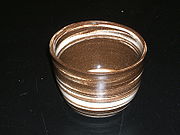
decorated with a combination of contrasting colored clays.
The name agateware is derived from the agate stone
Agate
Agate is a microcrystalline variety of silica, chiefly chalcedony, characterised by its fineness of grain and brightness of color. Although agates may be found in various kinds of rock, they are classically associated with volcanic rocks and can be common in certain metamorphic rocks.-Etymology...
, which when sliced shows multicolored layers. This pottery technique allows for both precise and thought out patterns, and free random effects.
Technique
In order to avoid cracking and breaking which come along with mixing a variety of different kinds of clay, potters generally use one white or very light clay as a base. They then add colors in the form of stains or oxides. Colorant is added to the clay when it is in powder form in order to avoid blistering. 1-10% of colorant is generally applied, however it is up to the individual taste of the potter. The drying process is the most crucial part of this technique.Process
One waymaterials: this process requires the use of two or more differently colored clays. Body stains can be used to obtain almost any color desired.
- combine two or more different colored clays by kneadingKneadingKneading is a process in the making of bread or pasta dough, used to mix together the ingredients and add strength to the final product. Its importance lies in the mixing of flour with water. When these two ingredients are combined and kneaded, the gliadin and glutenin proteins in the flour expand...
and wedging. - slice through to determine the amount of blending desired (generally agate patterning consists of a smaller amount of the stronger color).
- throwing/shape forming (you will not be able to see the agate effect)
- leather-hard stage (you will start to clearly see the agate effect at this point)
Further reading
- Cosentino, Peter. The Encyclopedia Of Pottery Techniques. Philadelphia: Running P, 1990. 11-13.