

Aeolian mode

Encyclopedia
The Aeolian mode is a musical mode
or, in modern usage, a diatonic scale
called the natural minor scale.
The word "Aeolian" in the music theory
of ancient Greece
was an alternative name (used by some later writers, such as Cleonides) for what Aristoxenus
called the Low Lydian tonos (in the sense of a particular overall pitching of the musical system—not a scale), nine semitones higher than the lowest "position of the voice", which was called Hypodorian. In the mid-16th century, this name was given by Heinrich Glarean
to his newly defined ninth mode, with the diatonic
octave species
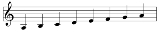
of the natural notes extending one octave from A to A—corresponding to the modern natural minor scale). Up until this time, chant theory recognized eight musical mode
s: the relative natural scales in D, E, F and G, each with their authentic
and plagal
counterparts, and with the option of B-flat instead of B-natural in several modes.
In 1547 Heinrich Glarean published his Dodecachordon. His premise had as its central idea the existence of twelve diatonic modes rather than eight, including a separate pair of modes each on the finals A and C. Finals on these notes, as well as on B♮, had been recognized in chant theory at least since Hucbald
in the early tenth century, but they were regarded as merely transpositions from the regular finals a fifth lower. In the eleventh century Guido d'Arezzo, in chapter 8 of his Micrologus, designated these transposed finals A, B♮ and C as "affinals", and later still the term "confinal" was used in the same way. In 1525, Pietro Aaron was the first theorist to explain polyphonic modal usage in terms of the eightfold system, including these transpositions. As late as 1581, Illuminato Aiguino da Brescia published the most elaborate theory defending the eightfold system for polyphonic music against Glarean's innovations, in which he regarded the traditional plainchant modes 1 and 2 (Dorian and Hypodorian) at the affinal position (that is, with their finals on A instead of D) as a composite of species from two modes, which he described as "mixed modes." Glarean added Aeolian as the name of the new ninth mode: the relative natural mode in A with the perfect fifth
as its dominant, reciting note or tenor
. The tenth mode, the plagal version of the Aeolian mode, Glarean called Hypoaeolian ("under Aeolian"), based on the same relative scale, but with the minor third
as its tenor, and having a melodic range from a perfect fourth
below the tonic to a perfect fifth
above it.
Although scholars for the past three centuries have regarded the modes added by Glarean as the basis of the minor
/major
division of classical European music, as homophonic music replaced Renaissance polyphony
, this is an oversimplification. Even the key of A minor is as closely related to the old transposed modes 1 and 2 (Dorian and Hypodorian) with finals on A—as well as to mode 3 (Phrygian)—as it is to Glarean's Aeolian.
 In modern usage, the Aeolian mode is the sixth mode of the major scale and has the formula 1, 2, 3, 4, 5, 6, 7. In C, this is C, D, E, F, G, A, B (three flats); in A, this is A, B, C, D, E, F, G (no flats or sharps).
From the point of view of its relative major key, the aeolian tonic chord is the submediant minor triad (vi). For example, if the Aeolian mode is used in its all-white-note pitch based on A, this would be an A-minor triad, which would be the submediant in the relative major key of C major
.
Musical mode
In the theory of Western music since the ninth century, mode generally refers to a type of scale. This usage, still the most common in recent years, reflects a tradition dating to the middle ages, itself inspired by the theory of ancient Greek music.The word encompasses several additional...
or, in modern usage, a diatonic scale
Diatonic scale
In music theory, a diatonic scale is a seven note, octave-repeating musical scale comprising five whole steps and two half steps for each octave, in which the two half steps are separated from each other by either two or three whole steps...
called the natural minor scale.
The word "Aeolian" in the music theory
Music theory
Music theory is the study of how music works. It examines the language and notation of music. It seeks to identify patterns and structures in composers' techniques across or within genres, styles, or historical periods...
of ancient Greece
Ancient Greece
Ancient Greece is a civilization belonging to a period of Greek history that lasted from the Archaic period of the 8th to 6th centuries BC to the end of antiquity. Immediately following this period was the beginning of the Early Middle Ages and the Byzantine era. Included in Ancient Greece is the...
was an alternative name (used by some later writers, such as Cleonides) for what Aristoxenus
Aristoxenus
Aristoxenus of Tarentum was a Greek Peripatetic philosopher, and a pupil of Aristotle. Most of his writings, which dealt with philosophy, ethics and music, have been lost, but one musical treatise, Elements of Harmony, survives incomplete, as well as some fragments concerning rhythm and...
called the Low Lydian tonos (in the sense of a particular overall pitching of the musical system—not a scale), nine semitones higher than the lowest "position of the voice", which was called Hypodorian. In the mid-16th century, this name was given by Heinrich Glarean
Heinrich Glarean
Heinrich Glarean was a Swiss music theorist, poet and humanist. He was born in Mollis and died in Freiburg....
to his newly defined ninth mode, with the diatonic
Diatonic and chromatic
Diatonic and chromatic are terms in music theory that are most often used to characterize scales, and are also applied to intervals, chords, notes, musical styles, and kinds of harmony...
octave species
Octave species
In early Greek music theory, an octave species is a sequence of incomposite intervals making up a complete octave...
of the natural notes extending one octave from A to A—corresponding to the modern natural minor scale). Up until this time, chant theory recognized eight musical mode
Musical mode
In the theory of Western music since the ninth century, mode generally refers to a type of scale. This usage, still the most common in recent years, reflects a tradition dating to the middle ages, itself inspired by the theory of ancient Greek music.The word encompasses several additional...
s: the relative natural scales in D, E, F and G, each with their authentic
Authentic mode
An authentic mode is one of four Gregorian modes whose final is the lowest note of the scale...
and plagal
Plagal mode
A Plagal mode may mean different church chanting modes, depending on the context.-In Western Practice:A plagal mode is a musical mode, which is one of four Gregorian modes whose range includes the octave from the fourth below the tonic, or final, to the fifth above...
counterparts, and with the option of B-flat instead of B-natural in several modes.
In 1547 Heinrich Glarean published his Dodecachordon. His premise had as its central idea the existence of twelve diatonic modes rather than eight, including a separate pair of modes each on the finals A and C. Finals on these notes, as well as on B♮, had been recognized in chant theory at least since Hucbald
Hucbald
Hucbald was a Frankish music theorist, composer, teacher, writer, hagiographer, and Benedictine monk...
in the early tenth century, but they were regarded as merely transpositions from the regular finals a fifth lower. In the eleventh century Guido d'Arezzo, in chapter 8 of his Micrologus, designated these transposed finals A, B♮ and C as "affinals", and later still the term "confinal" was used in the same way. In 1525, Pietro Aaron was the first theorist to explain polyphonic modal usage in terms of the eightfold system, including these transpositions. As late as 1581, Illuminato Aiguino da Brescia published the most elaborate theory defending the eightfold system for polyphonic music against Glarean's innovations, in which he regarded the traditional plainchant modes 1 and 2 (Dorian and Hypodorian) at the affinal position (that is, with their finals on A instead of D) as a composite of species from two modes, which he described as "mixed modes." Glarean added Aeolian as the name of the new ninth mode: the relative natural mode in A with the perfect fifth
Perfect fifth
In classical music from Western culture, a fifth is a musical interval encompassing five staff positions , and the perfect fifth is a fifth spanning seven semitones, or in meantone, four diatonic semitones and three chromatic semitones...
as its dominant, reciting note or tenor
Tenor (disambiguation)
Tenor means generally:* the true purport and effect of a deed or instrument;* the character or usual pattern of something;* the drift or general meaning of a statement or discourse;...
. The tenth mode, the plagal version of the Aeolian mode, Glarean called Hypoaeolian ("under Aeolian"), based on the same relative scale, but with the minor third
Minor third
In classical music from Western culture, a third is a musical interval encompassing three staff positions , and the minor third is one of two commonly occurring thirds. The minor quality specification identifies it as being the smallest of the two: the minor third spans three semitones, the major...
as its tenor, and having a melodic range from a perfect fourth
Perfect fourth
In classical music from Western culture, a fourth is a musical interval encompassing four staff positions , and the perfect fourth is a fourth spanning five semitones. For example, the ascending interval from C to the next F is a perfect fourth, as the note F lies five semitones above C, and there...
below the tonic to a perfect fifth
Perfect fifth
In classical music from Western culture, a fifth is a musical interval encompassing five staff positions , and the perfect fifth is a fifth spanning seven semitones, or in meantone, four diatonic semitones and three chromatic semitones...
above it.
Although scholars for the past three centuries have regarded the modes added by Glarean as the basis of the minor
Minor scale
A minor scale in Western music theory includes any scale that contains, in its tonic triad, at least three essential scale degrees: 1) the tonic , 2) a minor-third, or an interval of a minor third above the tonic, and 3) a perfect-fifth, or an interval of a perfect fifth above the tonic, altogether...
/major
Major scale
In music theory, the major scale or Ionian scale is one of the diatonic scales. It is made up of seven distinct notes, plus an eighth which duplicates the first an octave higher. In solfege these notes correspond to the syllables "Do, Re, Mi, Fa, Sol, La, Ti/Si, ", the "Do" in the parenthesis at...
division of classical European music, as homophonic music replaced Renaissance polyphony
Polyphony
In music, polyphony is a texture consisting of two or more independent melodic voices, as opposed to music with just one voice or music with one dominant melodic voice accompanied by chords ....
, this is an oversimplification. Even the key of A minor is as closely related to the old transposed modes 1 and 2 (Dorian and Hypodorian) with finals on A—as well as to mode 3 (Phrygian)—as it is to Glarean's Aeolian.
From the point of view of its relative major key, the aeolian tonic chord is the submediant minor triad (vi). For example, if the Aeolian mode is used in its all-white-note pitch based on A, this would be an A-minor triad, which would be the submediant in the relative major key of C major
C major
C major is a musical major scale based on C, with pitches C, D, E, F, G, A, and B. Its key signature has no flats/sharps.Its relative minor is A minor, and its parallel minor is C minor....
.