

Actaea

Encyclopedia
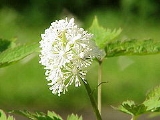
Actaea, commonly called baneberry or bugbane, is a genus
Genus
In biology, a genus is a low-level taxonomic rank used in the biological classification of living and fossil organisms, which is an example of definition by genus and differentia...
of flowering plant
Flowering plant
The flowering plants , also known as Angiospermae or Magnoliophyta, are the most diverse group of land plants. Angiosperms are seed-producing plants like the gymnosperms and can be distinguished from the gymnosperms by a series of synapomorphies...
s belonging to the family Ranunculaceae
Ranunculaceae
Ranunculaceae are a family of about 1700 species of flowering plants in about 60 genera, distributed worldwide....
, native to temperate regions of the Northern Hemisphere
Northern Hemisphere
The Northern Hemisphere is the half of a planet that is north of its equator—the word hemisphere literally means “half sphere”. It is also that half of the celestial sphere north of the celestial equator...
.
The genus is closely related to Cimicifuga
Cimicifuga
Cimicifuga is a genus of between 12-18 species of flowering plants belonging to the family Ranunculaceae, native to temperate regions of the Northern Hemisphere....
and Souliea, and many botanists include those genera within Actaea (e.g. Compton et al. 1998, Compton & Culham 2002, Gao et al. 2006, RHS Plant Finder, 2007) based on combined evidence from DNA sequence data, similarity in biochemical constituents and on morphology; if included, the number of species in Actaea rises to 25-30. Other botanists (e.g. Hoffman 1999, Wang et al. 1999, Lee & Park 2004) reject this merger because only one group (Actaea) have fleshy fruit while the remainder have dry fruit. The genus is treated here in its broader sense.
Selected species
- Actaea asiaticaActaea asiaticaActaea asiatica is species of baneberry that ranges throughout Asia.The flowers are ranges from gray to white. The berries are black-purple. The plant is extremely poisonous to humans. The fruits are eaten by birds which disperse the seeds....
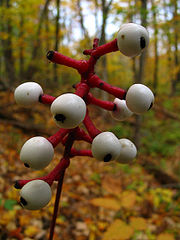
- Actaea pachypodaActaea pachypodaActaea pachypoda is a flowering plant in the family Ranunculaceae, native to eastern North America....
– White Baneberry, White Cohosh, Doll's Eyes - Actaea racemosa – Black Cohosh, Black Bugbane
- Actaea rubra (syn. Actaea erythrocarpa) – Red Baneberry
- Actaea spicataActaea spicataActaea spicata is a species of flowering plant in the genus Actaea, native to Europe and Western Asia....
(syn. Actaea alba) – Baneberry, Herb Christopher
The name Actaea alba (L.) Mill. is a confused one (Fernald 1940); although described as an American species (now named A. pachypoda), the illustration on which the description was based was actually a picture of the European A. spicata, and strictly, the name is therefore a synonym of the European species. Some texts however still treat A. pachypoda under this name.
Actaea is recorded as a food plant for the larva
Larva
A larva is a distinct juvenile form many animals undergo before metamorphosis into adults. Animals with indirect development such as insects, amphibians, or cnidarians typically have a larval phase of their life cycle...
of the Dot Moth
Dot Moth
The Dot Moth is a moth of the family Noctuidae. It is found throughout Europe apart from the south-east.This is a very distinctive species with very dark brown, almost black, forewings marked with a large white stigma from which the species gets its common name. The hindwings are grey with a dark...
.
Use and toxicity
Baneberry contains cardiogenic toxins than can have an immediate sedative effect on human cardiac muscle tissue. The berries are the most poisonous part of the plant (hence the name baneberry). Children have been poisoned by eating the waxy, shiny red or white berries. Ingestion of the berries can lead to cardiac arrest and death. It is toxic to rabbits. The berries are harmless to birds, the plant's primary seed disperser. Actaea species are closely related to plants in the genus AconitumAconitum
Aconitum , known as aconite, monkshood, wolfsbane, leopard's bane, women's bane, Devil's helmet or blue rocket, is a genus of over 250 species of flowering plants belonging to the buttercup family .-Overview:These herbaceous perennial plants are chiefly natives of the mountainous parts of the...
, a highly toxic plant genus which contains wolfbane and several varieties of monkshood.
The roots of A. rubra contain β-sitosterol glucoside
Glucoside
A glucoside is a glycoside that is derived from glucose. Glucosides are common in plants, but rare in animals. Glucose is produced when a glucoside is hydrolysed by purely chemical means, or decomposed by fermentation or enzymes....
, and they were used medicinally by Native Americans as an alternative to Black Cohosh, (A. racemosa), for menstrual cramping and menopausal discomfort.
Sources
- RHS Plant Finder http://www.rhs.org.uk/rhsplantfinder/plantfinder.asp
- Germplasm Resources Information Network: Actaea (treats genus in broad sense)
- Flora of China: Actaea (treats genus in narrow sense)
- Flora of North America: Actaea (treats genus in narrow sense)
- Edible and Medicinal plants of the West, Gregory L. Tilford, ISBN 0-87842-359-1