

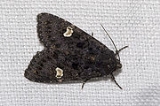
Dot Moth

Encyclopedia
The Dot Moth is a moth
of the family Noctuidae
. It is found throughout Europe
apart from the south-east.
This is a very distinctive species with very dark brown, almost black, forewings marked with a large white stigma
from which the species gets its common name. The hindwings are grey with a dark band at the termen
. The wingspan
is 38-50 mm. It flies at night in July and August and is attracted to light, sugar and flower
s.
.jpg) The larva
The larva
is rather variable in colour, being green, brown or even purplish. It is marked with lighter diagonal markings and has a distinctive hump at the rear end. It is polyphagous, feeding on a wide variety of plant
s (see list below). The species overwinters as a pupa
.
Moth
A moth is an insect closely related to the butterfly, both being of the order Lepidoptera. Moths form the majority of this order; there are thought to be 150,000 to 250,000 different species of moth , with thousands of species yet to be described...
of the family Noctuidae
Noctuidae
The Noctuidae or owlet moths are a family of robustly-built moths that includes more than 35,000 known species out of possibly 100,000 total, in more than 4,200 genera. They constitute the largest family in the Lepidoptera....
. It is found throughout Europe
Europe
Europe is, by convention, one of the world's seven continents. Comprising the westernmost peninsula of Eurasia, Europe is generally 'divided' from Asia to its east by the watershed divides of the Ural and Caucasus Mountains, the Ural River, the Caspian and Black Seas, and the waterways connecting...
apart from the south-east.
This is a very distinctive species with very dark brown, almost black, forewings marked with a large white stigma
Glossary of Lepidopteran terms
This glossary describes the terms used in the formal descriptions of insect species, jargon used mostly by professionals or entomologist....
from which the species gets its common name. The hindwings are grey with a dark band at the termen
Glossary of Lepidopteran terms
This glossary describes the terms used in the formal descriptions of insect species, jargon used mostly by professionals or entomologist....
. The wingspan
Wingspan
The wingspan of an airplane or a bird, is the distance from one wingtip to the other wingtip. For example, the Boeing 777 has a wingspan of about ; and a Wandering Albatross caught in 1965 had a wingspan of , the official record for a living bird.The term wingspan, more technically extent, is...
is 38-50 mm. It flies at night in July and August and is attracted to light, sugar and flower
Flower
A flower, sometimes known as a bloom or blossom, is the reproductive structure found in flowering plants . The biological function of a flower is to effect reproduction, usually by providing a mechanism for the union of sperm with eggs...
s.
Larva
A larva is a distinct juvenile form many animals undergo before metamorphosis into adults. Animals with indirect development such as insects, amphibians, or cnidarians typically have a larval phase of their life cycle...
is rather variable in colour, being green, brown or even purplish. It is marked with lighter diagonal markings and has a distinctive hump at the rear end. It is polyphagous, feeding on a wide variety of plant
Plant
Plants are living organisms belonging to the kingdom Plantae. Precise definitions of the kingdom vary, but as the term is used here, plants include familiar organisms such as trees, flowers, herbs, bushes, grasses, vines, ferns, mosses, and green algae. The group is also called green plants or...
s (see list below). The species overwinters as a pupa
Pupa
A pupa is the life stage of some insects undergoing transformation. The pupal stage is found only in holometabolous insects, those that undergo a complete metamorphosis, going through four life stages; embryo, larva, pupa and imago...
.
- The flight season refers to the British IslesBritish IslesThe British Isles are a group of islands off the northwest coast of continental Europe that include the islands of Great Britain and Ireland and over six thousand smaller isles. There are two sovereign states located on the islands: the United Kingdom of Great Britain and Northern Ireland and...
. This may vary in other parts of the range.
Recorded food plants
- AconitumAconitumAconitum , known as aconite, monkshood, wolfsbane, leopard's bane, women's bane, Devil's helmet or blue rocket, is a genus of over 250 species of flowering plants belonging to the buttercup family .-Overview:These herbaceous perennial plants are chiefly natives of the mountainous parts of the...
- ActaeaActaeaActaea, commonly called baneberry or bugbane, is a genus of flowering plants belonging to the family Ranunculaceae, native to temperate regions of the Northern Hemisphere....
- Aegopodium - Ground-elderGround-elderAegopodium podagraria, commonly called ground elder, herb gerard, bishop's weed, goutweed, and snow-in-the-mountain, is a perennial plant in the carrot family that grows in shady places. The name "ground elder" comes from the superficial similarity of its leaves and flowers to those of elder ,...
- Alnus - Grey AlderGrey AlderAlnus incana is a species of alder with a wide range across the cooler parts of the Northern Hemisphere....
- Aquilegia - ColumbineAquilegiaAquilegia is a genus of about 60-70 species of perennial plants that are found in meadows, woodlands, and at higher altitudes throughout the Northern Hemisphere, known for the spurred petals of their flowers.-Etymology:The genus name Aquilegia is derived from the Latin word for eagle , because...
- Betula - Silver BirchSilver BirchBetula pendula is a widespread European birch, though in southern Europe it is only found at higher altitudes. Its range extends into southwest Asia in the mountains of northern Turkey and the Caucasus...
- CallunaCallunaCalluna vulgaris is the sole species in the genus Calluna in the family Ericaceae. It is a low-growing perennial shrub growing to tall, or rarely to and taller, and is found widely in Europe and Asia Minor on acidic soils in open sunny situations and in moderate shade...
- Heather - CampanulaCampanulaCampanula is one of several genera in the family Campanulaceae with the common name bellflower. It takes its name from their bell-shaped flowers—campanula is Latin for "little bell"....
- Cirsium - Creeping ThistleCirsium arvenseCirsium arvense is a species of Cirsium, native throughout Europe and northern Asia, and widely introduced elsewhere. The standard English name in its native area is Creeping Thistle.-Alternate names:...
- DelphiniumDelphiniumDelphinium is a genus of about 300 species of perennial flowering plants in the buttercup family Ranunculaceae, native throughout the Northern Hemisphere and also on the high mountains of tropical Africa. The common name, larkspur, is shared with the closely related genus Consolida...
- Hieracium - HawkweedHawkweedHawkweed refers to any species in the very large genus Hieracium and its segregate genus Pilosella, in the sunflower family ....
- ImpatiensImpatiensImpatiens is a genus of about 850–1,000 species of flowering plants, widely distributed throughout the Northern Hemisphere and tropics. Together with the puzzling Hydrocera triflora, this genus makes up the family Balsaminaceae...
- Touch-me-not Balsam - Larix - LarchLarchLarches are conifers in the genus Larix, in the family Pinaceae. Growing from 15 to 50m tall, they are native to much of the cooler temperate northern hemisphere, on lowlands in the north and high on mountains further south...
- Lupinus - LupinLupinLupinus, commonly known as Lupins or lupines , is a genus in the legume family . The genus comprises about 280 species , with major centers of diversity in South and western North America , and the Andes and secondary centers in the Mediterranean region and Africa Lupinus, commonly known as Lupins...
- LysimachiaLysimachiaLysimachia is a genus of flowering plants. It is traditionally classified in the family Primulaceae but should, according to molecular phylogenetic study, be placed to the family Myrsinaceae .-Characteristics:...
- Yellow Loosestrife - PetuniaPetuniaPetunia is a widely cultivated genus of flowering plants of South American origin, closely related with tobacco, cape gooseberries, tomatoes, deadly nightshades, potatoes and chili peppers; in the family Solanaceae. The popular flower derived its name from French, which took the word petun, meaning...
- PhloxPhloxPhlox is a genus of 67 species of perennial and annual plants found mostly in North America in diverse habitats from alpine tundra to open woodland and prairie. Some flower in spring, others in summer and autumn....
- PolygonumPolygonumPolygonum is a genus in the Polygonaceae family. Common names include knotweed, knotgrass, bistort, tear-thumb, mile-a-minute, and several others. In the Middle English glossary of herbs "Alphita" , it was known as ars-smerte. There have been various opinions about how broadly the genus should be...
- Prunus - Bird CherryBird CherryPrunus padus, known as Bird Cherry or Hackberry, is a species of cherry, native to northern Europe and northern Asia. It is a deciduous small tree or large shrub, 8–16 m tall, which grows north of the Arctic Circle in Norway, Sweden, Finland and Russia...
- Pteridium - BrackenBrackenBracken are several species of large, coarse ferns of the genus Pteridium. Ferns are vascular plants that have alternating generations, large plants that produce spores and small plants that produce sex cells . Brackens are in the family Dennstaedtiaceae, which are noted for their large, highly...
- Quercus - Holm oakHolm OakQuercus ilex, the Holm Oak or Holly Oak is a large evergreen oak native to the Mediterranean region. It takes its name from holm, an ancient name for holly...
- RibesRibesRibes is a genus of about 150 species of flowering plants native throughout the temperate regions of the Northern Hemisphere. It is usually treated as the only genus in the family Grossulariaceae. Seven subgenera are recognized....
- Currant - Rubus - RaspberryRaspberryThe raspberry or hindberry is the edible fruit of a multitude of plant species in the genus Rubus, most of which are in the subgenus Idaeobatus; the name also applies to these plants themselves...
- RudbeckiaRudbeckiaRudbeckia is a plant genus of 23 species in the family Asteraceae. The species are commonly called coneflowers and black-eyed-susans; all are native to North America and many species are cultivated in gardens for their showy yellow or gold flower heads.The species are herbaceous, mostly perennial...
- Salix - WillowWillowWillows, sallows, and osiers form the genus Salix, around 400 species of deciduous trees and shrubs, found primarily on moist soils in cold and temperate regions of the Northern Hemisphere...
- Sambucus - ElderElderberrySambucus is a genus of between 5 and 30 species of shrubs or small trees in the moschatel family, Adoxaceae. It was formerly placed in the honeysuckle family, Caprifoliaceae, but was reclassified due to genetic evidence...
- Solidago - GoldenrodGoldenrodSolidago, commonly called goldenrods, is a genus of about 100 species of flowering plants in the family Asteraceae. Most are herbaceous perennial species found in the meadows and pastures, along roads, ditches and waste areas in North America. There are also a few species native to Mexico, South...
- Sorbus - RowanRowanThe rowans or mountain-ashes are shrubs or small trees in genus Sorbus of family Rosaceae. They are native throughout the cool temperate regions of the Northern Hemisphere, with the highest species diversity in the mountains of western China and the Himalaya, where numerous apomictic microspecies...
- Spinacia - SpinachSpinachSpinach is an edible flowering plant in the family of Amaranthaceae. It is native to central and southwestern Asia. It is an annual plant , which grows to a height of up to 30 cm. Spinach may survive over winter in temperate regions...
- TagetesTagetesTagetes is a genus of 56 species of annual and perennial mostly herbaceous plants in the sunflower family . The genus is native to North and South America, but some species have become naturalized around the world. One species, T...
- Tropaeolum - Nasturtium
- Urtica - NettleNettleNettles constitute between 24 and 39 species of flowering plants of the genus Urtica in the family Urticaceae, with a cosmopolitan though mainly temperate distribution. They are mostly herbaceous perennial plants, but some are annual and a few are shrubby...
- Vaccinium - BilberryBilberryBilberry is any of several species of low-growing shrubs in the genus Vaccinium , bearing edible berries. The species most often referred to is Vaccinium myrtillus L., but there are several other closely related species....