

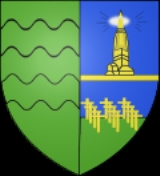
Ablain-Saint-Nazaire

Encyclopedia
Ablain-Saint-Nazaire is a commune
in the Pas-de-Calais department in northern France
.
. The Saint-Nazaire stream, which passes through the commune, is a small tributary of the river Deûle
.
, the Battle of Lorette lasted for 12 months, from October 1914 to October 1915, resulting in high casualties on both sides: 100,000 killed and as many wounded.
A French national cemetery was built on 13 hectares nearby and comprises 20,000 graves, laid out irrespective of rank or military training. General Barbot has a private soldier buried next to him, on his right.
In eight ossuaries, around the base of the lantern tower, are the remains of 22,970 unidentified soldiers. A portion of the cemetery has been reserved for Muslim soldiers.
Communes of France
The commune is the lowest level of administrative division in the French Republic. French communes are roughly equivalent to incorporated municipalities or villages in the United States or Gemeinden in Germany...
in the Pas-de-Calais department in northern France
France
The French Republic , The French Republic , The French Republic , (commonly known as France , is a unitary semi-presidential republic in Western Europe with several overseas territories and islands located on other continents and in the Indian, Pacific, and Atlantic oceans. Metropolitan France...
.
Geography
A farming village located 8 miles (12 km) north of Arras, on the D57 road. It was rebuilt after being destroyed during World War IWorld War I
World War I , which was predominantly called the World War or the Great War from its occurrence until 1939, and the First World War or World War I thereafter, was a major war centred in Europe that began on 28 July 1914 and lasted until 11 November 1918...
. The Saint-Nazaire stream, which passes through the commune, is a small tributary of the river Deûle
Deûle
The Deûle is a river of northern France which is currently channeled for the main part of its course . The upstream part is still partly free-flowing and is known as the Souchez...
.
Population
History
At the start of World War IWorld War I
World War I , which was predominantly called the World War or the Great War from its occurrence until 1939, and the First World War or World War I thereafter, was a major war centred in Europe that began on 28 July 1914 and lasted until 11 November 1918...
, the Battle of Lorette lasted for 12 months, from October 1914 to October 1915, resulting in high casualties on both sides: 100,000 killed and as many wounded.
A French national cemetery was built on 13 hectares nearby and comprises 20,000 graves, laid out irrespective of rank or military training. General Barbot has a private soldier buried next to him, on his right.
In eight ossuaries, around the base of the lantern tower, are the remains of 22,970 unidentified soldiers. A portion of the cemetery has been reserved for Muslim soldiers.
Places of interest
- The church of St. Pierre, dating from the twentieth century.
- The ruins of the fifteenth century church, destroyed in World War IWorld War IWorld War I , which was predominantly called the World War or the Great War from its occurrence until 1939, and the First World War or World War I thereafter, was a major war centred in Europe that began on 28 July 1914 and lasted until 11 November 1918...
. - The war museum.