
All Topics  
Abaya

 
Abaya

   Email Print
   Bookmark   Link


Abaya


The abaya "cloak" ( ‘abaya[tu] or ‘aba'a[tu], plural ‘abaya[tu]) is an overgarment worn by some women in parts of the Islamic world. It is the traditional form of hijab
Hijab

Hijab or ?ijab is the Arabic word for "curtain / cover" , based on the root ??? meaning "to cover, to veil, to shelter". In popular use, hijab means "head cover and modest dress for women" among Muslims, which most Islamic legal systems define as covering everything except the face, feet and hands in public....
, or Islam
Islam

Islam is a Monotheism, Abrahamic religion originating with the teachings of the Prophets of Islam Muhammad, a 7th century Arab religious and political figure....
ic dress, for many countries of the Arabian peninsula
Arabian Peninsula

The Arabian Peninsula , Arabia, Arabistan, and the Arabian subcontinent is a peninsula in Southwest Asia at the junction of Africa and Asia. The area is an important part of the Middle East and plays a critically important geopolitics role because of its vast reserves of petroleum and natural gas....
 such as the United Arab Emirates
United Arab Emirates

The United Arab Emirates is a federation of seven states situated in the southeast of the Arabian Peninsula in Southwest Asia on the Persian Gulf, bordering Oman and Saudi Arabia....
, where it is the national dress.

Traditional abayat are black and may be either a large square of fabric draped from the shoulders or head or a long caftan.


Discussion
Ask a question about 'Abaya'
Start a new discussion about 'Abaya'
Answer questions from other users
Full Discussion Forum


Recent Posts


Encyclopedia


The abaya "cloak" ( ‘abaya[tu] or ‘aba'a[tu], plural ‘abaya[tu]) is an overgarment worn by some women in parts of the Islamic world. It is the traditional form of hijab
Hijab

Hijab or ?ijab is the Arabic word for "curtain / cover" , based on the root ??? meaning "to cover, to veil, to shelter". In popular use, hijab means "head cover and modest dress for women" among Muslims, which most Islamic legal systems define as covering everything except the face, feet and hands in public....
, or Islam
Islam

Islam is a Monotheism, Abrahamic religion originating with the teachings of the Prophets of Islam Muhammad, a 7th century Arab religious and political figure....
ic dress, for many countries of the Arabian peninsula
Arabian Peninsula

The Arabian Peninsula , Arabia, Arabistan, and the Arabian subcontinent is a peninsula in Southwest Asia at the junction of Africa and Asia. The area is an important part of the Middle East and plays a critically important geopolitics role because of its vast reserves of petroleum and natural gas....
 such as the United Arab Emirates
United Arab Emirates

The United Arab Emirates is a federation of seven states situated in the southeast of the Arabian Peninsula in Southwest Asia on the Persian Gulf, bordering Oman and Saudi Arabia....
, where it is the national dress.

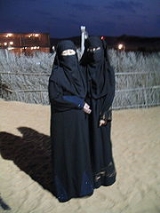
Traditional abayat are black and may be either a large square of fabric draped from the shoulders or head or a long caftan. The abaya covers the whole body except the face, feet, and hands. It can be worn with the niqab
Niqab

A niqab is a veil which covers the face, worn by some Muslim women as a part of sartorial hijab.Niqab is most common in the Arab countries of the Persian Gulf such as Saudi Arabia, Yemen, Bahrain, Kuwait, Qatar, Oman, Iraq, and the UAE....
, a face veil covering all but the eyes. Some women choose to wear long black gloves, so their hands are covered as well.

Saudi Arabia
Saudi Arabia

The Kingdom of Saudi Arabia, KSA , is an Arab country and the largest country of the Arabian Peninsula. It is bordered by Jordan on the northwest, Iraq on the north and northeast, Kuwait, Qatar, Bahrain, and the United Arab Emirates on the east, Oman on the southeast, and Yemen on the south....
 requires women to cover in public. Covering is enforced by the religious police, the mu??awwi‘in
Mutaween

The Mutaween means "subjugated people" in Arabic is commonly used as a casual term for the government-authorized or -recognized religious police of Saudi Arabia....
 (also known as the muttawwa). In Iran
Iran

Iran , officially the Islamic Republic of Iran and formerly known internationally as Persian Empire until 1935, is a country in Central Eurasia, located on the northeastern shore of the Persian Gulf and the southern shore of the Caspian Sea....
 the cover is often referred to as a chador
Chador

A chador or chadar is an outer garment or open cloak worn by many Women in Iran in public spaces; it is one possible way in which a Women and Islam may follow the Islamic dress code known as hijab....
. Some Muslim women living in the West
The West

The West is a generic term referring to the Western world, or Western culture or civilization.The term can also mean:* Western culture or Western civilization, referring to cultures derived from European origin....
 also cover themselves as part of their religion and culture.

Abayat are known by various names but serve the same purpose, which is to cover. Contemporary models are usually caftans, cut from light, flowing fabrics like crepe
Crępe

A cr?pe is a type of very thin, cooked pancake usually made from wheat flour. The word, like the pancake itself, is of France origin, deriving from the Latin crispa, meaning "curled." While cr?pes originate from Brittany, a region in the northwest of France, their consumption is nowadays widespread in France and it is considered...
, georgette, and chiffon
Chiffon (fabric)

Chiffon, from the French language word for a cloth or rag, is a lightweight, balanced plain weave Sheer textiles woven of alternate Spinning crepe yarns....
. Styles differ from region to region: some abayat have embroidery on black material while others are brightly coloured and have different forms of artwork across them.

See also

  • List of types of sartorial hijab
  • Islam and clothing
    Islam and clothing

    Adherents of Islam are concerned with clothing in two contexts: clothing for everyday, inside and outside the house, and clothing required in specifically religious contexts....