
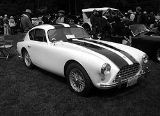
The
Aceca is a closed
coupéA coupé or coupe is a closed car body style , the precise definition of which varies from manufacturer to manufacturer, and over time...
from the British
AC CarsAC Cars Group Ltd. formerly known as Auto Carriers Ltd. is a British specialist automobile manufacturer and one of the oldest independent car marques founded in Britain...
company, produced from 1954 until 1963. The car originally had an AC engine but the similar
BristolBristol Cars is a manufacturer of hand-built luxury cars headquartered in Patchway, near Bristol, United Kingdom. Bristol have always been a low-volume manufacturer; the most recent published official production figures were for 1982, which stated that 104 cars were produced in that year...
-engined
Aceca-Bristol was also available alogside the original from 1956 to 1963 when production of the engine ceased. A few cars were built from 1961 to 1963 with a 2553 cc tuned
Ford ZephyrThe Ford Zephyr was a car manufactured by the Ford Motor Company in the United Kingdom. Between 1950 and 1972, it was sold as a more powerful six-cylinder saloon to complement the four-cylinder Ford Consul: from 1962 the Zephyr itself was offered in both four- and six-cylinder versions.The Zephyr...
engine and sold as the Aceca 2.6.
Based on the open two seat AC Ace, the Aceca was a hand-built
grand tourerA grand tourer is a high-performance luxury automobile designed for long-distance driving. The most common format is a two-door coupé with either a two-seat or a 2+2 arrangement....
in the British tradition, with
ashFraxinus is a genus flowering plants in the olive and lilac family, Oleaceae. It contains 45-65 species of usually medium to large trees, mostly deciduous though a few subtropical species are evergreen. The tree's common English name, ash, goes back to the Old English æsc, while the generic name...
wood and steel tubing used in their construction. One notable feature was the
hatchbackA Hatchback is a car body style incorporating a shared passenger and cargo volume, with rearmost accessibility via a rear third or fifth door, typically a top-hinged liftgate—and features such as fold-down rear seats to enable flexibility within the shared passenger/cargo volume. As a two-box...
at the rear, making the Aceca only the second car, after the 1953
Aston Martin DB2/4The DB2/4 is a grand tourer sold by Aston Martin from 1953 through 1957. It was based on the DB2 it replaced, available as a Drophead coupe and 2+2 hatchback well ahead of the times. Other changes included a wraparound windscreen, larger bumpers, and repositioned headlights...
, to incorporate this element.
151 Acecas, 169 Aceca-Bristols and 8 Ford-engined models were built when production halted in 1963.
The main difference between the Aceca and Aceca-Bristol was the engine. Both used a
straight-6The straight-six engine or inline-six engine is a six-cylinder internal combustion engine with all six cylinders mounted in a straight line along the crankcase...
unit, but the Aceca shared its 90 hp, 1991 cc overhead camshaft AC engine with the lighter
AC Ace-History:AC came back to the market after the Second World War with the staid Two-litre range of cars in 1947, but it was with the Ace sports car of 1953 that the company really made its reputation in the post war years...
, while the Aceca-Bristol used a 125 hp (93 kW) "D-Type" 2.0 L (1971 cc/120 in³) unit sourced from
Bristol CarsBristol Cars is a manufacturer of hand-built luxury cars headquartered in Patchway, near Bristol, United Kingdom. Bristol have always been a low-volume manufacturer; the most recent published official production figures were for 1982, which stated that 104 cars were produced in that year...
. The Aceca-Bristol was also available with a milder "B-Type" Bristol engine of 105 hp (78 kW). The Bristol specification added $1000 to the Aceca's $5,400 price tag in the United States. In the UK the basic car cost £1722.
The front-end styling of the Ace and Aceca reportedly traces back to a design done by Pinin Farina for AC in the late 1940s. The car is rather light owing to a tubular frame, aluminium engine block and aluminium body panels. Large 16" spoked road wheels, and near 50/50 weight distribution allowed exceptional handling on loose, dirt tracks. Later Acecas feature front-wheel disc brakes (added in 1957), while all share transverse "de Dion" leaf rear suspension, articulated rear half-axles, worm-gear steering, an optional overdrive on 2nd, 3rd & 4th gears, curved windshield, and leather covered bucket seats. The suspension is independent at the front and rear using transverse leaf springs.
Aceca-Bristol
The in-line six Bristol engine fitted to the Aceca-Bristol was based on a design from BMW with cast iron block and aluminium cylinder head. It has a single camshaft with pushrods running vertically to a rocker shaft on the inlet side of the engine and further horizontal pushrods running in 6 tubes over the top of the engine in order to reach the exhaust rockers. The two inclined rocker covers give the engine a similar appearance to an overhead - camshaft arrangement. Three inline Solex downdraft carburettors bolted directly to the cylinder head casting via small adaptor plates.
Driving
The car has a fairly hard ride owing to the stiff suspension and holds the road well in corners, with some oversteer. The narrow wheelbase is noticeable, though. On the downside, the 90 hp engine is best at higher rpm, so the 0-60 mph time is not exceptional. Other weaknesses include inadequate rear mirrors, even though the hatchback window affords a large rear view, a heating system that isn't suited for cold winters, and inadequate soundproofing for easy passenger conversation when cruising above 75 mph (121 km/h). The gear-shift is more solid than smooth and has synchromesh on 2nd, 3rd and 4th gears, only.