

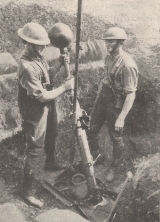
2 inch Medium Mortar

Encyclopedia
The 2 inch Medium Trench Mortar, also known as the 2-inch Howitzer, and nicknamed the "Toffee Apple" or "Plum Pudding" mortar, was a British SBML medium trench mortar in use in World War I from mid 1915 to mid 1917. The designation "2 inch" refers to the mortar barrel, into which only the 22-inch bomb shaft but not the bomb itself was inserted; the bomb itself was actually 9 inches (230 mm) in diameter and weighed 42 lb (19 kg), hence this weapon is more comparable to a standard mortar of approximately 5-6 inch bore.
in late 1914, British forces found themselves with no means of replying to the German minenwerfer
s (trench mortars) which were lobbing both small and large (over 100 pound) high-explosive shells into their frontline trenches from short range. British commanders requested an accurate short-range weapon which was manually portable in the trenches, could be safely used to attack enemy trenches as close as 100 yards to the British trenches, was easily concealed and projected a reasonably large explosive charge capable of damaging protected enemy positions. The British Expeditionary Force had been expected to participate only in mobile warfare and was not equipped with any mortars.
Various alternative designs for light and medium mortars were evaluated, prompted by the need to get at least some weapon into action without diverting manufacturing capacity from guns and howitzers, which were given priority. Hence the emphasis was on designs for both mortar and ammunition that could be manufactured by small unsophisticated workshops unsuited to other war work :
The 2-inch mortar served in limited numbers in France in 1915 from March, with early mortars and ammunition made by the Royal Ordnance Factory, with the Vickers 1.57 inch model. Mass production began with an order in August 1915 for 800 mortars from several railway workshops and agricultural machinery makers, together with an order for 675,000 bombs from numerous small firms. Manufacture of the Vickers model which was twice as expensive was ended and it was withdrawn by January 1917.
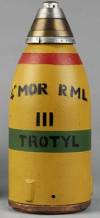
It fired a spherical cast-iron bomb "the size of a football" painted dirty white filled with Amatol
(identified by a painted green band) or Ammonal
(identified by a painted pink band) attached to the end of a pipe ("stick"), hence the nicknames "Toffee Apple" and "Plum Pudding". Weights of bombs as delivered without fuzes varied. Light bombs, from 39 lb 14 oz to below 40 lb 10 oz (18.09 to 18.43 kg), were marked with a stenciled "L". Heavy bombs, above 41 lb 10 oz to 42 lb 6 oz (18.43 to 19.22 kg) were marked with a stenciled "Hv". Hence the total fuzed weight with stick of 51 lb is an average.
The 2-inch designation refers to the mortar barrel's bore and the projectile stick inserted into it, not the much-larger bomb itself which remained outside the barrel. It was comparable in explosive power if not range to other 4-inch mortars.
The 2-inch mortar was itself superseded by the Newton 6 inch Mortar
from mid-1917 onwards. Some Australian units retained them for projecting smoke screens.
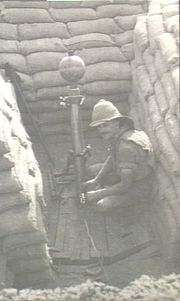
. A typical infantry division was equipped with 3 batteries designated X, Y, Z, each with 4 mortars.
(between the British and enemy front line) was relatively narrow. It was used to fire some White Star (50%-50% chlorine
and phosgene
) gas bombs during the Battle of the Somme until other specialised longer range projectors became available.
Cordite
charges appropriate to the required range were dropped into the barrel before the bomb was loaded. Charges and ranges:
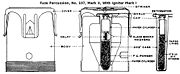
The original design for igniting the powder propellant charge involved the insertion of a standard artillery "T friction tube" into a hole near the base of the barrel. The Royal Artillery had a higher priority in receiving the already insufficient number of tubes so ignition was changed to use a Lee-Enfield bolt mechanism and chamber screwed into a socket in the barrel near the base. A special blank rifle cartridge was loaded and fired via a lanyard from a sheltered position if possible due to the risk of bombs falling short. This ignited the propellant charge and launched the bomb.
In early use it was situated in frontline trenches but this tended to attract enemy fire onto the troops manning them. Standard procedure became to locate the mortars separately from frontline trenches, in unoccupied trenches or in saps running off the frontline. This had the benefit of drawing enemy fire away from troops manning the front line.
Estimated rounds required for various targets, with instantaneous percussion fuze 107:
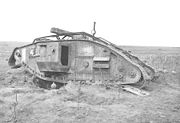 In Spring 1918 many of these obsolescent bombs were buried on the Western Front
under metal plates as anti-tank mines in expectation of attack by German tanks. This led to some later confusion as to whether unearthed bombs were unexploded mortar projectiles ("Duds") or undetonated mines.
These minefields were inadequately documented. This caused the British problems in the closing months of the war when they had to advance again over territory they had previously abandoned and also prevented full clearance of the minefields after the war. This led to some French farmers being blown up in the 1930s when they started using tractors e.g. around Gouzeaucourt.
Background and predecessors
As the Western Front in France and Belgium stagnated into trench warfareTrench warfare
Trench warfare is a form of occupied fighting lines, consisting largely of trenches, in which troops are largely immune to the enemy's small arms fire and are substantially sheltered from artillery...
in late 1914, British forces found themselves with no means of replying to the German minenwerfer
Minenwerfer
Minenwerfer is the German name for a class of short range mortars used extensively during the First World War by the German Army...
s (trench mortars) which were lobbing both small and large (over 100 pound) high-explosive shells into their frontline trenches from short range. British commanders requested an accurate short-range weapon which was manually portable in the trenches, could be safely used to attack enemy trenches as close as 100 yards to the British trenches, was easily concealed and projected a reasonably large explosive charge capable of damaging protected enemy positions. The British Expeditionary Force had been expected to participate only in mobile warfare and was not equipped with any mortars.
Various alternative designs for light and medium mortars were evaluated, prompted by the need to get at least some weapon into action without diverting manufacturing capacity from guns and howitzers, which were given priority. Hence the emphasis was on designs for both mortar and ammunition that could be manufactured by small unsophisticated workshops unsuited to other war work :
4 inch mortar
- A 4-inch mortar was the only official type to enter service before the end of 1914 (12 units). It fired a 8½ pound steel bomb with studs to engage rifling grooves in the mortar barrel, similar to the German minenwerfer. The barrel was improvised by boring out a 6-inch shell. Its range of 900 yards and its accuracy was considered acceptable, but the shell case was expensive and was slow to load. About 40 guns and several thousand rounds were issued by June 1915, with 168 of the total 300 manufactured eventually serving in France. It was soon replaced by the 3-inch Stokes mortar in its "light mortar" class.
3.7 inch mortar
- A 3.7 inch pipe gun was an early improvised mortar. 18 were initially made by the Indian Corps in France by December 1914. It was a smooth tube firing a 4½ pound "tin-pot" filled with ammonalAmmonalAmmonal is an explosive made up of ammonium nitrate, trinitrotoluene , and aluminium powder.The ammonium nitrate functions as an oxidizer and aluminium as a power enhancer. To some extent the aluminium makes it more sensitive to detonation...
. The fuze was a length of Bickford fuseSafety fuseThe safety fuse is a type of fuse invented and patented by William Bickford in 1831. Originally it consisted of a "tube" of gunpowder surrounded by a water-proofed varnished jute "rope". It replaced earlier and less reliable methods of igniting gunpowder blasting charges which had caused many...
ignited by the burning of the propellant, which made it too dangerous for longterm use. By the end of June 1915 another 100 had been manufactured and sent to France and 20 to Gallipoli.
Vickers 1.57 inch mortar
- The Vickers 1.57 inch trench mortar was first introduced to France in March 1915, 127 by the end of June, and about 275 were manufactured until it was withdrawn in January 1917 after being replaced by the 2 inch mortar. The 1.57 inch was similar to the eventual 2 inch model, but the particular Vickers design was complicated and expensive to manufacture. It fired either a 18 or 33 pound cast-iron bomb filled with Permite (perchlorate) , but the smaller bomb was considered too light and the heavier had a range of only 200 yards.
The 2-inch Medium Mortar
This was designed and manufactured by the Royal Ordnance Factories in early 1915 and introduced along with the 1.57 inch mortar in March 1915. It incorporated what was known of the German prewar Krupp mortar. This was the first design to meet all the requirements, after modifications to simplify manufacture; it fired a good-sized spherical cast-iron bomb of 42 pounds (total projectile weight 51 pounds with stick and fuze), considered the largest practical size for use from trenches, at ranges from 100 to 600 yards using a simple 2-inch tube as the mortar body. The mortar and ammunition could be cheaply manufactured by small unsophisticated "trade" workshops; the bomb was safely detonated by a standard No. 80 "time and percussion" artillery fuze. Drawbacks were that the steel tail was usually projected backwards towards the firer when the bomb detonated, resulting in occasional casualties and the No. 80 fuze was also required by the 18-pounder field guns which were given priority, limiting mortar ammunition supply to the front until early 1916 when a special cheap trench mortar fuze was developed.The 2-inch mortar served in limited numbers in France in 1915 from March, with early mortars and ammunition made by the Royal Ordnance Factory, with the Vickers 1.57 inch model. Mass production began with an order in August 1915 for 800 mortars from several railway workshops and agricultural machinery makers, together with an order for 675,000 bombs from numerous small firms. Manufacture of the Vickers model which was twice as expensive was ended and it was withdrawn by January 1917.
It fired a spherical cast-iron bomb "the size of a football" painted dirty white filled with Amatol
Amatol
Amatol is a highly explosive material made from a mixture of TNT and ammonium nitrate. Its name originates from the words ammonium and toluene...
(identified by a painted green band) or Ammonal
Ammonal
Ammonal is an explosive made up of ammonium nitrate, trinitrotoluene , and aluminium powder.The ammonium nitrate functions as an oxidizer and aluminium as a power enhancer. To some extent the aluminium makes it more sensitive to detonation...
(identified by a painted pink band) attached to the end of a pipe ("stick"), hence the nicknames "Toffee Apple" and "Plum Pudding". Weights of bombs as delivered without fuzes varied. Light bombs, from 39 lb 14 oz to below 40 lb 10 oz (18.09 to 18.43 kg), were marked with a stenciled "L". Heavy bombs, above 41 lb 10 oz to 42 lb 6 oz (18.43 to 19.22 kg) were marked with a stenciled "Hv". Hence the total fuzed weight with stick of 51 lb is an average.
The 2-inch designation refers to the mortar barrel's bore and the projectile stick inserted into it, not the much-larger bomb itself which remained outside the barrel. It was comparable in explosive power if not range to other 4-inch mortars.
The 2-inch mortar was itself superseded by the Newton 6 inch Mortar
Newton 6 inch Mortar
The Newton 6 inch Mortar was the standard British medium mortar in World War I from early 1917 onwards.-Description:The Newton 6 inch replaced the 2 inch Medium Mortar beginning in February 1917....
from mid-1917 onwards. Some Australian units retained them for projecting smoke screens.
Combat use
Deployment
The weapon was initially operated by joint infantry and artillery detachments, eventually it became the responsibility of the Royal Field ArtilleryRoyal Field Artillery
The Royal Field Artillery of the British Army provided artillery support for the British Army. It came into being when the Royal Artillery was divided on 1 July 1899, it was reamalgamated back into the Royal Artillery in 1924....
. A typical infantry division was equipped with 3 batteries designated X, Y, Z, each with 4 mortars.
Use in action
Its primary use was in cutting barbed wire defenses and attacking enemy front line trenches, such as in the July 1916 attack on the Somme. The spherical shape and relatively low velocity brought the benefit that the bomb did not penetrate the ground before exploding. The short range was a disadvantage as it could only be used if no man's landNo man's land
No man's land is a term for land that is unoccupied or is under dispute between parties that leave it unoccupied due to fear or uncertainty. The term was originally used to define a contested territory or a dumping ground for refuse between fiefdoms...
(between the British and enemy front line) was relatively narrow. It was used to fire some White Star (50%-50% chlorine
Chlorine
Chlorine is the chemical element with atomic number 17 and symbol Cl. It is the second lightest halogen, found in the periodic table in group 17. The element forms diatomic molecules under standard conditions, called dichlorine...
and phosgene
Phosgene
Phosgene is the chemical compound with the formula COCl2. This colorless gas gained infamy as a chemical weapon during World War I. It is also a valued industrial reagent and building block in synthesis of pharmaceuticals and other organic compounds. In low concentrations, its odor resembles...
) gas bombs during the Battle of the Somme until other specialised longer range projectors became available.
Cordite
Cordite
Cordite is a family of smokeless propellants developed and produced in the United Kingdom from 1889 to replace gunpowder as a military propellant. Like gunpowder, cordite is classified as a low explosive because of its slow burning rates and consequently low brisance...
charges appropriate to the required range were dropped into the barrel before the bomb was loaded. Charges and ranges:
- 1.5 ounces (40 g): 100–220 yards (90–200 m) (dangerous due to propensity for incomplete burn and hence to fall short)
- 2.5 ounces (70 g): 180–340 yards (160–310 m)
- 3.5 ounces (100 g): 300–500 yards (270–460 m)
The original design for igniting the powder propellant charge involved the insertion of a standard artillery "T friction tube" into a hole near the base of the barrel. The Royal Artillery had a higher priority in receiving the already insufficient number of tubes so ignition was changed to use a Lee-Enfield bolt mechanism and chamber screwed into a socket in the barrel near the base. A special blank rifle cartridge was loaded and fired via a lanyard from a sheltered position if possible due to the risk of bombs falling short. This ignited the propellant charge and launched the bomb.
In early use it was situated in frontline trenches but this tended to attract enemy fire onto the troops manning them. Standard procedure became to locate the mortars separately from frontline trenches, in unoccupied trenches or in saps running off the frontline. This had the benefit of drawing enemy fire away from troops manning the front line.
Estimated rounds required for various targets, with instantaneous percussion fuze 107:
- Cutting barbed wire: 1 round per 10 square yards (8 m²)
- Cutting loose wire: 1 round per 6 square yards (5 m²)
- Destroy trenches frontally: 5 rounds per yard
- Destroy trenches in enfilade: 2.5 rounds per yard
- Destroy a machine-gun emplacement with top cover not more than 3 feet of earth: 80 rounds
Silencer
Provision was made in mid-1916 for attachment of the "Temple Silencer" at the muzzle, intended to reduce the flash and noise generated on firing, which at the short ranges the mortar operated at was quickly noticed by the enemy and invited artillery response. This required the use of bombs with a special piston attached to the tail which was retained in the barrel by the silencer on firing, and hence sealed the muzzle after the bomb tail left the barrel. This had the major disadvantage of causing the barrel to overheat during prolonged daylight firing, and the silencer was only used at night.Use as anti-tank mines
Western Front (World War I)
Following the outbreak of World War I in 1914, the German Army opened the Western Front by first invading Luxembourg and Belgium, then gaining military control of important industrial regions in France. The tide of the advance was dramatically turned with the Battle of the Marne...
under metal plates as anti-tank mines in expectation of attack by German tanks. This led to some later confusion as to whether unearthed bombs were unexploded mortar projectiles ("Duds") or undetonated mines.
These minefields were inadequately documented. This caused the British problems in the closing months of the war when they had to advance again over territory they had previously abandoned and also prevented full clearance of the minefields after the war. This led to some French farmers being blown up in the 1930s when they started using tractors e.g. around Gouzeaucourt.
See also
- MortarMortar (weapon)A mortar is an indirect fire weapon that fires explosive projectiles known as bombs at low velocities, short ranges, and high-arcing ballistic trajectories. It is typically muzzle-loading and has a barrel length less than 15 times its caliber....
- Mortier de 58 mm type 2Mortier de 58 mm type 2The Mortier de 58 mm type 2, also known as the Crapouillot or "little toad" from its appearance, was the standard French medium trench mortar of World War I.-Combat use:3 types of bomb were available :...
French equivalent - List of heavy mortars