
All Topics  
1967 USS Forrestal fire


   Email Print
   Bookmark   Link


1967 USS Forrestal fire


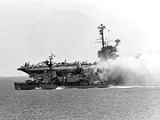
The 1967 USS Forrestal fire was a devastating fire and series of chain-reaction explosions on 29 July 1967 that caused great loss of life on the aircraft carrier
Aircraft carrier

An aircraft carrier is a warship designed with a primary mission of deploying and recovering aircraft, acting as a seagoing airbase. Aircraft carriers thus allow a navy force to project air power great distances without having to depend on local bases for staging aircraft operations....
  after an unusual electrical anomaly discharged a Zuni rocket
Zuni (rocket)

The Zuni is a 5.0 inch unguided rocket deployed by the United States Military of the United States. The rocket was developed for both Air-to-air missile and Air-to-surface missile operations....
 on the flight deck
Flight deck

The flight deck of an aircraft carrier is the Deck from which its aircraft take off and land, essentially a miniature airfield at sea. On smaller naval ships which do not have aviation as a primary mission, the landing area for helicopters and other VTOL aircraft is also referred to as the flight deck....
. 134 sailors were killed, 161 injured. Forrestal was engaged in combat operations in the Gulf of Tonkin
Gulf of Tonkin

The Gulf of Tonkin, in Vietnamese language: V?nh B?c B? or in Chinese language: Beibu Wan is an arm of the South China Sea. Covering an area of 126,250 km?, the gulf borders Vietnam on the northwest, west and southwest....
 during the Vietnam War
Vietnam War

The Vietnam War, also known as the Second Indochina Wars, the Vietnam Conflict, or often in Vietnam the American War occurred in Vietnam, Laos and Cambodia from 1959 to April 30, 1975....
 at the time, and the damage totaled $
United States dollar

The United States dollar is the unit of currency of the United States and was defined by the Coinage Act of 1792 to be between 371 and 416 grains of silver ....
72 million (not including damage to aircraft).
orrestal had departed Norfolk
Norfolk, Virginia

Norfolk is an independent city in the Virginia in the United States. With a population of 234,403 as of the United States Census 2000, it is Virginia's second-largest incorporated city....
 in early June.


Discussion
Ask a question about '1967 USS Forrestal fire'
Start a new discussion about '1967 USS Forrestal fire'
Answer questions from other users
Full Discussion Forum


Encyclopedia


The 1967 USS Forrestal fire was a devastating fire and series of chain-reaction explosions on 29 July 1967 that caused great loss of life on the aircraft carrier
Aircraft carrier

An aircraft carrier is a warship designed with a primary mission of deploying and recovering aircraft, acting as a seagoing airbase. Aircraft carriers thus allow a navy force to project air power great distances without having to depend on local bases for staging aircraft operations....
  after an unusual electrical anomaly discharged a Zuni rocket
Zuni (rocket)

The Zuni is a 5.0 inch unguided rocket deployed by the United States Military of the United States. The rocket was developed for both Air-to-air missile and Air-to-surface missile operations....
 on the flight deck
Flight deck

The flight deck of an aircraft carrier is the Deck from which its aircraft take off and land, essentially a miniature airfield at sea. On smaller naval ships which do not have aviation as a primary mission, the landing area for helicopters and other VTOL aircraft is also referred to as the flight deck....
. 134 sailors were killed, 161 injured. Forrestal was engaged in combat operations in the Gulf of Tonkin
Gulf of Tonkin

The Gulf of Tonkin, in Vietnamese language: V?nh B?c B? or in Chinese language: Beibu Wan is an arm of the South China Sea. Covering an area of 126,250 km?, the gulf borders Vietnam on the northwest, west and southwest....
 during the Vietnam War
Vietnam War

The Vietnam War, also known as the Second Indochina Wars, the Vietnam Conflict, or often in Vietnam the American War occurred in Vietnam, Laos and Cambodia from 1959 to April 30, 1975....
 at the time, and the damage totaled $
United States dollar

The United States dollar is the unit of currency of the United States and was defined by the Coinage Act of 1792 to be between 371 and 416 grains of silver ....
72 million (not including damage to aircraft).

Background

Forrestal had departed Norfolk
Norfolk, Virginia

Norfolk is an independent city in the Virginia in the United States. With a population of 234,403 as of the United States Census 2000, it is Virginia's second-largest incorporated city....
 in early June. Upon completion of the required inspections for the upcoming WESTPAC Cruise, she then went on to Brazil for a show of force. She then set sail "around the horn" of Africa, and went on to dock for a short while at Leyte Pier at N.A.S. Cubi Point in the Phillipine Islands. She then set sail to "Yankee Station" in the Gulf of Tonkin. For four days in the gulf, aircraft of Attack Carrier Air Wing 17
Carrier Air Wing Seventeen

Carrier Air Wing Seventeen , is a United States Navy aircraft carrier air wing based at Naval Air Station Oceana, Virginia. Until June 2008, the air wing was attached to the aircraft carrier USS George Washington ....
 flew about 150 missions against targets in North Vietnam
North Vietnam

The Democratic Republic of Vietnam , or less commonly, Vietnamese Democratic Republic was an effective state all over Vietnam from 1945 until the partition of Vietnam in 1954....
. Because of a shortage of bombs, old Composition B
Composition B

Composition B is an explosive consisting of castable mixtures of RDX and Trinitrotoluene.It is used as the main explosive filling in artillery shell s, rockets, land mines, hand grenades and various other munitions....
 bombs had been loaded from the ammunition ship , instead of newer Composition H6
Composition H6

Composition H6 is a castable military explosive compound composed of the following percentages by weight:* 45% RDX* 30% trinitrotoluene* 20% Powder aluminium...
, capable of withstanding high heat or exploding with low order.

Fire

About 10:50 (local time) on 29 July, while preparations for the second strike of the day were being made near , an unguided 5-inch Mk-32 "Zuni" rocket
Zuni (rocket)

The Zuni is a 5.0 inch unguided rocket deployed by the United States Military of the United States. The rocket was developed for both Air-to-air missile and Air-to-surface missile operations....
, one of four contained in a LAU-10 underwing rocket pod mounted on a F-4 Phantom II
F-4 Phantom II

The McDonnell Douglas F-4 Phantom II is a two-seat, twin-engined, all-weather, long-range supersonic interceptor jet fighter/fighter-bomber originally developed for the United States Navy by McDonnell Aircraft....
, was accidentally fired due to an electrical power surge during the switch from external power to internal power.

The rocket flew across the flight deck, striking a wing-mounted external fuel tank on an A-4 Skyhawk
A-4 Skyhawk

The Douglas A-4 Skyhawk is a aircraft carrier ground-attack aircraft designed for the United States Navy and U.S. Marine Corps. The delta winged "Skyhawk", powered by a single turbojet was designed and produced by Douglas Aircraft Company ....
 awaiting launch, either aircraft No. 405, piloted by LCDR
Lieutenant commander (United States)

In the United States Navy, the United States Coast Guard, the United States Public Health Service Commissioned Corps, and the National Oceanic and Atmospheric Administration Commissioned Corps, lieutenant commander is a junior officer rank, with the pay grade of O-4....
 Fred D. White, or No. 416, piloted by future U.S. Senator LCDR John McCain
John McCain

John Sidney McCain III is the senior senator United States United States Senator from Arizona. He was the Republican Party presidential nominee in the 2008 United States presidential election....
. The warhead's safety mechanism prevented it from detonating, but the impact tore the tank off the wing and ignited the resulting spray of escaping JP-5
JP-5

JP-5, or JP5 is a jet fuel that weighs 6.8 pounds per gallon and has a high flash point . It was developed in 1952 for use in aircraft stationed aboard aircraft carriers where the risk from fire is particularly great....
 fuel, causing an instantaneous conflagration
Conflagration

Conflagration is an uncontrolled burning that threatens human life, health, property or ecology. A conflagration can be accidental or intentionally created ....
. Other external fuel tanks overheated and ruptured, releasing more jet fuel to feed the flames which spread along the flight deck, leaving pilots in their aircraft with the options of being incinerated in their cockpits or running through the flames to escape. LCDR White leaped from his burning aircraft but was killed instantly (along with many firefighters) by the cooking off
Cooking off

Cooking off refers to ammunition exploding prematurely due to heat in the surrounding environment....
 of the first bomb. LCDR Herbert A. Hope of VA-46 (and operations officer of CVW-17) jumped out of the cockpit of his Skyhawk between explosions, rolled off the flight deck and into the starboard man-overboard net. Making his way down below to the hangar deck, he took command of a firefighting team. "The port quarter of the flight deck where I was", he recalled, "is no longer there." With his aircraft surrounded by flames, McCain escaped by climbing out of the cockpit, walking down the nose and jumping off the refueling probe
Aerial refueling

Aerial refueling, also called air refueling, in-flight refueling , air-to-air refueling or tanking, is the process of transferring fuel from one aircraft to another during flight....
.

The impact of the Zuni dislodged two of the bombs, which lay in the burning fuel. The fire team's chief, Gerald Farrier (without benefit of protective clothing) immediately smothered the bombs with a PKP
Purple-K

Purple-K is a dry chemical fire suppression agent used in some dry powder fire extinguishers. It is the most effective dry chemical in fighting Fire classes fires, and can be used against some energized electrical equipment fires ....
 fire extinguisher in an effort to knock down the fuel fire long enough to allow the pilots to escape. According to their training, the fire team normally had almost three minutes to reduce the temperature of the bombs to a safe level, but the chief did not realize the "Comp. B" bombs were already critically close to cooking-off until one split open. The chief, knowing a lethal explosion was imminent, shouted for the fire team to withdraw but the bomb exploded seconds later - only one and a half minutes after the start of the fire.

The detonation destroyed McCain's aircraft (along with its remaining fuel and armament), blew a crater in the armored flight deck, and sprayed the deck and crew with shrapnel and burning jet fuel. It killed the entire on-deck firefighting contingent, with the exception of three men who survived with critical injuries. The two bomb-laden A-4s in line ahead of McCain's were riddled with shrapnel and engulfed in the flaming jet fuel still spreading over the deck, causing more bombs to detonate and more fuel to spill.

Nine bomb explosions occurred on the flight deck, eight caused by the "Comp. B" bombs and the ninth occurred as a between an old bomb and a newer H6 bomb. The explosions tore large holes in the armored flight deck, causing flaming jet fuel to drain into the interior of the ship, including the living quarters directly underneath the flight deck, and the below-decks aircraft hangar.

Sailors and Marines controlled the flight deck fires by 12:15, and continued to clear smoke and to cool hot steel on the 02 and 03 levels until all fires were under control by 13:42. They finally declared the fire defeated at 04:00 the next morning, due to additional flare-ups.

Throughout the day the ship’s medical staff worked in dangerous conditions to assist their comrades. HM2 Paul Streetman, one of 38 corpsmen assigned to the carrier, spent over 11 hours on the mangled flight deck tending to his shipmates. The large number of casualties quickly overwhelmed the ship’s Sick Bay staff, and Forrestal was escorted by USS Henry W. Tucker (DD-875)
USS Henry W. Tucker (DD-875)

USS Henry W. Tucker was a Gearing class destroyer destroyer of the United States Navy. She was named for Pharmacist?s Mate Third Class Henry W....
  to rendezvous with hospital ship USS Repose (AH-16)
USS Repose (AH-16)

USS Repose was built as Marine Beaver in 1943 by Sun Shipbuilding & Drydock Co., Chester, Pennsylvania. 11,141 tons. 520 x 71.6 x 24....
 at 20:54, allowing the crew to begin transferring the dead and wounded at 22:53.

Aftermath

The fire left 134 Forrestal crewmen dead and 161 more injured. Many planes and armament were jettisoned to prevent them from catching fire or exploding. Twenty-one aircraft also sustained enough damage from fire, explosions and salt water to be stricken from naval inventory, including seven F-4 Phantom II
F-4 Phantom II

The McDonnell Douglas F-4 Phantom II is a two-seat, twin-engined, all-weather, long-range supersonic interceptor jet fighter/fighter-bomber originally developed for the United States Navy by McDonnell Aircraft....
s (BuNos 153046, 153054, 153060, 153061, 153066, 153069 and 153912); eleven A-4E Skyhawks
A-4 Skyhawk

The Douglas A-4 Skyhawk is a aircraft carrier ground-attack aircraft designed for the United States Navy and U.S. Marine Corps. The delta winged "Skyhawk", powered by a single turbojet was designed and produced by Douglas Aircraft Company ....
 (149996, 150064, 150068, 150084, 150115, 150118, 150129, 152018, 152024, 152036 and 152040); and three RA-5 Vigilantes (148932, 149282 and 149305). The fire also revealed that Forrestal required a heavy duty, armored forklift for use in the emergency jettisoning of aircraft (particularly heavier types such as the RA-5C Vigilante), since the sailors of Forrestal had been forced to manually jettison numerous aircraft through human force, which was both inefficient and dangerous to the exposed crew.

From 31 July to 11 August 1967, Forrestal was moored at Leyte Pier at Naval Air Station Cubi Point
Naval Air Station Cubi Point

U.S. Naval Air Station Cubi Point was a United States Navy facility located at the edge of Naval Base Subic Bay and abutting the Bataan Peninsula in the Philippines....
 in the Philippines for temporary repairs. On September 12-13 , Forrestal arrived at Mayport and unloaded aircraft and the crews of squadrons based in Florida. On September 14, the ship returned to Norfolk and was welcomed home by over 3,000 family members and friends gathered on Pier 12 and on board Randolph
USS Randolph (CV-15)

USS Randolph was one of 24 s built during World War II for the United States Navy. The ship was the second US Navy ship to bear the name, and was named for Peyton Randolph, president of the First Continental Congress....
, Forrestal’s host ship.

From 19 September 1967 to 8 April 1968, Forrestal underwent repairs in Norfolk Naval Shipyard
Norfolk Naval Shipyard

The Norfolk Naval Shipyard, often called the Norfolk Navy Yard and abbreviated as NNSY, is a United States Navy facility in Portsmouth, Virginia, Virginia, for building, remodeling, and repairing the Navy's ships....
. The carrier occupied drydock number 8 from 21 September 1967 to 10 February 1968. The ship floated from drydock and shifted to Berths 42 and 43 in front of the drydock to complete repairs. During the post-fire refit, the ship's four aft 5"/54 caliber Mark 42 guns were removed. The forward four guns were removed prior to 1962.

From April 8 - 15 1968 CAPT Robert B. Baldwin sailed the carrier down the Elizabeth River
Elizabeth River

Elizabeth River may refer to:*Elizabeth River that flows into the Arthur Kill in New Jersey in the United States*Elizabeth River , an estuary that is an arm of Hampton Roads in Virginia in the United States...
 and out into the waters off the Virginia capes for her post repair trials, the ship’s first time at sea in 207 days. While accomplishing trials the ship also recorded her first arrested landing since the fire when CDR Robert E. Ferguson, Commander, CVW-17, landed on board.

Even today the Navy commonly refers to the fire aboard the Forrestal, and the lessons learned, when teaching damage control
Damage control

Damage control is the term used in the Merchant Marine, maritime industry and Navy for the emergency control of situations that may hazard the sinking of a ship....
 and ammunition safety. The Navy circulated the lessons which the men of Forrestal re-learned at such cost throughout the Fleet, and the flight deck film of the flight operations, subsequently entitled Learn Or Burn, became mandatory viewing for fire fighting trainees for years. All new Navy recruits are required to view a training video titled "Trial by Fire: A Carrier Burns", produced from footage of the fire and damage control efforts, both successful and unsuccessful. On the one hand there were damage control teams spraying foam on the deck to contain the flames, which was the correct procedure, while on the other hand crewmen on the other side of the deck sprayed seawater, washing away the foam and worsening the situation by washing burning fuel through the hole in the flight deck into the decks below; burning fuel is not easily extinguished and can in fact be spread by water. Due to the first bomb blast killing nearly all of the specially trained firefighters on the ship, the remaining crew, who had no formal firefighting training, had to improvise.

Nowadays, it is said that every Navy Sailor is a firefighter first. A large portion of basic training is dedicated to firefighting and prevention tactics. Though there were many firefighting tools available on the Forrestal, including emergency respirators, the general crew were not trained in their use and failed to use them correctly.

In response, a "wash down" system was incorporated into all carriers, which floods the flight deck with foam or water. Many other fire safety improvements stemmed from this incident.

The Farrier Fire Fighting School Learning Site in Norfolk is named for Chief
Chief Petty Officer

Chief Petty Officer is a Non-commissioned officer or equivalent in many navy....
 Aviation Boatswain's Mate
Aviation Boatswain's Mate

Aviation Boatswain's Mate is a United States Navy occupational Naval rating....
 Gerald W. Farrier, the sailor who died in the initial explosion in an attempt to extinguish the fire with a single PKP
Purple-K

Purple-K is a dry chemical fire suppression agent used in some dry powder fire extinguishers. It is the most effective dry chemical in fighting Fire classes fires, and can be used against some energized electrical equipment fires ....
 extinguisher.

Eighteen crew members were buried at Arlington National Cemetery
Arlington National Cemetery

Arlington National Cemetery, in Arlington, Virginia is a United States National Cemetery in the United States of America, established during the American Civil War on the grounds of Arlington House, The Robert E....
. Names of the dead are also listed on the Vietnam Veterans Memorial
Vietnam Veterans Memorial

The Vietnam Veterans Memorial is a national war memorial in Washington, D.C. It honors members of the Military of the United States who fought in the Vietnam War and who died in service or are still unaccounted for....
.

The Forrestal was unkindly nicknamed the "Forest Fire" for the remainder of her career.

Investigation

Although investigators could not identify the exact chain of events behind the carnage, they revealed potential maintenance issues including concerns in circuitry (stray voltage) associated with LAU-10 rocket launchers and Zunis, as well as the age of the 1,000 pound "fat bombs" loaded for the strike, shards from one of which dated it originally to the Korean War in 1953.

Safety regulations should have prevented the Zuni rocket from firing. A triple ejector rack (TER) electrical safety pin prevented any electrical signal from reaching the rockets but it was known that high winds could sometimes catch the attached tags and blow them free. The backup was the “pigtail” connection of the electrical wiring to the rockets pod. Regulations required they be connected only when the aircraft was attached to the catapult ready to launch. The Navy investigation found that four weeks before the fire the Forrestal’s Weapons Coordination Board had a meeting to discuss the possible problem of a faulty pigtail delaying a mission while the aircraft was removed from the launcher. The board ruled that in the future the crew could ignore protocol and connect the pigtails while the aircraft were still queued. Though never made official, the crew immediately acted on the ruling. The inquiry found that the TER pin was likely blown free while the pigtail was connected and that the missile fired due to a power surge when the pilot transferred his systems from external to internal power. This incident also led the U.S. Navy to implement safety reviews for weapons systems going on board ships (whether for use or for shipping). Today, this evaluation still exists as the Weapon System Explosives Safety Review Board
Weapon System Safety

The United States Navy formed the Weapon System Explosives Safety Review Board in 1968 as a result of the tragic 1967 USS Forrestal fire on the USS Forrestal ....
.

Further reading

  • A complete account of the 1967 Forrestal fire can be found in the book Sailors to the End by Gregory A. Freeman. 2002. HarperCollins
    HarperCollins

    HarperCollins is a publishing company owned by News Corporation. It is the combination of the publishers William Collins, Sons and Co Ltd, a British company, and Harper & Row, an American company....
    . ISBN 0060936908


See also

  • had a large fire and heavy damage relating to another Zuni rocket
    Zuni (rocket)

    The Zuni is a 5.0 inch unguided rocket deployed by the United States Military of the United States. The rocket was developed for both Air-to-air missile and Air-to-surface missile operations....
     misfire on January 14, 1969.
  • National Geographic Seconds From Disaster episodes
    Seconds From Disaster

    Seconds From Disaster is a documentary television series that investigates historically relevant man-made and natural disasters. Each episode aims to explain a single incident by analyzing the causes and circumstances that ultimately affected the disaster....


External links

  • US Navy. . from Naval Aviation News, October 1967.
  • US Navy Safety Center. .
  • US Navy. . August 1 2002.
  • NAVAIR Warfighter's Encyclopedia. [https://wrc.navair-rdte.navy.mil/warfighter_enc/history/dyk/1stpage/forrfire.htm Did You Know - The terrible fire aboard the USS Forrestal was the worst single Naval casualty event of the Viet Nam War]?
  • US Navy Damage Control Museum. .
  • .