
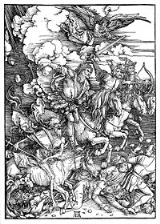
Woodcut—occasionally known as
xylography—is a
relief printA relief print is an image created by a printmaking process where protruding surface faces of the matrix are inked; recessed areas are ink free. Printing the image is therefore a relatively simple matter of inking the face of the matrix and bringing it in firm contact with the paper...
ing artistic technique in
printmakingPrintmaking is the process of making artworks by printing, normally on paper. Printmaking normally covers only the process of creating prints with an element of originality, rather than just being a photographic reproduction of a painting. Except in the case of monotyping, the process is capable...
in which an image is carved into the surface of a block of
woodWood is a hard, fibrous tissue found in many trees. It has been used for hundreds of thousands of years for both fuel and as a construction material. It is an organic material, a natural composite of cellulose fibers embedded in a matrix of lignin which resists compression...
, with the printing parts remaining level with the surface while the non-printing parts are removed, typically with gouges. The areas to show 'white' are cut away with a knife or chisel, leaving the characters or image to show in 'black' at the original surface level. The block is cut along the grain of the wood (unlike
wood engravingWood engraving is a technique in printmaking where the "matrix" worked by the artist is a block of wood. It is a variety of woodcut and so a relief printing technique, where ink is applied to the face of the block and printed by using relatively low pressure. A normal engraving, like an etching,...
where the block is cut in the end-grain). In Europe
beechBeech is a genus of ten species of deciduous trees in the family Fagaceae, native to temperate Europe, Asia and North America.-Habit:...
wood was most commonly used; in Japan, a special type of
cherryPrunus serrulata or Japanese Cherry; also called Hill Cherry, Oriental Cherry or East Asian Cherry, is a species of cherry native to Japan, Korea and China. It is known for its spring cherry blossom displays and festivals....
wood was used.
The surface is covered with ink by rolling over the surface with an ink-covered roller (
brayerA brayer is a hand roller used in printmaking techniques to spread ink in the process of offsetting an image from a plate to paper.-Materials:...
), leaving ink upon the flat surface but not in the non-printing areas.
Multiple colors can be printed by keying the paper to a frame around the woodblocks (where a different block is used for each color). The art of carving the woodcut can be called "xylography", but this is rarely used in English for images alone, although that and "xylographic" are used in connection with blockbooks, which are small books containing text and images in the same block.
Single-leaf woodcut is a term for a woodcut presented as a single image or
printAn old master print is a work of art produced by a printing process within the Western tradition . A date of about 1830 is usually taken as marking the end of the period whose prints are covered by this term. The main techniques concerned are woodcut, engraving and etching, although there are...
, as opposed to a book illustration.
Division of labour
In both Europe and the Far East, traditionally the artist only designed the woodcut, and the block-carving was left to specialist craftsmen, called block-cutters, or
Formschneider in Germany, some of whom became well-known in their own right - among the best known are the 16th century
Hieronymus AndreaeHieronymus Andreae, or Andreä, or Hieronymus Formschneider, was a German woodblock cutter , printer, publisher and typographer closely associated with Albrecht Dürer...
(who also used "Formschneider" as his surname),
Hans LützelburgerHans Lützelburger , also known as Hans Franck, was a German blockcutter for woodcuts, regarded as one of the finest of his day. He cut the blocks but as far as is known was not an artist himself...
and
Jost de NegkerJost de Negker was a cutter of woodcuts and also a printer and publisher of prints during the early 16th century, mostly in Augsburg, Germany. He was a leading "formschneider" or blockcutter of his day, but always to the design of an artist. He is "closely tied to the evolution of the fine...
, all of whom ran workshops and also operated as printers and publishers. The formschneider in turn handed the block on to specialist printers. There were further specialists who made the blank blocks.
There were various methods of transferring the artist's drawn design onto the block for the cutter to follow. Either the drawing would be made directly onto the block (often whitened first), or a
drawingDrawing is a form of visual art that makes use of any number of drawing instruments to mark a two-dimensional medium. Common instruments include graphite pencils, pen and ink, inked brushes, wax color pencils, crayons, charcoal, chalk, pastels, markers, styluses, and various metals .An artist who...
on paper was glued to the block. Either way, the artist's drawing was destroyed during the cutting process. Other methods were used, including tracing.
This is why woodcuts are sometimes described by museums or books as "designed by" rather than "by" an artist; but most authorities do not use this distinction. The division of labour had the advantage that a trained artist could adapt to the medium relatively easily, without needing to learn the use of
woodworkingWoodworking is the process of building, making or carving something using wood.-History:Along with stone, mud, and animal parts, wood was one of the first materials worked by early humans. Microwear analysis of the Mousterian stone tools used by the Neanderthals show that many were used to work wood...
tools.
In both Europe and the Far East, such as Japan and China, in the early twentieth century some artists began to do the whole process themselves. In Japan, this movement was called
Sōsaku hanga was an art movement in early 20th-century Japan, during the Taishō and Shōwa periods. It advocated the principles of "self-drawn" , "self-carved" and "self-printed" art, stressing the artist, motivated by a desire for self-expression, as the sole creator...
, as opposed to the
Shin hanga was an art movement in early 20th-century Japan, during the Taishō and Shōwa periods, that revitalized traditional ukiyo-e art rooted in the Edo and Meiji periods...
movement, which retained the traditional methods. In the West, many artists used the easier technique of
linocutLinocut is a printmaking technique, a variant of woodcut in which a sheet of linoleum is used for the relief surface. A design is cut into the linoleum surface with a sharp knife, V-shaped chisel or gouge, with the raised areas representing a reversal of the parts to show printed...
instead.
Methods of printing
Compared to
intaglioIntaglio is a family of printmaking techniques in which the image is incised into a surface, known as the matrix or plate, and the incised line or area holds the ink. Normally, copper or zinc plates are used as a surface, and the incisions are created by etching, engraving, drypoint, aquatint or...
techniques like
etchingEtching is the process of using strong acid or mordant to cut into the unprotected parts of a metal surface to create a design in intaglio in the metal...
and
engravingEngraving is the practice of incising a design on to a hard, usually flat surface, by cutting grooves into it. The result may be a decorated object in itself, as when silver, gold, steel, or glass are engraved, or may provide an intaglio printing plate, of copper or another metal, for printing...
, only low pressure is required to print. As a relief method, it is only necessary to ink the block and bring it into firm and even contact with the paper or cloth to achieve an acceptable print.
There are three methods of printing to consider:
- Stamping: Used for many fabrics and most early European woodcuts (1400–40). These were printed by putting the paper/fabric on a table or other flat surface with the block on top, & pressing or hammering the back of the block
- Rubbing: Apparently the most common method for Far Eastern printing on paper at all times. Used for European woodcuts and block-books later in the fifteenth century, and very widely for cloth. Also used for many Western woodcuts from about 1910 to the present. The block goes face up on a table, with the paper or fabric on top. The back is rubbed with a "hard pad, a flat piece of wood, a burnisher, or a leather frotton". A traditional Japanese tool used for this is called a baren
Baren is a Japanese hand tool used in printmaking processes such as woodcut or lino cut.The baren is a disk like device with a flat bottom and on the reverse side, a knotted handle...
. Later in Japan, complex wooden mechanisms were used to help hold the woodblock perfectly still and to apply proper pressure in the printing process. This was especially helpful once multiple colors began to be introduced, and needed to be applied with precision atop previous ink layers.
- Printing in a press: presses only seem to have been used in Asia in relatively recent times. Printing-presses were used from about 1480 for European prints and block-books, and before that for woodcut book illustrations. Simple weighted presses may have been used in Europe before the print-press, but firm evidence is lacking. A deceased Abbess of Mechelen
Mechelen Footnote: Mechelen became known in English as 'Mechlin' from which the adjective 'Mechlinian' is derived...
in 1465 had "unum instrumentum ad imprintendum scripturas et ymagines ... cum 14 aliis lapideis printis" - "an instrument for printing texts and pictures ... with 14 stones for printing" which is probably too early to be a Gutenberg-type printing press in that location.
History
Main articles Old master printAn old master print is a work of art produced by a printing process within the Western tradition . A date of about 1830 is usually taken as marking the end of the period whose prints are covered by this term. The main techniques concerned are woodcut, engraving and etching, although there are...
for Europe, Woodblock printing in JapanWoodblock printing in Japan is a technique best known for its use in the ukiyo-e artistic genre; however, it was also used very widely for printing books in the same period. Woodblock printing had been used in China for centuries to print books, long before the advent of movable type, but was only...
for Japan, and
LubokA lubok is a Russian popular print, characterized by simple graphics and narratives derived from literature, religious stories and popular tales. Lubki prints were used as decoration in houses and inns...
for Russia
In Europe, Woodcut is the oldest technique used for
old master printAn old master print is a work of art produced by a printing process within the Western tradition . A date of about 1830 is usually taken as marking the end of the period whose prints are covered by this term. The main techniques concerned are woodcut, engraving and etching, although there are...
s, developing about 1400, by using on paper existing techniques for printing on cloth. One of the ancient woodcut on paper you can see today is
The Fire Madonna (
Madonna del Fuoco, in Italian), in the Cathedral of
ForlìForlì is a comune and city in Emilia-Romagna, Italy, and is the capital of the province of Forlì-Cesena. The city is situated along the Via Emilia, to the right of the Montone river, and is an important agricultural centre...
, in
ItalyItaly , officially the Italian Republic languages]] under the European Charter for Regional or Minority Languages. In each of these, Italy's official name is as follows:;;;;;;;;), is a unitary parliamentary republic in South-Central Europe. To the north it borders France, Switzerland, Austria and...
.
The explosion of sales of cheap woodcuts in the middle of the century led to a fall in standards, and many popular prints were very crude. The development of
hatchingHatching is an artistic technique used to create tonal or shading effects by drawing closely spaced parallel lines...
followed on rather later than in
engravingEngraving is the practice of incising a design on to a hard, usually flat surface, by cutting grooves into it. The result may be a decorated object in itself, as when silver, gold, steel, or glass are engraved, or may provide an intaglio printing plate, of copper or another metal, for printing...
.
Michael WolgemutMichael Wolgemut was a German painter and printmaker, born in Nuremberg.-Biography:Little is known of Wolgemut's private life...
was significant in making German woodcut more sophisticated from about 1475, and
Erhard ReuwichErhard Reuwich was a Dutch artist, as a designer of woodcuts, and a printer, who came from Utrecht but then worked in Mainz. His dates and places of birth and death are unknown, but he was active in the 1480s....
was the first to use cross-hatching (far harder to do than in engraving or
etchingEtching is the process of using strong acid or mordant to cut into the unprotected parts of a metal surface to create a design in intaglio in the metal...
). Both of these produced mainly book-illustrations, as did various Italian artists who were also raising standards there at the same period. At the end of the century
Albrecht DürerAlbrecht Dürer was a German painter, printmaker, engraver, mathematician, and theorist from Nuremberg. His prints established his reputation across Europe when he was still in his twenties, and he has been conventionally regarded as the greatest artist of the Northern Renaissance ever since...
brought the Western woodcut to a level that has never been surpassed, and greatly increased the status of the
single-leaf (i.e. an image sold separately) woodcut.
As woodcut can be easily printed together with
movable typeMovable type is the system of printing and typography that uses movable components to reproduce the elements of a document ....
, because both are relief-printed, it was the main medium for book illustrations until the late-sixteenth century. The first woodcut book illustration dates to about 1461, only a few years after the beginning of printing with movable type, printed by Albrecht Pfister in
BambergBamberg is a city in Bavaria, Germany. It is located in Upper Franconia on the river Regnitz, close to its confluence with the river Main. Bamberg is one of the few cities in Germany that was not destroyed by World War II bombings because of a nearby Artillery Factory that prevented planes from...
. Woodcut was used less often for individual ("single-leaf") fine-art prints from about 1550 until the late nineteenth-century, when interest revived. It continued to be important for popular prints until the nineteenth century in most of Europe, and later in some places.
The art reached a high level of technical and artistic development in
East AsiaEast Asia or Eastern Asia is a subregion of Asia that can be defined in either geographical or cultural terms...
and
IranIran , officially the Islamic Republic of Iran , is a country in Southern and Western Asia. The name "Iran" has been in use natively since the Sassanian era and came into use internationally in 1935, before which the country was known to the Western world as Persia...
. In Japan woodblock printing is called "moku hanga", and was introduced in the seventeenth century for both books and art. The popular "floating world" genre of
ukiyo-e' is a genre of Japanese woodblock prints and paintings produced between the 17th and the 20th centuries, featuring motifs of landscapes, tales from history, the theatre, and pleasure quarters...
originated in the second half of the seventeenth century, with prints in monocrome or two colours. Sometimes these were hand-coloured after printing. Later prints with many colours were developed. Japanese woodcut became a major artistic form, although at the time it was accorded a much lower status than painting. It continued to develop through to the twentieth century.
White-line woodcut
This technique just carves the image in mostly thin lines, not unlike a rather crude engraving. The block is printed in the normal way, so that most of the print is black with the image created by white lines. This process was invented by the sixteenth-century Swiss artist
Urs GrafUrs Graf was a Swiss Renaissance painter and printmaker , as well as a mercenary soldier. He only produced two etchings, one of which dates from 1513 – the earliest known etching for which a date has been established...
, but became most popular in the nineteenth and twentieth century, often in a modified form where images used large areas of white-line contrasted with areas in the normal black-line style. This was pioneered by
Félix VallottonFélix Edouard Vallotton was a Swiss painter and printmaker associated with Les Nabis. He was an important figure in the development of the modern woodcut.-Life and work:...
.
Japonisme
In the 1860s, just as the Japanese themselves were becoming aware of Western art in general, Japanese prints began to reach Europe in considerable numbers, and became very fashionable, especially in France. They had a great influence on many artists, notably
Édouard ManetÉdouard Manet was a French painter. One of the first 19th-century artists to approach modern-life subjects, he was a pivotal figure in the transition from Realism to Impressionism....
,
Pierre BonnardPierre Bonnard was a French painter and printmaker, as well as a founding member of Les Nabis.-Biography:...
,
Henri de Toulouse-LautrecHenri Marie Raymond de Toulouse-Lautrec-Monfa or simply Henri de Toulouse-Lautrec was a French painter, printmaker, draughtsman, and illustrator, whose immersion in the colourful and theatrical life of fin de siècle Paris yielded an œuvre of exciting, elegant and provocative images of the modern...
,
Edgar DegasEdgar Degas[p] , born Hilaire-Germain-Edgar De Gas, was a French artist famous for his work in painting, sculpture, printmaking and drawing. He is regarded as one of the founders of Impressionism although he rejected the term, and preferred to be called a realist...
,
Paul GauguinEugène Henri Paul Gauguin was a leading French Post-Impressionist artist. He was an important figure in the Symbolist movement as a painter, sculptor, print-maker, ceramist, and writer...
,
Félix VallottonFélix Edouard Vallotton was a Swiss painter and printmaker associated with Les Nabis. He was an important figure in the development of the modern woodcut.-Life and work:...
and
Mary CassattMary Stevenson Cassatt was an American painter and printmaker. She lived much of her adult life in France, where she first befriended Edgar Degas and later exhibited among the Impressionists...
. In 1872 Jules Claretie dubbed the trend "Le Japonisme".
Though the Japanese influence was reflected in many artistic media, including painting, it did lead to a revival of the woodcut in Europe, which had been in danger of extinction as a serious art medium. Most of the artists above, except for Félix Vallotton and Paul Gauguin, in fact used
lithographyLithography is a method for printing using a stone or a metal plate with a completely smooth surface...
, especially for coloured prints. See below for Japanese influence in illustrations for children's books.
Artists, notably
Edvard MunchEdvard Munch was a Norwegian Symbolist painter, printmaker and an important forerunner of expressionist art. His best-known composition, The Scream, is part of a series The Frieze of Life, in which Munch explored the themes of love, fear, death, melancholia, and anxiety.- Childhood :Edvard Munch...
and Franz Masereel, continued to use the medium, which in
ModernismModernism, in its broadest definition, is modern thought, character, or practice. More specifically, the term describes the modernist movement, its set of cultural tendencies and array of associated cultural movements, originally arising from wide-scale and far-reaching changes to Western society...
came to appeal because it was relatively easy to complete the whole process, including printing, in a studio with little special equipment. The German Expressionists used woodcut a good deal.
Colour
Coloured woodcut first appeared in ancient China. The oldest known colored woodcuts are three Buddhist images dating back to the 10th century. European woodcut prints with coloured blocks were invented in Germany in 1508 and are known as
chiaroscuroChiaroscuro in art is "an Italian term which literally means 'light-dark'. In paintings the description refers to clear tonal contrasts which are often used to suggest the volume and modelling of the subjects depicted"....
woodcuts (see below). However colour did not become the norm, as it did in Japan, in the
ukiyo-e' is a genre of Japanese woodblock prints and paintings produced between the 17th and the 20th centuries, featuring motifs of landscapes, tales from history, the theatre, and pleasure quarters...
and other forms.
In Europe and Japan, colour woodcuts were normally only used for prints rather than book illustrations. In China, where the individual print did not develop until the nineteenth century, the reverse is true, and early colour woodcuts mostly occur in luxury books about art, especially the more prestigious medium of painting. The first known example is a book on ink-cakes printed in 1606, and colour technique reached its height in books on painting published in the seventeenth century. Notable examples are the
Treatise on the Paintings and Writings of the Ten Bamboo Studio of 1633, and the
Mustard Seed Garden Painting Manual published in 1679 and 1701.
In Japan colour technique, called
nishiki-erefers to Japanese multi-colored woodblock printing; this technique is used primarily in ukiyo-e. It was invented in the 1760s, and perfected and popularized by the printmaker Suzuki Harunobu, who produced a great many nishiki-e prints between 1765 and his death five years later.Previously, most...
in its fully developed form, spread more widely, and was used for prints, from the 1760s on. Text was nearly always monochrome, as were images in books, but the growth of the popularity of
ukiyo-e brought with it demand for ever increasing numbers of colors and complexity of techniques. By the nineteenth century most artists worked in colour. The stages of this development were:
- Sumizuri-e (墨摺り絵, "ink printed pictures") - monochrome printing using only black ink
- Benizuri-e
' are a type of “primitive” ukiyo-e style Japanese woodblock prints. They were usually printed in pink and green, occasionally with the addition of another color, either printed or added by hand. The production of benizuri-e reached its peak in the early 1740s...
(紅摺り絵, "crimson printed pictures") - red ink details or highlights added by hand after the printing process;green was sometimes used as well
- Tan-e (丹絵) - orange highlights using a red pigment called tan
- Aizuri-e
Aizuri-e literally means “blue printed picture”. The term usually refers to Japanese woodblock prints that are printed entirely or predominantly in blue. When a second color is used, it is usually red...
(藍摺り絵, "indigo printed pictures"), Murasaki-e (紫絵, "purple pictures"), and other styles in which a single color would be used in addition to, or instead of, black ink
- Urushi-e
Urushi-e , literally meaning "lacquer picture," refers to two types of Japanese artworks: paintings painted with actual lacquer, and particular woodblock printing styles which use regular ink but are said to resemble the darkness and thickness of black lacquer.-Prints:Urushi-e woodblock prints were...
(漆絵) - a method in which glue was used to thicken the ink, emboldening the image; gold, mica and other substances were often used to enhance the image further. Urushi-e can also refer to paintings using lacquerIn a general sense, lacquer is a somewhat imprecise term for a clear or coloured varnish that dries by solvent evaporation and often a curing process as well that produces a hard, durable finish, in any sheen level from ultra matte to high gloss and that can be further polished as required...
instead of paint; lacquerIn a general sense, lacquer is a somewhat imprecise term for a clear or coloured varnish that dries by solvent evaporation and often a curing process as well that produces a hard, durable finish, in any sheen level from ultra matte to high gloss and that can be further polished as required...
was very rarely if ever used on prints.
- Nishiki-e
refers to Japanese multi-colored woodblock printing; this technique is used primarily in ukiyo-e. It was invented in the 1760s, and perfected and popularized by the printmaker Suzuki Harunobu, who produced a great many nishiki-e prints between 1765 and his death five years later.Previously, most...
(錦絵, "brocade pictures") - a method in which multiple blocks were used for separate portions of the image, allowing a number of colors to be utilized to achieve incredibly complex and detailed images; a separate block would be carved to apply only to the portion of the image designated for a single color. Registration marks called kentō (見当) were used to ensure correspondence between the application of each block.
In the 19th century a number of different methods of colour printing using woodcut (technically
ChromoxylographyChromoxylography was a colour woodblock printing process popular from the mid 19th to the early 20th century, commonly used to produce illustrations in children's books, serial pulp magazine such as mysteries and romances, and cover art for yellow-backs and penny dreadfuls.In the 19th century...
) were developed in Europe. George Baxter patented in 1835 a method using an intaglio line plate (or occasionally a lithograph), printed in black or a dark colour, and then overprinted with up to twenty different colours from woodblocks.
Edmund EvansEdmund Evans was a prominent English wood engraver and colour printer during the Victorian era. Evans specialized in full-colour printing, which became popular in the mid-19th century...
used relief and wood throughout, with up to eleven different colours, and latterly specialized in illustrations for children's books, using fewer blocks but overprinting non-solid areas of colour to achieve blended colours. Artists such as
Randolph CaldecottRandolph Caldecott was a British artist and illustrator, born in Chester. The Caldecott Medal was named in his honor. He exercised his art chiefly in book illustrations. His abilities as an artist were promptly and generously recognized by the Royal Academy. Caldecott greatly influenced...
,
Walter CraneWalter Crane was an English artist and book illustrator. He is considered to be the most prolific and influential children’s book creator of his generation and, along with Randolph Caldecott and Kate Greenaway, one of the strongest contributors to the child's nursery motif that the genre of...
and
Kate GreenawayCatherine Greenaway , known as Kate Greenaway, was an English children's book illustrator and writer, who spent much of her childhood at Rolleston, Nottinghamshire. She studied at what is now the Royal College of Art in London, which at that time had a separate section for women, and was headed by...
were able to draw influence from the Japanese prints now available and
fashionableJaponism, or Japonisme, the original French term, was first used in 1872 by Jules Claretie in his book L'Art Francais en 1872 and by Philippe Burty in Japanisme III. La Renaissance Literaire et Artistique in the same year...
in Europe to create a suitable style, with flat areas of colour.
In the 20th century,
Ernst Ludwig KirchnerErnst Ludwig Kirchner was a German expressionist painter and printmaker and one of the founders of the artists group Die Brücke or "The Bridge", a key group leading to the foundation of Expressionism in 20th century art. He volunteered for army service in the First World War, but soon suffered a...
of the
Die BrückeDie Brücke was a group of German expressionist artists formed in Dresden in 1905, after which the Brücke Museum in Berlin was named. Founding members were Fritz Bleyl, Erich Heckel, Ernst Ludwig Kirchner and Karl Schmidt-Rottluff. Later members were Emil Nolde, Max Pechstein and Otto Mueller...
group developed a process of producing colored woodcut prints using a single block applying different colors to the block with a brush
à la poupée and then printing (halfway between a woodcut and a monotype). A remarkable example of this technique is the 1915
Portrait of Otto MüllerOtto Mueller or Müller was a German painter and printmaker of the Die Brücke expressionist movement.-Life and work:...
woodcut print from the collection of the
British MuseumThe British Museum is a museum of human history and culture in London. Its collections, which number more than seven million objects, are amongst the largest and most comprehensive in the world and originate from all continents, illustrating and documenting the story of human culture from its...
.
Chiaroscuro woodcuts
ChiaroscuroChiaroscuro in art is "an Italian term which literally means 'light-dark'. In paintings the description refers to clear tonal contrasts which are often used to suggest the volume and modelling of the subjects depicted"....
woodcuts do not necessarily feature strong contrasts of light and dark, but are
old master printAn old master print is a work of art produced by a printing process within the Western tradition . A date of about 1830 is usually taken as marking the end of the period whose prints are covered by this term. The main techniques concerned are woodcut, engraving and etching, although there are...
s in woodcut using two or more blocks printed in different colours. They were first invented by
Hans BurgkmairHans Burgkmair the elder was a German painter and printmaker in woodcut.Burgkmair was born in Augsburg, the son of painter Thomas Burgkmair and his son, Hans the Younger, became one too. From 1488 he was a pupil of Martin Schongauer in Colmar, who died during his two years there, before Burgkmair...
in Germany in 1508, and first made in Italy by
Ugo da CarpiUgo da Carpi , painter and printmaker, the first Italian practitioner of the art of the chiaroscuro woodcut, a technique involving the use of several wood blocks to make one print, each block cut to produce a different tone of the same colour...
a few years later.
http://www.metmuseum.org/toah/hd/wdct/ho_17.50.1.htm Other printmakers to use the technique include
CranachLucas Cranach the Elder , was a German Renaissance painter and printmaker in woodcut and engraving...
, Hans Baldung Grien and
ParmigianinoGirolamo Francesco Maria Mazzola , also known as Francesco Mazzola or more commonly as Parmigianino or sometimes "Parmigiano", was an Italian Mannerist painter and printmaker active in Florence, Rome, Bologna, and his native city of Parma...
. In Germany the technique was only in use for a few years, but Italians continued to use it throughout the sixteenth century, and later artists like Goltzius sometimes made use of it. In the German style, one block usually had only lines and is called the "line block", whilst the other block or blocks had flat areas of colour and are called "tone blocks". The Italians usually used only tone blocks, for a very different effect, much closer to the drawings the term was originally used for, or watercolours.
Examples
Europe
- Ars moriendi
The Ars moriendi are two related Latin texts dating from about 1415 and 1450 which offer advice on the protocols and procedures of a good death, explaining how to "die well" according to Christian precepts of the late Middle Ages...
- Dürer's Rhinoceros
Dürer's Rhinoceros is the name commonly given to a woodcut executed by German painter and printmaker Albrecht Dürer in 1515. The image was based on a written description and brief sketch by an unknown artist of an Indian rhinoceros that had arrived in Lisbon earlier that year. Dürer never saw the...
- Emblem book
Emblem books are a category of mainly didactic illustrated book printed in Europe during the 16th and 17th centuries, typically containing a number of emblematic images with explanatory text....
- Four horsemen of the Apocalypse
The Four Horsemen of the Apocalypse are described in the last book of the New Testament of the Bible, called the Book of Revelation of Jesus Christ to Saint John the Evangelist at 6:1-8. The chapter tells of a "'book'/'scroll' in God's right hand that is sealed with seven seals"...
- Hypnerotomachia Poliphili
Hypnerotomachia Poliphili , called in English Poliphilo's Strife of Love in a Dream, is a romance said to be by Francesco Colonna and a famous example of early printing...
- Just So Stories
The Just So Stories for Little Children were written by British author Rudyard Kipling. They are highly fantasised origin stories and are among Kipling's best known works.-Description:...
- Lubok
A lubok is a Russian popular print, characterized by simple graphics and narratives derived from literature, religious stories and popular tales. Lubki prints were used as decoration in houses and inns...
prints
Japan
- 36 Views of Mount Fuji (Hokusai)
is an ukiyo-e series of large, color woodblock prints by the Japanese artist Katsushika Hokusai . The series depicts Mount Fuji in differing seasons and weather conditions from a variety of different places and distances. It actually consists of 46 prints created between 1826 and 1833...
- The Dream of the Fisherman's Wife
, also known as Girl Diver and Octopi, Diver and Two Octopi, etc., is an erotic woodcut of the ukiyo-e genre by the Japanese artist Hokusai. It is from the book Kinoe no Komatsu , a three-volume collection of shunga erotic prints first published in 1814, and is the most famous shunga Hokusai ever...
- Ukiyo-e
' is a genre of Japanese woodblock prints and paintings produced between the 17th and the 20th centuries, featuring motifs of landscapes, tales from history, the theatre, and pleasure quarters...
Artists
- Aubrey Beardsley
Aubrey Vincent Beardsley was an English illustrator and author. His drawings, done in black ink and influenced by the style of Japanese woodcuts, emphasized the grotesque, the decadent, and the erotic. He was a leading figure in the Aesthetic movement which also included Oscar Wilde and James A....
- Hans Baldung
Hans Baldung, known as Hans Baldung Grien/Grün was a German Renaissance artist in painting and printmaking in woodcut. He was considered the most gifted student of Albrecht Dürer.-Life:...
- Leonard Baskin
Leonard Baskin was an American sculptor, book-illustrator, wood-engraver, printmaker, graphic artist, writer and teacher.-Life and work:...
- Gustave Baumann
Gustave Baumann was a printmaker and painter, and one of the leading figures of the color woodcut revival in America. His works have been shown at the New York Metropolitan Museum of Art, the National Gallery of Art in Washington DC, and the New Mexico Museum of Art...
- Max Beckmann
Max Beckmann was a German painter, draftsman, printmaker, sculptor, and writer. Although he is classified as an Expressionist artist, he rejected both the term and the movement...
- Carroll Thayer Berry
Carroll Thayer Berry was an American artist who grew up in Maine, and whose work is often said to be emblematic of New England, especially the seacoast. In addition, he was one of first U.S. artists to be assigned to camouflage in World War I.-Early life:Berry was born and raised in New...
- Torsten Billman
- Erich Buchholz
Erich Buchholz was a German artist in painting and printmaking. He was a central figure in the development of non-objective or concrete art in Berlin between 1918 and 1924. He interrupted his artistic activity in 1925, first because of economic hardship and, from 1933, as he was forbidden to paint...
- Hans Burgkmair
Hans Burgkmair the elder was a German painter and printmaker in woodcut.Burgkmair was born in Augsburg, the son of painter Thomas Burgkmair and his son, Hans the Younger, became one too. From 1488 he was a pupil of Martin Schongauer in Colmar, who died during his two years there, before Burgkmair...
- Domenico Campagnola
Domenico Campagnola was an Italian painter and printmaker in engraving and woodcut of the Venetian Renaissance, but whose most influential works were his drawings of landscapes.-Life and work:...
- Ugo da Carpi
Ugo da Carpi , painter and printmaker, the first Italian practitioner of the art of the chiaroscuro woodcut, a technique involving the use of several wood blocks to make one print, each block cut to produce a different tone of the same colour...
- Billy Childish
Billy Childish is an English artist, painter, author, poet, photographer, film maker, singer and guitarist...
- Gustave Doré
Paul Gustave Doré was a French artist, engraver, illustrator and sculptor. Doré worked primarily with wood engraving and steel engraving.-Biography:...
- Werner Drewes
- Albrecht Dürer
Albrecht Dürer was a German painter, printmaker, engraver, mathematician, and theorist from Nuremberg. His prints established his reputation across Europe when he was still in his twenties, and he has been conventionally regarded as the greatest artist of the Northern Renaissance ever since...
- M. C. Escher
Maurits Cornelis Escher , usually referred to as M. C. Escher , was a Dutch graphic artist. He is known for his often mathematically inspired woodcuts, lithographs, and mezzotints...
- James Flora
James "Jim" Flora , best known for his distinctive and idiosyncratic album cover art for RCA Victor and Columbia Records during the 1940s and 1950s, was also a prolific commercial illustrator from the 1940s to the 1970s and the author/illustrator of 17 popular children's books...
- Antonio Frasconi
Antonio Frasconi is an artist known for his woodcuts. He has won a number of awards and illustrated over 100 books. His major work took ten years to complete and is a series of woodcuts that illustrate "The Disappeared"...
- Vincent Van Gogh
Vincent Willem van Gogh , and used Brabant dialect in his writing; it is therefore likely that he himself pronounced his name with a Brabant accent: , with a voiced V and palatalized G and gh. In France, where much of his work was produced, it is...
- Urs Graf
Urs Graf was a Swiss Renaissance painter and printmaker , as well as a mercenary soldier. He only produced two etchings, one of which dates from 1513 – the earliest known etching for which a date has been established...
- Suzuki Harunobu
was a Japanese woodblock print artist, one of the most famous in the Ukiyo-e style. He was an innovator, the first to produce full-color prints in 1765, rendering obsolete the former modes of two- and three-color prints. Harunobu used many special techniques, and depicted a wide variety of...
- Hiroshige
was a Japanese ukiyo-e artist, and one of the last great artists in that tradition. He was also referred to as Andō Hiroshige and by the art name of Ichiyūsai Hiroshige ....
- Jacques Hnizdovsky
Jacques Hnizdovsky , was a Ukrainian-American painter, printmaker, sculptor, ex libris designer, book illustrator, and art historian.- Biography :...
- Hokusai
was a Japanese artist, ukiyo-e painter and printmaker of the Edo period. He was influenced by such painters as Sesshu, and other styles of Chinese painting...
- Tom Huck
Tom Huck is an American printmaker best known for his large scale satirical woodcuts. He lives and works in St. Louis, Missouri where he runs his own press, Evil Prints. He is a regular contributor to BLAB! of Fantagraphics Books. His work draws heavily upon the influence of Albrecht Dürer, José...
- Alfred Garth Jones
Alfred Garth Jones was an English artist and illustrator who worked mainly in woodcut, pen and ink line art drawing and watercolour.-Early life:...
- Ernst Ludwig Kirchner
Ernst Ludwig Kirchner was a German expressionist painter and printmaker and one of the founders of the artists group Die Brücke or "The Bridge", a key group leading to the foundation of Expressionism in 20th century art. He volunteered for army service in the First World War, but soon suffered a...
- Käthe Kollwitz
Käthe Kollwitz was a German painter, printmaker, and sculptor whose work offered an eloquent and often searing account of the human condition in the first half of the 20th century...
- J.J. Lankes
- Frans Masereel
Frans Masereel was a Flemish painter and graphic artist who worked mainly in France. He is known especially for his woodcuts. His greatest work is generally said to be the wordless graphic novel Mon Livre d'Heures . He completed over 20 other wordless novels in his career...
- Hishikawa Moronobu
was a Japanese painter and printmaker known for his advancement of the ukiyo-e woodcut style starting in the 1670s.-Early life and training:Moronobu was the son of a well-respected dyer and a gold and silver-thread embroiderer in the village of Hodamura, Awa Province, near Edo Bay. After moving to...
- Edvard Munch
Edvard Munch was a Norwegian Symbolist painter, printmaker and an important forerunner of expressionist art. His best-known composition, The Scream, is part of a series The Frieze of Life, in which Munch explored the themes of love, fear, death, melancholia, and anxiety.- Childhood :Edvard Munch...
- Giovanni Battista Palumba
- Jacob Pins
Jacob Otto Pins was a German-Israeli woodcut artist and notable art collector, particularly of Japanese prints and paintings....
- J. G. Posada
- Endi E. Poskovic
Endi Poskovic is a Bosnian-American artist and printmaker whose graphic work merges visual representation with text, often shifting the reading of the imagery through continuous representation and re-contextualization...
- Mark Rowden
Mark Rowden was born in Margate, England in 1979. He left school to study full time at a local art college. Finishing this course after a year he then moved to Sydney, Australia, in the late-1990s...
- Hannah Tompkins
Hannah Tompkins was an American artist primarily known for her large body of artwork based on the writings of William Shakespeare...
- Urs Graf
Urs Graf was a Swiss Renaissance painter and printmaker , as well as a mercenary soldier. He only produced two etchings, one of which dates from 1513 – the earliest known etching for which a date has been established...
- Helen K. Siegl
- Utamaro
was a Japanese printmaker and painter, who is considered one of the greatest artists of woodblock prints . His name was romanized as Outamaro. He is known especially for his masterfully composed studies of women, known as bijinga...
- Félix Vallotton
Félix Edouard Vallotton was a Swiss painter and printmaker associated with Les Nabis. He was an important figure in the development of the modern woodcut.-Life and work:...
- Susan Dorothea White
Susan Dorothea White , also called Sue White and Susan White, is an Australian painter, sculptor, and printmaker. She is a narrative artist and her work concerns the natural world and human situation, increasingly incorporating satire and irony to convey her concern for human rights and equality...
- Mary Azarian
Mary Azarian is an American woodcut artist and children's book illustrator. In 1999 she won the Caldecott Medal for her book, Snowflake Bentley, a picture book of the life of Wilson Bentley....
- Hussein el gebaly
- Artist Biography :Hussein El Gebaly , born in 1934 in Giza, Egypt.Diploma of the Faculty of Fine Arts in Cairo in 1958.Diploma of the Higher Institute for Artistic Education in 1959....
See also
- Blockbooks - Medieval European books with both text and pictures in woodcut
- Carving
- Chiaroscuro
Chiaroscuro in art is "an Italian term which literally means 'light-dark'. In paintings the description refers to clear tonal contrasts which are often used to suggest the volume and modelling of the subjects depicted"....
- Western woodcuts in colour
- Cordel literature
Cordel literature are popular and inexpensively printed booklets or pamphlets containing folk novels, poems and songs, which are produced and sold in fairs and by sidestreet vendors in the Northeast of Brazil...
- Popular Brazilian woodcut books
- Linocut
Linocut is a printmaking technique, a variant of woodcut in which a sheet of linoleum is used for the relief surface. A design is cut into the linoleum surface with a sharp knife, V-shaped chisel or gouge, with the raised areas representing a reversal of the parts to show printed...
- Metalcut
Metalcut is a relief printmaking technique, belonging to the category of old master prints. It was almost entirely restricted to the period from about 1450 to 1540, and mostly to the region around the Rhine in Northern Europe, the Low Countries, Germany, France and Switzerland; the technique...
- relief prints from metal plates
- Old master print
An old master print is a work of art produced by a printing process within the Western tradition . A date of about 1830 is usually taken as marking the end of the period whose prints are covered by this term. The main techniques concerned are woodcut, engraving and etching, although there are...
- Social and Art History of the woodcut and other print techniques
- Printmaking
Printmaking is the process of making artworks by printing, normally on paper. Printmaking normally covers only the process of creating prints with an element of originality, rather than just being a photographic reproduction of a painting. Except in the case of monotyping, the process is capable...
- main article covering all techniques
- Relief print
A relief print is an image created by a printmaking process where protruding surface faces of the matrix are inked; recessed areas are ink free. Printing the image is therefore a relatively simple matter of inking the face of the matrix and bringing it in firm contact with the paper...
- Rubber stamp
Rubber stamping, also called stamping, is a craft in which some type of ink made of dye or pigment is applied to an image or pattern that has been carved, molded, laser engraved or vulcanized, onto a sheet of rubber. The rubber is often mounted onto a more stable object such as a wood, brick or an...
- Scandinavian flat-plane style of woodcarving
The Scandinavian flat-plane style of woodcarving is a style of figure carving. The figures are carved in large flat planes, created primarily using a carving knife. Tool marks are left in the carving and very little rounding or sanding is done...
- Shin hanga
was an art movement in early 20th-century Japan, during the Taishō and Shōwa periods, that revitalized traditional ukiyo-e art rooted in the Edo and Meiji periods...
- 20th century "New Prints" movement in Japan
- Sōsaku hanga
was an art movement in early 20th-century Japan, during the Taishō and Shōwa periods. It advocated the principles of "self-drawn" , "self-carved" and "self-printed" art, stressing the artist, motivated by a desire for self-expression, as the sole creator...
- 20th century "Creative Prints" movement in Japan
- Wood carving
Wood carving is a form of working wood by means of a cutting tool in one hand or a chisel by two hands or with one hand on a chisel and one hand on a mallet, resulting in a wooden figure or figurine, or in the sculptural ornamentation of a wooden object...
- wood engraving
Wood engraving is a technique in printmaking where the "matrix" worked by the artist is a block of wood. It is a variety of woodcut and so a relief printing technique, where ink is applied to the face of the block and printed by using relatively low pressure. A normal engraving, like an etching,...
- invented by Bewick; much used
- Woodblock printing
Woodblock printing is a technique for printing text, images or patterns used widely throughout East Asia and originating in China in antiquity as a method of printing on textiles and later paper....
- Overview of history, including non-artistic uses
- Ukiyo-e
' is a genre of Japanese woodblock prints and paintings produced between the 17th and the 20th centuries, featuring motifs of landscapes, tales from history, the theatre, and pleasure quarters...
- main article on 19th century Japanese woodcut prints
External links