
|
|
|
|
Zima
|
| |
|
| |
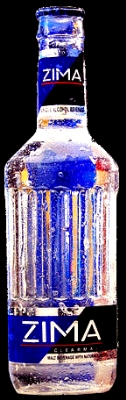
Zima was a lightly-carbonated clear beverage made and distributed by the Coors Brewing Company, ultimately MillerCoors. Introduced in 1993, it was marketed not as a beer, but as an alternative to beer, an early example of what is now often referred to as alcopop. Its production ceased in October 2008, and distribution from existing inventory anticipated through December.
directly means "winter" in Bosnian, Croatian, Macedonian, Polish, Czech, Serbian, Slovak, and Slovene and in transliteration from Bulgarian, Belarusian and Russian languages; the name is also reminiscent of zymurgy, the science of fermentation, or brew-making.

Discussion
Ask a question about 'Zima'
Start a new discussion about 'Zima'
Answer questions from other users
|
Encyclopedia
Zima was a lightly-carbonated clear beverage made and distributed by the Coors Brewing Company, ultimately MillerCoors. Introduced in 1993, it was marketed not as a beer, but as an alternative to beer, an early example of what is now often referred to as alcopop. Its production ceased in October 2008, and distribution from existing inventory anticipated through December.
History
Zima directly means "winter" in Bosnian, Croatian, Macedonian, Polish, Czech, Serbian, Slovak, and Slovene and in transliteration from Bulgarian, Belarusian and Russian languages; the name is also reminiscent of zymurgy, the science of fermentation, or brew-making. It was launched nationally in the United States as Zima Clearmalt in 1993 after being test-marketed two years earlier in the cities of Nashville, Sacramento, and Syracuse. The lemon-lime drink was part of the "clear craze" of the 1990s that produced products such as Crystal Pepsi and Tab Clear. The slogans used in early advertisements for Zima were "a truly unique alcohol beverage" and "Zomething different," and that was certainly true in one sense—Zima was literally in a category by itself—an alcoholic beverage that wasn't beer (at least, not obviously), wasn't wine, and wasn't hard alcohol.
Zima offered an alternative to the then-successful wine cooler category, and it became faddishly popular. The fact that Zima was a malt-based beverage gave it an advantage over wine coolers in many American markets, since many locations in the U.S. allow beer to be sold in convenience stores and supermarkets, while wine-based beverages can only legally be sold in liquor stores—even if they have an alcohol content comparable to a bottle of beer. Coors spent $50 million marketing Zima in its first year, persuading nearly half of American alcohol drinkers to try it. Brandweek Magazine reported that at Zima's peak in 1994, 1.2 million barrels of the beverage were sold. Originally popular among young women, Coors made its first attempt at attracting young men to the brand in 1995 by marketing Zima Gold; the drink was unpopular and disappeared from store shelves within the year.
Zima was associated with an urban myth which variously spread claiming that the beverage did not contain alcohol, or that its alcohol content would not register on alcohol-breath-test equipment; the myths were alleged to have improved the beverage's popularity among teenagers.
In describing the "The Long, Slow, Torturous Death of Zima", writer Brendan Koerner cited Zima's perceived reputation as a "girly-man" beverage and its persistent parodization by late-night TV host David Letterman. The Chicago Tribune quoted distributors ordered to stock "caffeinated alcoholic beverage Sparks on retail store shelves to make up for Zima’s absence."
Competitors to Zima in the US have included Miller's Qube and Stroh's Clash, which are no longer made today. In 2000, Smirnoff launched Smirnoff Ice, which outsold Zima in its latter years.
In the late 2000's, the beverage was marketed in three flavors other than the original formula:
- ZIMA Citrus
- ZIMA Tangerine
- ZIMA Pineapple Citrus
On October 20, 2008, MillerCoors LLC announced that it had discontinued production of Zima, choosing instead to focus on other "malternative" beverages.
In popular culture
In an episode of The Simpsons, "A Fish Called Selma", a character said "Excuse me, I ordered a Zima, not Emphysema!" In the episode Co-Dependent's Day, Homer Vows To Give Up all clear alcohol and Marge asks "even Zima?". In the episode "Homer vs. Patty and Selma", Lenny and Carl persuade Homer to go to Moe's for a Zima after work, and in "That 90's Show" Homer is drinking a Zima.
In Futurama episode "The Route of All Evil", Fry complains that the metal shavings in Pabst Blue Robot make his throat bloody, to which Bender riposted, "Wah, wah, wah. Baby wants a Zima."
In MadTV, the character Rusty makes several references to Zima.
In Gilmore Girls, Luke and Lorelei celebrate their engagement by toasting Zimas.
In Friends, Joey suggests they order Zima after Ross invites his colleagues to his bachelor party.
In the novel jPod by Douglas Coupland, Zima is referenced and discussed several times. One character even suggests that "drinking Zima is something Douglas Coupland would make a character do" in order "to locate the characters in time and a specific sort of culture".
In Buffy the Vampire Slayer episode "Storyteller", Andrew Wells says to Buffy Summers "But it tickles and I’m all tense. Can’t I have a cool refreshing Zima?" Buffy answers "No Zima!" and Spike adds "Shut your face about the Zima. Just talk."
In Drawn Together episode "A Very Special Drawn Together Afterschool Special", the cast helps gay character Xandir practice coming out of the closet to his parents by role-playing. Toots, acting as his mother calls Captain Hero, acting as his father, "Zima Dick" to which he retorts "Zima helps me relax!"
Zima is referenced in an episode of Babylon 5 as being a drink still produced (or produced again) in the year 2259.
On December 02, 2008 on The Colbert Report, host Stephen Colbert drank a sip of Zima to cool down. His response after the sip was "Mmm... That is bottled crap."
External links
|
| |
|
|