
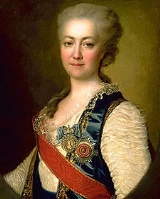
Princess
Yekaterina Romanovna Vorontsova-Dashkova (28 March [17 March o.s.] 1743 – 15 January [4 January o.s.] 1810, though her memoirs list her birth date as 1744, they are footnoted as a "slip of the pen") was the closest female friend of Empress
Catherine the GreatCatherine II, also known as Catherine the Great , Empress of Russia, was born in Stettin, Pomerania, Prussia on as Sophie Friederike Auguste von Anhalt-Zerbst-Dornburg...
and a major figure of the
Russian EnlightenmentThe Russian Age of Enlightenment was a period in the eighteenth century in which the government began to actively encourage the proliferation of arts and sciences. This time gave birth to the first Russian university, library, theatre, public museum, and relatively independent press...
. Her name was often spelt in English as
Princess Dashkov.
Early life
Born Countess Catherine Vorontsova, she was the third daughter of Count Roman Vorontsov, a member of the
SenateThe Governing Senate was a legislative, judicial, and executive body of Russian Monarchs, instituted by Peter the Great to replace the Boyar Duma and lasted until the very end of the Russian Empire. It was chaired by the Ober-Procurator...
, distinguished for her intellectual gifts. Her uncle
Mikhail IllarionovichCount Mikhail Illarionovich Vorontsov was a Russian statesman and diplomat, who laid foundations for the fortunes of the Vorontsov family....
and brother
Alexander RomanovichCount Alexander Romanovich Vorontsov was the Russian imperial chancellor during the early years of Alexander I's reign....
both served as Imperial Chancellors, while her brother
SemyonCount Semyon Romanovich Vorontsov was a Russian diplomat whose siblings included Alexander Vorontsov, Elizaveta Vorontsova, and Ekaterina Dashkova...
was Russian ambassador to Great Britain, and a celebrated Anglophile. She received an exceptionally good education, having displayed from very early age the abilities and tastes which made her whole career so singular. She was well versed in
mathematicsMathematics is the study of quantity, space, structure, and change. Mathematicians seek out patterns and formulate new conjectures. Mathematicians resolve the truth or falsity of conjectures by mathematical proofs, which are arguments sufficient to convince other mathematicians of their validity...
, which she studied at the
University of MoscowLomonosov Moscow State University , previously known as Lomonosov University or MSU , is the largest university in Russia. Founded in 1755, it also claims to be one of the oldest university in Russia and to have the tallest educational building in the world. Its current rector is Viktor Sadovnichiy...
. In general
literatureLiterature is the art of written works, and is not bound to published sources...
, her favorite authors were
BaylePierre Bayle was a French philosopher and writer best known for his seminal work the Historical and Critical Dictionary, published beginning in 1695....
,
MontesquieuCharles-Louis de Secondat, baron de La Brède et de Montesquieu , generally referred to as simply Montesquieu, was a French social commentator and political thinker who lived during the Enlightenment...
,
BoileauNicolas Boileau-Despréaux was a French poet and critic.-Biography:Boileau was born in the rue de Jérusalem, in Paris, France. He was brought up to the law, but devoted to letters, associating himself with La Fontaine, Racine, and Molière...
,
VoltaireFrançois-Marie Arouet , better known by the pen name Voltaire , was a French Enlightenment writer, historian and philosopher famous for his wit and for his advocacy of civil liberties, including freedom of religion, free trade and separation of church and state...
and
HelvétiusClaude Adrien Helvétius was a French philosopher and littérateur.-Life:...
.
Catherine's coup d'état
While still a girl, she was connected with the Russian court, and became one of the leaders of the party that attached itself to the Grand Duchess Catherine Alexeyevna.
Before she was sixteen, she married Prince Mikhail Ivanovich Dashkov (1736–1764), a prominent Russian nobleman of
RurikidThe Rurik dynasty or Rurikids was a dynasty founded by the Varangian prince Rurik, who established himself in Novgorod around the year 862 AD...
stock, in February 1759, and went to reside with him in
MoscowMoscow is the capital, the most populous city, and the most populous federal subject of Russia. The city is a major political, economic, cultural, scientific, religious, financial, educational, and transportation centre of Russia and the continent...
. She learned Russian there to communicate with her in-laws. After the death of Prince Dashkov, she gave herself up to her children, to literature, and to politics.
In 1762, she was at
Saint PetersburgSaint Petersburg is a city and a federal subject of Russia located on the Neva River at the head of the Gulf of Finland on the Baltic Sea...
and took, according to her own account, the leading part in the
coup d'étatA coup d'état state, literally: strike/blow of state)—also known as a coup, putsch, and overthrow—is the sudden, extrajudicial deposition of a government, usually by a small group of the existing state establishment—typically the military—to replace the deposed government with another body; either...
by which Catherine was raised to the throne. Another course of events would probably have resulted in the elevation of the Princess Dashkov's elder sister,
ElizabethElizaveta Romanovna Vorontsova was a mistress of Emperor Peter III of Russia. During their affair, Peter was rumored to have intentions of divorcing his wife Catherine to marry Vorontsova....
, who was the former emperor's mistress, and in whose favor he made no secret of his intention to depose Catherine.
Foreign travels
Her relations with the new empress were not of cordial nature, though she continued to be devotedly loyal. She often disliked the men Catherine the Great chose to take as lovers, and often resented the graces and devotion shown to them by the Empress. Her blunt manners, her unconcealed scorn of the male favorites that in her eye disgraced the court, and perhaps also her sense of unrequited merit, produced an estrangement between her and the empress, which ended in her asking permission to travel abroad. Permission was granted, and shortly thereafter she departed, but remained a loyal supporter of Catherine, and the two women remained friends. The true cause of her request to leave was said to have been the refusal by Catherine the Great of her request to be appointed
colonelColonel , abbreviated Col or COL, is a military rank of a senior commissioned officer. It or a corresponding rank exists in most armies and in many air forces; the naval equivalent rank is generally "Captain". It is also used in some police forces and other paramilitary rank structures...
of the imperial guards.
Her husband having meanwhile died, she set out in 1768 on an extended tour through
EuropeEurope is, by convention, one of the world's seven continents. Comprising the westernmost peninsula of Eurasia, Europe is generally 'divided' from Asia to its east by the watershed divides of the Ural and Caucasus Mountains, the Ural River, the Caspian and Black Seas, and the waterways connecting...
. She was received with great consideration at foreign courts, and her literary and scientific reputation procured her the entree to the society of the learned in most of the capitals of Europe.
In
ParisParis is the capital and largest city in France, situated on the river Seine, in northern France, at the heart of the Île-de-France region...
, she secured the warm friendship and admiration of
DiderotDenis Diderot was a French philosopher, art critic, and writer. He was a prominent person during the Enlightenment and is best known for serving as co-founder and chief editor of and contributor to the Encyclopédie....
and
VoltaireFrançois-Marie Arouet , better known by the pen name Voltaire , was a French Enlightenment writer, historian and philosopher famous for his wit and for his advocacy of civil liberties, including freedom of religion, free trade and separation of church and state...
. She showed in various ways a strong liking for
BritainThe United Kingdom of Great Britain and Northern IrelandIn the United Kingdom and Dependencies, other languages have been officially recognised as legitimate autochthonous languages under the European Charter for Regional or Minority Languages...
and the
BritishThe British are citizens of the United Kingdom, of the Isle of Man, any of the Channel Islands, or of any of the British overseas territories, and their descendants...
. She corresponded with
GarrickDavid Garrick was an English actor, playwright, theatre manager and producer who influenced nearly all aspects of theatrical practice throughout the 18th century and was a pupil and friend of Dr Samuel Johnson...
,
Dr. BlairHugh Blair FRSE was a Scottish minister of religion, author and rhetorician, considered one of the first great theorists of written discourse....
, and
Principal RobertsonWilliam Robertson FRSE FSA was a Scottish historian, minister of religion, and Principal of the University of Edinburgh...
; and when in
EdinburghEdinburgh is the capital city of Scotland, the second largest city in Scotland, and the eighth most populous in the United Kingdom. The City of Edinburgh Council governs one of Scotland's 32 local government council areas. The council area includes urban Edinburgh and a rural area...
, where she was very well received, she arranged to entrust the education of her son, Pavel Michailovich, Prince Dashkov to Principal Robertson.
She lived in Edinburgh from 1777 to 1779, and donated a collection of Russian commemorative medals to the
University of EdinburghThe University of Edinburgh, founded in 1583, is a public research university located in Edinburgh, the capital of Scotland, and a UNESCO World Heritage Site. The university is deeply embedded in the fabric of the city, with many of the buildings in the historic Old Town belonging to the university...
. Her son became an adjutant of Grigory Potyomkin.
She travelled in
IrelandIreland is an island to the northwest of continental Europe. It is the third-largest island in Europe and the twentieth-largest island on Earth...
, where she can be seen watching a review of the
Irish VolunteersThe Irish Volunteers were a militia in late 18th century Ireland. The Volunteers were founded in Belfast in 1778 to defend Ireland from the threat of foreign invasion when regular British soldiers were withdrawn from Ireland to fight across the globe during the American War of Independence...
in a picture by
Francis WheatleyFrancis Wheatley was an English portrait and landscape painter.-Life and work:Wheatley was born at Wild Court, Covent Garden, London, the son of a master tailor. He studied at William Shipley's drawing school and the Royal Academy, and won several prizes from the Society of Arts...
in November 1779. She was friends with Georgiana Shipley, daughter of
Jonathan ShipleyJonathan Shipley was the son of a London stationer; his mother's family were owners of Twyford House, a large manor in Winchester, England. He was ordained a minister in the Church of England and became both Bishop of Llandaff and Bishop of St Asaph.Jonathan grew up at Walbrook in the City of...
, in London. She met
Benjamin FranklinDr. Benjamin Franklin was one of the Founding Fathers of the United States. A noted polymath, Franklin was a leading author, printer, political theorist, politician, postmaster, scientist, musician, inventor, satirist, civic activist, statesman, and diplomat...
in Paris on 3 February 1781.
Exhibitions
"The Princess and the Patriot: Ekaterina Dashkova, Benjamin Franklin and the Age of Enlightenment" exhibition was held in Philadelphia, U.S.A., from February to December 2006.
Benjamin FranklinDr. Benjamin Franklin was one of the Founding Fathers of the United States. A noted polymath, Franklin was a leading author, printer, political theorist, politician, postmaster, scientist, musician, inventor, satirist, civic activist, statesman, and diplomat...
and Dashkova met only once, in
ParisParis is the capital and largest city in France, situated on the river Seine, in northern France, at the heart of the Île-de-France region...
in 1781. Franklin was 75 and Dashkova was 37. Franklin and Dashkova were both evidently impressed with each other. Franklin invited Dashkova to become the first woman to join the
American Philosophical SocietyThe American Philosophical Society, founded in 1743, and located in Philadelphia, Pa., is an eminent scholarly organization of international reputation, that promotes useful knowledge in the sciences and humanities through excellence in scholarly research, professional meetings, publications,...
, and the only one to be so honored for another 80 years. Later, Dashkova reciprocated by making him the first American member of the Russian Academy. The correspondence between Franklin and Dashkova was the highlight of the exhibition.
Head of Two Academies
In 1782, Dashkova returned to the Russian capital, and was at once taken into favor by the empress, who strongly sympathized with her in her literary tastes, and especially in her desire to elevate Russian to a high place among the literary languages of Europe.
Immediately after her return, the princess was appointed Director of the
Imperial Academy of Arts and SciencesThe Russian Academy of Sciences consists of the national academy of Russia and a network of scientific research institutes from across the Russian Federation as well as auxiliary scientific and social units like libraries, publishers and hospitals....
(known now as the Russian Academy of Sciences). Theoretically the head of the Academy was always its President; however, Count
Kirill RazumovskyCount Kirill Grigorievich Razumovsky was a Ukrainian Registered Cossack from the Kozelets regiment in north-eastern Ukraine, who served as the last Hetman of Left- and Right-Bank Ukraine until 1764; Razumovsky was subsequently elected Hetman of the sovereign Zaporozhian Host in 1759, a position...
, who had been appointed President in 1746 (when he was just 18) played only a nominal role in the Academy, and the actual leadership in the Academy, such as there was, belonged to successive Directors.
Dashkova was the first woman in the world to head a national academy of sciences. Although not a scientist herself, Dashkova restored the failing institution to prominence and intellectual respectability. This came at a critical time in the history of science, its transformation from what was called natural philosophy, often practiced by gifted amateurs, to a professional enterprise.
In 1784 Dashkova was also named the first president of the newly created
Russian AcademyThe Russian Academy or Imperial Russian Academy was established in St. Petersburg, Russia, in 1783 by Empress Catherine II of Russia and princess Dashkova as a research center for Russian language and Russian literature, following the example of the Académie française...
. In this position, too, she acquitted herself with marked ability. She launched the
Russian AcademyThe Russian Academy or Imperial Russian Academy was established in St. Petersburg, Russia, in 1783 by Empress Catherine II of Russia and princess Dashkova as a research center for Russian language and Russian literature, following the example of the Académie française...
's project for the creation of its 6-volume Dictionary of the Russian Languages, arranged its plan, and executed a part of the work herself.
In 1783 she was elected an honorary member of the
Royal Swedish Academy of SciencesThe Royal Swedish Academy of Sciences or Kungliga Vetenskapsakademien is one of the Royal Academies of Sweden. The Academy is an independent, non-governmental scientific organization which acts to promote the sciences, primarily the natural sciences and mathematics.The Academy was founded on 2...
, the first woman among this academy's foreign members, and its second female member after
Eva EkebladEva Ekeblad , née Eva De la Gardie, was a Swedish agronomist, scientist, Salonist and noble . Her most known discovery was to make flour and alcohol out of potatoes...
.
Shortly before Catherine's death, the friends quarrelled over a
tragedyTragedy is a form of art based on human suffering that offers its audience pleasure. While most cultures have developed forms that provoke this paradoxical response, tragedy refers to a specific tradition of drama that has played a unique and important role historically in the self-definition of...
which the princess had allowed to find a place in the publications of the Academy, though it contained revolutionary principles, according to the empress. A partial reconciliation was effected, but the princess soon afterwards retired from court.
Exile and legacy
On the accession of the
Emperor PaulPaul I was the Emperor of Russia between 1796 and 1801. He also was the 72nd Prince and Grand Master of the Order of Malta .-Childhood:...
in 1796, she was deprived of all her offices, and ordered to retire to a miserable village in the government of Novgorod, to meditate on the events of 1762. After a time the sentence was partially recalled on the petition of her friends, and she was permitted to pass the closing years of her life on her own estate near
MoscowMoscow is the capital, the most populous city, and the most populous federal subject of Russia. The city is a major political, economic, cultural, scientific, religious, financial, educational, and transportation centre of Russia and the continent...
, where she died on January 4, 1810.
Her son, the last of the Dashkov family, died in 1807 and bequeathed his fortune to his cousin Ivan Vorontsov, who thereupon by imperial licence assumed the name Vorontsov-Dashkov. Ivan's son, Count
Illarion Ivanovich Vorontsov-DashkovCount Illarion Ivanovich Vorontsov-Dashkov was the last notable representative of the Vorontsov family. He served as Minister of Imperial Properties in 1881-97 and the General Governor of Caucasus in 1905-15....
, held an appointment in the tsar's household from 1881 to 1897 before gaining wide renown as a General-Governor of
CaucasusThe Caucasus, also Caucas or Caucasia , is a geopolitical region at the border of Europe and Asia, and situated between the Black and the Caspian sea...
from 1905 to 1915.
Works
Besides her work on the Russian dictionary, Princess Dashkova edited a monthly magazine, and wrote at least two dramatic works:
The Marriage of Fabian, and a comedy entitled
Toissiokoff. Her memoirs were published in French in Paris in 1804 (
Mon Histoire) and in English in 1840 in
LondonLondon is the capital city of :England and the :United Kingdom, the largest metropolitan area in the United Kingdom, and the largest urban zone in the European Union by most measures. Located on the River Thames, London has been a major settlement for two millennia, its history going back to its...
in two volumes (
Memoirs of the Princess Daschkaw, written by herself).
The English version of her memoirs was edited by Mrs. W. Bradford, who, as Catherine Wilmot, had resided with the princess between 1803 and 1808, and had suggested their preparation.
Sources
- http://books.google.com/books?id=gy0LAAAAIAAJ&printsec=frontcover&dq=The+Princess+and+the+Patriot:+Ekaterina+Dashkova,+Benjamin+Franklin+and+the+Age+of+Enlightenment&source=bl&ots=h8JFXnaIdu&sig=DUfu_CK0RmAaosHH9y8XEzEIhjY&hl=en&ei=GWsfTL2ZO4H6lwfnxcC8Dg&sa=X&oi=book_result&ct=result&resnum=5&ved=0CCYQ6AEwBA#v=onepage&q&f=falseThe princess & the patriot: Ekaterina Dashkova, Benjamin Franklin , and the Age of Enlightenment], Volume 96, Part 1, Editor Sue Ann Prince, American Philosophical Society, 2006, ISBN 9780871699619
- Woronzoff-Dashkoff, A. Dashkova: A Life of Influence and Exile. American Philosophical Society: Philadelphia, 2008.
- The memoirs of Princess Dashkova, Editors Jehanne M. Gheith, Alexander Woronzoff-Dashkoff, Translator Kyril FitzLyon,Duke University Press, 1995, ISBN 9780822316213
- "Princess Ekaterina Romanovna Vorontsova Dashkova", Great Women Travel Writers: From 1750 to the Present, Editors Alba Amoia, Bettina Knapp, Continuum International Publishing Group, 2006, ISBN 9780826418401
External links