
All Topics  
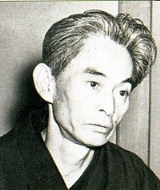
Yasunari Kawabata


   Email Print
   Bookmark   Link


Yasunari Kawabata


was a Japan
Japan

Japan is an island country in East Asia. Located in the Pacific Ocean, it lies to the east of the Sea of Japan, People's Republic of China, North Korea, South Korea and Russia, stretching from the Sea of Okhotsk in the north to the East China Sea and Taiwan in the south....
ese short story
Short story

The short story refers to a work of fiction that is usually written in prose, usually in narrative format. This format or medium tends to be more pointed than longer works of fiction, such as novellas and novels or books....
 writer and novelist whose spare, lyrical, subtly-shaded prose works won him the Nobel Prize for Literature in 1968, the first Japanese author to receive the award. His works have enjoyed broad international appeal and are still widely read.

in Osaka
Osaka

is a Cities of Japan in Japan, located at the mouth of the Yodo River on Osaka Bay, in the Kansai region of the main island of Honshu.Osaka is a City designated by government ordinance under the Local Autonomy Law and the capital city of Osaka Prefecture....
, Yasunari was orphaned when he was four, after which he lived with his grandparents. He had an older sister who was taken in by an aunt, and whom he met only once thereafter, at the age of ten (July 1909).


Discussion
Ask a question about 'Yasunari Kawabata'
Start a new discussion about 'Yasunari Kawabata'
Answer questions from other users
Full Discussion Forum


Quotations


Because you cannot see him, God is everywhere.


Encyclopedia


was a Japan
Japan

Japan is an island country in East Asia. Located in the Pacific Ocean, it lies to the east of the Sea of Japan, People's Republic of China, North Korea, South Korea and Russia, stretching from the Sea of Okhotsk in the north to the East China Sea and Taiwan in the south....
ese short story
Short story

The short story refers to a work of fiction that is usually written in prose, usually in narrative format. This format or medium tends to be more pointed than longer works of fiction, such as novellas and novels or books....
 writer and novelist whose spare, lyrical, subtly-shaded prose works won him the Nobel Prize for Literature in 1968, the first Japanese author to receive the award. His works have enjoyed broad international appeal and are still widely read.

Biography

Born in Osaka
Osaka

is a Cities of Japan in Japan, located at the mouth of the Yodo River on Osaka Bay, in the Kansai region of the main island of Honshu.Osaka is a City designated by government ordinance under the Local Autonomy Law and the capital city of Osaka Prefecture....
, Yasunari was orphaned when he was four, after which he lived with his grandparents. He had an older sister who was taken in by an aunt, and whom he met only once thereafter, at the age of ten (July 1909). Kawabata's grandmother died when he was seven (September 1906), and his grandfather when he was fifteen (May 1914).

Having lost all close relatives, he moved in with his mother's family (the Kurodas). However, in January 1916, he moved into a boarding house near the junior high school (comparable to a modern high school) to which he had formerly commuted by train. After graduating from junior high school in March 1917, just before his 18th birthday, he moved to Tokyo
Tokyo

, officially , is one of the 47 prefectures of Japan of Japan and located on the eastern side of the main island Honshu. The twenty-three special wards of Tokyo, each governed as a city, cover the area that was once the Tokyo City in the eastern part of the prefecture, and total over 8 million people....
, hoping to pass the exams of Dai-ichi Koto-gakko (First Upper School), which was under the direction of Tokyo Imperial University. He succeeded in the exam the same year and entered the humanities faculty as an English
English language

English is a West Germanic language that originated in Anglo-Saxon England and has lingua franca status in many parts of the world as a result of the military, economic, scientific, political and cultural influence of the British Empire in the 18th, 19th and early 20th centuries and that of the United States from the mid 20th century onwa...
 major (July 1920).

Kawabata graduated in 1924, by which time he had already caught the attention of Kikuchi Kan and other noted writers and editors through his submissions to Kikuchi's literary magazine
Literary magazine

A literary magazine is a periodical devoted to literature in a broad sense. Literary magazines usually publish short stories, poetry and essays along with literary criticism, book reviews, biographical profiles of authors, interviews and letters....
, the Bungei Shunju.

In addition to fiction writing, Kawabata also worked as a reporter, most notably for the Mainichi Shimbun
Mainichi Shimbun

The is one of the major newspapers in Japan, published by ....
. Although he refused to participate in the militaristic fervor that accompanied World War II
World War II

World War II, or the Second World War , was a global military conflict which involved a Participants in World War II, including all of the great powers, organised into two opposing military alliances: the Allies of World War II and the Axis powers....
, he also demonstrated little interest in postwar political reforms. Along with the death of all his family while he was young, Kawabata suggested that the War was one of the greatest influences on his work, stating he would be able to write only elegies in postwar Japan. Still, many commentators detect little thematic change between Kawabata's prewar and postwar writings.

Kawabata apparently committed suicide in 1972 by gassing
Natural gas

Natural gas is a gas consisting primarily of methane. It is found associated with fossil fuels, in coal beds, as methane clathrates, and is created by methanogenic organisms in marshes, bogs, and landfills....
 himself, but a number of close associates, including his widow, consider his death to have been accidental. Many theories have been advanced as to his reasons, among them poor health (the discovery that he had Parkinson's disease
Parkinson's disease

Parkinson's disease is a degenerative disorder of the central nervous system that often impairs the sufferer's motor skills and speech, as well as other functions....
), a possible illicit love affair, or the shock caused by the suicide of his friend Yukio Mishima
Yukio Mishima

was the pseudonym of , a Japanese people author, poet and playwright....
 in 1970. Unlike Mishima, Kawabata left no note, and since (again unlike Mishima) he had not discussed significantly in his writings the topic of taking his own life, his motives remain unclear. However, his Japanese biographer, Takeo Okuno, has related how he had nightmares about Mishima for two or three hundred nights in a row, and was incessantly haunted by the specter of Mishima. In a persistently depressed state of mind, he would tell friends during his last years that sometimes, when on a journey, he hoped his plane would crash.

Artistic career

While still a university student, Kawabata re-established the Tokyo University literary magazine Shin-shicho ("New Tide of Thought"), which had been defunct for more than four years. There he published his first short story, "Shokonsai ikkei" ("A scene from a Séance"). During university, he changed faculties to Japanese literature
Japanese literature

Japanese literature spans a period of almost two millennia. Early works were heavily influenced by cultural contact with China and Chinese literature, often written in Classical Chinese....
 and wrote a graduation thesis titled, "A short history of Japanese novels". He graduated from university in March 1924.

In October 1924 Kawabata, Kataoka Teppei, Yokomitsu Riichi
Yokomitsu Riichi

was an experimental, modernist Japanese writer.Yokomitsu began publishing in dojinshi such as Machi and To after entering Waseda University in 1916....
, and a number of other young writers started a new literary journal Bungei Jidai ("The Artistic Age"). This journal was a reaction to the entrenched old school of Japanese literature, specifically the Japanese movement descended from Naturalism
Naturalism (literature)

Naturalism is a Literature Literary movement that seeks to replicate a Verisimilitude everyday life, as opposed to such movements as Romanticism or Surrealism, in which subjects may receive highly symbolic, idealistic, or even supernatural treatment....
, while it also stood in opposition to the "workers'" or proletarian literature movement of the Socialist/Communist schools. It was an "art for art's sake
Art for art's sake

"Art for art's sake" is the usual English language rendition of a French language slogan, from the early 19th century, l'art pour l'art, and expresses a philosophy that the intrinsic value of art, and the only "true" art, is divorced from any didactic, moral or utilitarian function....
" movement, influenced by European Cubism
Cubism

Cubism was a 20th century avant-garde art movement, pioneered by Pablo Picasso and Georges Braque, that revolutionized European painting and sculpture, and inspired related movements in music and literature....
, Expressionism
Expressionism

Expressionism is the tendency of an artist to distort reality for an emotional effect; it is a subjective art form. Expressionism is exhibited in many art forms, including painting, literature, theatre, film, Expressionist architecture and Expressionism ....
, Dada
Dada

Dada or Dadaism is a cultural movement that began in Z?rich, Switzerland, during World War I and peaked from 1916 to 1922. The movement primarily involved visual arts, literature?poetry, art manifestoes, aesthetics?theatre, and graphic design, and concentrated its anti-war politics through a rejection of the prevailing standards in art...
, and other modernist
Modernism

Modernism, in its broadest definition, is modern thought, character, or practice. More specifically, the term describes both a set of cultural tendencies and an array of associated cultural movements, originally arising from wide-scale and far-reaching changes to Western culture in the late nineteenth and early twentieth century....
 styles. The term Shinkankakuha, which Kawabata and Yokomitsu used to describe their philosophy, has often been mistakenly translated into English as "Neo-Impressionism
Impressionism

Impressionism was a 19th-century art movement that began as a loose association of Paris-based artists art exhibition their art publicly in the 1860s....
". However, Shinkankakuha was not meant to be an updated or restored version of Impressionism; it focused on offering "new impressions" or, more accurately, "new sensations" or "new perceptions" in the writing of literature.

Kawabata started to achieve recognition with a number of short stories shortly after he graduated, receiving acclaim for "The Dancing Girl of Izu
The Dancing Girl of Izu

"The Dancing Girl of Izu" or "The Izu Dancer", published in 1926, was the first work of literature by Japanese author Yasunari Kawabata to achieve great popular and critical acclaim....
" in 1926, a story about a melancholy student who, on a walking trip down Izu Peninsula
Izu Peninsula

The is a peninsula to the west of Tokyo on the Japanese island of Honshu. Formerly the eponymous Izu Province, the Izu peninsula is now a part of Shizuoka prefecture....
, meets a young dancer, and returns to Tokyo in much improved spirits. This story, which explored the dawning eroticism of young love, was successful because he used dashes of melancholy and even bitterness to offset what might have otherwise been overly sweet. Most of his subsequent works explored similar themes.

In the 1920s, Kawabata was living in the plebeian district of Asakusa
Asakusa

File:Kaminarimon1500.jpg is a district in Taito, Tokyo, Japan, most famous for the Senso-ji, a Buddhist temple dedicated to the bodhisattva Kannon. There are several more temples in Asakusa, as well as various festivals....
, Tokyo. During this period, Kawabata experimented with different styles of writing. In Asakusa kurenaidan (The Scarlet Gang of Asakusa), serialized from 1929 to 1930, he explores the lives of the demimonde
Demimonde

Demimonde was a polite 19th century term that was often used the same way we use the term "mistress" today. In the 19th century it primarily referred to a class of women on the fringes of respectable society supported by wealthy lovers ....
 and others on the fringe of society, in a style echoing that of late Edo period
Edo period

The , or , is a division of History of Japan running from 1603 to 1868. The period marks the governance of the Edo or Tokugawa shogunate, which was officially established in 1603 by the first Edo shogun Tokugawa Ieyasu....
 literature. On the other hand, his Suisho genso (Crystalline Fantasy) is pure stream-of-consciousness writing.

Kawabata relocated from Asakusa to Kamakura
Kamakura, Kanagawa

is a cities of Japan located in Kanagawa Prefecture, Japan, about south-south-west of Tokyo. It used to be also called . Although Kamakura proper is today rather small, it is sometimes considered a former de facto capital of Japan as the seat of the Shogunate and of the Shikken during the Kamakura Period....
, Kanagawa prefecture
Kanagawa Prefecture

is a prefectures of Japan located in the southern Kanto region of Honshu, Japan. The capital is Yokohama. Kanagawa is part of the Greater Tokyo Area....
 in 1934 and, although he initially enjoyed a very active social life among the many other writers and literary people residing in that city during the war years and immediately thereafter, in his later years he became very reclusive.

One of his most famous novels was Snow Country
Snow Country

is the first full-length novel by the Nobel Prize for Literature-winning Japanese language author Yasunari Kawabata. The novel established Kawabata as one of Japan's foremost authors and became an instant classic....
, started in 1934 and first published in installments from 1935 through 1947. Snow Country is a stark tale of a love affair between a Tokyo dilettante and a provincial geisha
Geisha

, or are traditional, female Japanese entertainers, whose skills include performing various Japanese arts, such as classical music and dance....
, which takes place in a remote hot-spring town somewhere in the mountainous regions of northern Japan. It established Kawabata as one of Japan's foremost authors and became an instant classic, described by Edward G. Seidensticker as "perhaps Kawabata's masterpiece".

After the end of World War II, Kawabata's success continued with novels such as Thousand Cranes
Thousand Cranes

is a novel by Japanese author Yasunari Kawabata, who won the Nobel Prize for Literature in 1968. This was the first time any Japanese author won this prize....
 (a story of ill-fated love); The Sound of the Mountain
The Sound of the Mountain

The Sound of the Mountain is a novel by Japanese writer Yasunari Kawabata, serialized between 1949 and 1954. Its translation into English by Edward G....
; The House of the Sleeping Beauties
The House of the Sleeping Beauties

House of the Sleeping Beauties is a novella by Nobel Prize winning author Yasunari Kawabata.A story about a lonely man, Old Eguchi continuously visits the House of the Sleep Beauties in hopes of something more....
; Beauty and Sadness
Beauty and Sadness (novel)

Beauty and Sadness is a 1964 novel by Japanese author Yasunari Kawabata. Opening on the train to Kyoto, the novel in characteristic Kawabata fashion subtly brings up issues of tradition vs....
; and The Old Capital
The Old Capital

The Old Capital is a novel by Yasunari Kawabata originally published in 1962. It was first translated into English language in 1987 by J. Martin Holman....
 .

The book that he himself considered his finest work, The Master of Go
The Master of Go

The Master of Go is a novel by the Nobel Prize-winning Japanese language author Yasunari Kawabata, first published in serial form in 1951. Titled Meijin in its original Japanese, Kawabata considered it his finest work, although it is in contrast with his other works....
 (1951), is in severe contrast to his other works. It is a semi-fictional recounting of a major Go
Go (board game)

Go is a strategic board game for two players. It is known as w?iq? in Chinese , or in Japanese, and baduk in Korean language ....
 match in 1938, on which Kawabata had actually reported for the Mainichi newspaper chain. It was the last game of the master Shusai
Honinbo Shusai

is the professional name of Hoju Tamura, also known as , who was a Japanese professional Go Go players....
's career and he lost to his younger challenger, only to die a little over a year later. Although the novel is moving on the surface as a retelling of a climactic struggle, some readers consider it a symbolic parallel to the defeat of Japan in World War II.

His two most important post-war works are Sembazuru (Thousand Cranes
Thousand Cranes

is a novel by Japanese author Yasunari Kawabata, who won the Nobel Prize for Literature in 1968. This was the first time any Japanese author won this prize....
) from 1949 to 1951, and Yama no Oto (The Sound of the Mountain
The Sound of the Mountain

The Sound of the Mountain is a novel by Japanese writer Yasunari Kawabata, serialized between 1949 and 1954. Its translation into English by Edward G....
), 1949-1954. Sembazuru is centered on the tea ceremony
Tea ceremony

A tea ceremony is an Asian ritual form of making tea. The term generally refers to the Japanese tea ceremony. One can also refer to the whole set of rituals, tools, mudra, etc....
 and hopeless love. The protagonist is attracted to the mistress of his dead father and, after her death, to her daughter, who flees from him. The tea ceremony provides a beautiful background for ugly human affairs, but Kawabata’s intent is rather to explore feelings about death. The tea ceremony utensils are permanent and forever, whereas people are frail and fleeting. These themes of implicit incest, impossible love and impending death are again explored in Yama no Oto, set in Kawabata’s home town of Kamakura. The protagonist, an aging man, has no affection for his children and has lost all passion for his wife. He is strongly attracted to someone forbidden — his daughter in law — and his thoughts for her are interspersed with memories of another forbidden love, for his dead sister-in-law. The story is left dangling at the end.

Kawabata left many of his stories unfinished, sometimes to the annoyance of readers and reviewers. This was done intentionally, as Kawabata felt that vignettes of incidents along the way were far more important than conclusions. He equated his form of writing with the traditional poetry of Japan, the haiku
Haiku

' ', plural haiku, is a form of Japanese poetry, consisting of 17 Mora e , in three metrical phrases of 5, 7 and 5 morae respectively. Haiku typically contain a kigo, or seasonal reference, and a kireji or verbal caesura....
.

As the president of Japanese P.E.N.
International PEN

International PEN, the worldwide association of writers, was founded in London in 1921 to promote friendship and intellectual co-operation among writers everywhere....
 for many years after the war (1948-1965), Kawabata was a driving force behind the translation of Japanese literature into English and other Western languages.

In 1968 Kawabata became the first Japanese to receive the Nobel Prize for Literature "for his narrative mastery, which with great sensibility expresses the essence of the Japanese mind." In awarding the prize, the Nobel Committee cited three of his novels, Snow Country
Snow Country

is the first full-length novel by the Nobel Prize for Literature-winning Japanese language author Yasunari Kawabata. The novel established Kawabata as one of Japan's foremost authors and became an instant classic....
, Thousand Cranes
Thousand Cranes

is a novel by Japanese author Yasunari Kawabata, who won the Nobel Prize for Literature in 1968. This was the first time any Japanese author won this prize....
, and The Old Capital
The Old Capital

The Old Capital is a novel by Yasunari Kawabata originally published in 1962. It was first translated into English language in 1987 by J. Martin Holman....
.

Selected works

Year Japanese Title English Title English Translation
1926 ?????
Izu no Odoriko
The Dancing Girl of Izu

"The Dancing Girl of Izu" or "The Izu Dancer", published in 1926, was the first work of literature by Japanese author Yasunari Kawabata to achieve great popular and critical acclaim....
1955, 1998
1930 ????
Asakusa Kurenaidan
The Scarlet Gang of Asakusa

The Scarlet Gang of Asakusa written by Nobel Prize-winning author Yasunari Kawabata. It was originally serialized in a newspaper before eventually being compiled into a novel in 1930....
2005
1935-1937,
1947
??
Yukiguni
Snow Country
Snow Country

is the first full-length novel by the Nobel Prize for Literature-winning Japanese language author Yasunari Kawabata. The novel established Kawabata as one of Japan's foremost authors and became an instant classic....
1956, 1996
1951-1954 ??
Meijin
The Master of Go
The Master of Go

The Master of Go is a novel by the Nobel Prize-winning Japanese language author Yasunari Kawabata, first published in serial form in 1951. Titled Meijin in its original Japanese, Kawabata considered it his finest work, although it is in contrast with his other works....
1972
1949-1952 ???
Senbazuru
Thousand Cranes
Thousand Cranes

is a novel by Japanese author Yasunari Kawabata, who won the Nobel Prize for Literature in 1968. This was the first time any Japanese author won this prize....
1958
1949-1954 ???
Yama no Oto
The Sound of the Mountain

The Sound of the Mountain is a novel by Japanese writer Yasunari Kawabata, serialized between 1949 and 1954. Its translation into English by Edward G....
1970
1954 ????(????)
Mizuumi
The Lake
The Lake (novel)

The Lake is a short 1954 in literature novel by Japanese Nobel laureate Yasunari Kawabata. This book tells the story of a former schoolteacher named Gimpei Momoi....
1974
1961 ?????
Nemureru Bijo
The House of the Sleeping Beauties

House of the Sleeping Beauties is a novella by Nobel Prize winning author Yasunari Kawabata.A story about a lonely man, Old Eguchi continuously visits the House of the Sleep Beauties in hopes of something more....
1969
1962 ??
Koto
The Old Capital
The Old Capital

The Old Capital is a novel by Yasunari Kawabata originally published in 1962. It was first translated into English language in 1987 by J. Martin Holman....
1987, 2006
1964 ????????
Utsukushisa to Kanashimi to
Beauty and Sadness
Beauty and Sadness (novel)

Beauty and Sadness is a 1964 novel by Japanese author Yasunari Kawabata. Opening on the train to Kyoto, the novel in characteristic Kawabata fashion subtly brings up issues of tradition vs....
1975
1964 ??
Kataude
One Arm
One Arm

is a novella by Nobel Prize winning author Yasunari Kawabata, published in 1964.In ?One Arm? a young woman removes her right arm and gives it to the a man to keep for the night....
1969
  ????
Tenohira no Shosetsu
Palm-of-the-Hand Stories

is the name Japanese author Yasunari Kawabata gave to more than 140 short stories he wrote over his long career, the earliest published in the 1920 and the last appearing posthumously in 1972....
1988, 2006


Further reading

  • Starrs, Roy
    Roy Starrs

    Roy Starrs is a scholar of Japanese literature and culture who teaches at the University of Otago in New Zealand. He has written critical studies of the major Japanese writers Yasunari Kawabata, Naoya Shiga, Osamu Dazai, and Yukio Mishima, and edited books on Asian nationalism , globalization, and pan-Asianism....
     (1998) Soundings in Time: The Fictive Art of Kawabata Yasunari, University of Hawai'i Press/RoutledgeCurzon


External links