
|
|
|
|
Women in Love
|
| |
|
| |
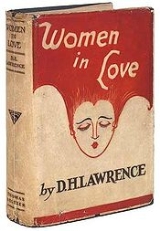
Women in Love is a novel by British author D. H. Lawrence published in 1920. It is a sequel to his earlier novel The Rainbow, and follows the continuing loves and lives of the Brangwen sisters, Gudrun and Ursula. Gudrun Brangwen, an artist, pursues a destructive relationship with Gerald Crich, an industrialist. Lawrence contrasts this pair with the love that develops between Ursula and Rupert Birkin, an alienated intellectual who articulates many opinions associated with the author. The emotional relationships thus established are given further depth and tension by an unadmitted homoerotic attraction between Gerald and Rupert. The novel ranges over the whole of British society at the time of the First World War and eventually ends high up in the snows of the Swiss Alps.
As with most of Lawrence's works, Women in Love caused controversy over its sexual subject matter. One early reviewer said of it, "I do not claim to be a literary critic, but I know dirt when I smell it, and here is dirt in heaps — festering, putrid heaps which smell to high Heaven."
Plot Summary Ursula and Gudrun Brangwen are two sisters living in the Midlands of England in the 1910s. Ursula is a teacher, Gudrun an artist. They meet two men who live nearby, Rupert Birkin and Gerald Crich. The four become friends. Ursula and Birkin become involved and Gudrun eventually begins a love affair with Gerald.
All four are deeply concerned with questions of society, politics, and the relationship between men and women. At a party at Gerald's manor house, Gerald's sister, Diana, drowns. Gudrun becomes the teacher and mentor of his youngest sister. Soon Gerald's coal-mine-owning father passes away as well after a drawn-out illness.
Birkin asks Ursula to marry him, and she agrees. Gerald and Gudrun's relationship, however, becomes stormy. The four vacation in the Alps. Gudrun begins an intense friendship with Loerke, a physically puny but emotionally commanding artist. Gerald, enraged by Loerke, by Gudrun's abuse and by his own destructive nature, tries to murder Gudrun. In failing, he retreats back over the mountains and falls to his death in the snow.
PublicationWomen in Love was originally published out of New York City in a limited run, available only to subscribers; this was due to the controversy caused by his previous work, The Rainbow.
Film adaptationScreenwriter and producer Larry Kramer and director Ken Russell adapted the novel in the Academy Award-winning 1969 film Women in Love (for which Glenda Jackson won for Best Actress). It was one of the first theatrical movies to show male genitals, when Gerald Crich and Rupert Birkin wrestle in the nude in front of a roaring fireplace, in addition to several early skinny dipping shots and an explicit sequence of Birkin running naked in the forest after being hit on the head by his spurned former mistress, Hermione Roddice.
Literary criticism - Richard Beynon, (ed.), D. H. Lawrence: The Rainbow and Women in Love (Cambridge: Icon Books, 1997).
- Michael Black (2001) Lawrence's England: The Major Fiction, 1913 - 1920 (Palgrave-MacMillan)
- Paul Delaney (1979) D. H. Lawrence's Nightmare: The Writer and his Circle in the Years of the Great War (Hassocks: Harvester Press)
- F. R. Leavis (1955) D. H. Lawrence: Novelist (London, Chatto and Windus)
- F. R. Leavis (1976) Thought, Words and Creativity: Art and Thought in D. H. Lawrence (London, Chatto and Windus)
-
- Charles L. Ross (1991) Women in Love: A Novel of Mythic Realism (Boston, Mass.: Twayne)
- John Worthen, The Restoration of Women in Love, in Peter Preston and Peter Hoare (eds.)(1989), D. H. Lawrence in the Modern World (London and Basingstoke: Macmillan), pp 7-26
External links
|
| |
|
|