


Whipple shield

Encyclopedia
Hypervelocity
The term hypervelocity usually refers to a very high velocity, approximately over 3,000 meters per second . In particular, it refers to velocities so high that the strength of materials upon impact is very small compared to inertial stresses. Thus, even metals behave like fluids under hypervelocity...
impact shield used to protect manned and unmanned spacecraft
Spacecraft
A spacecraft or spaceship is a craft or machine designed for spaceflight. Spacecraft are used for a variety of purposes, including communications, earth observation, meteorology, navigation, planetary exploration and transportation of humans and cargo....
from collisions with micrometeoroid
Micrometeoroid
A micrometeoroid is a tiny meteoroid; a small particle of rock in space, usually weighing less than a gram. A micrometeor or micrometeorite is such a particle that enters the Earth's atmosphere or falls to Earth.-Scientific interest:...
s and orbital debris whose velocities generally range between 3 km/s.
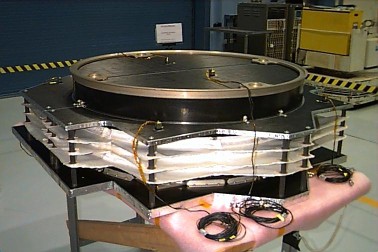
As opposed to monolithic shielding of early spacecraft, Whipple shields consist of a relatively thin outer bumper placed a certain distance off of the wall of the spacecraft. This improves the shielding to mass ratio, critical for spaceflight components, but also increases the thickness of the spacecraft walls, which is not ideal for fitting spacecraft into launch vehicle fairings. The advantage of a bumper placed at a standoff over a single thick shield is that the bumper wall can shock the incoming particle and cause it to disintegrate. This spreads out the impulse particle over a larger area of the inner wall of the spacecraft.
There are several variations on the simple Whipple shield. Multi-shock shields, like the one used on the Stardust
Stardust (spacecraft)
Stardust is a 300-kilogram robotic space probe launched by NASA on February 7, 1999 to study the asteroid 5535 Annefrank and collect samples from the coma of comet Wild 2. The primary mission was completed January 15, 2006, when the sample return capsule returned to Earth...
spacecraft, use multiple bumpers spaced apart to increase the shield's ability to protect the spacecraft. Whipple shields that have a filling in between the rigid layers of the shield are called Stuffed Whipple shields. The filling in these shields is usually a high strength material like Kevlar
Kevlar
Kevlar is the registered trademark for a para-aramid synthetic fiber, related to other aramids such as Nomex and Technora. Developed at DuPont in 1965, this high strength material was first commercially used in the early 1970s as a replacement for steel in racing tires...
™ or Nextel™. The type of shield along with the material, thickness and distance between layers are varied to produce a shield with minimal mass that will also minimize the probability of penetration. There are over 100 shield configurations on the International Space Station
International Space Station
The International Space Station is a habitable, artificial satellite in low Earth orbit. The ISS follows the Salyut, Almaz, Cosmos, Skylab, and Mir space stations, as the 11th space station launched, not including the Genesis I and II prototypes...
alone, with higher risk areas having better shielding.
External links
- Brief descriptions of spacecraft shielding by NASA
- B.G. Cour-Palais' reminisces of the Apollo meteoroid protection program
- The Skylab meteoroid shield design and development
- ESA Giotto dust shield
- J.L. Crews' recounting of the invention of the multi-shock shield, p. 21-29
- Installing the Nextel/Kevlar blankets in the Destiny laboratory stuffed Whipple Shields
- Meteoroid/Debris Protection System Development at ESA for ATV and Columbus
- Hyper-velocity impact test at JAXA of Kibo's debris shield