
|
|
|
|
War bond
|
| |
|
| |
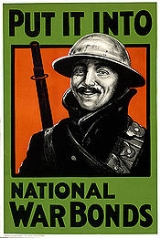
War bonds are a type of savings bond used by combatant nations to help fund a war effort and as a monetary policy for controlling inflation from an economy overstimulated by a war.
rding to the Massachusetts Historical Society, Because the first World War cost the federal government more than 30 billion dollars (by way of comparison, total federal expenditures in 1913 were only $970 million), these programs became vital as a way to raise funds.
Canada's war bonds were called Victory Bonds.
941, in an effort to control inflation, the U.S.

Discussion
Ask a question about 'War bond'
Start a new discussion about 'War bond'
Answer questions from other users
|
Recent Posts

Encyclopedia
War bonds are a type of savings bond used by combatant nations to help fund a war effort and as a monetary policy for controlling inflation from an economy overstimulated by a war.
First World War In 1917 and 1918, the United States government issued Liberty Bonds to raise money for its involvement in World War I.
According to the Massachusetts Historical Society, Because the first World War cost the federal government more than 30 billion dollars (by way of comparison, total federal expenditures in 1913 were only $970 million), these programs became vital as a way to raise funds.
Canada's war bonds were called Victory Bonds.
World War II
In 1941, in an effort to control inflation, the U.S. Treasury began marketing the new Series E bonds U.S. Savings Bonds as "defense bonds". The government used the hype of the war to market the bonds to the country as a way to raise money for the war, when in fact they were used to remove money from the economy to control inflation. The first one was sold to President Franklin D. Roosevelt on May 1, 1941, by Secretary of the Treasury Henry Morgenthau. After the formal entry of the United States into the war in December of that year, these bonds became known as "war bonds". These bonds were simply the latest offering of the U.S. Savings Bonds program that had begun in 1935, which replaced U.S. Postal Savings Bonds, and continues to this day. However, the mood of the nation at that time allowed the U.S. government to market Series E bonds as "war bonds", "war loans", "victory bonds", and by other names meant to appeal to a sense of patriotism.
Popular contemporary art was used to help promote the bonds. Norman Rockwell's painting series, the Four Freedoms, toured in a war bond effort that raised $132 million. Some of his Willie Gillis paintings and his Rosie the Riveter painting were raffled off during the United States Department of the Treasury's Second War Loan Drive.
National Service Board for Religious Objectors offered civilian bonds in the United States during World War II, primarily to members of the historic peace churches as an alternative for those who could not conscientiously buy something meant to support the war. These were U.S. Government Bonds not labeled as defense bonds. In all, 33,006 subscriptions were sold for a total value of $6,740,161, mostly to Mennonites, Brethren and Quakers. In a similar way, an alternative to war savings stamps was offered to school children.
The government appealed to the public through popular culture. The music industry got on board with songs and various campaigns, such as the song and accompanying animated short, Any Bonds Today?. The Music Publishers Protective Association encouraged its members to include patriotic messages on the front of their sheet music like "Buy U.S. Bonds and Stamps". Various band leaders and celebrities held rallies, where they encouraged the public to help their country by buying war bonds.
Although they were initially marketed as war bonds, Series E bonds continued to be offered by the U.S. government until June 1980, when they were replaced by the Series EE bond.
Patriot Bonds On December 11, 2001, three months after the September 11, 2001 attacks, the U.S. government began issuing a version of the Series EE bond known as the "Patriot Bond". While the paper document has the words "Patriot Bond" printed on it, the regular terms and conditions of Series EE bonds apply to Patriot Bonds, and money raised from the sale of Patriot Bonds is applied to the general fund.
External links
|
| |
|
|