
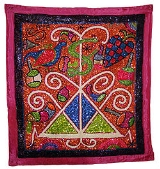
Haitian Vodou or
Vaudou is a syncretic
religionA religion is a system of human thought which usually includes a set of narratives, symbols, beliefs and practices that give meaning to the practitioner's experiences of life through reference to a higher power, deity or deities, or ultimate truth...
originating from the
CaribbeanThe Caribbean is a region consisting of the Caribbean Sea, its islands , and the surrounding coasts...
country of
HaitiHaiti , officially the Republic of Haiti , is a Creole- and French-speaking Caribbean country. Along with the Dominican Republic, it occupies the island of Hispaniola, in the Greater Antillean archipelago...
, located on the island of
HispaniolaHispaniola is a major island in the Caribbean, comprising Haiti and the Dominican Republic. It is located between the islands of Cuba to the west, and Puerto Rico to the east, directly within the hurricane belt...
. It is based upon a merging of the beliefs and practices of West African peoples, (mainly the
FonFon is a major West African ethnic and linguistic group in the country of Benin, and southwest Nigeria, made up of more than 3,500,000 people. The Fon language is the main language spoken in Southern Benin, and is a member of the Gbe language group. Closely related cultures include the Ewe, Aja and...
and
EweThe Ewe are a people located on the southeast corner of Ghana, east of the Volta River, in an area now described as the Volta Region. They are a people of southeastern Ghana, Togo and Benin...
; see West African Vodun), with Roman Catholic Christianity, which was brought about as African slaves were brought to Haiti in the 16th century and forced to convert to the religion of their owners, whilst they largely still followed their traditional African beliefs.
Overview
The principal belief in Haitian Vodou is that there are various deities, or
Loa, who are subordinate to a greater God, known as
Bondyè, who does not interfere with human affairs. Therefore it is to the
loa that Vodou worship is directed. Other characteristics of Vodou include ancestor worship and protection against evil
witchcraftWitchcraft, in various historical, anthropological, religious and mythological contexts, is the use of certain kinds of supernatural or magical powers. Witchcraft can refer to the use of such powers in order to inflict harm or damage upon members of a community or their property...
.
Haitian Vodou shares many similarities with other faiths of the
African diasporaThe African Diaspora was the movement of Africans and their descendants to places throughout the world - predominantly to the Americas, then later to Europe, the Middle East and other places around the globe....
, such as
Louisiana VoodooLouisiana Voodoo, also known as New Orleans Voodoo, originated from the traditions of the African diaspora. It is a cultural form of the Voodoo religions which historically developed within the French, Spanish, and Creole speaking African-American population of the U.S. state of Louisiana...
of New Orleans,
SanteríaSantería is a syncretic religion of Caribbean origin, also known as Regla de Ocha, La Regla Lucumi, or Lukumi.- Etymology :...
and
AraráThe term Arará refers to a minority group in Cuba and elsewhere in the Caribbean who descend from Fon, Ewe, Popo, Mahi and other ethnic groups in Dahomey...
of
CubaThe Republic of Cuba is an island country in the Caribbean. It consists of the island of Cuba, the Isla de la Juventud, and several archipelagos. Havana is the largest city in Cuba and the country's capital. Santiago de Cuba is the second largest city. Cuba is home to over 11 million people and is...
, and
CandombléCandomblé is an African-originated or Afro-Brazilian religion, practiced chiefly in Brazil by the "povo de santo" . The religion was largely originated in the city of Salvador, the capital of Bahia. Although Candomblé is practiced primarily within Brazil, it is also practiced in other countries...
and
UmbandaUmbanda is an Afro-Brazilian religion that blends African religions with CatholicismUmbanda is related to and has many similitudes with other Afro-Brazilian religions like Candomblé, Batuque, Macumba, Quimbanda, Xambá, Egungun, Ifá, Irmandade, Confraria, Xangô do Nordeste and Tambor de Mina, but...
of
BrazilBrazil , officially the Federative Republic of Brazil , is a country in South America. It is the fifth largest country by geographical area, occupying nearly half of South America, the fifth most populous country, and the fourth most populous democracy in the world. Bounded by the Atlantic Ocean...
. The Vodou temple is called a
HounfourThe Voodoo temple is called a Hounfour, and the leader of the ceremony is a male priest called a Houngan, or a female priest called a Mambo.At the centre of the temple there is a post used to contact spirits, and a highly decorated altar...
.
In Haitian Vodou (
Sèvis Loa in
CreoleHaitian Creole language , often called simply Creole or Kreyòl , is a language spoken in Haiti by about eight million people, which is nearly the entire population, and via emigration, by about one million speakers residing in the Bahamas, Cuba, Canada, Cayman Islands, Dominican Republic, French...
or "Service to the Loa"), there are strong elements from the Bakongo of
Central AfricaCentral Africa is a core region of the African continent often considered to include Burundi, the Central African Republic, Chad, Democratic Republic of the Congo, and Rwanda....
and the
IgboIgbo people, also referred to as the Ibo, Ebo, Eboans or Heebo are an ethnic group living chiefly in southeastern and south Nigeria. They speak Igbo, which includes various Igboid languages and dialects; today, a majority of them speak English alongside Igbo as a result of British colonialism...
and
YorubaYoruba people are one of the largest ethno-linguistic or ethnic groups in west Africa. The majority of the Yoruba speak the Yoruba language...
of
NigeriaNigeria , officially the Federal Republic of Nigeria, is a federal constitutional republic comprising thirty-six states and one Federal Capital Territory. The country is located in West Africa and shares land borders with the Republic of Benin in the west, Chad and Cameroon in the east, and Niger...
, although many different nations of Africa have representation in the liturgy of the Sèvis Lwa. An often overlooked yet significant element was that of the
TaínoThe Taínos are pre-Columbian inhabitants of the Bahamas, Greater Antilles, and the northern Lesser Antilles. It is believed that the seafaring Taínos are relatives of the Arawakan people of South America...
Indians, venerated as the indigenous population (and hence, a form of ancestors) of the island now known as
HispaniolaHispaniola is a major island in the Caribbean, comprising Haiti and the Dominican Republic. It is located between the islands of Cuba to the west, and Puerto Rico to the east, directly within the hurricane belt...
. The Taíno contributed considerable influence to the belief system of Haitian Vodou, most notably the Petro (
Petwo in
CreoleHaitian Creole language , often called simply Creole or Kreyòl , is a language spoken in Haiti by about eight million people, which is nearly the entire population, and via emigration, by about one million speakers residing in the Bahamas, Cuba, Canada, Cayman Islands, Dominican Republic, French...
) sect, a sect of the religion with virtually no counterpart and origin from the African continent. Characterized by the aggression of the loa, the sect bears influence from the zemis of Amerindian folklore. A large and significant portion of Haitian Vodou most often overlooked by scholars, until recently is the
KongoThe Kingdom of Kongo was an African kingdom located in west central Africa in what are now northern Angola, Cabinda, the Republic of the Congo, and the western portion of the Democratic Republic of the Congo...
component. The entire Northern area of Haiti is especially influenced by Kongo practice. In the North, it is more often called Kongo Rite or
LembaThe Lemba or Lembaa are an ethnic group numbering 70,000 in southern Africa who claim a common descent and belonging to the Jewish people....
, from the Lemba rites of the
LoangoLoango may refer to:* Loango National Park, a national park in Western Gabon* Petit Loango, a town in Gabon* Kingdom of Loango, a pre-colonial state in what is now the Republic of Congo* Loango, a schooner wrecked in 1909 at St Ives, Cornwall...
area and Mayombe. In the south, Kongo influence is called Petwo (Petro). Many loa or lwa (also a Kikongo term) are of Kongo origin such as Basimbi, Lemba, etc.
HaitiHaiti , officially the Republic of Haiti , is a Creole- and French-speaking Caribbean country. Along with the Dominican Republic, it occupies the island of Hispaniola, in the Greater Antillean archipelago...
an
creoleThe term Creole and its cognates in other languages — such as crioulo, criollo, créole, kriolu, criol, kreyol, kriulo, kriol, krio, kreol, etc. — have been applied to people in different countries and epochs, with rather different meanings...
forms of Vodou exist in Haiti, the
Dominican RepublicThe Dominican Republic is a nation on the island of Hispaniola, part of the Greater Antilles archipelago in the Caribbean region. The western third of the island is occupied by the nation of Haiti, making Hispaniola one of two Caribbean islands that are occupied by two countries...
, parts of Cuba, some of the out-islands of the Bahamas, the
United StatesThe United States of America is a federal constitutional republic comprising fifty states and a federal district...
, and other places that Haitian immigrants dispersed to over the years. However, it is important to note that the Vodun religion (separate from Haitian Vodou) existed in the United States, having been brought over by West Africans enslaved in America, specifically from the Ewe, Fon, Mina, Kabaye, and Nago groups. Some of its more enduring forms still exist in the
Gullah IslandsThe Gullah are African Americans who live in the Low Country region of South Carolina and Georgia, which includes both the coastal plain and the Sea Islands...
. There is a re-emergence of these Vodun traditions in America, which maintains the same ritual and cosmological elements as is practiced in West Africa. These and other African-diasporic religions such as Lukumi or Regla de Ocha (also known as
SanteríaSantería is a syncretic religion of Caribbean origin, also known as Regla de Ocha, La Regla Lucumi, or Lukumi.- Etymology :...
) in Cuba,
CandombléCandomblé is an African-originated or Afro-Brazilian religion, practiced chiefly in Brazil by the "povo de santo" . The religion was largely originated in the city of Salvador, the capital of Bahia. Although Candomblé is practiced primarily within Brazil, it is also practiced in other countries...
and
UmbandaUmbanda is an Afro-Brazilian religion that blends African religions with CatholicismUmbanda is related to and has many similitudes with other Afro-Brazilian religions like Candomblé, Batuque, Macumba, Quimbanda, Xambá, Egungun, Ifá, Irmandade, Confraria, Xangô do Nordeste and Tambor de Mina, but...
in Brazil, all religions that evolved among descendants of transplanted Africans in the Americas.
Deities
Vodouisants believe in both a supreme God called
Bondye , and many lesser spirits, known as the
loa. This had been a belief held in several west African religions such as that of the Yoruba, Odinani, and Vodun, and when it came in contact with Roman Catholicism, the greater deity was associated with the Judeo-Christian
GodGod is a deity in theistic and deistic religions and other belief systems, representing either the sole deity in monotheism, or a principal deity in polytheism....
, and the
loa with the saints.
Bondye
Haitian Vodouisants are
monotheistsIn theology, monotheism is the belief that only one god exists. The concept of "monotheism" tends to be dominated by the concept of God in the Abrahamic religions, such as Judaism, Christianity and Islam, and the Platonic concept of God as put forward by Pseudo-Dionysius the Areopagite...
, believing in one supreme
GodGod is a deity in theistic and deistic religions and other belief systems, representing either the sole deity in monotheism, or a principal deity in polytheism....
, known as
Bondye (from the French "Bon Dieu" or "Good God"). Vodouisants do not see Bondye as different from the
Abrahamic conceptions of GodJudaism, Christianity, Islam and the Bahá'í Faith see God as the eternal being who created the universe and all there is. God is usually held to have the properties of holiness , justice , sovereignty , omnipotence , omniscience , omni-benevolence ,...
, in the sense that Bondye is considered to be the creator of all. Bondye is distant from its creation, being a
pandeistPandeism or Pan-Deism , is a term used at various times to describe religious beliefs...
deity, and because of this, Vodouisants don't believe that they can contact it for help.
Loa
Because Bondye is considered unreachable, Vodouisants focus their prayer and devotion to lesser entities, spirits known as
loaThe Loa are the spirits of the Voodoo religion practiced in Haiti, and other parts of the world. They are also referred to as Mystères and the Invisibles. They are somewhat akin to saints or angels in Christianity in that they are intermediaries between Bondye —the Creator, who is distant from the...
, or
mistè. Some of the most notable loa include
Papa LegbaPapa Legba is the master linguist, the trickster, warrior, and the personal messenger of destiny. In Haitian Vodou, Papa Legba is the intermediary between the loa and humanity. He stands at a spiritual crossroads and gives permission to speak with the spirits of Guinee, and is believed to...
the guardian of the crossroads, Erzulie Freda the spirit of love,
SimbiIn Haitian Vodou, Simbi is a large and diverse family of serpent Loa from the West Central Africa / Kongo region. Some prominent Simbi Loa include Simbi Dlo , Simbi Makaya, Simbi Andezo , and Gran Simba...
the spirit of rain and magicians, Kouzin Zaka the spirit of agriculture, and The Marasa, who are divine twins considered to be the first children of Bondye.
These loa can be divided into 21 nations, which include the Petwo, Rada, Congo and Nago .The Petwo and the Rada contrast most with one another, because the Petwo are hot or aggressive and restless, whereas the Rada are cool or calm and peaceful.
The loa also fall into family groups, who share a surname, such as Ogou,
EziliIn Vodou, Erzulie is a family of lwa, or spirits.-Erzulie Freda Dahomey:Erzulie Freda Dahomey, the Rada aspect of Erzulie, is the spirit of love, beauty, jewellery, dancing, luxury, and flowers. Homosexual men are considered to be under her particular patronage. She wears three wedding rings, one...
,
AzakaAzaka are a family of Loa in Haitian mythology.The name is shared between:*Azaka Medeh - loa of harvest*Azaka-Tonnerre - loa of thunder...
or Ghede. For instance, "Ezili" is a family, Ezili Danto and Ezili Freda are two individual spirits in that family. Each family are associated with a specific aspect, for instance the Ogou family are soldiers, the Ezili govern the feminine spheres of life, the Azaka govern agriculture, the Ghede govern the sphere of death and fertility.
Each of the loa is associated with a particular Roman Catholic saint.
Morality
Vodou's moral code focuses on the vices of dishonour and greed. There is also a notion of relative propriety — and what is appropriate to someone with Dambala Wedo as their head may be different from someone with Ogou Feray as their head. For example, one spirit is very cool and the other is very hot. Coolness overall is valued, and so is the ability and inclination to protect oneself and one's own if necessary. Love and support within the family of the Vodou society seem to be the most important considerations. Generosity in giving to the community and to the poor is also an important value. One's blessings come through the community and there is the idea that one should be willing to give back to it in turn. There are no "solitaries" in Vodou, only people separated geographically from their elders and house. A person without a relationship of some kind with elders will not be practicing Vodou as it is understood in Haiti and among Haitians.
Vodou is an ecstatic rather than a fertility based religion.
Orthodoxy and diversity
There is a diversity of practice in Vodou across the country of Haiti and the Haitian diaspora. For instance in the north of Haiti the lave tèt ("head washing") or kanzwe may be the only initiation, as it is in the Dominican Republic and Cuba, whereas in Port-au-Prince and the south they practice the kanzo rites with three grades of initiation kanzo senp, si pwen, and asogwe and the latter is the most familiar mode of practice outside of Haiti. Some lineages combine both, as Manbo
Katherine DunhamKatherine Mary Dunham was an American dancer, choreographer, songwriter, author, educator and activist who was trained as an anthropologist...
reports from her personal experience in her book
Island Possessed.
While the overall tendency in Vodou is very conservative in accord with its African roots, there is no singular, definitive form, only what is right in a particular house or lineage. Small details of service and the spirits served will vary from house to house, and information in books or on the internet therefore may seem contradictory. There is no central authority or "
popeThe pope is the Bishop of Rome and, as such, is leader of the worldwide Catholic Church...
" in Haitian Vodou since "every manbo and houngan is the head of their own house", as a popular saying in Haiti goes. Another consideration in terms of Haitian diversity are the many sects besides the Sèvi Gine in Haiti such as the Makaya, Rara, and other secret societies, each of which has its own distinct pantheon of spirits.
Liturgy and practice
After a day or two of preparation setting up altars, ritually preparing and cooking fowl and other foods, etc., a Haitian Vodou service begins with a series of Catholic prayers and songs in French, then a litany in Kreyòl and African "langaj" that goes through all the European and African saints and lwa honored by the house, and then a series of verses for all the main spirits of the house. This is called the "Priyè Gine" or the African Prayer. After more introductory songs, beginning with saluting Hounto, the spirit of the drums, the songs for all the individual spirits are sung, starting with the Legba family through all the Rada spirits, then there is a break and the Petwo part of the service begins, which ends with the songs for the
GedeGede is a village on the Indian Ocean coast of Kenya, lying south of Malindi and north of Watamu. The Ruins of Gedi are located there...
family.
As the songs are sung, participants believe that spirits come to visit the ceremony, by taking possession of individuals and speaking and acting through them. When a ceremony is made, only the family of those possessed is benefited. At this time it is believed that devious mambo or houngan can take away the luck of the worshippers through particular actions. For instance, if a priest asks for a drink of champagne, a wise participant will refuse. Sometimes these ceremonies may include dispute among the singers as to how a hymn is to be sung. In Haiti, these vodou ceremonies, depending on the Priest or Priestess, may be more organized. But in the United States, many vodou practitioners and clergy take it as a sort of non-serious party or "folly".
In a serious rite, each spirit is saluted and greeted by the initiates present and will give readings, advice and cures to those who approach them for help. Many hours later, as morning dawns, the last song is sung, the guests leave, and all the exhausted hounsis and houngans and manbos can go to sleep.
On the individual's household level, a Vodouisant or "sèvitè"/"serviteur" may have one or more tables set out for their ancestors and the spirit or spirits that they serve with pictures or statues of the spirits, perfumes, foods, and other things favored by their spirits. The most basic set up is just a white candle and a clear glass of water and perhaps flowers. On a particular spirit's day, one lights a candle and says an Our Father and
Hail MaryThe Angelic Salutation, Hail Mary, or Ave Maria is a traditional Catholic prayer asking for the intercession of the Virgin Mary, the mother of Jesus. The Hail Mary is used within Roman Catholicism, and it forms the basis of the Rosary...
, salutes Papa Legba and asks him to open the gate, and then one salutes and speaks to the particular spirit as an elder family member. Ancestors are approached directly, without the mediating of Papa Legba, since they are said to be "in the blood".
Priests
Most Vodouisants are not
initiatedInitiation is a rite of passage ceremony marking entrance or acceptance into a group or society. It could also be a formal admission to adulthood in a community or one of its formal components...
, referred to as being "bossale"; it is not a requirement to be an initiate in order to serve one's spirits. There are clergy in Haitian Vodou whose responsibility it is to preserve the rituals and songs and maintain the relationship between the spirits and the community as a whole (though some of this is the responsibility of the whole community as well). They are entrusted with leading the service of all of the spirits of their lineage. Sometimes they are "called" to serve in a process called "being reclaimed," which they may resist at first.
PriestA priest or priestess is a person having the authority or power to administer religious rites; in particular, rites of sacrifice to, and propitiation of, a deity or deities. Their office or position is the priesthood, a term which may also apply to such persons collectively.Priests and priestesses...
s are referred to as "Houngans" and priestesses as "Mambos". Below the houngans and mambos are the hounsis, who are initiates who act
as assistants during ceremonies and who are dedicated to their own personal mysteries.
African origins
The word
vodou derives from
vodũ, which in
Fon, Ewe, and related languageThe Gbe languages form a cluster of about twenty related languages stretching across the area between eastern Ghana and western Nigeria. The total number of speakers of Gbe languages is between four and eight million. The most widely spoken Gbe language is Ewe , followed by Fon...
(distributed from contemporary
GhanaThe Republic of Ghana is a country in West Africa which borders Côte d'Ivoire to the west, Burkina Faso to the north, Togo to the east, and the Gulf of Guinea to the south...
to
BeninBenin , officially the Republic of Benin, is a country in West Africa. It borders Togo to the west, Nigeria to the east and Burkina Faso and Niger to the north; its short coastline to the south leads to the Bight of Benin....
) means
spirit or
divine creature (in the sense of
divine creation).
The cultural area of the
FonFon is a major West African ethnic and linguistic group in the country of Benin, and southwest Nigeria, made up of more than 3,500,000 people. The Fon language is the main language spoken in Southern Benin, and is a member of the Gbe language group. Closely related cultures include the Ewe, Aja and...
,
EweThe Ewe are a people located on the southeast corner of Ghana, east of the Volta River, in an area now described as the Volta Region. They are a people of southeastern Ghana, Togo and Benin...
, and
YorubaYoruba people are one of the largest ethno-linguistic or ethnic groups in west Africa. The majority of the Yoruba speak the Yoruba language...
peoples share common
metaphysicalMetaphysics investigates principles of reality transcending those of any particular science. Cosmology and ontology are traditional branches of metaphysics. It is concerned with explaining the fundamental nature of being and the world...
conceptions around a dual
cosmologicalCosmology is the study of the Universe in its totality, and by extension, humanity's place in it...
divine principle
Nana BulukuNana Buluku is the Supreme Deity of the Fon from Dahomey.Nana Buluku is an androgynous deity. Like the Judeo-Christian god, Nana Buluku created the Universe and all that exists in it...
, the
GodGod is a deity in theistic and deistic religions and other belief systems, representing either the sole deity in monotheism, or a principal deity in polytheism....
-Creator, and the vodou(s) or God-Actor(s), daughters and sons of the Creator's twin children Mawu (goddess of the moon) and Lisa (god of the sun). The God-Creator is the cosmogonical principle and does not trifle with the mundane; the vodou(s) are the God-Actor(s) who actually govern earthly issues.
The
pantheon of vodounThe Dahomey are a nation located in Benin, Africa. The mythology of the Dahomey includes an entire pantheon of thunder gods; for example,*Xevioso is the god of thunder in the So region....
is quite large and complex. In one version, there are seven male and female twins of Mawu, interethnic and related to natural phenomena or historical or mythical individuals, and dozens of ethnic vodous, defenders of a certain clan or tribe.
West African Vodun has its primary emphasis on the ancestors, with each family of spirits having its own specialized priest- and priestesshood which are often hereditary. In many African clans, deities might include
Mami WataMami Wata is a pantheon of water spirits or deities, venerated in West, Central, and Southern Africa, and in the African diaspora in the Caribbean and parts of North and South America.-Appearance:...
, who are gods and goddesses of the waters; Legba, who in some clans is virile and young in contrast to the old man form he takes in Haiti and in many parts of Togo;
GuIn Haitian Vodou and Yoruba mythology, Ogun is a loa and orisha, who presides over fire, iron, hunting, politics and war. He is the patron of smiths and is usually displayed with his attributes: machete or sabre, rum and tobacco...
(or Ogoun), ruling iron and smithcraft; Sakpata, who rules diseases; and many other spirits distinct in their own way to West Africa.
European
colonialismColonialism is the building and maintaining of colonies in one territory by people from another territory. Sovereignty over the colony is claimed by the metropole...
, followed by totalitarian regimes in
West AfricaWest Africa or Western Africa is the westernmost region of the African continent. Geopolitically, the UN definition of Western Africa includes the following 16 countries distributed over an area of approximately 5 million square km:*Benin...
, suppressed Vodun as well as other forms of the religion. However, because the Vodou deities are born to each African clan-group, and its clergy is central to maintaining the moral, social, and political order and ancestral foundation of its villagers, it proved to be impossible to eradicate the religion. Though permitted by Haiti's 1987 constitution, which recognizes religious equality, many books and films have sensationalized voodoo as black magic based on animal and human sacrifices to summon
zombieA zombie is a creature that appears in folklore and popular culture typically as a reanimated corpse or a mindless human being. Stories of zombies originated in the Afro-Caribbean spiritual belief system of Vodou, which told of the people being controlled as laborers by a powerful sorcerer...
s and evil spirits.
Haitian evolution
The majority of the Africans who were brought as
slavesSlavery is a form of forced labor in which people are considered to be the property of others. Slaves can be held against their will from the time of their capture, purchase or birth, and deprived of the right to leave, to refuse to work, or to receive compensation...
to Haiti were from Western and Central Africa. The Vodun practitioners brought over and enslaved in the United States primarily descend from the Ewe, Anlo-Ewe, and other West African groups. The survival of the belief systems in the
New WorldThe New World is one of the names used for the non-Afro-Eurasian parts of the Earth, specifically the Americas and possibly Australia. When the term originated in the late 15th century, the Americas were new to the Europeans, who previously thought of the world as consisting only of Europe, Asia,...
is remarkable, although the traditions have changed with time and have even taken on some Catholic forms of worship. Two important factors, however, characterize the uniqueness of Haitian Vodou as compared to African Vodun; the transplanted Africans of Haiti, similar to those of
CubaThe Republic of Cuba is an island country in the Caribbean. It consists of the island of Cuba, the Isla de la Juventud, and several archipelagos. Havana is the largest city in Cuba and the country's capital. Santiago de Cuba is the second largest city. Cuba is home to over 11 million people and is...
and
BrazilBrazil , officially the Federative Republic of Brazil , is a country in South America. It is the fifth largest country by geographical area, occupying nearly half of South America, the fifth most populous country, and the fourth most populous democracy in the world. Bounded by the Atlantic Ocean...
, were obliged to disguise their
loaThe Loa are the spirits of the Voodoo religion practiced in Haiti, and other parts of the world. They are also referred to as Mystères and the Invisibles. They are somewhat akin to saints or angels in Christianity in that they are intermediaries between Bondye —the Creator, who is distant from the...
(sometimes spelled
lwa) or spirits as Roman Catholic
saintSaints, individuals of exceptional holiness, are significant in many religions, particularly Christianity.-General characteristics :Though the term is mostly used for Christians considered holy or virtuous, many religions use similar concepts to elevate people worthy of respect, e.g. see Hindu...
s, an element of a process called
syncretismSyncretism is the attempt to reconcile disparate or contrary beliefs, often while melding practices of various schools of thought. This may involve attempts to merge and analogise several originally discrete traditions, especially in the theology and mythology of religion, and thus assert an...
. The Taíno contribution was brought on by the cultural and racial mixing between surviving Amerindians and escaped African maroons in the mountains of Haiti.
Roman CatholicismThe Catholic Church, also known as the Roman Catholic Church, is the world's largest Christian church. With more than a billion members, over half of all Christians and more than one-sixth of the world's population, the Catholic Church is a communion of the Western, or Latin Rite Church, and...
was mixed into the religion to hide their "
paganPaganism is a word with several different meanings.In its broadest definition, pagan denotes all non-Abrahamic religions, that is to say it denotes all religions other than Judaism, Christianity, and Islam.Other usages are:*Paganism may mean Polytheism: The group so defined includes most of the...
" religion from their masters, who had forbidden them to practice it. Thus, Haitian Vodou has roots in several West African religions, and incorporates some Roman Catholic and Arawak Amerindian influences. It is common for Haitians followers of the Vodou religion to integrate Roman Catholic practices by including Catholic prayers in Vodou worship. Throughout the history of the island from the day of independence of 1804 to the present, missionaries repeatedly came over to the island to convert the Haitians back to the Christian religion which previously had been forced on them. This has set many Haitians to project vodou as an evil religion, from the influence of the missionaries to abusive practitioners who use vodou to persecute.
Vodou, as it is known in Haiti and the Haitian
diasporaA diaspora is any movement of a population sharing common ethnic identity. While refugees may or may not ultimately settle in a new geographic location, the term diaspora refers to a permanently displaced and relocated collective.Diasporic cultural development often assumes a different course from...
, is the result of the pressures of many different cultures and ethnicities of people being uprooted from Africa and imported to Hispaniola during the African slave trade. Under slavery, African culture and religion was suppressed, lineages were fragmented, and people pooled their religious knowledge and from this fragmentation became culturally unified. In addition to combining the spirits of many different African and Amerindian nations, Vodou has incorporated pieces of Roman Catholic liturgy to replace lost prayers or elements. Images of Catholic saints are used to represent various spirits or "mistè" ("mysteries", actually the preferred term in Haiti), and many saints themselves are honored in Vodou in their own right. This syncretism allows Vodou to encompass the African, the Indian, and the European ancestors in a whole and complete way. It is truly a
Kreyòl religion.
The most historically important Vodou ceremony in Haitian history was the Bwa Kayiman or
Bois CaïmanBois Caïman is the purported site of the Vodou ceremony presided over by Dutty Boukman on August 14, 1791. It is widely accepted as the starting point for the Haitian Revolution. Some scholars, however, have deemphasized the role of the Bois Caïman ceremony in sparking the Haitian revolution or...
ceremony of August 1791 that began the
Haitian RevolutionThe Haitian Revolution is, as historian C.L.R. James affirms, "the only successful slave revolt in history." It established Haiti as the first republic ruled by blacks. At the time of the revolution, Haiti was known as Saint-Domingue and was a colony of France...
, in which the spirit
Ezili DantorEzili Dantor is the Petro nation aspect of the Erzulie family of lwa, or spirits in Haitian Vodou. Ezili Dantor is considered to be the lwa of motherhood, single motherhood in particular...
possessed a priestess and received a
black pigThe Creole Pig was a breed of pig indigenous to the Caribbean nation of Haiti. Creole pigs were well adapted to the rugged terrain and sparse vegetation of Haiti. The pig’s resilience allowed Haitian peasants to raise these pigs with little resources...
as an offering, and all those present pledged themselves to the fight for freedom. This ceremony ultimately resulted in the liberation of the Haitian people from
FrenchFrance , officially the French Republic , is a country located in Western Europe, with several overseas islands and territories located on other continents. Metropolitan France extends from the Mediterranean Sea to the English Channel and the North Sea, and from the Rhine to the Atlantic Ocean...
colonialThe French colonial empire is the set of territories outside Europe that were under French rule primarily from the 1600s to the late 1960s . In the 19th and 20th centuries, the colonial empire of France was the second largest in the world behind the British Empire...
rule in 1804, and the establishment of the first black people's
republicA republic is a form of government in which the head of state is not a monarch and the people have an impact on its government. The word 'republic' is derived from the Latin phrase res publica which can be translated as "a public affair".Both modern and ancient republics vary widely in their...
in the history of the world and the second independent nation in the Americas.
Contemporary
Today Vodou is practiced not only by Haitians, but by Americans and people of many nationalities that have been exposed to the Haitian culture. However, because of the demand some impose on vodou, high priests and priestesses began the abuse of exploiting their clients and asking high monetary funds for work that brings no result. It can be said that the culture of vodou is becoming a dying religion due to the greed of many who practice. It is known that the majority of Haitians involved in the practice have been initiated to become a Houngan or Mambo. In Haiti, a houngan or mambo is considered a person of possible high power and status who can make a significant amount of money. It's a growing occupation in Haiti that attracts many impoverished citizen to practice this field, not only to have power but to have money as well. Many vodou practitioners with a hunger to live a life of money and power go into this field to exploit foreigners and Haitians who are uneducated about vodou into their web of scams to collect many monetary funds with exchange of poor quality work.
Myths and misconceptions
Vodou has come to be associated in the popular mind with the lore about Satanism, zombies and "voodoo dolls." While there is evidence of zombie creation, it is a minor phenomenon within rural Haitian culture and not a part of the Vodou religion as such. Such things fall under the auspices of the
bokorBokors in the religion of vodou are sorcerers or houngan for hire who are said to 'serve the loa with both hands', meaning that they can practice both dark magic and benevolent magic...
or sorcerer rather than the priest of the Loa.
The practice of sticking pins in dolls has history in folk magic, but its exact origins are unclear. How it became known as a method of cursing an individual by some followers of what has come to be called
New Orleans VoodooThe New Orleans VooDoo was an American football team which played in the Arena Football League from 2004-2008. The team was owned in part by Tom Benson, who also owned the National Football League's New Orleans Saints...
, but more appropriately Hoodoo (folk magic), is a mystery. This practice is not unique to vodou or hoodoo, however, and has as much basis in magical devices such as the
poppetThe word poppet is an older spelling of puppet, from the Middle English popet, meaning a small child or doll. In British Dialect it continues to hold this meaning. Poppet is also a chiefly English term of endearment.-Folk magic:...
and the
nkisiAn Nkisi , literally translates as "sacred medicine". The term Nkisi is the general name for a variety of objects used throughout the Congo Basin in Central Africa thought to contain spiritual powers or spirits...
or
bocio of West and Central Africa. These are in fact power objects, what in Haiti would be referred to as
pwen, rather than magical surrogates for an intended target of sorcery whether for boon or for bane. Such vodou dolls are not a feature of Haitian religion, although dolls intended for tourists may be found in the Iron Market in Port au Prince. The practice became closely associated with the Vodou religions in the public mind through the vehicle of horror movies and popular novels.
There is a practice in Haiti of nailing crude poppets with a discarded shoe on trees near the cemetery to act as messengers to the otherworld, which is very different in function from how poppets are portrayed as being used by vodou worshippers in popular media and imagination, ie. for purposes of
sympathetic magicSympathetic magic, also known as imitative magic, is a type of magic based on imitation or correspondence.-Imitation in sympathetic magic:...
towards another person. Another use of dolls in authentic Vodou practice is the incorporation of plastic doll babies in altars and objects used to represent or honor the spirits, or in
pwen, which recalls the aforementioned use of
bocio and
nkisi figures in Africa.
Although Vodou is often associated with
SatanismSatanism comprises a number of related beliefs and social phenomena. They share the feature of symbolism, veneration or admiration of Satan . Satan first appeared in the Hebrew Bible and was an Angel who challenged the religious faith of humans. In the Book of Job he is called "the Satan" and...
,
SatanSatan is an embodiment of antagonism that originates from the Abrahamic religions, being traditionally considered an angel in Judeo-Christian belief, and a Jinn in Islamic belief...
is rarely incorporated in Vodou tradition. When
Mississippi Delta folksongsThe Delta blues is one of the earliest styles of blues music. It originated in the Mississippi Delta, a region of the United States that stretches from Memphis, Tennessee in the north to Vicksburg, Mississippi in the south, the Mississippi River on the west to the Yazoo River on the east. The...
mix references to Vodou and to Satan, it may represent social pain such as from racism, although some crossover due to syncretism is bound to occur.
Further adding to the dark reputation of Vodou was the 1973
film adaptationLive and Let Die is the eighth spy film in the James Bond series, and the first to star Roger Moore as the fictional MI6 agent James Bond. The film was produced by Albert R. Broccoli and Harry Saltzman...
of the thriller
Live and Let DieLive and Let Die is the second novel in Ian Fleming's James Bond series. First published by Jonathan Cape on April 5, 1954, it is considered one of Fleming's most controversial novels due to its depiction of Afro-Caribbean people and voodoo....
, part of
Ian FlemingIan Lancaster Fleming was a British author and journalist. Fleming is best remembered for creating the character of James Bond and chronicling Bond's adventures in twelve novels and nine short stories...
's widely successful
James BondJames Bond 007 is a fictional character created in 1953 by writer Ian Fleming, who featured him in twelve novels and two short story collections. The character has also been used in the longest running and most financially successful English language film franchise to date, starting in 1962 with Dr...
series, which had been continually in print in both the English original and translations to numerous languages. Fleming's depiction of the schemings of a fiendish Soviet agent (see
Mr. BigMr. Big is a fictional character and the main antagonist in the James Bond novel and film Live and Let Die. In the film, Big is portrayed by actor Yaphet Kotto. The novel and film versions of Mr. Big are extremely different, with the film incarnation bordering on being a completely new character...
, Baron Samedi) using Vodou to intimidate and control a vast network of submissive black followers got an incomparably greater audience than any careful scholarly work on the subject of Vodou.
See also
- Afro-American religion
Afro-American religions are a number of related religions that developed in the Americas among African slaves and their descendants in various countries of the Caribbean Islands and Latin America, as well as parts of the southern United States...
- Baron Samedi
Baron Samedi is one of the loa of Haitian Vodou. Samedi is a loa of the dead, along with Baron's numerous other incarnations Baron Cimetière, Baron La Croix, and Baron Kriminel. He is the head of the Guédé family of Loa, or an aspect of them, or possibly their spiritual father...
- Gullah
The Gullah are African Americans who live in the Low Country region of South Carolina and Georgia, which includes both the coastal plain and the Sea Islands...
- Haitian mythology
Haitian Vodou is a predominantly African derived belief system. It is a syncretic mixture of Roman Catholic rituals introduced during the French colonial period, African beliefs, with roots in the Yoruba, Kongo and Dahomey mythology, and folkloric influence from the indigenous Taino Amerindians...
- Homosexuality and Voodoo
Homosexuality in Haitian Voodoo is religiously acceptable and homosexuals are allowed to participate in all religious activities. However, in countries with large Voodoo populations , some Christian influence may have given homosexuality a social stigma , at least on some levels of society...
- Hoodoo
- Kumina
Kumina or Cumina is a cultural form indigenous to Jamaica. It is a religion, music and dance practiced by in large part Jamaicans who reside in the eastern parish on St. Thomas on the island. These people have retained the drumming and dancing of the Bantu-speaking peoples of the Congo. Like the...
- Louisiana Voodoo
Louisiana Voodoo, also known as New Orleans Voodoo, originated from the traditions of the African diaspora. It is a cultural form of the Voodoo religions which historically developed within the French, Spanish, and Creole speaking African-American population of the U.S. state of Louisiana...
- Obeah
Obeah is a term used in the West Indies to refer to folk magic, sorcery, and religious practices derived from Central African and West African origins. Obeah can either be a form of 'dark' magic or 'good' magic. As such, Obeah is similar to Palo, Voodoo, Santeria, rootwork, and hoodoo...
- Santeria
Santería is a syncretic religion of Caribbean origin, also known as Regla de Ocha, La Regla Lucumi, or Lukumi.- Etymology :...
- West African Vodun
- Paket kong
External links
----
Shaman, V., & Heaven, R. March, 2005. Culture of Haiti - Religion of Haiti. In the Culture of Haiti: Encyclopedia II - Culture of Haiti - Religion of Haiti. (Vol. 2 pp. 211 – 245). Jacques Romain