


Virtual finite state machine

Encyclopedia
Finite state machine
A finite-state machine or finite-state automaton , or simply a state machine, is a mathematical model used to design computer programs and digital logic circuits. It is conceived as an abstract machine that can be in one of a finite number of states...
(FSM) defined in a virtual environment. The VFSM concept provides a software specification method to describe the behaviour of a control system using assigned names of input control properties and of output actions.
The VFSM method introduces an execution model and facilitates the idea of an executable specification. This technology is mainly used in complex machine control, instrumentation and telecommunication applications.
Control Properties
A variable in the VFSM environment may have one or more values which are relevant for the control – in such a case it is an input variable. Those values are the control properties of this variable. Control properties are not necessarily specific data values but are rather certain states of the variable. For instance, a digital variable could provide three control properties: TRUE, FALSE and UNKNOWN according to its possible boolean values. A numerical (analog) input variable has control properties such as: LOW, HIGH, OK, BAD, UNKNOWN according to its range of desired values. A timer can have its OVER state (time-out occurred) as its most significant control value; other values could be STOPPED, RUNNING etc...Actions
A variable in the VFSM environment may be activated by actions - in such a case it is an output variable. For instance, a digital output has two actions: True and False. A numerical (analog) output variable has an action: Set. A timer which is both: an input and output variable can be triggered by actions like: Start, Stop or Reset.Virtual Environment
The virtual environment characterises the environment in which a VFSM operates. It is defined by three sets of names:- input names, represented by the control properties of all available variables
- output names, represented by all the available actions on the variables
- state names, as defined for each of the states of the FSM.
The input names build virtual conditions to perform state transitions or input actions. The virtual conditions are built using the positive logic algebra. The output names trigger actions (entry actions, exit actions, input actions or transition actions).
Positive Logic Algebra
To build a virtual condition using input names the boolean operations AND and OR are allowed. The NOT operator is not possible because the input names can not be negated, even when they apparently describe boolean values. They simply exist or not.VFSM Execution Model
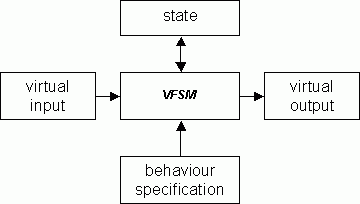
A subset of all defined output names, which can exist only in a certain situation is called virtual output (VO). VO is built by the current action(s) of the VFSM.
The behaviour specification is built by a state table which describes all details of a single state of the VFSM.
The VFSM executor is triggered by VI and the current state of the VFSM. In consideration of the behaviour specification of the current state, the VO is set.
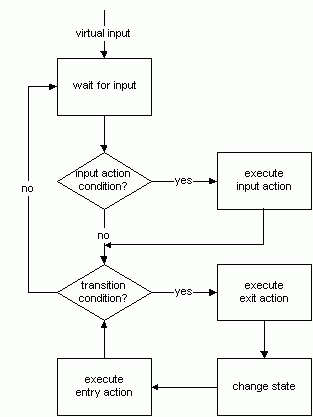
Figure 2 shows one possible implementation of a VFSM executor. Based on this implementation a typical behaviour characteristics must be considered.
State Table
- main page: state transition tableState transition tableIn automata theory and sequential logic, a state transition table is a table showing what state a finite semiautomaton or finite state machine will move to, based on the current state and other inputs...
.
A state table defines all details of the behaviour of a state of a VFSM. It consists of three columns: in the first column state names are used, in the second the virtual conditions built out of input names using the positive logic algebra are placed and in the third column the output names appear:
| State Name | Condition(s) | Actions(s) |
|---|---|---|
| Current state | Entry action | Output name(s) |
| Exit action | Output name(s) | |
| Virtual condition | Output name(s) | |
| ... | ... | |
| Next state name | Virtual condition | Output name(s) |
| Next state name | Virtual condition | Output name(s) |
| ... | ... | ... |
Read the table as following: the first two lines define the entry and exit actions of the current state. The following lines which do not provide the next state represent the input actions. Finally the lines providing the next state represent the state transition conditions and transition actions. All fields are optional. A pure combinatorial VFSM is possible in case only where input actions are used, but no state transitions are defined. The transition action can be replaced by the proper use of other actions.