
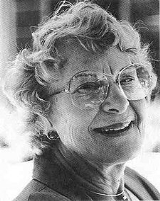
Virginia Satir was an
AmericanThe United States of America is a federal constitutional republic comprising fifty states and a federal district...
author and
psychotherapistPsychotherapy is a general term referring to any form of therapeutic interaction or treatment contracted between a trained professional and a client or patient; family, couple or group...
, known especially for her approach to
family therapyFamily therapy, also referred to as couple and family therapy, family systems therapy, and family counseling, is a branch of psychotherapy that works with families and couples in intimate relationships to nurture change and development. It tends to view change in terms of the systems of...
and her work with
Systemic ConstellationsThe Systemic Constellation process is a trans-generational, phenomenological, therapeutic intervention with roots in family systems therapy , existential-phenomenology , and the ancestor reverence of the South African Zulus...
. She is widely regarded as the "Mother of Family Therapy"Her most well-known books are
Conjoint Family Therapy, 1964,
Peoplemaking, 1972, and
The New Peoplemaking, 1988.
She is also known for creating the Virginia Satir Change Process Model, a psychological model which was developed through clinical studies. Change management and organizational gurus of the 1990s and 2000s embrace this model to define how change impacts organizations.
Early years
Virginia Satir was born 26 June 1916 in
Neillsville, WisconsinNeillsville is a city in Clark County in the U.S. state of Wisconsin. The population was 2,731 at the 2000 census. It is the county seat.-Geography:Neillsville is located at ....
, the eldest of five children born to Oscar Alfred Reinnard Pagenkopf and Minnie Happe Pagenkopf. When she was five years old, Satir suffered from
appendicitisAppendicitis is a condition characterized by inflammation of the appendix. It is classified as a medical emergency and many cases require removal of the inflamed appendix, either by laparotomy or laparoscopy. Untreated, mortality is high, mainly because of the risk of rupture leading to...
. Her mother, a devout Christian Scientist, refused to take her to a doctor. By the time Satir's father decided to overrule his wife, the young girl's
appendixThe appendix is a blind-ended tube connected to the cecum , from which it develops embryologically. The cecum is a pouchlike structure of the colon...
had ruptured. Doctors were able to save her life, but Satir was forced to stay in the hospital for several months.
A curious child, Satir taught herself to read by age three, and by nine had read all of the books in the library of her small
one-room schoolOne-room schools were commonplace throughout rural portions of various countries including the United States, Canada, Australia, New Zealand, United Kingdom, Ireland and Spain in the late 19th and early 20th centuries. In most rural and small town schools, all of the students met in a single room...
. When she was five, Satir decided that she would grow up to be "a children's detective on parents." She later explained that "I didn't quite know what I would look for, but I realized a lot went on in families that didn't meet the eye."
In 1929, her mother insisted that the family move from their farm to Milwaukee so that Satir could attend high school. Satir's high school years coincided with the
Great DepressionThe Great Depression was a severe worldwide economic depression in the decade preceding World War II. The timing of the Great Depression varied across nations, but in most countries it started in about 1929 and lasted until the late 1930s or early 1940s...
, and to help her family she took a part-time job and also attended as many courses as she could so that she could graduate early. In 1932, she received her high school diploma and promptly enrolled in Milwaukee State Teachers College (now University of Wisconsin–Milwaukee.) To pay for her education she worked part-time for the Works Projects Administration and for Gimbels Department Store and further supplemented her income by babysitting.
Career as a therapist
After graduating school, Satir began working in private practice. She met with her first family in 1951, and by 1955 was working with Illinois Psychiatric Institute, encouraging other therapists to focus on families instead of individual patients. By the end of the decade she had moved to
CaliforniaCalifornia is a state located on the West Coast of the United States. It is by far the most populous U.S. state, and the third-largest by land area...
, where she cofounded the
Mental Research InstituteThe Palo Alto Mental Research Institute is one of the founding institutions of brief and family therapy. Founded by Don D. Jackson and colleagues in 1959, MRI has been one of the leading sources of ideas in the area of interactional/systemic studies, psychotherapy, and family...
(MRI) in Palo Alto, California. MRI received a grant from
NIMHThe National Institute of Mental Health is one of 27 institutes and centers that make up the National Institutes of Health...
in 1962, allowing them to begin the first formal family therapy training program ever offered; Satir was hired as its Training Director.
Innovation
One of Satir's most novel ideas at the time, was the "presenting issue" or surface problem – that the presenting issue itself was seldom the real problem; rather, how people
coped with the issue
created the problem." Satir also offered insights into the particular problems that low
self-esteemSelf-esteem is a term in psychology to reflect a person's overall evaluation or appraisal of his or her own worth. Self-esteem encompasses beliefs and emotions such as triumph, despair, pride and shame: some would distinguish how 'the self-concept is what we think about the self; self-esteem, the...
could cause in relationships.
Satir published her first book,
Conjoint Family Therapy, in 1964, developed from the training manual she wrote for students at MRI. Her reputation grew with each subsequent book, and she travelled the world to speak on her methods. She also became a Diplomate of the Academy of Certified Social Workers and received the
American Association for Marriage and Family TherapyThe American Association for Marriage and Family Therapy is the professional association for the field of marriage and family therapy representing more than 25,000 marriage and family therapists throughout the United States, Canada, and abroad....
's Distinguished Service Award.
Long interested in the idea of
networkingA social network is a social structure made up of individuals called "nodes", which are tied by one or more specific types of interdependency, such as friendship, kinship, common interest, financial exchange, dislike, sexual relationships, or relationships of beliefs, knowledge or prestige.Social...
, Satir founded two groups to help individuals find mental health workers or other people who were suffering from similar issues to their own. In 1970, she organized Beautiful People, which later became known as the International Human Learning Resources Network. In 1977 she founded the Avanta Network.
Recognition
Two years later, Satir was appointed to the Steering Committee of the International Family Therapy Association and became a member of the Advisory Board for the National Council for Self-Esteem.
She has also been recognized with several honorary doctorates, including a 1978 doctorate in
Social SciencesSocial science is the field of study concerned with society. "Social science" is commonly used as an umbrella term to refer to a plurality of fields outside of the natural sciences usually exclusive of the administrative or managerial sciences...
from the
University of Wisconsin–MadisonThe University of Wisconsin–Madison is a public research university located in Madison, Wisconsin, United States. Founded in 1848, UW–Madison is the flagship campus of the University of Wisconsin System. It became a land-grant institution in 1866...
, and a 1986 doctorate from the Professional School of Psychological Studies.
Honors and Awards Received
- 1976 Awarded Gold Medal of "Outstanding and Consistent Service to Mankind" by the University of Chicago.
- 1978 Awarded honorary doctorate in Social Sciences from the University of Wisconsin–Madison.
- 1982 Selected by the West German Government as one of the twelve most influential leaders in the world today.
- 1985 Time magazine quotes a colleague, “She can fill any auditorium in the country”, after her stellar contribution to the Evolution of Psychotherapy Conference in Phoenix, Arizona.
- 1985 Selected by the prestigious National Academy of Practice as one of two members to advise on health concerns to the Congress of the United States.
- 1986 Selected as member of the International Council of Elders, a society developed by the recipients of the Nobel Peace Prize.
- 1987 Named Honorary Member of the Czechoslovakian Medical Society.
- She was honored in the California Social Work Hall of Distinction
The California Social Work Hall of Distinction was established in 2002 to honor those involved in bringing about the betterment of society and to ensure that the contributions of social work leaders, innovators and pioneers would be recognized and preserved for the future.The Hall of Distinction is...
.
- In two national surveys of Psychiatrists, Psychologists, Social Workers, and Marriage and Family Therapists, she was voted the most influential therapist.
Work and influence
Her entire work was done under the umbrella of "Becoming More Fully Human". From the possibility of a nurturing primary triad of father, mother, and child she conceived a process of Human Validation. She continually planted the seeds of hope toward world peace. As she said (Align, 1988, p. 20): "The family is a microcosm. By knowing how to heal the family, I know how to heal the world." With this overview she established professional training groups in the Satir Model in the Middle East, the Orient, Western and Eastern Europe, Central and Latin America, and Russia. The Institute for International Connections, Avanta Network, and the International Human Learning Resources Network are concrete examples of teaching people how to connect with one another and then extend the connections. Her world impact could be summed up in her universal mantra: peace within, peace between, peace among.
In the mid-1970s her work was extensively studied by the co-founders of
Neuro-linguistic programming (NLP)Neuro-linguistic programming is an approach to psychotherapy, self-help and organizational change. Founders Richard Bandler and John Grinder say that NLP is a model of interpersonal communication and a system of alternative therapy which seeks to educate people in self-awareness and effective...
,
Richard BandlerRichard Wayne Bandler is an American author and trainer in the field of self-help. He is best known as the co-inventor of Neuro-linguistic programming , a collection of concepts and techniques intended to understand and change human behavior-patterns...
and
John GrinderJohn Grinder, Ph.D., is an American linguist, author, management consultant, trainer and speaker. Grinder is credited with the co-creation with Richard Bandler of the field of Neuro-linguistic programming. He is co-director of Quantum Leap Inc., a management consulting firm founded by his partner...
, who used it as one of the three fundamental models of NLP. Bandler and Grinder also collaborated with Satir to author
Changing With Families for Science and Behavior Books, which bore the subtitle 'A Book About Further Education for Being Human'. AVANTA is an international organization that carries on her work and promotes her approach to family therapy.
Steve Andreas, one of Bandler and Grinder's students, wrote
Virginia Satir: The Patterns of Her Magic (1991) in which he summarized the major patterns of Satir's work, and then showed how Satir applied them in a richly annotated verbatim transcript of a videotaped session titled "Forgiving Parents". In this session, Satir works with a woman who hated her mother, and had difficulty connecting with others as a result. Using a variety of role-plays, including a "family reconstruction", (
Systemic ConstellationsThe Systemic Constellation process is a trans-generational, phenomenological, therapeutic intervention with roots in family systems therapy , existential-phenomenology , and the ancestor reverence of the South African Zulus...
) this woman came to see her mother as her "best friend", as detailed in a 3½ year follow-up interview.
See also
- Family systems therapy
- Carl Whitaker
- Positive and negative (NLP)
The term positive is generally used to mean "desirable" or "beneficial", and negative is generally used to mean "undesirable" or "bad". However, in neuro-linguistic programming they have a specific meanings in the phrases positive intent and stated in the positive, and negative intent and stated in...
- Sally Pierone
Sally Pierone is the former art director of the Marshall Plan who in 1952 worked at the American Embassy in Paris creating posters, booklets and displays to help rebuild Europe after World War II....
- Systems psychology
Systems psychology is a branch of applied psychology that studies human behaviour and experience in complex systems. It is inspired by systems theory and systems thinking, and based on the theoretical work of Roger Barker, Gregory Bateson, Humberto Maturana and others. It is an approach in...
External links