
The Arab-Israeli conflict is the result of numerous factors. Reasons cited for the conflict therefore vary from participant to participant and observer to observer. A powerful example of this divide can be found in opinion surveys of Palestinians and
IsraelisIsraelis , are citizens or nationals of the modern state of Israel. Israel is a multi-ethnic nation, home to people of different ethnic and national backgrounds including most numerously Jews, Muslims, Christians, Arabs, Druze, Circassians, and others...
. In a March, 2005 poll 63% of the Israelis blamed the failure of the Oslo Peace Process on Palestinian violence, but only 5% of the Palestinians agreed. 54% of Palestinians put the blame on continuing Israeli settlement activity, but only 20% of the Israelis agreed
http://www.pcpsr.org/survey/polls/2005/p15ejoint.html. It is therefore difficult to develop a single, objective reason for the conflict, so this article will present some of the arguments made by each side, in turn.
Israeli views
There is not a single "Israeli view"; there are many different Israeli views, which differ widely.
Israeli Peace Offers
When Israel met Arab leaders who spoke the language of peace to their own people and were willing to take concrete steps for peace, such as President Sadat of Egypt and King Hussein of Jordan, Israel made sacrifices for the sake of peace and reached peace agreements with them.
http://www.israelemb.org/faq_main_peace.htmhttp://www.jewishvirtuallibrary.org/jsource/Peace/peace_with_Egypt.html
Peacemaking requires concessions and confidence-building measures on both sides. Just as Israel is willing to address the rights and interests of other parties in the conflict, Israelis insist that their rights and interests must be addressed as well. However, Israel maintained a blockade against Gaza, starving the people throughout 2008 , and Israel broke the 2008 ceasefire on November 5 (in spite of Hamas honouring the ceasefire) by entering Gazan soil, killing 6 armed persons, peace negotiations were halted briefly in the face of this Israeli military action.
In 2000, at
Camp DavidNaval Support Facility Thurmont, popularly known as Camp David, is a mountain based military camp in Frederick County, Maryland used as a country retreat and for high alert protection of the President of the United States and his guests....
, the Palestinians were offered a nominally independent state composed of discontiguous parts of most of Gaza and the West Bank, with Israeli control over its airspace, borders and trade. Led by Arafat, the Palestinians rejected this offer, claiming that this state would be a "
BantustanA bantustan, black African homeland or simply homeland, was territory set aside for black inhabitants of South Africa and South West Africa , as part of the policy of apartheid...
" (a state divided in many pieces) without sovereignty. The Israeli government attempted to reduce Palestinian authority into various parcels of land with varying degrees of autonomy. These would be surrounded by the Israeli army. This would effectively place the costs of maintaining the Palestinians on the PLO while leaving military power in the hands of the Israeli's. Therefore the Palestinian Arabs rejected the proposal. When President Clinton and the Israelis asked the Palestinians to offer a counter-proposal, Arafat declined and returned to the West Bank. Later, further negotiations did take place, but they were terminated by the Israeli side. In his book
The Missing Peace: The Inside Story of the Fight for Middle East PeaceThe Missing Peace: The Inside Story of the Fight for Middle East Peace is a 2004 non-fiction book by Dennis Ross on the history of and his participation in the Israeli–Palestinian peace process and the Arab-Israeli peace process. Ross, an American diplomat, was the Director of Policy Planning in...
,
Dennis RossDennis B. Ross is an American diplomat and author. He has served as the Director of Policy Planning in the State Department under President George H. W...
, the American ambassador and facilitator, asserts that the idea the Palestinian state would be a "Bantustan" was a myth, and provides maps showing an offer that included contiguous territory.
http://www.motherjones.com/news/qa/2004/10/09_404.html
Arab Peace Offers
The PLO have openly stated that they are prepared to recognise the state of Israel on the basis of the removal of illegal settlements and retreat from Palestinian territory back to the 1967 borders. Israel maintains that Hamas refuse to recognise Israel.
Arab hostility
Many if not most Israelis believe that the conflict is largely a result of Arab attempts to destroy Israel, and that only Israeli military power stands between them and annihilation.
They characterize the Arab-Israeli War, the Six Day War and the
Yom Kippur WarThe Yom Kippur War, Ramadan War or October War , also known as the 1973 Arab-Israeli War and the Fourth Arab-Israeli War, was fought from October 6 to October 26, 1973, between Israel and a coalition of...
as attempts to destroy Israel. As evidence of this intent, pro-Israeli literature often places a heavy emphasis on statements made by Arab leaders during and preceding the wars. The following quotes are mainstays of pro-Israeli arguments:
- "I declare a holy war, my Muslim brothers! Murder the Jews! Murder them all!" (Mufti Mohammad Amin al-Husayni
Mohammad Amin al-Husayni , a member of the al-Husayni clan of Jerusalem, was a Palestinian Arab nationalist and Muslim leader in the British Mandate of Palestine...
of Jerusalem, 1948)
- "If Israel embarks on an aggression against Syria or Egypt...The battle will be a general one and our basic objective will be to destroy Israel." (Gamal Abdel Nasser
Gamal Abdel Nasser was the second President of Egypt from 1956 until his death in 1970. He led the Egyptian Revolution of 1952, which removed King Farouk I and heralded a new period of industrialization in Egypt, together with a profound advancement of Arab nationalism, including a short-lived...
's speech to Arab Trade Unionists (May 26 1967) http://www.mfa.gov.il/MFA/Foreign%20Relations/Israels%20Foreign%20Relations%20since%201947/1947-1974/7%20Statement%20by%20President%20Nasser%20to%20Arab%20Trade%20Unio)
- On May 30 1967, Nasser proclaimed: "The armies of Egypt, Jordan, Syria and Lebanon are poised on the borders of Israel...to face the challenge, while standing behind us are the armies of Iraq, Algeria, Kuwait, Sudan and the whole Arab nation. This act will astound the world. Today they will know that the Arabs are arranged for battle, the critical hour has arrived. We have reached the stage of serious action and not declarations." (Isi Leibler, The Case For Israel, 1972, p.60.) After Iraq joined the Arab military alliance in June 4, its president Abdur Rahman Aref announced: "The existence of Israel is an error which must be rectified. This is our opportunity to wipe out the ignominy which has been with us since 1948. Our goal is clear - to wipe Israel off the map." (Leibler, p.18)
Israel chooses to fight in self-defense
IsraelIsrael officially the State of Israel , is a developed state in Western Asia located on the eastern shore of the Mediterranean Sea. It borders Lebanon in the north, Syria in the northeast, Jordan in the east, and Egypt on the southwest, and contains geographically diverse features within its...
is generally claim that, when nations declare war against Israel, Israel by definition is then at war with them. Israel claims that they have always preferred peace to war.
SC 242, the
Land for peace'Land for peace' is an interpretation of UN Security Council Resolution 242 which has formed the basis of subsequent Arab-Israeli peace making. The name Land for Peace is derived from the wording of the resolution's first operative paragraph which affirms that peace should include the application...
formula, was adopted on November 22, 1967 in the aftermath of the
Six-Day WarThe Six-Day War of June 5-10, 1967 was a war between the Israel army and the armies of the neighboring states of Egypt, Jordan, and Syria. The Arab states of Iraq, Saudi Arabia, Sudan, Tunisia, Morocco and Algeria also contributed troops and arms. At the war's end, Israel had gained control of the...
and the
Khartoum ResolutionThe Khartoum Resolution of September 1, 1967 was issued at the conclusion of an Arab League summit in the wake of the Six-Day War. The resolution, which formed a basis of the policies of these governments toward Israel until the 1973 Yom Kippur War, called for: a continued state of belligerency...
. It called for withdrawal from occupied territories and for "termination of all claims or states of belligerency" and mutual "acknowledgment of the sovereignty, territorial integrity and political independence" by Israel and the other states in the area, and recognized the right of "every state in the area" to live "free from threats or acts of force" within "secure and recognized boundaries".
Immediately after the
Six-Day WarThe Six-Day War of June 5-10, 1967 was a war between the Israel army and the armies of the neighboring states of Egypt, Jordan, and Syria. The Arab states of Iraq, Saudi Arabia, Sudan, Tunisia, Morocco and Algeria also contributed troops and arms. At the war's end, Israel had gained control of the...
, Israel maintains that it offered to return the
Golan HeightsThe Golan Heights is a strategic plateau and mountainous region at the southern end of the Anti-Lebanon Mountains and remains a highly contested land straddling the borders of Syria and Israel. Two-thirds of the area is currently governed by Israel...
to
SyriaSyria , officially the Syrian Arab Republic , is a country in Western Asia, bordering Lebanon and the Mediterranean Sea to the west, Turkey to the north, Iraq to the east, Jordan to the south and Israel to the southwest....
and the
Sinai PeninsulaThe Sinai Peninsula or Sinai The Sinai Peninsula or Sinai The Sinai Peninsula or Sinai (sina; Egyptian Arabic: سينا sina; sina'a; is a triangular peninsula in Egypt. It lies between the Mediterranean Sea to the north and the Red Sea to the south, forming a land bridge between Africa and Southwest...
(including the
Gaza StripThe Gaza Strip lies on the coast of the Mediterranean Sea. It borders Egypt on the south-west and Israel on the south, east and north. It is about long, and between 6 and 12 kilometers wide, with a total area of . The area is recognized internationally as part of the Palestinian territories...
) to
EgyptEgypt , officially the Arab Republic of Egypt, is a country mainly in North Africa, with the Sinai Peninsula forming a land bridge in Western Asia...
in exchange for peace treaties and various concessions, but that Syria and Egypt refused the offer and this offer was very soon withdrawn.
Anwar SadatMuhammad Anwar Al Sadat, or Anwar El Sadat , was the third President of Egypt, serving from 15 October 1970 until his assassination on 6 October 1981...
, the Egyptian President at the time, proposed negotiations towards peace with Israel in the early 1970s but Israel refused the offer, claiming that it held unreasonable preconditions. Later Israel signed the Camp David Accords (1978) with Egypt and subsequently withdrew from all Egyptian territory it occupied.
Many, including the original framers of the resolution, have noted that the English language version of SC 242 did not state
all territories occupied during the conflict, recognizing that some territorial adjustments were likely and rejected previous drafts with the word
all (see UN Security Council Resolution 242#Arguments against "all territories" reading). The French language translation of the text did include the definite article. Israel considers it has complied with this sense of the resolution when it returned the
SinaiThe Sinai Peninsula or Sinai The Sinai Peninsula or Sinai The Sinai Peninsula or Sinai (sina; Egyptian Arabic: سينا sina; sina'a; is a triangular peninsula in Egypt. It lies between the Mediterranean Sea to the north and the Red Sea to the south, forming a land bridge between Africa and Southwest...
to Egypt in 1982.
Israel has no partner for peace
IsraelIsrael officially the State of Israel , is a developed state in Western Asia located on the eastern shore of the Mediterranean Sea. It borders Lebanon in the north, Syria in the northeast, Jordan in the east, and Egypt on the southwest, and contains geographically diverse features within its...
claims that it has demonstrated flexibility and understanding by bringing about the initiation of the peace process, agreeing to painful concessions, and partially implementing them. As opposed to this, many Israelis consider that the predominant
PalestinianThe Palestinian people, also referred to as Palestinians or Palestinian Arabs , are an Arabic-speaking people with family origins in Palestine...
views of the peace process do not recognize Israel's right to exist, and believe that the only real long-term
ArabArab people or Arabs are an ethnic group whose members identify along linguistic, cultural or genealogical grounds...
goal is the complete destruction of the
Jewish statesee also Proposals for a Jewish stateThe terms "Jewish state" and "homeland of the Jewish people" are used to describe the Zionist movement and the State of Israel and refer to its status as a nation-state established in Palestine for Jews.-History:...
.
Non-recognition of Israel's right to existThe right to exist is said to be an attribute of a sovereign state in international law. An essay on nationalism by nineteenth century French philosopher Ernest Renan helped popularize the phrase. It has featured prominently in the Arab-Israeli dispute since 1967...
or existence and non-recognition of democratically elected Hamas
Many Jews and supporters of Israel, and most Palestinians and supporters of Palestine, take the view that the very existence of the state of Israel is at stake. Most of the other parties to the dispute maintain formally that Israel should be recognized as a state, although some consider that it should be abolished. Some opponents of Israel do not even acknowledge its existence, refusing any contact with or mention of it, and instead describing it as "The Zionist Entity" with outdated land claims. On the other hand, Hamas were democratically elected to govern in Gaza. Although they are regarded as a terrorist organisation by Israel, this is highly debatable due to the massively outnumbering in death that Palestinian people have suffered (more than 5 times more Palestinian civilians have died at very conservative estimates compared to Israili civilan deaths over a 10 year period). By refusing to recognise the democratically elected government of Gaza, Israel can effectively prevent meaningful peace negotiations indefinitely.
Israelis argue that the continued Jewish presence in the area throughout the past three millennia, and the deep religious ties maintained by Judaism with the Land of Israel, give Jews a continuing and valid claim. Although the 1800 years preceding the establishment of Israel saw very limited Jewish presence, they emphasize that the destruction of the
Kingdom of IsraelThe Kingdom of Israel ) was one of the successor states to the older United Monarchy . It existed roughly from the 930s BC until about the 720s BC, when the kingdom was conquered by the Assyrian Empire...
and
Jewish DiasporaThe Jewish diaspora , the presence of Jews outside of the Land of Israel, is a result of the expulsion or emigration of Jews from Israel...
were due to foreign conquests. They also point out that since antiquity, Jewish beliefs were frequently branded as "obsolete" (see
Against ApionAgainst Apion was a polemical work written by Flavius Josephus as a defense of Judaism as a classical religion and philosophy, stressing its antiquity against what he perceived as more recent traditions of the Greeks.-Text:Against Apion 1:8 also defines which books he viewed as being in the Jewish...
,
SupersessionismSupersessionism and replacement theology are uniquely Christian interpretations of New Testament claims, viewing God's relationship with Christians as being either the "replacement" or "completion" of the promise made to the Jews and Jewish Proselytes...
). It may also be noted that historical grounds are not the only reasons given for the establishment of a Jewish state.
Israelis regard many of the
ArabArab people or Arabs are an ethnic group whose members identify along linguistic, cultural or genealogical grounds...
criticisms against the state of Israel as threats to the state's existence, and say that against the multitude and power of the Arab states, there is only one Jewish state, which, they feel, should behave vigilantly, and assert its power in both a defensive and preemptive manner as deemed necessary.
Treatment of Jews in Arab-ruled societies and vice-versa
Some Israelis point to issues of unfair and prejudicial treatment of Jews in Arab-ruled societies historically
http://www.jewishvirtuallibrary.org/jsource/myths/mf15.html and currently. Israelis claim that Arab countries such as
SyriaSyria , officially the Syrian Arab Republic , is a country in Western Asia, bordering Lebanon and the Mediterranean Sea to the west, Turkey to the north, Iraq to the east, Jordan to the south and Israel to the southwest....
and
YemenYemen , officially the Republic of Yemen is a country located on the Arabian Peninsula in Southwest Asia...
do not give full rights and freedoms to Jews, and others (such as
Saudi ArabiaSaudi Arabia , is an Arab country and the largest country of the Arabian Peninsula. It is bordered by Jordan on the northwest, Iraq on the north and northeast, Kuwait, Qatar, Bahrain, and the United Arab Emirates on the east, Oman on the southeast, and Yemen on the south...
) do not even allow Jews to be citizens. The United Nations Human Development Reports
http://www.rbas.undp.org/ and human rights groups report that many Arab countries do not allow political opposition and other freedoms and lack checks and balances and
separation of powersThe separation of powers, also known as trias politica, is a model for the governance of democratic states. The model was first developed in ancient Greece and came into widespread use by the Roman Republic as part of the uncodified Constitution of the Roman Republic...
.
They also argue that within Israel, Israeli Arabs are not subject to this type of discrimination. They point to Israel's democratic system which protects the rights of Jewish and Arab Israelis alike. Within the
pre-1967 armistice linesThe 1949 Armistice Agreements are a set of agreements signed during 1949 between Israel and neighboring Egypt, Lebanon, Jordan, and Syria. The agreements ended the official hostilities of the 1948 Arab-Israeli War, and established armistice lines between Israel and the Jordanian-held West Bank,...
, Arab and other minorities are given freedom of religion, culture and political organization. Several Arab political parties have elected parliament members in the
KnessetThe Knesset is the legislature of Israel, located in Givat Ram, Jerusalem.-Operation of the Knesset:...
. Arabs are typically not conscripted into the Israeli military (though they are accepted as volunteers), so they will generally never have to fight their peoples. However, it is recognized that this can affect later job opportunities, as some jobs in Israel require previous military service.
Many Israeli Arabs, however, claim that they are discriminated against, and that Israeli government agencies treat them worse than non-Arab Israelis
http://news.bbc.co.uk/2/hi/middle_east/4493525.stm http://www.hrw.org/reports/2001/israel2/index.htm#TopOfPage. In 2004, the US State Department's Country Report on Human Rights Practices indicates that Israel "did little to reduce institutional, legal, and societal discrimination against the country's Arab citizens"
http://www.state.gov/g/drl/rls/hrrpt/2004/41723.htm.
Islamic vs. other views of Land ownership
Some pro-
IsraelIsrael officially the State of Israel , is a developed state in Western Asia located on the eastern shore of the Mediterranean Sea. It borders Lebanon in the north, Syria in the northeast, Jordan in the east, and Egypt on the southwest, and contains geographically diverse features within its...
i views focus on differences in concepts of land ownership as a root source of conflict.
ShariaSharia is an Arabic word meaning ‘way’ or ‘path’. In Arabic, the collocation ‘Šarīʿat Allāh’ is traditionally used not only by Muslims, but also Christians and Jews, sometimes translating expressions such as Torat Elōhīm [תורת אלוהים] or ‘ho nómos toû theoû' '’...
(Islamic law) contains the concept of Waqf, revenue-generating property as religious endowment that, once established, is permanent in nature
http://i-cias.com/e.o/waqf.htm.
Under some traditional interpretations,
Muslim:A Muslim , , is an adherent of the religion of Islam. The feminine form is Muslimah . Literally, the word means "one who submits ". Muslim is the participle of the same verb of which Islam is the infinitive. Muslims believe that there is only one God, translated in Arabic as Allah...
territory encompass all land that was ever under Muslim control. The Hamas charter
http://memri.org/bin/articles.cgi?Page=countries&Area=palestinian&ID=SP109206 embraces this view of land ownership: "The Islamic Resistance Movement maintains that the land of Palestine is Waqf land given as endowment for all generations of Muslims until the Day of Resurrection. One should not neglect it or [even] a part of it, nor should one relinquish it or [even] a part of it. No Arab state, or [even] all of the Arab states [together], have [the right] to do this; no king or president has this right nor all the kings and presidents together; no organization, or all the organizations together - be they Palestinian or Arab - [have the right to do this] because Palestine is Islamic Waqf land given to all generations of Muslims until the Day of Resurrection. This is the legal status of the land of Palestine according to Islamic law. In this respect, it is like any other land that the Muslims have conquered by force, because the Muslims consecrated it at the time of the conquest as religious endowment for all generations of Muslims until the Day of Resurrection."
This concept of a permanent Waqf, while strongly held under Sharia law, is not agreed to internationally.
Characterizations of Zionism as Racism and Colonialism
Most
IsraelIsrael officially the State of Israel , is a developed state in Western Asia located on the eastern shore of the Mediterranean Sea. It borders Lebanon in the north, Syria in the northeast, Jordan in the east, and Egypt on the southwest, and contains geographically diverse features within its...
is see
ZionismZionism is the international political movement that originally supported the reestablishment of a homeland for the Jewish People in Palestine. The area was the Jewish Biblical homeland, called the Land of Israel...
as merely the desire of
JewThe Jews , also known as the Jewish people, are an ethnoreligious group originating in the Israelites or Hebrews of the Ancient Near East. The Jewish ethnicity, nationality, and religion are strongly interrelated, as Judaism is the traditional faith of the Jewish nation...
ish people to live as free people in the
land of IsraelThe Land of Israel is, according to the Hebrew Bible, the region which was promised by their God to the descendants of Abraham through his son Isaac and to the Israelites, descendants of Jacob, Abraham's grandson. This land forms part of the Abrahamic, Jacob and Israel covenants...
, as was promised to them in the
TorahThe term "Torah" , refers either to the Five Books of Moses or to the entirety of Judaism's founding legal and ethical religious texts...
. This opinion would argue that Zionism does not imply the superiority of Jews over any other nationality or ethnicity, but it does imply a superior right to Biblical land.
People of many races, colors and ethnic backgrounds live in Israel. It is pointed out that Israeli Jews come from a wide variety of ethnic backgrounds. In the 1930s, ideas of a 'population exchange' of Arabs and Jews between Arab states and Israel were actually popular among Zionists. In practice, most Jews living in Arab Nations in 1948 have currently left Arab countries: 2/3 have moved to Israel. Zionism allows
ArabArab people or Arabs are an ethnic group whose members identify along linguistic, cultural or genealogical grounds...
s,
DruzeThe Druze are a religious community found primarily in Syria, Lebanon, Israel, and Jordan, whose traditional religion is said to have begun as an offshoot of Islam, but is unique in its incorporation of Gnostic, neo-Platonic and other philosophies, similar to other followers of Ismaili Shi'a...
,
BedouinThe Bedouin, , are a predominantly desert-dwelling Arab ethnic group found throughout most of the desert belt extending from the Atlantic coast of the Sahara via the Western Desert, Sinai, and Negev to the Arabian Desert...
and other non-Jews to live in Israel as well, although by most interpretations it requires a Jewish majority to be established.
While some extremist Israelis (particularly supporters of
KachKach is town and union council of the Ziarat District in the Balochistan province of Pakistan. It is located at 30°26'2N 67°19'27E and has an altitude of 2020m ....
) believe in the forced transfer of Arabs from Israel, this is not a widely held view.
Zionists hold that Zionism is not colonialism, since they claim it does not wish to enslave any other peoples or take over any lands other than the one in question, nor to exploit them, but rather is about allowing the Jewish people to have a state in one area. They also point out that they are not representing an outsider colonial force but full-fledged movement of self-determination, and accept the use of force in colonizing and securing the land.
Jewish refugees
After the establishment of the State of
IsraelIsrael officially the State of Israel , is a developed state in Western Asia located on the eastern shore of the Mediterranean Sea. It borders Lebanon in the north, Syria in the northeast, Jordan in the east, and Egypt on the southwest, and contains geographically diverse features within its...
in 1948, most of the
Jewish population in Arab countriesThe Jewish exodus from Arab lands refers to the 20th century expulsion or mass departure of Jews, primarily of Sephardi and Mizrahi background, from Arab and Islamic countries...
fled, were expelled, were coerced by Arab governments, or voluntarily left their homes in an increasing climate of hostility, with nearly 66% absorbed by
IsraelIsrael officially the State of Israel , is a developed state in Western Asia located on the eastern shore of the Mediterranean Sea. It borders Lebanon in the north, Syria in the northeast, Jordan in the east, and Egypt on the southwest, and contains geographically diverse features within its...
. The State of Israel reacted by encouraging and facilitating emigration of non-local Jews to Israel. In a few Arab countries, this population change occurred over several decades and was accelerated by the promise of prosperity and acceptance in Israel. Many Jews lost much of their property and continue to claim compensation.
http://www.americansephardifederation.org/sub/sources/jewish_refugees.asp There has since been various return invitations from Arab states although these are mostly dismissed as politically motivated attempts to discredit Israel, and virtually no resettled Jews have shown interest in returning to their former homes, as they have integrated in their new homes or fear persecution in Arab states.
According to
Benny MorrisBenny Morris is professor of History in the Middle East Studies department of Ben-Gurion University of the Negev in the city of Be'er Sheva, Israel. He is a key member of a group of Israeli historians known as the 'New Historians', because they are rewriting the history of Israel since its...
, "[i]n the early years of statehood, Israeli leaders like
David Ben-Gurion' was the first Prime Minister of Israel. Ben-Gurion's passion for Zionism, which began early in life, culminated in his instrumental role in the founding of the state of Israel...
and
Moshe SharettMoshe Sharett was the second Prime Minister of Israel , serving for a little under two years between David Ben-Gurion's two terms.-Early life:...
viewed the flight of Palestinians and the
influx of Oriental JewsThe Jewish exodus from Arab lands refers to the 20th century expulsion or mass departure of Jews, primarily of Sephardi and Mizrahi background, from Arab and Islamic countries...
as simply a 'population exchange,' akin to those between Greece and Turkey in the 1920's or India and Pakistan in 1947."
http://www.samuelfreedman.com/articles/jinterest/nyt10132003.html IraqIraq , officially the Republic of Iraq , also known as Mesopotamia, is a country in Western Asia spanning most of the northwestern end of the Zagros mountain range, the eastern part of the Syrian Desert and the northern part of the Arabian Desert.Iraq shares borders with Jordan to the west, Syria...
i
Prime MinisterA prime minister is the most senior minister of cabinet in the executive branch of government in a parliamentary system. The position is usually held by, but need not always be held by, a politician. In many systems, the prime minister selects and can dismiss other members of the cabinet, and...
Nuri as-SaidNuri Pasha al-Said was an Iraqi politician during the British Mandate and during the Kingdom of Iraq. He served in various key cabinet positions, and served seven terms as Prime Minister of Iraq.-Biography:...
and other Arab leaders viewed it the same way.
http://www.meforum.org/article/263 Many continue to view it this way.
http://www.acpr.org.il/publications/policy-papers/pp090-xs.html http://www.meforum.org/article/263 http://www.americansephardifederation.org/sub/sources/jewish_refugees.asp http://www.jewishvirtuallibrary.org/jsource/History/jewref.html Some Palestinian refugees never accepted that a "population exchange" had occurred,
http://www.samuelfreedman.com/articles/jinterest/nyt10132003.html though others do accept that an irrevocable population exchange has occurred.
http://www.meforum.org/article/263
Furthermore, Israel has charged that Palestinian refugees were neglected by most Arab nations, whereas Jewish refugees were integrated into Israeli society, and that this neglect is a contributing cause to the poverty and misery experienced by the residents of those camps.
Palestinian refugees
IsraelIsrael officially the State of Israel , is a developed state in Western Asia located on the eastern shore of the Mediterranean Sea. It borders Lebanon in the north, Syria in the northeast, Jordan in the east, and Egypt on the southwest, and contains geographically diverse features within its...
does not recognize a Palestinian
Right of ReturnThe term right of return refers to a principle of international law, codified in the Universal Declaration of Human Rights and the International Covenant on Civil and Political Rights, giving any person the right to return and re-enter his country of origin...
. Property that belonged to Arabs who left or fled Israel before, during and after the
1948 Arab-Israeli WarThe 1948 Arab–Israeli War, known by Israelis as the War of Independence or War of Liberation and by Palestinians as the Catastrophe , was the first in a series of wars fought between the newly declared State of Israel and its Arab neighbours in the long-running Arab-Israeli conflict.The war...
is confiscated under the Absentee Property Act.
Israel maintains that the General Assembly resolutions establishing the Right of Return are merely recommendations under International law, and in any event doubt that the refugees wish to "live in peace with their neighbors".
Jewish Israelis fear that if
Palestinian refugeePalestinian refugees or Palestine refugees are the people and their descendants, predominantly Arabs, who fled or were expelled from their homes during and after the 1948 Palestine War, within that part of the British Mandate of Palestine that after that war became the territory of the State of...
s were allowed to return to
IsraelIsrael officially the State of Israel , is a developed state in Western Asia located on the eastern shore of the Mediterranean Sea. It borders Lebanon in the north, Syria in the northeast, Jordan in the east, and Egypt on the southwest, and contains geographically diverse features within its...
, the Jews would become a minority and
IsraelIsrael officially the State of Israel , is a developed state in Western Asia located on the eastern shore of the Mediterranean Sea. It borders Lebanon in the north, Syria in the northeast, Jordan in the east, and Egypt on the southwest, and contains geographically diverse features within its...
would no longer be a
Jewish statesee also Proposals for a Jewish stateThe terms "Jewish state" and "homeland of the Jewish people" are used to describe the Zionist movement and the State of Israel and refer to its status as a nation-state established in Palestine for Jews.-History:...
. Many believe that if surrounding Arab states integrate the Palestinian refugees hostilities could be diffused, and that the harsh treatment of refugees in Arab states is done deliberately by those states in order to keep the conflict alive.
Israel has stated that it is willing to allow a limited number of Arabs to immigrate on a humanitarian basis (such as the unification of families) and limited compensation for others in the framework of a comprehensive peace plan. Although serious discussion of how this would be implemented between both sides have yet to take place.
The text of UN Resolution 194 refer to a "just settlement of the refugee problem" and does not specifically mention either the
Palestinian refugeePalestinian refugees or Palestine refugees are the people and their descendants, predominantly Arabs, who fled or were expelled from their homes during and after the 1948 Palestine War, within that part of the British Mandate of Palestine that after that war became the territory of the State of...
s or the
Jewish refugeesIn the course of history, Jewish populations have been expelled or ostracised by various local authorities and have sought asylum from antisemitism numerous times...
http://domino.un.org/unispal.nsf/0/c758572b78d1cd0085256bcf0077e51a?OpenDocument. However, in 2004, in Resolution 59/117, the UN General Assembly "[n]otes with regret that repatriation or compensation of the refugees, as provided for in paragraph 11 of General Assembly resolution 194 (III), has not yet been effected and that, therefore, the situation of the Palestine refugees continues to be a matter of grave concern"
http://www.un.org/unrwa/publications/resolutions/2004/res59117.pdf.
Settlements
Israelis typically of the political right, particularly in the
LikudLikud is the major center-right political party in Israel. It was founded in 1973 by Menachem Begin in an alliance with several right-wing and liberal parties. Likud's victory in the 1977 elections was a major turning point in the country's political history, marking the first time the left had...
party, strongly support settlements in the
West BankThe West Bank is a landlocked territory and is the eastern part of the Palestinian territories; on the west bank of the River Jordan in the Middle East. To the west, north, and south, the West Bank shares borders with the state of Israel, which maintains the security of this area. To the east,...
. The platform of the Likud party states that "settlement of the land is a clear expression of the unassailable right of the Jewish people to the Land of Israel and constitutes an important asset in the defense of the vital interests of the State of Israel."
http://www.knesset.gov.il/elections/knesset15/elikud_m.htm
Israelis typically of the political left oppose settlements, believing they are illegal under the
Fourth Geneva ConventionThe Fourth Geneva Convention relates to the protection of civilians during times of war "in the hands" of an enemy and under any military occupation by a foreign power. This should not be confused with the better known Third Geneva Convention, which deals with the treatment of prisoners of war...
and/or thwart peace efforts. However, most Israelis do not view the building of houses and stores in
Israeli settlementIsraeli settlements are Israeli civilian communities in the Israeli-occupied territories . Such settlements currently exist in the West Bank, East Jerusalem and the Golan Heights...
s as an act of war, and believe that disputes over land do not justify violent resistance or terrorism, but that there should be politically negotiated solutions. This view is rejected by Palestinians and many outside Israel, as Israel's leadership continues to build settlements on land they contend to be Palestinian, an activity that is roundly condemned by much of the world except Israel and overlooked by the
United StatesThe United States of America is a federal constitutional republic comprising fifty states and a federal district...
.
Israel's settlement supporters argue that the Fourth Geneva Convention does not technically apply to the territories, since they have no "High Contracting Party", and claim that the Convention in any event only applied to forcible transfers of populations into or out of captured territories. However, a conference of High Contracting Parties in 2001 "reaffirmed the applicability of the Fourth Geneva Convention to the Occupied Palestinian Territory, including East Jerusalem" and "they reiterated the need for full respect for the provisions of the said Convention in that Territory."
http://domino.un.org/UNISPAL.NSF/85255a0a0010ae82852555340060479d/8fc4f064b9be5bad85256c1400722951!OpenDocument
Palestinian and other Arab views
There is not a single "Arab view"; there are many different Arab views, which differ widely.
Illegitimacy or illegality of Israel
- See also International law and the Arab-Israeli conflict
There is a broad international consensus that the actions of the nations involved in the Arab-Israeli conflict violate prohibitions contained in international law . However, this legality is disputed by some of the nations involved....
.
Palestinians claim they have
International lawPublic international law concerns the structure and conduct of sovereign states, analogous entities, such as the Holy See, and intergovernmental organizations. To a lesser degree, international law also may affect multinational corporations and individuals, an impact increasingly evolving beyond...
on their side.
UN General Assembly Resolution 181The United Nations Partition Plan for Palestine or United Nations General Assembly Resolution 181 Future Government of Palestine was a plan adopted by a decision of the General Assembly. The resolution was approved by a vote of 33 to 13, with 10 abstentions on November 29, 1947...
orders that "Independent Arab and Jewish States...shall come into existence in Palestine". Israeli founding father and author of Resolution 181
Abba EbanAbba Eban was an Israeli diplomat and politician.-Political career:...
claimed that Israel "tear[s] up its own birth certificate" when it ignores UN resolutions.
http://www.haaretzdaily.com/hasen/pages/ShArt.jhtml?itemNo=231659&contrassID=3&subContrassID=0&sbSubContrassID=0
Palestinians hold that Israel disregards the following UN resolutions/International Law provisions:
- UN General Assembly Resolution 194
United Nations General Assembly Resolution 194 was passed on December 11 1948, near the end of the 1948 Arab-Israeli War. The resolution expresses appreciation for the efforts of UN Envoy Folke Bernadotte after his assassination by members of the Lehi group...
calls for "the refugees wishing to return to their homes and live at peace with their neighbours should be permitted to do so at the earliest practicable date, and that compensation should be paid for the property of those choosing not to return and for loss of or damage to property" not naming either Palestinian refugees or Jewish refugeesIn the course of history, Jewish populations have been expelled or ostracised by various local authorities and have sought asylum from antisemitism numerous times...
. Palestinians hold that this resolution should allow for the Palestinian exodus to return to their homes in Israel. Israel has blocked the return of these refugees and confiscated their land as "absentee".
- UN Security Council Resolution 242, adopted after the Six-Day War
The Six-Day War of June 5-10, 1967 was a war between the Israel army and the armies of the neighboring states of Egypt, Jordan, and Syria. The Arab states of Iraq, Saudi Arabia, Sudan, Tunisia, Morocco and Algeria also contributed troops and arms. At the war's end, Israel had gained control of the...
, emphasizes "the inadmissibility of the acquisition of territory by war and the need to work for a just and lasting peace in which every State in the area can live in security," and calls for "withdrawal of Israel armed forces from territories occupied in the recent conflict" and for the recognition of the "sovereignty, territorial integrity and political independence of every State in the area and their right to live in peace within secure and recognized boundaries free from threats or acts of force". These territories occupied included the Gaza StripThe Gaza Strip lies on the coast of the Mediterranean Sea. It borders Egypt on the south-west and Israel on the south, east and north. It is about long, and between 6 and 12 kilometers wide, with a total area of . The area is recognized internationally as part of the Palestinian territories...
, Golan HeightsThe Golan Heights is a strategic plateau and mountainous region at the southern end of the Anti-Lebanon Mountains and remains a highly contested land straddling the borders of Syria and Israel. Two-thirds of the area is currently governed by Israel...
, West BankThe West Bank is a landlocked territory and is the eastern part of the Palestinian territories; on the west bank of the River Jordan in the Middle East. To the west, north, and south, the West Bank shares borders with the state of Israel, which maintains the security of this area. To the east,...
and the Sinai PeninsulaThe Sinai Peninsula or Sinai The Sinai Peninsula or Sinai The Sinai Peninsula or Sinai (sina; Egyptian Arabic: سينا sina; sina'a; is a triangular peninsula in Egypt. It lies between the Mediterranean Sea to the north and the Red Sea to the south, forming a land bridge between Africa and Southwest...
. The Palestinian Authority intends eventually to establish a state in the West Bank and Gaza Strip. Israel maintains control of the West Bank and maritime/aerospace control of the Gaza Strip.
- The Fourth Geneva Convention
The Fourth Geneva Convention relates to the protection of civilians during times of war "in the hands" of an enemy and under any military occupation by a foreign power. This should not be confused with the better known Third Geneva Convention, which deals with the treatment of prisoners of war...
forbids an occupying power from confiscating occupied land and transferring its own population to that territory.
Historical treatment of Jews in the Arab world
Many
Muslim:A Muslim , , is an adherent of the religion of Islam. The feminine form is Muslimah . Literally, the word means "one who submits ". Muslim is the participle of the same verb of which Islam is the infinitive. Muslims believe that there is only one God, translated in Arabic as Allah...
s and contemporary western historians assert that
JewThe Jews , also known as the Jewish people, are an ethnoreligious group originating in the Israelites or Hebrews of the Ancient Near East. The Jewish ethnicity, nationality, and religion are strongly interrelated, as Judaism is the traditional faith of the Jewish nation...
s were treated
betterThe historical interaction of Judaism and Islam started in the 7th century AD with the origin and spread of Islam in the Arabian peninsula. Because Judaism and Islam share a common origin in the Middle East through Abraham, both are considered Abrahamic religions...
by Muslims than by other rulers who
persecutedPersecution of Jews has occurred on numerous occasions and at widely different geographical locations. As well as being a major component in Jewish history, it has significantly impacted the general history and social development of the countries and societies in which the persecuted Jews...
them. One pertinent example is the mass expulsion of Jews from
SpainSpain , officially the Kingdom of Spain , is a country located in southwestern Europe on the Iberian Peninsula.
[The Spanish constitution does not establish any official denomination of the country, even though España , Estado español and Nación española are used interchangeably...]
after the fall of their last refuge there, the Muslim kingdom of
GranadaGranada is a city and the capital of the province of Granada, in the autonomous community of Andalusia, Spain.- Overview :The city of Granada is placed at the foot of the Sierra Nevada mountains, at the confluence of three rivers, Beiro, Darro and Genil, at an elevation of 738 metres above sea...
in 1492. This resulted in the migration of Jews (especially those fleeing the
Spanish InquisitionThe Spanish Inquisition was an ecclesiastical tribunal started in 1478 by Catholic Monarchs Ferdinand II of Aragon and Isabella I of Castile. It was intended to maintain Catholic orthodoxy in their kingdoms, and to replace the medieval inquisition which was under papal control...
) to the
Ottoman Empire, including the present-day region of Israel and surrounding areas. Authoritative works summarizing Jewish treatment within Muslim lands written by Jews have concluded that although occasional violent persecution did occur, it was not systemic nor continuous and substantially better than treatment by Christians in the pre-modern era. (Lewis, 1984)
The creation of Israel as a cause of conflict
Supporters of this viewpoint regard historically good relations with much of the Middle East as having been shattered by the creation of Israel. They cite the example of
Mizrahi JewsMizrahi Jews or Mizrahim, , also referred to as Edot HaMizrach are Jews descended from the Jewish communities of the Middle East, Central Asia and the Caucasus. The term Mizrahi is used in Israel in the language of politics, media and some social scientists for Jews from the Arab world and...
, who had long been living in large measure peacefully among Arabs and Muslims, but who left after the establishment of the state of Israel for a variety of reasons (depending on the country), including Muslim hostility because of the new state. Some point out as well that during the times of the
Spanish InquisitionThe Spanish Inquisition was an ecclesiastical tribunal started in 1478 by Catholic Monarchs Ferdinand II of Aragon and Isabella I of Castile. It was intended to maintain Catholic orthodoxy in their kingdoms, and to replace the medieval inquisition which was under papal control...
, Muslim countries were prominent in accepting Jewish refugees.
Opponents of this viewpoint, including some Mizrahi Jews themselves, see this as one-sided at best. They point to the persecutions of the Jews of North Africa in the 12th century under the Almohades, the slaughter of thousands of Jews in Fez in 1465 (after the Jewish deputy vizier Harun (Aaron), who had imposed heavy taxes on the population on behalf of the vizier, was accused of treating a Muslim woman "offensively"),
http://www.jewishvirtuallibrary.org/jsource/myths/mf15.html#c and to similar massacres in
LibyaLibya , officially the Great Socialist People's Libyan Arab Jamahiriya , is a country located in North Africa...
,
AlgiersAlgiers is the capital and largest city of Algeria, and the second largest city in the Maghreb . According to the 1998 census, the population of the city proper was 1,519,570 and that of the urban agglomeration was 2,135,630...
, and Marrakesh in the 18th and 19th centuries (Morris, 2001). They also point to waves of synagogue destructions and forced conversions throughout the Arab world from the 11th to 19th centuries, and to the fact that, by the 19th century, most Jews of North Africa were forced to live in
mellahA mellah is a walled Jewish quarter of a city in Morocco, an analogue of the European ghetto. Jewish population were confined to mellahs in Morocco beginning from the 15th century and especially since the early 19th century.In cities, a mellah was surrounded by a wall with a fortified gateway...
s or ghettos, and were subject to a number of restrictions and humiliations, as they were in Europe.
Jewish immigration as a cause of conflict
Some Arabs maintain that there is nothing wrong with Jewish immigration into Palestine, in itself, any more than there is with Jewish immigration into any other part of the world. But in their view the Zionist immigrants arriving in Palestine from the late 1800s on did so in course of a plan to take it over and establish a Jewish majority state, in some cases by force; they consider this to be colonization of Palestinians' land, made possible not by Palestinian
self-determinationSelf-determination is defined as free choice of one’s own acts without external compulsion; and especially as the freedom of the people of a given territory to determine their own political status. In other words, it is the right of the people of a nation to decide how they want to be governed...
, or even consent, but by British (and to a lesser extent Turkish) fiat. This process led to what they regard as an expulsion by Zionists of the majority of the indigenous Palestinian population in 1948, and continues today with Israel's ongoing expansion of settlements. Palestinians also decry what they see as the inherent inequity of long-standing Israeli laws on immigration where, according to Israel's Law of Return, a Jew born in, say Stockholm, may immigrate to Israel and gain automatic citizenship and elect to live anywhere he chooses, including
East JerusalemEast Jerusalem refers to the parts of Jerusalem captured by Jordan in the 1948 Arab-Israeli War, and subsequently by Israel in the 1967 Six-Day War. It includes Jerusalem's Old City and some of the holiest sites of Judaism, Christianity and Islam, such as the Temple Mount, Western Wall, Al-Aqsa...
, whereas a Palestinian born and raised in Jerusalem and forced to leave as a refugee of war may not return to his home.
The detractors of this argument regard the existence of a Jewish minority in the
Land of IsraelThe Land of Israel is, according to the Hebrew Bible, the region which was promised by their God to the descendants of Abraham through his son Isaac and to the Israelites, descendants of Jacob, Abraham's grandson. This land forms part of the Abrahamic, Jacob and Israel covenants...
throughout the past two millennia, and the
importance of Jerusalem and the Land of Israel in JudaismJerusalem is the capital of Israel and its largest city in both population and area, with a population of 747,600 residents over an area of if disputed East Jerusalem is included...
, as giving Jews a right to go there that trumps Palestinians' objections. They also claim international approval for their immigration, noting that both the
League of NationsThe League of Nations was an inter-governmental organization founded as a result of the Treaty of Versailles in 1919–1920. At its greatest extent from 28 September 1934 to 23 February 1935, it had 58 members...
's 1922 Palestine Mandate and the 1947 UN Partition Plan supported the establishment of a Jewish National Homeland in the region, and view the Arab leadership's former rejection of any partition as an attempt to deny the Jews their right of
self-determinationSelf-determination is defined as free choice of one’s own acts without external compulsion; and especially as the freedom of the people of a given territory to determine their own political status. In other words, it is the right of the people of a nation to decide how they want to be governed...
. They claim that a national homeland for Jews would have protected them from persecution. Mainstream Zionists have argued that the land could support a greater population density without major population displacement.
Israeli treatment of minorities
Palestinians feel that the Jewish state of Israel was established under conditions that were deeply unfair to them. Palestinians do not oppose a Jewish state as such, but all Palestinians feel that it should not have been established at their expense. They argue that after World War II - and, indeed, after World War I - the world allowed a state for Jewish people in Palestine to be established without much concern for the existing indigenous Arab population. Accordingly, Palestinians were forcibly expelled from their homes by Jewish militias before and during the 1948 Arab-Israeli war (see Palestinian exodus.) Those who remained in Israel face various forms of discrimination, such as housing and employment discrimination. Many job opportunities in Israel are open only to those with previous military service, typically non-
haredi Jews,
DruzeThe Druze are a religious community found primarily in Syria, Lebanon, Israel, and Jordan, whose traditional religion is said to have begun as an offshoot of Islam, but is unique in its incorporation of Gnostic, neo-Platonic and other philosophies, similar to other followers of Ismaili Shi'a...
,
CircassiansCircassians is a term derived from the Turkic Cherkess . Generically it refers to the Caucasian peoples of northwest Caucasus. It might be understood in a narrower sense , or in a broader sense...
and Bedouins. Those who do not serve in the IDF (typically Israeli Arabs and
haredi-Jews) are denied those opportunities.
Some Palestinian Christians are of the opinion that the
Israeli-Palestinian conflictThe Israeli–Palestinian conflict is an ongoing dispute between Israel and the Palestinians. It forms part of the wider Arab–Israeli conflict. The term is also used in reference to the earlier phases of the same conflict, between Zionist halutzim and the Arab population living in Palestine under...
has led to the diminishment of their population
http://christianactionforisrael.org/antiholo/hate_jews.htmlhttp://www.amconmag.com/2004_05_24/article.html. Others, like Abe Ata are of the opinion that American
ChristiansChristianity is a monotheistic religion based on the life and teachings of Jesus of Nazareth as presented by the revelations in the New Testament....
have "turned their backs" on them by supporting Israel
http://www.natcath.com/NCR_Online/archives/112202/112202r.htm. Some Palestinian Christians have alleged that Israel does not give them permission to visit holy places in Jerusalem.
http://www.amin.org/eng/daoud_kuttab/2005/may20.html
Legitimacy of war against Israel
As the refugees' exile continued, some Palestinian groups chose war, considering it as a necessary way to regain what they saw as their rights over the land they came from. The failure of these efforts to improve the Palestinians' condition fueled increased hostility.
Some Palestinians distinguish between violent resistance against Israeli military occupation, and violent acts against Israeli civilians. They hold that the former is legitimate resistance under the
laws of warThe law of war is a body of law concerning acceptable justifications to engage in war and the limits to acceptable wartime conduct...
, while the latter comprise illegitimate acts of terrorism. Other Palestinian voices reject violence altogether and look to exclusively non-violent resistance as a solution. Palestinians making the case for purely non-violent resistance, or for armed resistance against only military targets but not Israeli civilians, invoke both practical arguments that such tactics are counterproductive, as well as moral and legal arguments against the use of violence, especially against civilians. Most Palestinians claim that Israel's occupation engenders routine violence against Palestinian civilians that is institutionalized and carried out on a much larger scale than anything Israelis experience. They often question what they see as the media's one-sided use of the word "terror" in cases where Palestinians are perpetrators and Israelis are victims, while ignoring what they view as state terrorism carried out by Israel against the Palestinian population.
Some Palestinian and Arab leaders believe that Palestinians are justified in using violence against any Israeli, seeing all Israelis as illegal occupants, and arguing that Israel's universal conscription renders almost all Israelis potential combatants. They see these illegal occupants as the source of tens of thousands of deaths, and millions of refugees. Some claim that trusting the international community to help them to get their rights back is useless, suggesting that, in recent history, as long as Palestinians were peaceful no state made any serious efforts to solve their problem. In their opinion, only when other countries see Palestinian problems as causing problems to themselves do they help Palestine.
They also argue that the civilian deaths caused by their operations are dwarfed by those dismissed as "
collateral damageCollateral damage is damage that is unintended or incidental to the intended outcome. The term originated in the United States military, but it has since expanded into broader use.-Etymology:...
" caused by the full scale military campaigns done by various world powers. Some see the innocent deaths caused by such operations as regrettable, but as an only option to solve the problems of millions of Palestinians. Furthermore, they point to the use of violence against non-combatants by most other independence struggles, including, they say, the American War of Independence.
Despite having underlying grievances in common, the relationships between the
PLO and HamasUntil the January 2006 legislative election the Palestine Liberation Organization was the main Palestinian organization. It has maintained conflictual ties with the Hamas over the years, which culminated with the election of the latter party...
and other Palestinian factions is rife with philosophical and tactical differences, as well as frequent power struggles, all of which tend to work to Israel's advantage and weaken Palestinians' ability to influence the outcome of the conflict.
Treatment of Palestinians
Restrictions on Palestinian movements were introduced to increase levels of security within Israel and Jewish settlements in the West Bank and Gaza. They have been of variable severity over time. The international community often views these as punishments of the masses because of the actions of a few. This perception of unjust persecution provides a continuing rationale for hostility toward Israel.
Bulldozing of houses and destruction of infrastructure within Palestinian residential areas in the name of Israeli security add to the poor conditions and lack of opportunities for the Palestinians. This is a frequently-used point of indignation against Israel by Palestinian sympathizers.
Arab publications and others have compared
ZionismZionism is the international political movement that originally supported the reestablishment of a homeland for the Jewish People in Palestine. The area was the Jewish Biblical homeland, called the Land of Israel...
to German
NazismNazism, known officially in German as National Socialism , is the totalitarian ideology and practices of the Nazi Party or National Socialist German Workers’ Party under Adolf Hitler, and the policies adopted by the dictatorial government of Nazi Germany from 1933 to 1945.Nazism is often considered...
and other historical examples of oppression and ethnic cleansing. Many Arabs, and others, believe Israel practices a form of Israeli apartheid against the Palestinian people, as bad as, or worse than, that practised by
South AfricaThe Republic of South Africa is a country located at the southern tip of Africa, with a coastline on the Atlantic and Indian Oceans. To the north lie Namibia, Botswana and Zimbabwe, to the east are Mozambique and Swaziland, while Lesotho is an independent country surrounded by South Africa.Modern...
, and that Zionism is a form of
colonialismColonialism is the building and maintaining of colonies in one territory by people from another territory. Sovereignty over the colony is claimed by the metropole...
and has been carried out through extensive ethnic cleansing. Pro-Israel advocates reply that these claims are non-factual and the comparisons are specious, or with assertions that such claims are hypocritical, since Arabs have created twenty-two Arab states, in some of which the remaining Jews are discriminated against. Palestinians hold that the existence of other Arab nations is irrelevant; they want to have the land they owned back, rather than being forced to throw themselves on others' charity in foreign countries.
Israel's Family Reunification Law allowed the Interior Minister to grant permanent resident status to West Bank Palestinians who have family members in Israel. A recent revision to this Law required that the Interior Minister "shall not grant" citizenship except in exceptional cases
http://www.csmonitor.com/2003/0808/p06s03-wome.html; recent additional modifications allow some citizenships, but limit based on age
http://www.israelnationalnews.com/news.php3?id=86654. In his comment to the Knesset Interior Affairs committee on July 19 2005, Shin Bet Chief Yuval Diskin stated that "11% of those involved in terror attacks are Palestinians who entered Israel via the Family Reunification Law."
http://www.reliefweb.int/rw/RWB.NSF/db900SID/FPRI-6EFGS8?OpenDocument http://www.ynetnews.com/articles/0,7340,L-3115064,00.html
Refugee issues
UN General Assembly Resolution 194United Nations General Assembly Resolution 194 was passed on December 11 1948, near the end of the 1948 Arab-Israeli War. The resolution expresses appreciation for the efforts of UN Envoy Folke Bernadotte after his assassination by members of the Lehi group...
calls for "the refugees wishing to return to their homes and live at peace with their neighbours should be permitted to do so at the earliest practicable date, and that compensation should be paid for the property of those choosing not to return and for loss of or damage to property". Israel has blocked the return of these refugees and confiscated their land as "absentee".
The supporters of Israel argue that the return of Palestinian refugees and millions of their descendants would mean the end of Jewish
self-determinationSelf-determination is defined as free choice of one’s own acts without external compulsion; and especially as the freedom of the people of a given territory to determine their own political status. In other words, it is the right of the people of a nation to decide how they want to be governed...
and assert the historical necessity for Jews to have a
safe havenSafe haven may refer to:* Safe haven law, for the decriminalization of leaving unharmed infants with statutorily designated private persons so that the child becomes a ward of the state* Safe harbor...
. See also
Jewish refugeesIn the course of history, Jewish populations have been expelled or ostracised by various local authorities and have sought asylum from antisemitism numerous times...
.
Furthermore, some argue that Palestinians, if allowed to return, would not live in peace with their neighbours.
Jewish settlements in the West Bank and the Gaza Strip
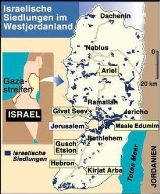
There are currently 246,000 Jewish settlers living in
settlementsIsraeli settlements are Israeli civilian communities in the Israeli-occupied territories . Such settlements currently exist in the West Bank, East Jerusalem and the Golan Heights...
in the West Bank, not including 200,000 Israeli Jews who live in annexed East Jerusalem
http://news.bbc.co.uk/2/hi/middle_east/4188216.stm. Ongoing settlement development and growth are major reasons Palestinians claim the peace process has failed
http://www.pcpsr.org/survey/polls/2005/p15ejoint.html, and the issue figures prominently in the larger narrative of the Arab-Israeli conflict among non-Palestinian Arabs
http://english.aljazeera.net/NR/exeres/0761B1FF-AC1B-4969-BE65-731D454BF983.htm.
These settlements are off-limits to Palestinians and other Arabs, while any Jewish citizen of Israel can at any time choose to settle there. To monitor and control Palestinian movement, Israel has established 50+ checkpoints in and around the West Bank
http://news.bbc.co.uk/2/shared/spl/hi/middle_east/03/v3_israel_palestinians/maps/html/settlements_checkpoints.stm. As well, recently, Israel has begun construction of a controversial West Bank barrier (see map
http://news.bbc.co.uk/2/shared/spl/hi/guides/456900/456944/html/nn2page1.stm). Palestinians complain that these measures greatly restrict their movement and are often humiliating, while Israel asserts that they are necessary for security. Palestinians also point out that Israel accelerated the expansion of
settlementsIsraeli settlements are Israeli civilian communities in the Israeli-occupied territories . Such settlements currently exist in the West Bank, East Jerusalem and the Golan Heights...
in the West Bank and Gaza Strip throughout the Oslo peace process.
During Fateh Central Committee meeting on September 5 2005, "[r]eferring to the lands Israel would evacuate in Gaza Strip, President Abbas said that 97.5% of these lands were state-owned lands"
http://www.ipc.gov.ps/ipc_new/english/details.asp?name=10285.
In 2005, approximately 9,000 settlers were evicted by Israel from the Gaza Strip and the West Bank.
Arab Peace Offer
In 2002,
Saudi ArabiaSaudi Arabia , is an Arab country and the largest country of the Arabian Peninsula. It is bordered by Jordan on the northwest, Iraq on the north and northeast, Kuwait, Qatar, Bahrain, and the United Arab Emirates on the east, Oman on the southeast, and Yemen on the south...
offered a
peace planThe Beirut Summit was a meeting of the Arab League in Beirut, Lebanon in March 2002 to discuss the Israeli-Palestinian conflict. The meeting became especially noteworthy for the adoption, by the Arab states attending, of a proposal offering a comprehensive peace between the Arab countries and...
in
The New York TimesThe New York Times is an American daily newspaper founded in 1851 and published in New York City. The largest metropolitan newspaper in the United States, "The Gray Lady"—named for its staid appearance and style—is regarded as a national newspaper of record...
and at a summit meeting of the
Arab LeagueThe Arab League , officially called the League of Arab States , is a regional organization of Arab states in Southwest Asia, and North and Northeast Africa. It was formed in Cairo on March 22, 1945 with six members: Egypt, Iraq, Transjordan , Lebanon, Saudi Arabia, and Syria...
in
BeirutBeirut is the capital and largest city of Lebanon with a population of over 2.1 million as of 2007. Located on a peninsula at the midpoint of Lebanon's coastline with the Mediterranean sea, it serves as the country's largest and main seaport and also forms the Beirut Metropolitan Area, which...
. The plan is based on, but goes beyond UN Security Council Resolution 242 and Resolution 338. It essentially calls for full withdrawal, solution of the
refugee problemPalestinian refugees or Palestine refugees are the people and their descendants, predominantly Arabs, who fled or were expelled from their homes during and after the 1948 Palestine War, within that part of the British Mandate of Palestine that after that war became the territory of the State of...
, and a
Palestinian stateProposals for a Palestinian state refer to the proposed establishment of an independent state for the Palestinian people in the Palestinian territories that have been occupied by Israel since the Six-Day War of 1967 and before by Egypt and by Jordan since 1949...
with its capital in
East JerusalemEast Jerusalem refers to the parts of Jerusalem captured by Jordan in the 1948 Arab-Israeli War, and subsequently by Israel in the 1967 Six-Day War. It includes Jerusalem's Old City and some of the holiest sites of Judaism, Christianity and Islam, such as the Temple Mount, Western Wall, Al-Aqsa...
in return for fully normalized relations with the whole Arab world. This proposal received the unanimous backing of the
Arab LeagueThe Arab League , officially called the League of Arab States , is a regional organization of Arab states in Southwest Asia, and North and Northeast Africa. It was formed in Cairo on March 22, 1945 with six members: Egypt, Iraq, Transjordan , Lebanon, Saudi Arabia, and Syria...
for the first time.
In response, Israeli Foreign Minister
Shimon Peres' is the ninth and current President of the State of Israel. Peres served twice as Prime Minister of Israel and once as Interim Prime Minister, and has been a member of 12 cabinets in a political career spanning over 66 years...
said: "[T]he details of every peace plan must be discussed directly between Israel and the Palestinians, and to make this possible, the Palestinian Authority must put an end to terror, the horrifying expression of which we witnessed just last night in Netanya."
http://www.mfa.gov.il/MFA/About+the+Ministry/MFA+Spokesman/2002/Response+of+FM+Peres+to+the+decisions+of+the+Arab.htm
Palestinians as victims of extremism
Some Palestinians believe that their cause may be damaged by extremists within their own ranks; an issue that is mirrored in the Israeli camp. Some view the conflict as essentially extremist vs. moderate, as opposed to Israeli vs. Palestinian. Pro-Israel advocates often assert that two sets of views exist from the same speaker, with a tolerant view usually expressed in English, and an anti-peace view usually expressed in Arabic, with pro-Arab advocates making similar charges about Israeli speakers. Most if not all Palestinian spokespeople declare that they wish Israel had never come into being, regarding its creation as a historic injustice and a manipulation of International Law. However, some accept its existence today and call merely for a state of their own. Still others envisage a one-state solution in all of historic Palestine. Within this one-state view, there are both secular and Islamist visions for the future. The secular view holds that a just and lasting peace is most likely if there exists a fully democratic government for all citizens, where legal status and civil rights are not based on ethnic and religious identity. The Islamist view aspires to an Islamic government in Palestine. In both views, Jews currently living in Israel might be allowed to remain there unmolested as free and equal citizens of a future state of Palestine (in the secular Arab view) or as
dhimmiA dhimmi is a non-Muslim subject of a state governed in accordance with sharia law...
s along with Druze and Christians, in the Islamist Arab view. Some Jews view it as extremely unlikely that they would be allowed to live unmolested in any sort of one-state Palestine.
Today, many Palestinians think that an equitable arrangement for all involved parties requires dialogue with Israelis and the international community. The PLO has officially accepted the right of Israel to exist within the
pre-1967 armistice linesThe 1949 Armistice Agreements are a set of agreements signed during 1949 between Israel and neighboring Egypt, Lebanon, Jordan, and Syria. The agreements ended the official hostilities of the 1948 Arab-Israeli War, and established armistice lines between Israel and the Jordanian-held West Bank,...
. However, some PLO representatives, including Yasser Arafat, have also declared at times that they saw these statements as politically necessary steps. Some observers interpret this to mean that they view the two-state solution as a stepping stone to a more integrated long-term solution. Others, particularly some Israelis, claim that these statements betray a hidden agenda and worldview where the peace process with Israel is only a temporary measure in support of the ultimate Palestinian goal, which is the destruction of the state of Israel, and presumably the eviction of its Jewish citizens. They point to the fact that the PLO never updated its formal statement of policy, the
Palestinian National CovenantThe Palestinian National Covenant or Palestinian National Charter is the charter or constitution of the Palestine Liberation Organization ....
to reflect their recognition of the State of Israel and that it still calls for the destruction of Israel; however the U.S. Embassy in Israel is on record confirming that "On April 24, 1996, the Palestinian National Council (PNC) amended the charter by canceling the articles inconsistent with its commitments to Israel"
http://www.usembassy-israel.org.il/publish/peace/plo_note.html. Still, belief in an existential threat from the PLO causes alarm among much of the Israeli public.
Biased text books
Many Palestinian school textbooks, including those distributed and sponsored by the Palestinian Authority since 1994, have historically minimized or ignored Jewish history of the land prior to the twentieth century. Israeli textbooks and school curriculum also often ignore Palestinian history. Texts and school curriculum on both sides are accused of propagating "myths" about the history of the conflict, and relegating important points of view and facts.
The role of the superpowers
Palestinians cite many reasons for the perceived lack of support of their cause in the United States, despite the perception that it is more broadly supported in Europe. One such reason is postulated to be ethnic bigotry in the U.S.; while stereotyping of many other groups is no longer rampant, many people believe that Muslims and Arabs, in particular, continue to be vilified and victimized by crude attacks. There is also strong influence by Zionist organizations on elected officials in the U.S. political system (see
AIPACThe American Israel Public Affairs Committee is a lobbying group that advocates for pro-Israel policies to the Congress and Executive Branch of the United States. It has been described as one of the most powerful lobbying groups in Washington, DC—including being a "de facto agent of a...
as one such example). It has also been argued that the U.S. continues to support Israel in order to have a strong foot hold in the region for their own national interests, politically and economically. Many also cite the political nature of the Cold War that aligned the U.S. with Israel against the USSR and its allies in the region.
The
USSRThe Union of Soviet Socialist Republics was a constitutionally socialist state that existed in Eurasia from 1922 to 1991. The name is a translation of the , tr. Soyuz Sovetskikh Sotsialisticheskikh Respublik, abbreviated СССР, SSSR. The common short name is Soviet Union, from , Sovetskiy Soyuz...
traditionally used Arabs as a proxy in the
Cold WarThe Cold War was the continuing state of political conflict, military tension, and economic competition existing after World War II , primarily between the USSR and its satellite states, and the powers of the Western world, including the United States...
against the
Western worldThe Western world, also known as the West and the Occident , is a term that can have multiple meanings depending on its context...
(and the West's proxy in the Middle East, Israel). Some of today's
anti-ZionistAnti-Zionism is opposition to Zionism, and a term which has been used to describe several very different religious and political points of view, both historically and in current debates. All these points of view have in common some form of opposition to Zionism, but their diversity of motivation...
rhetoric still reflects the position of Soviet
ZionologySoviet Anti-Zionism was a doctrine promulgated in the Soviet Union during the course of the Cold War, and intensified after the 1967 Six Day War. It was officially sponsored by the Department of propaganda of the Communist Party of the Soviet Union and by the KGB. It alleged that Zionism was a form...
.
Peace and reconciliation
Despite the long history of conflict between Israelis and Arabs, there are many people working on peaceful solutions that respect the rights of peoples on all sides. See projects working for peace among Israelis and Palestinians.
- Currently active List of Middle East peace proposals include:
- Geneva Accord
The Draft Permanent Status Agreement, better known as the Geneva Accord or Geneva Initiative, is an extra-governmental and therefore unofficial peace proposal meant to solve the Israeli-Palestinian conflict. It would give Palestinians almost all of the West Bank and Gaza Strip and part of...
- Road map for peace
The "road map" for peace is a plan to resolve the Israeli-Palestinian conflict proposed by a "quartet" of international entities: the United States, the European Union, Russia, and the United Nations. The principles of the plan, originally drafted by U.S. Foreign Service Officer Donald Bloome, were...
- The People's Voice
The People's Voice is an Israeli-Palestinian civil initiative dedicated to advancing the process of achieving peace between Israel and the Palestinians...
Views of the Conflict: Pro-Israeli
- Myths and Facts of the Arab-Israeli Conflict, extensive collection of questions and answers with maps and documents published by the American-Israeli Cooperative Enterprise
- Arab-Israeli Conflict: Basic Facts from the Israeli Science and Technology Homepage
- Segev, Tom (1999.) One Palestine Complete: Jews and Arabs Under British Mandate. Published by Henry Holt and Company, LLC, 115 West 18th Street New York, New York 10011. ISBN 978-0-8050-6587-9
- Bard, Mitchell, Ph.D. (1999) Middle East Conflict. Published by Alpha Books, 201 West 103rd Street, Indianapolis, IN 46290. ISBN 978-0-02-863261-2
- The Associated Press (1967). Lightning Out of Israel The Arab-Israeli Conflict. Printed in the U.S.A. by Western Printing and Lithographing Company
- Dershowitz, Alan. The Case for Israel (John Wiley & Sons, 2004), ISBN 978-0-471-67952-3
- [Stunich, Andrew (2007). The Real Cause of and Likely Progression of the Arab-Israeli Conflict http://redwoodreality.blogspot.com/search?q=Arab+Israeli+conflict]
Views of the Conflict: Pro-Arab