
All Topics  
Venipuncture

 
Venipuncture

   Email Print
   Bookmark   Link


Venipuncture


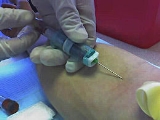
In medicine venipuncture or venepuncture (also known as phlebotomy, venesection, blood draw, drawing blood or taking blood) is the process of obtaining a sample of venous
Vein

In the circulatory system, veins are blood vessels that carry blood toward the heart. Most veins carry deoxygenated blood from the tissues back to the heart; exceptions are the pulmonary vein and umbilical veins, both of which carry oxygenated blood....
 blood
Blood

Blood is a specialized bodily fluid that delivers necessary substances to the body's Cell s ? such as nutrients and oxygen ? and transports waste products away from those same cells....
. Usually a 5 ml to 25 ml sample of blood is adequate depending on what blood tests have been requested.


Discussion
Ask a question about 'Venipuncture'
Start a new discussion about 'Venipuncture'
Answer questions from other users
Full Discussion Forum


Recent Posts


Encyclopedia


Blooddraw
In medicine venipuncture or venepuncture (also known as phlebotomy, venesection, blood draw, drawing blood or taking blood) is the process of obtaining a sample of venous
Vein

In the circulatory system, veins are blood vessels that carry blood toward the heart. Most veins carry deoxygenated blood from the tissues back to the heart; exceptions are the pulmonary vein and umbilical veins, both of which carry oxygenated blood....
 blood
Blood

Blood is a specialized bodily fluid that delivers necessary substances to the body's Cell s ? such as nutrients and oxygen ? and transports waste products away from those same cells....
. Usually a 5 ml to 25 ml sample of blood is adequate depending on what blood tests have been requested. In many circumstances it will be done by a phlebotomist
Phlebotomist

A phlebotomist is an individual trained to draw blood, either for laboratory tests or for blood donations....
, although medical practitioners
Physician

A physician, medical practitioner, doctor of medicine, or medical doctor practices medicine, and is concerned with maintaining or restoring human health through the study, diagnosis, and treatment of disease and injury....
, some EMTs, paramedics
Paramedics

#REDIRECT paramedic...
, other nursing staff are also trained to take blood.

Blood is most commonly obtained from the median cubital vein
Median cubital vein

In human anatomy, the median cubital vein a superficial vein of the upper limb. It connects the basilic vein and cephalic vein vein and is often used for venipuncture ....
, on the anterior forearm
Forearm

The forearm is the structure on the upper limb, between the Elbow-joint and the wrist.. This term is used in anatomy to distinguish it from the arm ....
 (the side within the fold of the elbow). This vein lies close to the surface of the skin, and there is not a large nerve supply.

Minute quantities of blood may be taken by fingersticks sampling and collected from infants by means of a heel stick or from scalp veins with a butterfly needle
Butterfly needle

Winged Infusion Sets, or "Butterfly" needles are used in venipuncture . They are often used with people who have spasticity.Since the butterfly needle uses a flexible tube, there is less chance of the patient causing damage if they move during the procedure....
.

Phlebotomy (incision into a vein) is also the treatment of certain diseases such as hemochromatosis and primary and secondary polycythemia
Polycythemia

Polycythemia is a condition in which there is a net increase in the total number of blood cells, primarily red blood cells, in the body. The overproduction of red blood cells may be due to a primary process in the bone marrow , or it may be a reaction to chronically Hypoxia or, rarely, a malignancy....
.

Equipment

There are many ways in which blood can be drawn from a vein. The best method varies with the age of the patient, equipment available and tests required.

Most blood collection in the US and UK is done with an evacuated tube system, such as the BD Vacutainer
Vacutainer

Vacutainer is a registered brand of test tube specifically designed for venipuncture. It was developed in 1947 by Joseph Kleiner, and is currently marketed by Becton, Dickinson and company....
 system or similar blood collection equipment consisting of a plastic hub, a hypodermic needle, and a vacuum tube. Under certain circumstances, a syringe may be used, usually with a butterfly needle, which is a plastic catheter attached to a short needle. In the developing world, a needle and syringe are still the most common method of drawing blood.

Venipuncture with evacuated or vacuum tubes


Vacuum tubes were first marketed by U.S. company BD (Becton, Dickinson and Company) under the trade name Vacutainer tubes. Today, many companies sell vacuum tubes as the patent for this device is in the public domain. Some models are a type of test tube
Test tube

A test tube, also known as a culture tube, sample tube, test flute or flaccid flute, is a piece of laboratory glassware composed of a finger-like length of glass tubing, open at the top, with a rounded U-shaped bottom....
 that contains a vacuum that automatically aspirates blood into itself. The tubes are made of glass or plastic. The tubes are attached to a needle and hub.

Multiple vacuum tubes can be attached to and removed in turn from a single needle, allowing multiple samples to be obtained from a single procedure. This is possible due to a Japanese invention called the multiple sample sleeve, which is basically a plastic cap fitting over the posterior end of the needle cannula, thus keeping blood from draining onto both health care worker and patient.

BD used this invention to create a sort of system that included the vacuum pressurized sleeve, and a cannula with sleeve attached to a holder that holds the needle/sleeve combination, and guides the negatively pressured collection vial that is inserted once the needle is in the patient.

Unfortunately, the sleeve that stops blood from moving until its seal is perforated by the collection tube's insertion, also prevents flashback, the tell-tale sign the vein has been entered properly.

They are commonly used in US, UK, and Australian hospitals, private doctors' offices and community labs, and are available in various sizes to suit the age of the patient and the type of sample needed.

Venipuncture with needle and syringe


A syringe
Syringe

A syringe is a simple piston pump consisting of a plunger that fits tightly in a tube. The plunger can be pulled and pushed along inside a cylindrical tube , allowing the syringe to take in and expel a liquid or gas through an orifice at the open end of the tube....
 is used to manually extract blood from a patient. This dated method is normally used on elderly patients, or patients with unreliable veins. Because syringes are manually operated, the amount of suction applied may be easily controlled. This is particularly helpful with patients that have small veins that collapse under the vacuum of BD Vacutainer tubes, but unfortunately, there is a greater chance of hemolysis
Hemolysis

Hemolysis ?from the Greek Hemo-, Greek language meaning blood, -lysis, meaning to break open?is the breaking open of red blood cells and the release of hemoglobin into the surrounding fluid ....
 when using a syringe, if the phlebotomist performing the venipuncture pulls the plunger of the syringe with excess force. A 23gauge needle is the same size as a butterfly. So it might be easier to stick with a syringe and 23g needle instead of trying with a butterfly.

The procedure is similar to venipuncture with a vacuum tube. After the needle is inserted into the vein, the phlebotomist receives confirmation of success when a small amount of blood appears in the back of the needle. This is often referred to as 'flash'. The plunger is then pulled backwards and blood fills the syringe. The blood is usually transferred quickly to a BD Vacutainer tube using a safety transfer device before clotting sets in using a similar defined tube order; normally the same order of draw as when using a BD Vacutainer tube, as the same additive cross-contamination issues still exist with this method.

Blood cultures

Most often, blood cultures are drawn using a winged collection set, commonly known as a butterfly needle. When blood cultures are being collected with a winged collection set, phlebotomist are to collect the aerobic sample first, as air in the tubing of the winged collection set can create problems in testing of the anaerobic blood culture.

Aerobic
Aerobic organism

An aerobic organism or aerobe is an organism that can survive and grow in an oxygenated environment....
 refers to bacteria that grow in the air and anaerobic
Anaerobic organism

An anaerobic organism is any organism that does not require oxygen for growth and may even die in its presence....
 refers to bacteria that do not grow in the air. Since there is air in the "butterfly" needle tubing anaerobic specimens cannot be drawn without first removing the air from the tubing. The tops of any containers used when drawing a blood culture should be sterilized with the use of iodine that is allowed to dry, seeing that isopropyl alcohol only cleans and does not sterilize. This is disputed in some labs, where iodine is thought to degrade the rubber stopper through which blood enters the bottle, thus allowing contaminates to enter the container.

Blood alcohol tests

It is generally not advisable to use isopropyl alcohol to cleanse the venipuncture site when obtaining a specimen for a blood alcohol test. Using soap and hot water or a povidone iodine swab are advisable alternatives to isopropyl alcohol in this case.

See also

  • Blood donation
    Blood donation

    A blood donation is when a healthy person free will has blood drawn. The blood is used for blood transfusion or made into medications by a process called fractionation#Plasma protein fractionation....
  • Fingerprick
    Fingerprick

    In medicine, some blood tests are conducted on venous blood obtained by fingerprick. There are various ways of opening a small wound that produces no more than a few drops of blood....
  • Neonatal heel prick
    Neonatal heel prick

    The neonatal heel prick is a common procedure for taking a blood sample from the heel of newborn infants. A pinprick puncture is made in the heel of the infant's foot, and blood from the foot is soaked into pre-printed collection cards known as Guthrie cards....
  • Vacutainer
    Vacutainer

    Vacutainer is a registered brand of test tube specifically designed for venipuncture. It was developed in 1947 by Joseph Kleiner, and is currently marketed by Becton, Dickinson and company....


External links