


Uma-jirushi

Encyclopedia
Japan
Japan is an island nation in East Asia. Located in the Pacific Ocean, it lies to the east of the Sea of Japan, China, North Korea, South Korea and Russia, stretching from the Sea of Okhotsk in the north to the East China Sea and Taiwan in the south...
to identify a daimyo
Daimyo
is a generic term referring to the powerful territorial lords in pre-modern Japan who ruled most of the country from their vast, hereditary land holdings...
or equally important military commander on the field of battle. They came into prominence during the Sengoku period
Sengoku period
The or Warring States period in Japanese history was a time of social upheaval, political intrigue, and nearly constant military conflict that lasted roughly from the middle of the 15th century to the beginning of the 17th century. The name "Sengoku" was adopted by Japanese historians in reference...
. While many were simply large flags, not very different from sashimono
Sashimono
Sashimono were small banners historically worn by soldiers in feudal Japan, for identification during battles.-Description:The sashimono poles were attached to the backs of the chest armor by special fittings. Sashimono were worn by common soldiers, known as ashigaru, to elite samurai, and in...
or hata-jirushi
Hata-jirushi
' were the most common of war banners used on the medieval Japanese battlefield. The term could be translated to literally mean symbol flag, marker banner or the like...
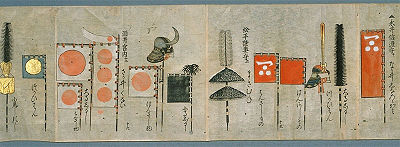
, most were three-dimensional figures, more like kites, and in the shape of bells, gongs, umbrellas, or streamers.
While these standards took many forms, they all fall into two broad categories: the ō-uma-jirushi and the ko-uma-jirushi, the great standard and the lesser standard respectively. Poorer daimyo had just one, the lesser standard, while wealthier daimyo had both. In 1645, the Tokugawa shogunate
Tokugawa shogunate
The Tokugawa shogunate, also known as the and the , was a feudal regime of Japan established by Tokugawa Ieyasu and ruled by the shoguns of the Tokugawa family. This period is known as the Edo period and gets its name from the capital city, Edo, which is now called Tokyo, after the name was...
formalized this, allowing daimyo with an income above 1300 koku
Koku
The is a Japanese unit of volume, equal to ten cubic shaku. In this definition, 3.5937 koku equal one cubic metre, i.e. 1 koku is approximately 278.3 litres. The koku was originally defined as a quantity of rice, historically defined as enough rice to feed one person for one year...
to have a ko-uma-jirushi, and daimyo earning more than 6000 koku
Koku
The is a Japanese unit of volume, equal to ten cubic shaku. In this definition, 3.5937 koku equal one cubic metre, i.e. 1 koku is approximately 278.3 litres. The koku was originally defined as a quantity of rice, historically defined as enough rice to feed one person for one year...
to have an ō-uma-jirushi as well.
The ō-uma-jirushi was the nucleus of action on the battlefield, and while it aided the organization and morale of friendly troops, it also attracted the attention of enemy warriors. The carrier of the uma-jirushi, therefore, was arguably the most dangerous position to be in on the field. The ō-uma-jirushi was sometimes held in a leather bucket attached to the carrier's belt; the especially large ones would often be securely strapped into a carrying frame on the warrior's back. The carrier was provided with ropes to steady the standard in the wind, or while running.
In 1650, a monk called Kyūan
Kyuan
, also romanized as Kyū-an, was a after Ten'yō and before Ninpei. This period spanned the years from July 1145 through January 1151. The reigning emperor was .-Change of Era:...
completed a text called O Uma Jirushi, a comprehensive illustrated survey of the heraldry
Heraldry
Heraldry is the profession, study, or art of creating, granting, and blazoning arms and ruling on questions of rank or protocol, as exercised by an officer of arms. Heraldry comes from Anglo-Norman herald, from the Germanic compound harja-waldaz, "army commander"...
of his time. This text describes the heraldry of most, if not all, of the major samurai families of the battles of the Sengoku period
Sengoku period
The or Warring States period in Japanese history was a time of social upheaval, political intrigue, and nearly constant military conflict that lasted roughly from the middle of the 15th century to the beginning of the 17th century. The name "Sengoku" was adopted by Japanese historians in reference...
. The text still survives today, and remains one of the chief sources of heraldic information available today on this period in Japan.