
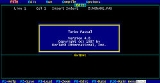
Turbo Pascal is a complete software development system that includes a compiler
Compiler
A compiler is a computer program that transforms source code written in a programming language into another computer language . The most common reason for wanting to transform source code is to create an executable program.... and an Integrated Development Environment
Integrated development environment
An integrated development environment also known as integrated design environment or integrated debugging environment is a software application that provides comprehensive facilities to computer programmers for software development.... (IDE) for the Pascal programming language running under CP/M
CP/M
CP/M is an operating system originally created for Intel 8080/Intel 8085 based microcomputers by Gary Kildall of Digital Research. Initially confined to single tasking on 8-bit processors and no more than 64 kilobytes of memory, later versions of CP/M added multi-user variations, and were migrated to 16-bit processors.... , CP/M-86
CP/M-86
CP/M-86 was a version of the CP/M operating system that Digital Research made for the Intel 8086 and Intel 8088. The commands are those of CP/M-80.... , and MS-DOS
MS-DOS
MS-DOS is an operating system commercialized by Microsoft. It was the most commonly used member of the DOS family of operating systems and was the main operating system for personal computers during the 1980s.... , developed by Borland
Borland
Borland Software Corporation is a Computer software company headquartered in Austin, Texas. It was founded in 1983 by Niels Jensen, Ole Henriksen, Mogens Glad and Philippe Kahn.... under Philippe Kahn
Philippe Kahn
Philippe Kahn is a technology innovator and entrepreneur, credited for creating the first camera phone solution sharing pictures instantly on public networks .... 's leadership. The name Borland Pascal was generally reserved for the high end packages (with more libraries and standard library source code) while the original cheap and widely known version was sold as Turbo Pascal.
Discussion
Ask a question about 'Turbo Pascal'
Start a new discussion about 'Turbo Pascal'
Answer questions from other users
Full Discussion Forum
Encyclopedia
Turbo Pascal is a complete software development system that includes a compiler
Compiler
A compiler is a computer program that transforms source code written in a programming language into another computer language . The most common reason for wanting to transform source code is to create an executable program.... and an Integrated Development Environment
Integrated development environment
An integrated development environment also known as integrated design environment or integrated debugging environment is a software application that provides comprehensive facilities to computer programmers for software development.... (IDE) for the Pascal programming language running under CP/M
CP/M
CP/M is an operating system originally created for Intel 8080/Intel 8085 based microcomputers by Gary Kildall of Digital Research. Initially confined to single tasking on 8-bit processors and no more than 64 kilobytes of memory, later versions of CP/M added multi-user variations, and were migrated to 16-bit processors.... , CP/M-86
CP/M-86
CP/M-86 was a version of the CP/M operating system that Digital Research made for the Intel 8086 and Intel 8088. The commands are those of CP/M-80.... , and MS-DOS
MS-DOS
MS-DOS is an operating system commercialized by Microsoft. It was the most commonly used member of the DOS family of operating systems and was the main operating system for personal computers during the 1980s.... , developed by Borland
Borland
Borland Software Corporation is a Computer software company headquartered in Austin, Texas. It was founded in 1983 by Niels Jensen, Ole Henriksen, Mogens Glad and Philippe Kahn.... under Philippe Kahn
Philippe Kahn
Philippe Kahn is a technology innovator and entrepreneur, credited for creating the first camera phone solution sharing pictures instantly on public networks .... 's leadership. The name Borland Pascal was generally reserved for the high end packages (with more libraries and standard library source code) while the original cheap and widely known version was sold as Turbo Pascal. The name Borland Pascal is also used more generically for Borland's dialect of Pascal.
Borland has released three versions of Turbo Pascal of historical interest free of charge: versions 1.0, 3.02 and 5.5 for MS-DOS.
Philippe Kahn is a technology innovator and entrepreneur, credited for creating the first camera phone solution sharing pictures instantly on public networks .... first saw an opportunity for Borland
Borland
Borland Software Corporation is a Computer software company headquartered in Austin, Texas. It was founded in 1983 by Niels Jensen, Ole Henriksen, Mogens Glad and Philippe Kahn.... , his newly formed software company, in the field of programming tools. Historically, the vast majority of programmers saw their work flow in terms of the edit/compile/link cycle, with separate tools dedicated to each task. Programmers wrote source code
Source code
In computer science, source code is any collection of statements or declarations written in some human-readable computer programming language.... and entered it using a text editor, a compiler created object code from source (often requiring multiple passes), and a linker
Linker
In computer science, a linker or link editor is a computer program that takes one ormore object file generated by a compiler and combines them into a single executable program.... combined object code with runtime libraries to produce an executable program.
In the IBM PC market of the early 1980s, the major programming tool
Programming tool
A programming tool or software development tool is a computer program or application software that software developers use to create, debug, maintain, or otherwise support other programs and applications.... vendors included IBM
IBM
International Business Machines Corporation, abbreviated IBM and nicknamed "Big Blue" , is a multinational corporation computer technology and consulting corporation headquartered in Armonk, New York, New York, United States.... , Microsoft
Microsoft
Microsoft Corporation is a multinational corporation computer technology corporation that develops, manufactures, licenses, and supports a wide range of computer software products for computing devices.... , and Lattice. They all made C compilers (and some made Pascal compilers), which all worked in a similar fashion. For example, the Microsoft Pascal
Microsoft Pascal
Microsoft Pascal was an implementation of the Pascal programming language that was developed by the Microsoft Corporation for compiler programs for running on its MS-DOS operating system and, in later versions, on OS/2 .... system consisted of two compiler passes and a final linking pass (which could take minutes on systems with only floppy disks for secondary storage). This process was the cumbersome product of the extremely limited resources of the early IBM PC models. Vendors of software development tools aimed their products at professional developers, and the price for these basic tools plus ancillary tools like profilers ran into the hundreds of dollars.
Kahn's idea was to integrate these separate functions in a programming toolkit, have it run with much better performance, and charge one low price for it all. Instead of selling the kit through established sales channels (retailers or resellers), his new tool would be sold inexpensively via mail-order. Turbo Pascal is generally considered to be the first popular Integrated Development Environment
Integrated development environment
An integrated development environment also known as integrated design environment or integrated debugging environment is a software application that provides comprehensive facilities to computer programmers for software development.... (IDE) of any type.
As an additional selling point against the bigger vendors, Turbo Pascal disks came with no copy protection
Copy protection
Copy protection, also known as content protection, copy prevention, or copy restriction, is a technology for preventing the reproduction of copyrighted software, movies, music, and other media.... of any sort. Turbo Pascal came with the famous "Book License": "You must treat this software just like a book ... may be used by any number of people ... may be freely moved from one computer location to another". Since the first versions didn't have online help, copy protection was effectively enforced by possession of the Turbo Pascal reference manual (pictured below).
Version history
The Turbo Pascal compiler is based on the Blue Label Pascal compiler originally produced for the NasSys cassette-based operating system of the Nascom
Nascom
The Nascom 1 and 2 were single-board computer kits issued in 1977 and 1979, respectively, based on the Zilog Z80 and including a computer keyboard and video interface, a serial port that could be used for storing data on a compact audio cassette using the Kansas City standard, and two 8-bit parallel communications.... microcomputer in 1981 by Anders Hejlsberg
Anders Hejlsberg
Anders Hejlsberg is a prominent Denmark software engineer who co-designed several popular and commercially successful programming languages and development tools.... . This was first rewritten as the Compas Pascal compiler for the CP/M
CP/M
CP/M is an operating system originally created for Intel 8080/Intel 8085 based microcomputers by Gary Kildall of Digital Research. Initially confined to single tasking on 8-bit processors and no more than 64 kilobytes of memory, later versions of CP/M added multi-user variations, and were migrated to 16-bit processors.... operating system and then as the Turbo Pascal compiler for DOS and CP/M. A version of Turbo Pascal was available for the Apple Macintosh from about 1986 but was eventually discontinued around 1992. Another version was available for CP/M machines like the DEC Rainbow through several releases.
Versions 1 to 3
See also .
Borland licensed the PolyPascal compiler core, written by Anders Hejlsberg
Anders Hejlsberg
Anders Hejlsberg is a prominent Denmark software engineer who co-designed several popular and commercially successful programming languages and development tools.... (Poly Data was the name of his company in Denmark), and added the user interface and editor. Anders joined the company as an employee and was the architect for all versions of the Turbo Pascal compiler and the first three versions of Borland Delphi
Borland Delphi
Delphi is a software development environment for Microsoft Windows applications. It has always supported development of native Windows applications in the Delphi programming language, a further development of Object Pascal.... .
The first version of Turbo Pascal, later referred to as version 1, was very fast compared to other microcomputer Pascal compilers. It was available for the CP/M
CP/M
CP/M is an operating system originally created for Intel 8080/Intel 8085 based microcomputers by Gary Kildall of Digital Research. Initially confined to single tasking on 8-bit processors and no more than 64 kilobytes of memory, later versions of CP/M added multi-user variations, and were migrated to 16-bit processors.... , CP/M-86
CP/M-86
CP/M-86 was a version of the CP/M operating system that Digital Research made for the Intel 8086 and Intel 8088. The commands are those of CP/M-80.... , and MS-DOS
MS-DOS
MS-DOS is an operating system commercialized by Microsoft. It was the most commonly used member of the DOS family of operating systems and was the main operating system for personal computers during the 1980s.... operating systems, all widely used at the time. The CP/M
CP/M
CP/M is an operating system originally created for Intel 8080/Intel 8085 based microcomputers by Gary Kildall of Digital Research. Initially confined to single tasking on 8-bit processors and no more than 64 kilobytes of memory, later versions of CP/M added multi-user variations, and were migrated to 16-bit processors.... version could be used on the very popular Apple II computer if fitted with a Z-80 SoftCard
Z-80 SoftCard
The Z-80 SoftCard was a plug-in card, supplied by Microsoft for use with the Apple II personal computer. It had a Zilog Z80 CPU and was eventually renamed the Microsoft SoftCard.... , the first hardware product of the small company Microsoft
Microsoft
Microsoft Corporation is a multinational corporation computer technology corporation that develops, manufactures, licenses, and supports a wide range of computer software products for computing devices.... released in 1980.
At the time CP/M used a simple executable file format using the file name extension .COM; MS-DOS could use either .COM files (incompatible with CP/M) or the more flexible relocatable .EXE format used almost universally in later years. Turbo Pascal generated only .COM files, which was not a severe restriction for the computer world of the time. Turbo Pascal itself was a single .COM file about 38 kilobytes long. which included the editor, compiler, linker, and the library routines. The edit/compile/run cycle was fast compared to other Pascal implementations because everything related to building the program was stored in RAM. The compiled program could run from the IDE; writing it to disk, once free of obvious errors, was an additional menu option.
When the first version of Turbo Pascal appeared on November 20 1983, the type of IDE it used was relatively new. On its debut in the American
United States
The United States of America is a Federal government constitutional republic comprising U.S. state and a federal district. The country is situated mostly in central North America, where its Contiguous United States and Washington, D.C., the Capital districts and territories, lie between the Pacific Ocean and Atlantic Oceans, Borders of the U... market, Turbo Pascal retailed for USD$
United States dollar
The United States dollar is the unit of currency of the United States and was defined by the Coinage Act of 1792 to be between 371 and 416 grains of silver .... 49.99. The integrated Pascal compiler also was of very good quality compared to other Pascal products of the time and was affordable above all. The "Turbo" name alluded to its compilation speed as well as the speed of the executables it produced. The speed of these "com
COM file
In many computer operating systems, a COM file is a type of executable; the name is derived from the file name extension .COM. Originally, the term stood for "Command file", a text file containing commands to be issued to the operating system , on many of the Digital Equipment Corporation minicomputer and mainframe operating systems going... " executable files was a revelation for developers whose only previous experience programming microcomputers was with interpreted BASIC or the semi-interpreted and more cumbersome UCSD Pascal
UCSD Pascal
UCSD Pascal or UCSD p-System was a portable, highly machine-independent operating system. The University of California, San Diego Institute for Information Systems developed it in 1978 to provide students with a common operating system that could run on any of the then available microcomputers as well as campus Digital Equipment Corpora... .
The IDE was incredible for its day, when computing resources were very limited. The IBM PC and other machines were often sold with 64 kbytes of RAM; the IBM PC was expandable up to a maximum 640kb. Many machines equipped with only one or two floppy disc drives of a 140 - 360 kilobytes capacity were used; a 5 or 10 megabyte hard disk was a luxury. Turbo Pascal was simple and intuitive, and had a well-organized menu system. Early versions of the editor used WordStar
WordStar
WordStar was a word processor application, published by MicroPro International, originally written for the CP/M operating system but later ported to DOS, that enjoyed a dominant market share during the early to mid-1980s.... key functions, which was the de facto standard because of WordStar's wide use. Later versions of the IDE, designed for later PCs with more disk space and memory, could display the definitions of the keywords of the language by putting the cursor over a keyword and pressing the F1 key. The definitions also frequently included example code that used the keyword. This enabled the inexperienced programmer to learn Pascal simply by using the IDE, without actually requiring help from a book.
Versions 2 and 3 were improved versions of the same basic all-in-one system, working in memory and producing .COM/.CMD files. Support for CP/M and CP/M-86 was dropped after version 3.
Later versions
Version 4, released in 1987, was a major rewrite of the whole system. The compiler generated executables in EXE format under MS-DOS, rather than the simpler but more restricted .COM executables. Support for the now obsolescent CP/M and CP/M-86 operating systems was dropped. This version also introduced a full-screen user interface with pull-down menus; earlier versions had a text-based menu screen and a separate full-screen editor.
Version 5.x introduced the familiar Borland blue screen, which would be the trademark of the company's MS-DOS compiler tools until the end of this line in the middle 1990s.
While all versions of Turbo Pascal could include inline assembly code, later versions had the ability to easily integrate assembly language
Assembly language
An assembly language is a low-level language for programming computers. It implements a symbolic representation of the numeric machine codes and other constants needed to program a particular CPU architecture.... within Pascal. Assembly code provides the lowest human-readable interface to the machine, and allows faster execution than can be generated by a compiler, with access to the machine at a very detailed level. Overall program execution could be improved by coding much-executed inner-loop code this way.
The IDE allowed single stepping through a program for debugging, and now assembly-language blocks could be stepped through. The user could add watch
Watch (computer programming)
A watch is a real-time view of a variable's or an expression's value. It is used during computer programs' debugging.... es on variables and registers in an IDE window. Programs using IBM PC
IBM PC compatible
IBM PC compatible computers are those generally similar to the original IBM Personal Computer, IBM Personal Computer XT, and IBM Personal Computer/AT.... graphics mode could flip between graphics and text mode automatically or manually.
Profiler has multiple meanings:*Criminal profiler, a criminologist who studies a criminal's behavior for clues to psychology to aid in capturing them... that could report on which parts of the program were using the most time. The books included with Borland Pascal had detailed descriptions of the Intel assembler language, going so far as to provide the clock cycles required by each instruction. Overall this system, as a whole, made for a relatively pleasant experience when trying to debug and optimize code; the user never had to leave the IDE.
Units
Over the years, Borland enhanced not only the IDE, but also the programming language. Borland's dialect of Pascal became a de facto industry standard (and is still implemented by modern variants like Free Pascal
Free Pascal
Free Pascal is a free software, Portability , open source, Pascal programming language and Object Pascal compiler. The 32/64-bit multi-CPU architecture and cross-platform compiler implements the Borland Pascal programming language dialects as well as some MacPascal constructs, and is available for... ), since ISO standard Pascal proved inadequate for real-world application development.
From version 4.0, the language introduced the concept of Units. Units were used as external function libraries, like the object files used in other languages such as C, but a little more high level (the programmer was able to define what will be visible outside the unit and what not).
Units in Borland's Pascal were similar to Modula-2
Modula-2
Modula-2 is a computer programming language invented by Niklaus Wirth at ETH, around 1978, as a successor to his intermediate language Modula. Modula-2 was implemented in 1980 for the Lilith computer, which was commercialized in 1982 by startup company DISER as MC1 and MC2.... 's separate compilation system. In 1987 when Turbo Pascal 4.0 came out, Modula-2 was making inroads as an educational language which could replace Pascal. Borland, in fact, had a Turbo Modula-2 compiler, but this product ran only on CP/M and was never ported to MS-DOS (its user interface was almost identical to that of Turbo Pascal 3.x and earlier). Instead of porting their Modula-2 compiler to MS-DOS, Borland elected to implement separate compilation in their popular Pascal product. Separate compilation was not part of the standard Pascal language, but was already available in UCSD Pascal
UCSD Pascal
UCSD Pascal or UCSD p-System was a portable, highly machine-independent operating system. The University of California, San Diego Institute for Information Systems developed it in 1978 to provide students with a common operating system that could run on any of the then available microcomputers as well as campus Digital Equipment Corpora... , which was very popular on 8-bit machines. Turbo Pascal syntax for units appears to have been borrowed from UCSD Pascal. With earlier versions of Turbo Pascal, which ran on computers with limited resources, the complexity of software written with the package did not demand it; but with the new ability to generate large EXE files, programs of significant complexity were now possible which needed separate compilation.
Object oriented programming
From version 5.5 onwards some object oriented programming features were introduced: classes (this should not be confused with "objects" because "classes" only become objects when they are instantiated/created), inheritance, and constructors and destructors. The IDE was already augmented with an object browser interface showing relations between objects and methods and allowing the programmer to navigate the modules easily. Some people call these extensions Object Pascal
Object Pascal
Object Pascal refers to a branch of Object-oriented programming derivatives of Pascal , mostly known as the primary programming language of CodeGear Delphi.... although that is more commonly used as a name for the language underlying Delphi (which has two totally separate OOP systems).
Turbo Pascal 7 and Borland Pascal 7
The last version released was version 7. Borland Pascal 7 contained an IDE and compilers for creating DOS, extended DOS
DOS extender
Developed in the 1980s to cope with the memory limitations of MS-DOS and its derivatives, DOS extenders are programs which enable software to run under the protected mode environment initially introduced with the Intel 80286 processor and later expanded upon with the Intel 80386, even if the host operating system is only capable of operating... and Windows 3.x
Windows 3.1x
Windows 3.1x is a line of operating systems produced by Microsoft for use on personal computers. The line began with Windows 3.1, which was released in March 1992 as a successor to Windows 3.0.... programs. Turbo Pascal 7 on the other hand could only create standard DOS
DOS
DOS, short for "Disk Operating System", is a shorthand term for several closely related operating systems that dominated the IBM PC compatible market between 1981 and 1995, or until about 2000 if one includes the partially DOS-based Microsoft Windows versions Windows 95, Windows 98, and Windows Me.... programs. It also had a graphical API
Application programming interface
An application programming interface is a set of subroutine, data structures, class and/or Protocol provided by library and/or operating system Service s in order to support the building of applications.... (the Graph unit) which supported multiple external drivers (BGI
Borland Graphics Interface
The Borland Graphics Interface, also known as BGI, is a graphics library bundled with several Borland compilers for the DOS operating systems. BGI was also used to provide graphics for many other Borland products including the Quattro spreadsheet.... files - standing for Borland's Graphics Interface) and provided a mechanism to link these drivers with the EXE, but as it was quite slow and caused unpleasant flickering, interchangeable visual pages were used, which caused overfilling the video memory
Video memory
Video memory is a term generally used in computers to describe some form of writable memory, usually random access memory, dedicated to the purpose of holding the information necessary for a graphics card to drive a display device.... . Some third party drivers, such as SVGA drivers, were made by fans, but they never gained big popularity, since next-generation tools like Delphi
Borland Delphi
Delphi is a software development environment for Microsoft Windows applications. It has always supported development of native Windows applications in the Delphi programming language, a further development of Object Pascal.... were on their way at that time.
Windows 3.1x is a line of operating systems produced by Microsoft for use on personal computers. The line began with Windows 3.1, which was released in March 1992 as a successor to Windows 3.0.... were released: Turbo Pascal for Windows 1.0 (based on Turbo Pascal 6 but released about 2 years later), and 1.5 (released after Turbo Pascal 7). The Windows compiler included in Borland Pascal 7 was entitled Borland Pascal for Windows but presumably was from the same code base as TPW 1.5.
All versions built Windows-compatible programs, and featured a Windows-based IDE, as opposed to the DOS
DOS
DOS, short for "Disk Operating System", is a shorthand term for several closely related operating systems that dominated the IBM PC compatible market between 1981 and 1995, or until about 2000 if one includes the partially DOS-based Microsoft Windows versions Windows 95, Windows 98, and Windows Me.... -based text IDE in Turbo Pascal. The IDE and editor commands conformed to Microsoft Windows user interface guidelines instead of the classic TP user interface. The support for Windows programs required the use of the ObjectWindows
Object Windows Library
The Object Windows Library is a Borland C++ object-oriented framework originally designed for Windows API. It was used in Turbo Pascal for Windows, Borland Pascal and their Borland C++ package.... library, similar but not identical to the first release of Borland C++
Borland C++
Borland C++ is a C and C++ programming environment for DOS, Microsoft Windows, and Windows NT. As a successor of Turbo C++. Its better debugger, the Turbo Debugger, was written in protected mode DOS.... , and radically different from the earlier DOS Turbo Vision
Turbo Vision
Turbo Vision is a DOS-based character-mode text user interface framework developed around 1992 by Borland for Pascal programming language, and C++.... environment. Turbo Pascal was essentially made obsolete for the Windows platform by the release of Delphi
Borland Delphi
Delphi is a software development environment for Microsoft Windows applications. It has always supported development of native Windows applications in the Delphi programming language, a further development of Object Pascal.... . The Delphi compiler can be used to produce command-line programs, so that the use of Turbo and Borland Pascal became unnecessary.
Apple Macintosh version
Borland released Turbo Pascal for Macintosh in 1985. Much like versions 1 to 3 for other operating systems, it was written in compact assembly language and had a very powerful IDE, but not a good debugger. Borland did not support this product very well, although they issued a version 1.1, patched to run on the 32-bit Macintosh II
Macintosh II
The Apple Macintosh II was the first personal computer model of the Macintosh II series in the Apple Macintosh line. Retailing for US$3,898 base price , the Macintosh II was the first "modular" Macintosh model, so called because it came in a horizontal desktop case like many PCs of the time.... . Macintosh support was dropped soon after.
Successors
By 1995, Borland had dropped Turbo Pascal and replaced it with the RAD environment Delphi
Borland Delphi
Delphi is a software development environment for Microsoft Windows applications. It has always supported development of native Windows applications in the Delphi programming language, a further development of Object Pascal.... , which included the language Object Pascal. Native 32-bit Delphi versions still support the more portable Pascal enhancements (i.e. those that are not 16-bit centric) of the earlier products including the earlier static object model.
Several Turbo Pascal compatibles also exist. The best-known ones are Free Pascal
Free Pascal
Free Pascal is a free software, Portability , open source, Pascal programming language and Object Pascal compiler. The 32/64-bit multi-CPU architecture and cross-platform compiler implements the Borland Pascal programming language dialects as well as some MacPascal constructs, and is available for... and Virtual Pascal
Virtual Pascal
Virtual Pascal is a freeware 32-bit Pascal programming language compiler, IDE and debugger for OS/2 and Microsoft Windows, with some limited Linux support.... .
Legacy
Borland Pascal is still taught at secondary, sixth form level and University level in the island of Malta
Malta
Malta , officially the Republic of Malta , is a densely populated developed country European microstates microstate in the European Union.... , at other colleges in Germany
Germany
Germany , officially the Federal Republic of Germany , is a country in Central Europe. It is bordered to the north by the North Sea, Denmark, and the Baltic Sea; to the east by Poland and the Czech Republic; to the south by Austria and Switzerland; and to the west by France, Luxembourg, Belgium, and the Netherlands.... and the USA and at some secondary schools in Belgium
Belgium
* A small German-speaking Community of Belgium exists in eastern Wallonia. Belgium's linguistic diversity and related political and cultural conflicts are reflected in the history of Belgium and a complex Communities and regions of Belgium.... , Romania
Romania
Romania is a country located in Southeastern Europe Central Europe, North of the Balkan Peninsula, on the Lower Danube, within and outside the Carpathian Mountains, bordering on the Black Sea.... , Serbia
Serbia
Serbia , officially the Republic of Serbia , is a country in Central Europe and Balkans Europe, covering the southern part of the Pannonian Plain and the central part of the Balkans.... , Moldova
Moldova
Moldova , officially the Republic of Moldova is a landlocked country in Eastern Europe, located between Romania to the west and Ukraine to the north, east and south.... and Bulgaria
Bulgaria
The state of Bulgaria , Scientific transliteration Balgarija, officially the Republic of Bulgaria has played a significant role in the Balkans in south-eastern Europe for over fourteen centuries.... . It was the state-approved educational programming language for all South Africa
South Africa
The Republic of South Africa, also known by Official names of South Africa, is a country located at the southern tip of the continent of Africa.... n secondary schools until 2002. Pascal is no longer taught in South Africa. Delphi
Borland Delphi
Delphi is a software development environment for Microsoft Windows applications. It has always supported development of native Windows applications in the Delphi programming language, a further development of Object Pascal.... and Java
Java (programming language)
Java is a programming language originally developed by James Gosling at Sun Microsystems and released in 1995 as a core component of Sun Microsystems' Java .... are the languages of choice in secondary schools. Today it continues to be taught in some universities around the world as an introduction to computer programming, usually continuing on with C
C (programming language)
C is a general-purpose computer programming language originally developed in 1972 by Dennis Ritchie at the Bell Telephone Laboratories to implement the Unix operating system.... and/or Java
Java (programming language)
Java is a programming language originally developed by James Gosling at Sun Microsystems and released in 1995 as a core component of Sun Microsystems' Java .... . Some lecturers prefer to use Borland Pascal 7 or Turbo Pascal 5.5 as it is very simple (in comparison to more modern IDEs like Microsoft Visual Studio
Microsoft Visual Studio
Microsoft Visual Studio is an integrated development environment from Microsoft. It can be used to develop Console application and graphical user interface applications along with Windows Forms applications, web sites, web applications, and web services in both native code together with managed code for all platforms supported by Microsoft W... or Borland JBuilder
JBuilder
JBuilder is a Java Integrated Development Environment from Borland/CodeGear. Codegear was recently purchased by Embarcadero Technologies.Borland/CodeGear sells a variety of versions of JBuilder, and offers a free limited version for beginners of the Java language.... ), introduces students less familiar with computing to using the keyboard and keyboard shortcuts (TP 5.5 has no mouse support), familiarises students with DOS
DOS
DOS, short for "Disk Operating System", is a shorthand term for several closely related operating systems that dominated the IBM PC compatible market between 1981 and 1995, or until about 2000 if one includes the partially DOS-based Microsoft Windows versions Windows 95, Windows 98, and Windows Me.... commands (which are largely the same as those of Microsoft Windows
Microsoft Windows
Microsoft Windows is a series of software operating systems and graphical user interfaces produced by Microsoft. Microsoft first introduced an operating environment named Windows in November 1985 as an add-on to MS-DOS in response to the growing interest in graphical user interfaces .... 's Command Prompt) and is available legally for free download.
Issue with CRT unit on fast processors
Several versions of Turbo Pascal, including the last version 7, include a CRT unit used by many fullscreen text mode applications. This unit contains code in its initialisation section to determine the CPU speed for calibration of delay loops. This code fails on processors with a speed greater than about 200 MHz and aborts immediately after loading the program with Runtime error 200. This is caused by using a counter to count the number of times a loop can be executed in a fixed time, measured by the real-time clock. When Turbo Pascal was developed it ran on machines with CPUs running at 1 to 8 MHz, and no thought was given to the possibility of much higher speeds; but at 200MHz the 16-bit counter overflows. More than one patch has been required as processor speeds increased.
Programs compiled with this error can be patched by a tool named TPPATCH or equivalent, or by loading a Terminate and Stay Resident
Terminate and Stay Resident
Terminate and Stay Resident is a computer system call in DOS computer operating systems that returns control to the system as if the program has quit, but keeps the program in memory.... program loaded before running the faulty program.
In many cases MS-DOS programs not known to have been compiled with Turbo Pascal fail with Runtime error 200; the above patch is worth trying.
For running the Turbo and Borland Pascal compilers on a fast machine, a version of TURBO.TPL patched with a corrected CRT unit to resolve the error can be used to generate programs compatible with fast machines. See links below.
The Borland Graphics Interface, also known as BGI, is a graphics library bundled with several Borland compilers for the DOS operating systems. BGI was also used to provide graphics for many other Borland products including the Quattro spreadsheet.... .
Sample code
Borland's Pascal is not case sensitive.
Historically, Pascal comments are indicated , or (* like this *), but later versions of Borland Pascal also supported C++-style comments // like this.
The line uses crt; is a Borland specific extension to Pascal.
Samples:
This simple program prints the words "Hello World" on the screen.
begin
WriteLn('Hello World');
end.
This asks for a person's name and prints it on the screen.
program WriteName;
var
Name: String;
begin
Write('Please give your name: ');
Readln(Name);
WriteLn('Hello ', Name)
end.
The Borland Graphics Interface, also known as BGI, is a graphics library bundled with several Borland compilers for the DOS operating systems. BGI was also used to provide graphics for many other Borland products including the Quattro spreadsheet....
Free Pascal is a free software, Portability , open source, Pascal programming language and Object Pascal compiler. The 32/64-bit multi-CPU architecture and cross-platform compiler implements the Borland Pascal programming language dialects as well as some MacPascal constructs, and is available for...
Virtual Pascal is a freeware 32-bit Pascal programming language compiler, IDE and debugger for OS/2 and Microsoft Windows, with some limited Linux support....
External links
, contains links to Runtime Error 200 patches and updated RTLs
SourceWare Archive Group — collection of source code and program examples for the Pascal programming language
Detailed explanation of Turbo Pascal 3 code generation
Google Inc. is an United States public company, earning revenue from AdWords related to its Google search, Gmail, Google Maps, Google Apps, Orkut, and YouTube services as well as selling advertising-free versions of the Google Search Appliance....