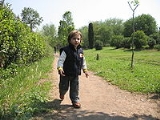
A
toddler is a young child, usually defined as being between the ages of one and three. Registered nurse, midwife and author, Robin Barker, states 'Any time from eight months onwards your baby will begin to realise he is a separate person from you. He will find it exciting to be able to move away from you but scary when you move away from him.'
Toddler development
The toddler years are a time of great cognitive, emotional and social development. Toddler development refers to the changes that occur in children aged between 1 and 3 years. Change may occur as a result of genetic processes known as maturation, or may be due to environmental factors and learning. Usually it involves an interaction between the two.
Developmental milestones and the toddler
Toddler development can be broken into a number of interrelated areas. There is reasonable consensus about what these include:
Physical: Refers to growth or an increase in size.
Gross motor: Refers to the control of large muscles, which enable walking, running, jumping and climbing.
Fine motor: Refers to the ability to control small muscles, enabling the toddler to feed themselves, drawand listen (interpret). Speech is the ability to understand and learn language and use it to communicate effectively.
Social: Refers to the ability to interact with the world through playing with others, taking turns and fantasy play.
Although it is useful to chart defined periods of development, it is also necessary to recognise that development exists on a continuum, with considerable individual differences between children. There is a wide range of what may be considered 'normal' development.
Developmental milestones at 1 year of age
At one year of age, the typical toddler will be able to display the following skills:
PHYSICAL AND MOTOR SKILLS
- Triple the birth weight
- Grow to a height of 50% over birth length
- Have a head circumference equal to that of the chest
- Have one to eight teeth
- Pull to stand
- Walk with help or alone
- Sit down without help
- Bang two blocks together
- Turn through the pages of a book by flipping many pages at a time
- Have a pincer grasp
- Sleep 8 - 10 hours a night and take one to two naps
SENSORY AND COGNITIVE DEVELOPMENT
- Follows a fast moving object
- Can respond to sounds
- Responds to his or her name
- Understands several words
- Can say mamma, papa, and at least one or two other words
- Understands simple commands
- Tries to imitate animal sounds
- Connects names with objects
- Understands that objects continue to exist, even when they are not seen (object constancy)
- Points to objects with index finger
- Waves bye bye
- May develop attachment to a toy or object
- Experiences separation anxiety and may cling to parents
- May make brief journeys away from parents to explore in familiar settings
14 months
- Walks well alone with wide based gait
- Creeps upstairs
- Builds of two blocks
- Drinks from a cup, uses spoon
- Enjoys throwing objects and picking them up
18 months
- Walks sideways and backwards, runs well, falls easily
- Climbs stairs or up on furnitures
- Scribbles vigorously, attempting a straight line
- Drinks well from a cup, still spills with a spoon
2 years
- Gross motor skills quite well refined, can walk up and down stairs on both feet, one step at a time while holding on to a rail
- Builds tower of five cubes
- Control of spoon well-developed
- Toilet trained
Toilet training, or potty training, is the process of training a young child to use the toilet for urination and defecation, though training may start with a smaller toilet bowl-shaped device...
during day time
15 months
- Can use 10-15 words
- Says "no" (see holophrasis
Holophrasis is the prelinguistic use of a single word to express a complex idea. A holophrase may resemble an interjection, but whereas an interjection is linguistic, and has a specific grammatical function, a holophrase is simply a vocalization memorized by rote and used without grammatical...
)
- Indicates when diaper is wet
18 months
- Uses phrases composed of adjective
In grammar, an adjective is a 'describing' word; the main syntactic role of which is to qualify a noun or noun phrase, giving more information about the object signified....
s and nounIn linguistics, a noun is a member of a large, open lexical category whose members can occur as the main word in the subject of a clause, the object of a verb, or the object of a preposition .Lexical categories are defined in terms of how their members combine with other kinds of...
s
- Begins to have temper tantrums
- Very ritualistic, has favorite toy or blanket, thumb-sucking may be at peak
2 years
- Vocabulary
A person's vocabulary is the set of words within a language that are familiar to that person. A vocabulary usually develops with age, and serves as a useful and fundamental tool for communication and acquiring knowledge...
of about 350 words
- Obey simple commands
- Helps undress self and put on simple clothes
- Shows sign of increased autonomy and individuality
- Does not share possessions, everything "mine"
Play (parallel play)
- Child plays alongside other children but not with them
- Mostly free and spontaneous, no rules or regulations
- Attention span very short and change of toys occur at frequent intervals
- Imitation and make-believe play begins by end of the second year
Games: throwing and retrieving objects
Suggested toys:
- Play furniture, dishes, cooking utensils, play telephone, puzzles with large pieces, pedal propelled toys, rocking horse, clay crayons, finger paints, pounding toys, blocks, push-pull toys, ball
A ball is a round, usually spherical but sometimes ovoid, object with various uses. It is used in ball games, where the play of the game follows the state of the ball as it is hit, kicked or thrown by players. Balls can also be used for simpler activities, such as catch, marbles and juggling...
s
Squatting
Young children squat instinctively as a continuous movement from standing up whenever they want to lower themselves to ground level. One and two year olds can commonly be seen playing in a stable squatting position, with feet wide apart and bottom not quite touching the floor, although at first they need to hold onto something to stand up again.
Language
Talking is the next milestone of which parents are typically aware. A toddler's first
wordIn language, a word is the smallest free form that may be uttered in isolation with semantic or pragmatic content . This contrasts with a morpheme, which is the smallest unit of meaning but will not necessarily stand on its own...
most often occurs around 12 months, but again this is only an average. The child will then continue to steadily add to his or her vocabulary until around the age of 18 months when language increases rapidly. He or she may learn as many as 7-9 new words a day. Around this time, toddlers generally know about 50 words. At 21 months is when toddlers begin to incorporate two word phrases into their vocabulary, such as "I go", "mama give", and "baby play". Before going to sleep they often engage in a
monologueIn theatre, a monologue is a speech presented by a single character, most often to express their thoughts aloud, though sometimes also to directly address another character or the audience. Monologues are common across the range of dramatic media...
called
crib talkCrib talk or crib speech is pre-sleep monologue made by young children while in bed. This starts somewhere around one-and-a-half years and usually ends by about two-and-a-half years of age, though children can continue longer. It consists of conversational discourse with turn-taking often...
in which they practice conversational skills. At this age, children are becoming very proficient at conveying their wants and needs to their parents in a verbal fashion.
Emotions and self
There are several other important milestones that are achieved in this time period that parents tend to not emphasize as much as walking and talking. Gaining the ability to point at whatever it is the child wants you to see shows huge psychological gains in a toddler. This generally happens before a child's first birthday.
This age is sometimes referred to as 'the terrible twos', because of the temper
tantrumA tantrum is an emotional outburst, usually associated with children or those in emotional distress, that is typically characterized by stubbornness, crying, screaming, yelling, shrieking, defiance, angry ranting, a resistance to attempts at pacification and, in some cases, violence...
s for which they are famous. This stage can begin as early as nine months old depending on the child and environment. Toddlers tend to have temper tantrums because they have such strong emotions but do not know how to express themselves the way that older children and adults do. They also throw tantrums to let others know that they are free and can do what they want. The toddler is discovering that they are a separate being from their parent and are testing their boundaries in learning the way the world around them works. Although the toddler is in their exploratory phase, it is also important to understand that the methods used by the parents for communicating with the toddler can either set off a tantrum or calm the situation. This time between the ages of two and five when they are reaching for independence repeats itself during adolescence.
Self-awareness is another milestone that helps parents understand how a toddler is reacting. Around 18 months of age, a child will begin to recognize himself or herself as a separate physical being with his/her own thoughts and actions. A parent can test if this milestone has been reached by noticing if the toddler recognizes that their
reflection in a mirrorThe mirror stage is a concept in the psychoanalytic theory of Jacques Lacan. Philosopher Raymond Tallis describes the mirror stage as "the cornerstone of Lacan’s oeuvre."...
is in fact themselves. One way to test this is to put
lipstickLipstick is a cosmetic product containing pigments, oils, waxes, and emollients that applies color, texture, and protection to the lips. Many varieties of lipstick are known. As with most other types of makeup, lipstick is typically, but not exclusively, worn by women...
on the child's forehead and show them their own reflection. Upon seeing the out-of-the-ordinary mark, if the child reaches to her own forehead, the child has achieved this important milestone. Along with self recognition comes feelings of embarrassment and pride that the child had not previously experienced.
Toilet training
Although there is a growing movement of parents who choose to help their babies use the toilet from birth (by means such as "
elimination communicationElimination communication is a toilet training practice in which a caregiver uses timing, signals, cues, and intuition to address an infant's need to eliminate waste. Caregivers try to recognize and respond to babies' bodily needs and enable them to urinate and defecate in an appropriate place...
" and the "infant potty training method"), most children in Western nations are
toilet trainedToilet training, or potty training, is the process of training a young child to use the toilet for urination and defecation, though training may start with a smaller toilet bowl-shaped device...
while they are toddlers. Often toilet training can begin as early as 9 months (as soon as the child starts to walk) for some, while others are not ready to begin toilet training until they are up to three years old. Two important indicators of toilet training readiness are whether a child understands the concept of using the toilet and whether they have any control over excreting waste (parents who use elimination communication do not have to wait for these readiness signs to help their babies use the potty). This can be a frustrating time for parents. Some toddlers can learn this task in a week, while some take up to eight or nine months.
Overview table
The toddler developmental timeline shows what an average toddler can do at what age. Times vary greatly from child to child. It is common for some toddlers to master certain skills (such as walking) well before other skills (like talking). Even close siblings can vary greatly in the time taken to achieve each key milestone.
| Age |
Physical |
Mental |
Emotional |
| 12–14 months |
- Walk alone well.
- Drink
Drinking is the act of consuming water or a beverage through the mouth. Water is required for many of life’s physiological processes. Both excessive and inadequate water intake are associated with health problems.-Physiology:... from a cup (poorly).
- Turn pages in a book
A book is a set or collection of written, printed, illustrated, or blank sheets, made of hot lava, paper, parchment, or other materials, usually fastened together to hinge at one side. A single sheet within a book is called a leaf or leaflet, and each side of a leaf is called a page... (a few at a time).
- Play
Play is a term employed in ethology and psychology to describe to a range of voluntary, intrinsically motivated activities normally associated with pleasure and enjoyment... ballA ball is a round, usually spherical but sometimes ovoid, object with various uses. It is used in ball games, where the play of the game follows the state of the ball as it is hit, kicked or thrown by players. Balls can also be used for simpler activities, such as catch, marbles and juggling... by rolling or tossing it. |
Uses one or two syllable words such as "ball" or "cookie"
Can follow a simple command with an associated gesture, such as: bringing a cup to you when you point at it and say "Please bring me the cup". |
Use gestures or words to convey objects, such as: Pointing at a book, raising arms to be picked up, or saying "cup".
Mimic actions such as covering eyeThe human eye is an organ which reacts to light for several purposes. As a conscious sense organ, the eye allows vision. Rod and cone cells in the retina allow conscious light perception and vision including color differentiation and the perception of depth... s while playing PeekabooPeekaboo is a game played with babies. In the game, the older player hides his/her face, pops back into the baby's view, and says Peekaboo! sometimes followed by I see you!... . |
| 15–18 months |
Hold a crayonA crayon is a stick of colored wax, charcoal, chalk, or other materials used for writing, coloring, drawing, and other methods of illustration. A crayon made of oiled chalk is called an oil pastel; when made of pigment with a dry binder, it is simply a pastel; both are popular media for color... well enough to scribbleA scribble is a drawing composed of random and abstract lines, generally without ever lifting the drawing device off of the paper. Scribbling is most often associated with young children and toddlers, because their lack of hand–eye coordination and lower mental development often make it very... .
Lift cup up to mouthThe mouth is the first portion of the alimentary canal that receives food andsaliva. The oral mucosa is the mucous membrane epithelium lining the inside of the mouth.... for drinking.
Climbthumb|right|An [[Embraer ERJ 145]] climbingIn aviation, the term climb refers both to the actual operation of increasing the altitude of an aircraft and to the logical phase of a typical flight following take-off and preceding the cruise, during which an increase in altitude to a predetermined... onto furnitureFurniture is the mass noun for the movable objects intended to support various human activities such as seating and sleeping in beds, to hold objects at a convenient height for work using horizontal surfaces above the ground, or to store things... .
- Uses 10–20 words.
- May be able to follow a command without a gesture.
- Stack two blocks.
|
Address others with greetings.
Mimic parental activities such as cleaning up or talking on a telephoneThe telephone , colloquially referred to as a phone, is a telecommunications device that transmits and receives sounds, usually the human voice. Telephones are a point-to-point communication system whose most basic function is to allow two people separated by large distances to talk to each other... . |
| 19–24 months |
Feed self with a spoon A spoon is a utensil consisting of a small shallow bowl, oval or round, at the end of a handle. A type of cutlery , especially as part of a place setting, it is used primarily for serving. Spoons are also used in food preparation to measure, mix, stir and toss ingredients... .
Run.
Climb into a small chairA chair is a stable, raised surface used to sit on, commonly for use by one person. Chairs are most often supported by four legs and have a back; however, a chair can have three legs or could have a different shape depending on the criteria of the chair specifications. A chair without a back or... .
Walk up steps.
Helps with dressing: Likes to dress and undress self. |
Speaks 20–50 words; understands many more
Stack six blocks
Understands non-physical relationships such as turning on lights or pushing buttons.
Sorting toys.
Searching for hidden objects.
Problem solving through experimentation. |
Wants to be independent at times. Will throw a tantrum or possibly say no.
Mimics social behavior Behavior or behaviour refers to the actions and mannerisms made by organisms, systems, or artificial entities in conjunction with its environment, which includes the other systems or organisms around as well as the physical environment... such as huggingPhysical intimacy is sensual proximity or touching. It can be enjoyed by itself or be an expression of feelings which people have for one another... a teddy bearThe teddy bear is a stuffed toy bear. They are usually stuffed with soft, white cotton and have smooth and soft fur. It is an enduring form of a stuffed animal in many countries, often serving the purpose of entertaining children. In recent times, some teddy bears have become collector's items... or feeding a dollA doll is a model of a human being, often used as a toy for children. Dolls have traditionally been used in magic and religious rituals throughout the world, and traditional dolls made of materials like clay and wood are found in the Americas, Asia, Africa and Europe. The earliest documented dolls... .
Self recognition.
Displays attachmentAttachment theory describes the dynamics of long-term relationships between humans. Its most important tenet is that an infant needs to develop a relationship with at least one primary caregiver for social and emotional development to occur normally. Attachment theory is an interdisciplinary study... .
Separation anxietySeparation anxiety disorder is a psychological condition in which an individual experiences excessive anxiety regarding separation from home or from people to whom the individual has a strong emotional attachment... .
Can play turn-taking gameA game is structured playing, usually undertaken for enjoyment and sometimes used as an educational tool. Games are distinct from work, which is usually carried out for remuneration, and from art, which is more often an expression of aesthetic or ideological elements... s.
Begins to be ready for toilet learning |
| 25–36 months |
Advanced mobility and climbing skills.
Increased dexterity with small objects, puzzles.
Able to dress oneself. |
Speaking in sentence In the field of linguistics, a sentence is an expression in natural language, and often defined to indicate a grammatical unit consisting of one or more words that generally bear minimal syntactic relation to the words that precede or follow it... s.
Ability to be independent to primary care giver.
Easily learns new words, places and people's names.
Anticipates routines.
Toilet learning continues
Plays with toys in imaginative ways.
Attempts to sing in-time with songIn music, a song is a composition for voice or voices, performed by singing.A song may be accompanied by musical instruments, or it may be unaccompanied, as in the case of a cappella songs... s. |
Knows boys from girls.
Shows preferences, such as clothes and entertainment.
Knows how to play different games. |
See also
- Baby walker
A baby walker is a device that can be used by infants who cannot walk on their own to move from one place to another. Patents have been issued for baby walkers as early as 1851. Modern baby walkers have a base made of hard plastic sitting on top of wheels and a suspended fabric seat with two leg...
- Child development stages
Child development stages describe theoretical milestones of child development. Many stage models of development have been proposed, used as working concepts and in some cases asserted as nativist theories....
- Early childhood
For the video game rating with a similar age group see ESRBEarly childhood is a stage in human development. It generally includes toddlerhood and some time afterwards. Play age is an unspecific designation approximately within the scope of early childhood.-Education:Infants and toddlers experience...
- Early childhood education
Early childhood education is the formal teaching and care of young children by people other than their family or in settings outside of the home. 'Early childhood' is usually defined as before the age of normal schooling - five years in most nations, though the U.S...
- Sign language in infants and toddlers