
All Topics  
Tlingit


   Email Print
   Bookmark   Link


Tlingit


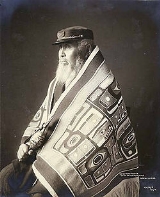
The Tlingit ( or in English, also or Tlinkit, which is often considered inaccurate) are an Indigenous people of northwestern America
Indigenous peoples of the Pacific Northwest Coast

The Indigenous peoples of the Pacific Northwest Coast are the pre-Columbian inhabitants of the Pacific Northwest, their descendants, and many ethnic groups who identify with those historical peoples....
. Their name for themselves is Lingít , meaning "people". The Russian
Russian language

Russian is the most geographically widespread language of Eurasia, the most widely spoken of the Slavic languages, and the largest native language in Europe....
 name Koloshi (from an Aleut
Aleut language

Aleut is a language of the Eskimo-Aleut language family. It is the tongue of the Aleut people living in the Aleutian Islands, Pribilof Islands, and Commander Islands....
 term for the lower lip piercing
Labret

A labret is one form of body piercing. Taken literally, it is any type of adornment that is attached to the facial lip . However, the term usually refers to a piercing that is below the bottom lip, above the chin....
) or the related German
German language

German is a West Germanic languages, thus related to and classified alongside English language and Dutch language. It is one of the world's world language and the most widely spoken mother tongue in the European Union....
 name Koulischen may be encountered in older historical literature.

The Tlingit are a matrilineal society that developed a complex hunter-gatherer
Hunter-gatherer

A hunter-gatherer society is one whose primary List of subsistence techniques involves the direct procurement of edible plants and animals from the wild, foraging and hunting without significant recourse to the domestication of either....
 culture in the temperate rainforest of the southeast Alaska
Alaska

Alaska is the largest U.S. state of the United States by area; it is situated in the northwest extremity of the North American continent, with Canada to the east, the Arctic Ocean to the north, and the Pacific Ocean to the west and south, with Russia further west across the Bering Strait....
 coast and the Alexander Archipelago
Alexander Archipelago

The Alexander Archipelago is a three-hundred-mile-long archipelago, or group of islands, off the southeastern coast of Alaska. It contains about 1,100 islands, which are the tops of the submerged coastal mountains that rise steeply from the Pacific Ocean....
.


Discussion
Ask a question about 'Tlingit'
Start a new discussion about 'Tlingit'
Answer questions from other users
Full Discussion Forum


Recent Posts


Encyclopedia


The Tlingit ( or in English, also or Tlinkit, which is often considered inaccurate) are an Indigenous people of northwestern America
Indigenous peoples of the Pacific Northwest Coast

The Indigenous peoples of the Pacific Northwest Coast are the pre-Columbian inhabitants of the Pacific Northwest, their descendants, and many ethnic groups who identify with those historical peoples....
. Their name for themselves is Lingít , meaning "people". The Russian
Russian language

Russian is the most geographically widespread language of Eurasia, the most widely spoken of the Slavic languages, and the largest native language in Europe....
 name Koloshi (from an Aleut
Aleut language

Aleut is a language of the Eskimo-Aleut language family. It is the tongue of the Aleut people living in the Aleutian Islands, Pribilof Islands, and Commander Islands....
 term for the lower lip piercing
Labret

A labret is one form of body piercing. Taken literally, it is any type of adornment that is attached to the facial lip . However, the term usually refers to a piercing that is below the bottom lip, above the chin....
) or the related German
German language

German is a West Germanic languages, thus related to and classified alongside English language and Dutch language. It is one of the world's world language and the most widely spoken mother tongue in the European Union....
 name Koulischen may be encountered in older historical literature.

The Tlingit are a matrilineal society that developed a complex hunter-gatherer
Hunter-gatherer

A hunter-gatherer society is one whose primary List of subsistence techniques involves the direct procurement of edible plants and animals from the wild, foraging and hunting without significant recourse to the domestication of either....
 culture in the temperate rainforest of the southeast Alaska
Alaska

Alaska is the largest U.S. state of the United States by area; it is situated in the northwest extremity of the North American continent, with Canada to the east, the Arctic Ocean to the north, and the Pacific Ocean to the west and south, with Russia further west across the Bering Strait....
 coast and the Alexander Archipelago
Alexander Archipelago

The Alexander Archipelago is a three-hundred-mile-long archipelago, or group of islands, off the southeastern coast of Alaska. It contains about 1,100 islands, which are the tops of the submerged coastal mountains that rise steeply from the Pacific Ocean....
. An inland subgroup, known as the Inland Tlingit, inhabit the far northwestern part of the province of British Columbia
British Columbia

British Columbia is the westernmost of Canada's Provinces and territories of Canada and is famed for its natural beauty, as reflected in its Latin motto, Splendor sine occasu ....
 and the southern Yukon Territory of Canada
Canada

Canada is a country occupying most of northern North America, extending from the Atlantic Ocean in the east to the Pacific Ocean in the west and northward into the Arctic Ocean....
. The Tlingit language
Tlingit language

The Tlingit language is spoken by the Tlingit people of Southeast Alaska and Western Canada. It is a branch of the Na-Den? languages family. Tlingit is very endangered language, with fewer than 140 native speakers still living, all of whom are bilingual or near-bilingual in English....
 is well known not only for its complex grammar
Grammar

Grammar is the field of linguistics that covers the conventions governing the use of any given natural language. It includes morphology and syntax, often complemented by phonetics, phonology, semantics, and pragmatics....
 and sound system, but also for using certain phonemes which are not heard in almost any other language.

Territory

Tlingit Map
The greatest territory historically occupied by the Tlingit extended from the Portland Canal
Portland Canal

The Portland Canal is an arm of Portland Inlet, one of the principal fjords of the British Columbia Coast. The Portland Canal forms part of the border between southeastern Alaska and British Columbia....
 along the present border between Alaska
Alaska

Alaska is the largest U.S. state of the United States by area; it is situated in the northwest extremity of the North American continent, with Canada to the east, the Arctic Ocean to the north, and the Pacific Ocean to the west and south, with Russia further west across the Bering Strait....
 and British Columbia
British Columbia

British Columbia is the westernmost of Canada's Provinces and territories of Canada and is famed for its natural beauty, as reflected in its Latin motto, Splendor sine occasu ....
, north to the coast just southeast of the Copper River
Copper River (Alaska)

The Copper River or Ahtna River is a river, approximately 300 mi long, in south-central Alaska in the United States. It drains a large region of the Wrangell Mountains and Chugach Mountains into the Gulf of Alaska....
 delta
River delta

A delta is a landform that is created at the mouth of a river where that river flows into an ocean, sea, estuary, lake, reservoir, flat arid area, or another river....
. The Tlingit occupied almost all of the Alexander Archipelago
Alexander Archipelago

The Alexander Archipelago is a three-hundred-mile-long archipelago, or group of islands, off the southeastern coast of Alaska. It contains about 1,100 islands, which are the tops of the submerged coastal mountains that rise steeply from the Pacific Ocean....
, except the southernmost end of Prince of Wales Island and its surroundings, where the Kaigani Haida
Haida

The Haida are an Indigenous peoples of the Pacific Northwest Coast of North America. The Haida territories comprise the archipelago of the Queen Charlotte Islands, known in the Haida language as Haida Gwaii , and the southern half of Prince of Wales Island in the southernmost Alaska Panhandle, which is the home of a subgroup called the '...
 moved just before the first encounters with European explorers. Inland, the Tlingit occupied areas along the major rivers which pierce the Coast Mountains
Coast Mountains

The Coast Mountains are a major mountain range of western North America, extending from southwestern Yukon through the Alaska Panhandle and virtually all of the British Columbia Coast....
 and Saint Elias Mountains
Saint Elias Mountains

The Saint Elias Mountains are a subgroup of the Pacific Coast Ranges located in southeastern Alaska , southwestern Yukon and the very far northwestern part of British Columbia ....
 and flow into the Pacific, including the Alsek
Alsek River

The Alsek River is a wilderness river flowing from the Yukon into Northern British Columbia and into Alaska. The surrounding area from the Western edge of the Alsek to East of the East Alsek is known to locals as Dry Bay....
, Tatshenshini
Tatshenshini River

The Tatshenshini River is a river in the southwestern Yukon and the northwestern corner of British Columbia. It originates in British Columbia, near Haines Highway....
, Chilkat
Chilkat River

The Chilkat River is a river in British Columbia and southeastern Alaska that flows southward from the Coast Range to the Chilkat Inlet and ultimately Lynn Canal....
, Taku
Taku River

The Taku River is a river running from British Columbia, Canada to the northwestern coast of North America, at Juneau, Alaska. Its mouth coincides with the U.S.-Canada border....
, and Stikine
Stikine River

The Stikine River is a river, historically also the Stickeen River, approximately 379 mi long, in northwestern British Columbia in Canada and southeastern Alaska in the United States....
 rivers. With regular travel up these rivers, the Tlingit developed extensive trade networks with Athabascan tribes of the interior, and commonly intermarried with them. From this regular travel and trade, a few relatively large populations of Tlingit settled around Atlin
Atlin Lake

Atlin Lake is a lake in northwestern British Columbia and is that province's largest natural lake. The northern tip of the lake is in the Yukon, as is Little Atlin Lake....
, Teslin
Teslin Lake

Teslin Lake is a large lake spanning the border between British Columbia and Yukon Territory in Canada. It is one of a group of large lakes in the region of far northwestern BC, east of the upper Alaska Panhandle, which are the southern extremity of the basin of the Yukon River, and which are known in the Yukon as "the Southern Lakes" ....
, and Tagish Lake
Tagish Lake

Tagish Lake is a lake in the Yukon Territory and northern British Columbia, Canada. The lake is more than 100 km long and about 2 km wide.It has two arms, the Taku Arm in the east which is very long and mostly in British Columbia and Windy Arm in the west, mostly in the Yukon....
s, whose headwaters flow from areas near the headwaters of the Taku River.

Delineating the modern territory of the Tlingit is complicated by because they are spread across the border between the United States and Canada, by the lack of designated reservations, other complex legal and political concerns, and a relatively high level of mobility among the population, as well as overlapped territory with various Athapaskan peoples such as the Tahltan
Tahltan

Tahltan refers to a Northern Athabaskan people who live in northern British Columbia around Telegraph Creek, British Columbia, Dease Lake, British Columbia, and Iskut, British Columbia....
, Kaska
Kaska

The Kaska or Kaska Dena are a First Nations people living mainly in northern British Columbia and the southeastern Yukon in Canada. The Kaska language originally spoken by the Kaska is an Athabaskan languages....
 and Tagish
Tagish

The Tagish or Tagish Khw?an are a group of Athabaskan First Nation people that lived around Tagish Lake and Marsh Lake, in the Yukon Territory of Canada....
. In Canada, the modern communities of Atlin, British Columbia
Atlin, British Columbia

Atlin is a community in northwestern British Columbia, Canada, located on Atlin Lake. It can be reached by the Atlin Road, or Yukon Territorial Highway 7, which is maintained jointly by the British Columbia and Yukon governments....
 (, Teslin, Yukon
Teslin, Yukon

The community of Teslin includes the village of Teslin and an adjacent Indian reserve in the Yukon, Canada. Teslin is situated at historical mile 804 on the Alaska Highway along Teslin Lake....
 (Teslin Tlingit Council
Teslin Tlingit Council

The Teslin Tlingit Council is a First Nation in the central Yukon Territory in Canada, located in Teslin, Yukon along the Alaska Highway and Teslin Lake....
), and Carcross, Yukon
Carcross, Yukon

Carcross, originally known as Caribou Crossing, is an unincorporated community in the Territory of Yukon, Canada on Bennett Lake and Nares Lake....
 (Carcross/Tagish First Nation
Carcross/Tagish First Nation

The Carcross/Tagish First Nation is a First Nation in the Yukon Territory in Canada. Its original population centres were Carcross, Yukon and Tagish, Yukon, although many of its citizens also live in Whitehorse, Yukon....
) have reserves
Indian reserve

In Canada, an Indian reserve is specified by the Indian Act as a "tract of land, the legal title to which is vested in Elizabeth II of the United Kingdom, that has been set apart by Her Majesty for the use and benefit of a band." The Act also specifies that land reserved for the use and benefit of a band which is not vested in the Crown is...
 and are the representative Interior Tlingit populations. The territory occupied by the modern Tlingit people in Alaska is however not restricted to particular reservation
Indian reservation

An Indian reservation is an area of land managed by a Native Americans of the United States tribe under the United States Department of the Interior Bureau of Indian Affairs....
s, unlike most tribes in the contiguous 48 states. This is the result of the Alaska Native Claims Settlement Act
Alaska Native Claims Settlement Act

The Alaska Native Claims Settlement Act, commonly abbreviated ANCSA, was signed into law by President Richard M. Nixon on December 18, 1971, the largest land claims settlement in United States history....
 (ANCSA) which established regional corporations throughout Alaska with complex portfolios of land ownership rather than bounded reservations administered by tribal governments. The corporation in the Tlingit region is Sealaska, Inc. which serves the Tlingit as well as the Haida
Haida

The Haida are an Indigenous peoples of the Pacific Northwest Coast of North America. The Haida territories comprise the archipelago of the Queen Charlotte Islands, known in the Haida language as Haida Gwaii , and the southern half of Prince of Wales Island in the southernmost Alaska Panhandle, which is the home of a subgroup called the '...
 in Alaska. Tlingit people as a whole participate in the commercial economy of Alaska, and as a consequence live in typically American nuclear family households with private ownership of housing and land. Many also possess land allotments from Sealaska or from earlier distributions predating ANCSA. Despite the legal and political complexities, the territory historically occupied by the Tlingit can be reasonably designated as their modern homeland, and Tlingit people today envision the land from around Yakutat south through the Alaskan Panhandle and including the lakes in the Canadian interior as being Lingít Aaní, the Land of the Tlingit.

Hoonah
The extant Tlingit territory can be roughly divided into four major sections, paralleling ecological, linguistic, and cultural divisions. The Southern Tlingit occupy the region south of Frederick Sound
Frederick Sound

Frederick Sound is a passage of water in the Alexander Archipelago in southeastern Alaska that separates Kupreanof Island to the south from Admiralty Island in the north....
, and live in the northernmost reaches of the Western Redcedar forest. North of Frederick Sound to Cape Spencer
Cape Spencer

Cape Spencer can refer to* Cape Spencer Light in Alaska* Cape Spencer in South Australia...
, and including Glacier Bay
Glacier Bay

Glacier Bay is a bay in south-eastern Alaska, United States. It runs north northwest to south south-east for about 105 km between two pinchets of Alaska....
 and the Lynn Canal
Lynn Canal

The Lynn Canal is an inlet into the mainland of southeast Alaska.The Lynn Canal runs about 90 miles from the inlets of the Chilkat River south to Chatham Strait and Stephens Passage....
, are the Northern Tlingit, who occupy the warmest and richest of the Sitka Spruce
Sitka Spruce

The Sitka Spruce is a large coniferous evergreen tree growing to 50?70 m tall, exceptionally to 100 m tall, and with a trunk diameter of up to 5 m, exceptionally to 6?7 m diameter....
 and Western Hemlock
Western Hemlock

Tsuga heterophylla is a species of Tsuga native to the west coast of North America, with its northwestern limit on the Kenai Peninsula, Alaska, and its southeastern limit in northern Sonoma County, California, California....
 forest. The Inland Tlingit live along the large interior lakes and the drainage of the Taku River as well as in the southern Yukon territory, and subsist in a manner similar to their Athabascan neighbors in the mixed spruce
Spruce

A spruce is a tree of the genus Picea, a genus of about 35 species of coniferous evergreen trees in the Family Pinaceae, found in the northern temperate and boreal regions of the earth....
 taiga
Taiga

Taiga is a biome characterized by coniferous forests. Covering most of inland Alaska, Canada, Sweden, Finland, inland Norway and Russia , as well as parts of the extreme northern continental United States , northern Kazakhstan and Japan , the taiga is the world's largest terrestrial biome....
. North of Cape Spencer, along the coast of the Gulf of Alaska
Gulf of Alaska

The Gulf of Alaska is an arm of the Pacific Ocean defined by the curve of the southern coast of Alaska, stretching from the Alaska Peninsula and Kodiak Island in the west to the Alexander Archipelago in the east, where Glacier Bay and the Inside Passage are found....
 to Controller Bay and Kayak Island
Kayak Island

Kayak Island , which includes the Bering Expedition Landing Site, is located in the Gulf of Alaska, 100 km SE of Cordova, Alaska Malaspina Coastal Plain....
, are the Gulf Coast Tlingit, who live along a narrow strip of coastline backed by steep mountains and extensive glaciers, and battered by Pacific storms. The trade and cultural interactions between each of these Tlingit groups and their disparate neighbors, the differences in food harvest practices, and the dialectical differences contribute to these identifications which are also supported by similar self-identifications among the Tlingit.

Tribes or kwaans


Culture

The Tlingit culture is multifaceted and complex, a characteristic of Northwest Pacific Coast peoples with access to easily exploited rich resources. In Tlingit culture a heavy emphasis is placed upon family and kinship, and on a rich tradition of oratory. Wealth and economic power are important indicators of status, but so is generosity and proper behavior, all signs of "good breeding" and ties to aristocracy. Art and spirituality are incorporated in nearly all areas of Tlingit culture, with even everyday objects such as spoons and storage boxes decorated and imbued with spiritual power and historical beliefs of the Tlingits.

Philosophy and religion

Tlingit thought and belief, although never formally codified, was historically a fairly well organized philosophical and religious system whose basic axioms shaped the way Tlingit people viewed and interacted with the world around them. Between 1886 and 1895, in the face of their shamans' inability to treat Old World diseases including smallpox
Smallpox

Smallpox is an infectious disease unique to humans, caused by either of two virus variants, Variola major and Variola minor. The disease is also known by the Latin names Variola or Variola vera, which is a derivative of the Latin varius, meaning spotted, or varus, meaning "pimple"....
, most of the Tlingit people converted to Orthodox Christianity
Eastern Orthodox Church

The Eastern Orthodox Church is the second largest single Christian communion in the world with an estimated 225 million members worldwide. It is considered by its adherents to be the Four Marks of the Church established by Jesus Christ and his Apostles nearly 2000 years ago....
. (Russian Orthodox
Russian Orthodox Church

The Russian Orthodox Church ; or The Moscow Patriarchate , also known as the Orthodox Christian Church of Russia, is a body of Christianity who constitute an Autocephaly Eastern Orthodox Church under the jurisdiction of the List of Metropolitans and Patriarchs of Moscow, in full communion with the other Eastern Orthodox Churches....
 missionaries had translated their liturgy into the Tlingit language.) After the introduction of Christianity
Christianity

Christianity is a Monotheistic religion #Christian view religion centered on the life and teachings of Jesus as New Testament view on Jesus' life....
, the Tlingit belief system began to erode.

Today, some young Tlingits look back towards what their ancestors believed, for inspiration, security, and a sense of identity. This causes some friction in Tlingit society, because most modern Tlingit elders are fervent believers in Christianity, and have transferred or equated many Tlingit concepts with Christian ones. Indeed, many elders believe that resurrection of heathen practices of shamanism and spirituality are dangerous, and are better forgotten.

Language

The Tlingit language (pronounced /'kl??k?t/ in English, Lingít IPA: [???k?´t] in Tlingit) is spoken by the Tlingit people of Southeast Alaska and Western Canada. It is a branch of the Na-Dené language family. Tlingit is highly endangered, with fewer than 140 native speakers still living, all of whom are bilingual or near-bilingual in English. Extensive effort is being put into revitalization programs in Southeast Alaska to revive and preserve the Tlingit language and its culture.

Food

Food is a central part of Tlingit culture, and the land is an abundant provider. A saying amongst the Tlingit is that "when the tide goes out the table is set". This refers to the richness of intertidal life found on the beaches of Southeast Alaska, most of which can be harvested for food. Another saying is that "in Lingít Aaní you have to be an idiot to starve". Since food is so easy to gather from the beaches, a person who can't feed himself at least enough to stay alive is considered to be a fool, perhaps mentally incompetent or suffering from very bad luck. However, though eating off the beach would provide a fairly healthy and varied diet, eating nothing but "beach food" is considered contemptible among the Tlingit, and a sign of poverty. Indeed, shamans and their families were required to abstain from all food gathered from the beach, and men might avoid eating beach food before battles or strenuous activities in the belief that it would weaken them spiritually and perhaps physically as well. Thus for both spiritual reasons as well as to add some variety to the diet, the Tlingit harvest many other resources for food besides those which are easily found outside their front doors. No other food resource receives as much emphasis as salmon
Salmon

Salmon is the common name for several species of fish of the family Salmonidae. Several other fish in the family are called trout,the difference is often attributed to the migratory life of the salmon as compared to the residential behaviour of trout, this holds true for the Atlantic salmon....
; however seal
Pinniped

Pinnipeds or fin-footed mammals are a widely distributed and diverse group of semi-aquatic marine mammals comprising the families Odobenidae , Otariidae , and Phocidae ....
 and game are both close seconds.

Fish were the primary source of food for the Tlingit. Large numbers of halibut, salmon, herring and candlefish were caught and eaten fresh or dried and stored for later use. The Tlingit also hunted sea mammals such as seals, sea lions and sea otters for use as food and clothing materials. In the forests near their homes, they hunted deer, bear, mountain goats and other small mammals.

See also

  • Chief Shakes
    Chief Shakes

    The Lineages of the ShakesThe orphan Gush X?een lived at Ch?aal?in. He was a Teikweid? named Joon?k?w. The leader of the Naanya.aay?, S.n?ok, took a liking to the orphaned boy and raised him as a nephew....
  • Battle of Sitka
    Battle of Sitka

    The Battle of Sitka was the last major armed conflict between Europeans and Alaska Natives, and was initiated in response to the destruction of a Russian trading post two years prior....
     (Tlingit Rebellion, 1802)
  • Auke people
    Auke people

    The Auke are an Alaskan Native people, a subgroup of the Tlingit whose name for thesmelves Aak'w Kw?an means "Small Lake People". The Auke lived along the northwestern coast of North America, in the area that is now the Alexander Archipelago and adjoining mainlaind of the Alaska Panhandle around Juneau, Alaska....
  • Taku people
    Taku people

    The Taku are an Alaskan Native people, a kwaan or tribe of the Tlingit, known in Tlingit language as the T'aaku Kw?an or "Geese Flood Upriver Tribe"".....


External links

  • - An online destination where users create comics, write stories, watch webisodes, download podcasts, play games, read stories and comics by other members, and find out about the Tlingit people of Canada.
  • , John R. Swanton
    John R. Swanton

    John Reed Swanton was an United States anthropologist who worked with Native American peoples throughout the United States.Born in Gardiner, Maine, Swanton's work in the fields of ethnology and ethnohistory is well recognized....
    , Bureau of American Ethnology Bulletin 39, 1909


Further reading

  • , George Thornton Emmons (Contributors Frederica De Laguna &Jean Low), University of Washington Press, 1991, ISBN 0295970081, 9780295970080, 488 pp.
  • , Andrei Val'terovich Grinev, Richard L. Bland, Katerina G. Solovjova, Translated by Richard L. Bland, Katerina G. Solovjova, Contributor Richard L. Bland, Katerina G. Solovjova, U. of Nebraska Press, 2005, ISBN 0803222149, 9780803222144, 386 pp.