

Tinkinswood

Encyclopedia
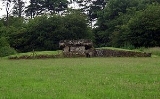
Tinkinswood or its full name Tinkinswood Burial Chamber , also known as Castell Carreg, Llech-y-Filiast and Maes-y-Filiast, is a megalith
ic burial chamber
, built around 6,000 BP (before Present
), during the Neolithic
period, in the Vale of Glamorgan
, near Cardiff
, Wales.
The structure is called a dolmen
, which was the most common megalithic structure in Europe. The dolmen is of the Severn-Cotswold tomb
type, and consists of a large capstone on top, with smaller upright stones supporting it. The limestone
capstone at Tinkinswood weighs approximately 40 long ton
s (36 metric tonne
s) and measures 24 feet (7.3 m) x 14 ft (4.3 m); it is thought to be the largest in Britain, and also in Europe. It would have taken some 200 people to lift the stone into the correct position. It was originally all covered by a mound of soil
, which has been removed over time, now the remaining mound behind the structure measures approximately 130 ft (39.6 m) x 59 ft (18 m) in size.
, about 1,000 years or so before Stonehenge
was constructed. The site was excavated in 1914, and inside the chamber there were 920 human bones, which were nearly all broken. This showed that at least forty people of all ages and sexes were buried there during the Neolithic period; it would appear to be a burial chamber used by the whole settlement. The corpses of the dead were probably left exposed before being moved into the burial chamber. Neolithic and Bell-Beaker style pottery
has also been found, this showed that the burial chamber tomb was probably used by a community over a long period of time, maybe up until the early Bronze Age
period. Restoration work was carried out at the same time, with a brick pillar built to support the capstone.
From the site two parallel lines of stones form an avenue leading away from the burial chamber to the south east. Along a second avenue to the north east lie many stones. A large single stone stands due east, and two flat parallel standing stones point to the top of the nearby Coed Sion Hill.
The site is managed by Cadw
, which is a Welsh Assembly Government
body responsible for the
protection, conservation and promotion of the built heritage of Wales. In October 2011, new excavations began at the site.
, a short distance away. Legend has it that anyone who spends a night at Tinkinswood on the evenings before May Day, St John's Day (23 June), or Midwinter Day
would either die, go mad, or become a poet. This legend is a similar to the general legend about mountain tops. The group of boulders to the south east of the monument are said to be women who were turned to stone for dancing on the Sabbath day, another legend which is associated with dolmens.
Megalith
A megalith is a large stone that has been used to construct a structure or monument, either alone or together with other stones. Megalithic describes structures made of such large stones, utilizing an interlocking system without the use of mortar or cement.The word 'megalith' comes from the Ancient...
ic burial chamber
Chamber tomb
A chamber tomb is a tomb for burial used in many different cultures. In the case of individual burials, the chamber is thought to signify a higher status for the interree than a simple grave. Built from rock or sometimes wood, the chambers could also serve as places for storage of the dead from one...
, built around 6,000 BP (before Present
Before Present
Before Present years is a time scale used in archaeology, geology, and other scientific disciplines to specify when events in the past occurred. Because the "present" time changes, standard practice is to use AD 1950 as the origin of the age scale, reflecting the fact that radiocarbon...
), during the Neolithic
Neolithic
The Neolithic Age, Era, or Period, or New Stone Age, was a period in the development of human technology, beginning about 9500 BC in some parts of the Middle East, and later in other parts of the world. It is traditionally considered as the last part of the Stone Age...
period, in the Vale of Glamorgan
Vale of Glamorgan
The Vale of Glamorgan is a county borough in Wales; an exceptionally rich agricultural area, it lies in the southern part of Glamorgan, South Wales...
, near Cardiff
Cardiff
Cardiff is the capital, largest city and most populous county of Wales and the 10th largest city in the United Kingdom. The city is Wales' chief commercial centre, the base for most national cultural and sporting institutions, the Welsh national media, and the seat of the National Assembly for...
, Wales.
The structure is called a dolmen
Dolmen
A dolmen—also known as a portal tomb, portal grave, dolmain , cromlech , anta , Hünengrab/Hünenbett , Adamra , Ispun , Hunebed , dös , goindol or quoit—is a type of single-chamber megalithic tomb, usually consisting of...
, which was the most common megalithic structure in Europe. The dolmen is of the Severn-Cotswold tomb
Severn-Cotswold tomb
Severn-Cotswold is a name given to a type of Megalithic chamber tomb built by Neolithic peoples in Wales and South West England around 3500 BC.-Description:...
type, and consists of a large capstone on top, with smaller upright stones supporting it. The limestone
Limestone
Limestone is a sedimentary rock composed largely of the minerals calcite and aragonite, which are different crystal forms of calcium carbonate . Many limestones are composed from skeletal fragments of marine organisms such as coral or foraminifera....
capstone at Tinkinswood weighs approximately 40 long ton
Long ton
Long ton is the name for the unit called the "ton" in the avoirdupois or Imperial system of measurements, as used in the United Kingdom and several other Commonwealth countries. It has been mostly replaced by the tonne, and in the United States by the short ton...
s (36 metric tonne
Tonne
The tonne, known as the metric ton in the US , often put pleonastically as "metric tonne" to avoid confusion with ton, is a metric system unit of mass equal to 1000 kilograms. The tonne is not an International System of Units unit, but is accepted for use with the SI...
s) and measures 24 feet (7.3 m) x 14 ft (4.3 m); it is thought to be the largest in Britain, and also in Europe. It would have taken some 200 people to lift the stone into the correct position. It was originally all covered by a mound of soil
Soil
Soil is a natural body consisting of layers of mineral constituents of variable thicknesses, which differ from the parent materials in their morphological, physical, chemical, and mineralogical characteristics...
, which has been removed over time, now the remaining mound behind the structure measures approximately 130 ft (39.6 m) x 59 ft (18 m) in size.
History
Tinkinswood was a once a village but now all that remains is the burial chamber, which was built about 6000 BPBefore Present
Before Present years is a time scale used in archaeology, geology, and other scientific disciplines to specify when events in the past occurred. Because the "present" time changes, standard practice is to use AD 1950 as the origin of the age scale, reflecting the fact that radiocarbon...
, about 1,000 years or so before Stonehenge
Stonehenge
Stonehenge is a prehistoric monument located in the English county of Wiltshire, about west of Amesbury and north of Salisbury. One of the most famous sites in the world, Stonehenge is composed of a circular setting of large standing stones set within earthworks...
was constructed. The site was excavated in 1914, and inside the chamber there were 920 human bones, which were nearly all broken. This showed that at least forty people of all ages and sexes were buried there during the Neolithic period; it would appear to be a burial chamber used by the whole settlement. The corpses of the dead were probably left exposed before being moved into the burial chamber. Neolithic and Bell-Beaker style pottery
Beaker culture
The Bell-Beaker culture , ca. 2400 – 1800 BC, is the term for a widely scattered cultural phenomenon of prehistoric western Europe starting in the late Neolithic or Chalcolithic running into the early Bronze Age...
has also been found, this showed that the burial chamber tomb was probably used by a community over a long period of time, maybe up until the early Bronze Age
Bronze Age
The Bronze Age is a period characterized by the use of copper and its alloy bronze as the chief hard materials in the manufacture of some implements and weapons. Chronologically, it stands between the Stone Age and Iron Age...
period. Restoration work was carried out at the same time, with a brick pillar built to support the capstone.
From the site two parallel lines of stones form an avenue leading away from the burial chamber to the south east. Along a second avenue to the north east lie many stones. A large single stone stands due east, and two flat parallel standing stones point to the top of the nearby Coed Sion Hill.
The site is managed by Cadw
Cadw
-Conservation and Protection:Many of Wales's great castles and other monuments, such as bishop's palaces, historic houses, and ruined abbeys, are now in Cadw's care. Cadw does not own them but is responsible for their upkeep and for making them accessible to the public...
, which is a Welsh Assembly Government
Welsh Assembly Government
The Welsh Government is the devolved government of Wales. It is accountable to the National Assembly for Wales, the legislature which represents the interests of the people of Wales and makes laws for Wales...
body responsible for the
protection, conservation and promotion of the built heritage of Wales. In October 2011, new excavations began at the site.
Myths and legends
Many of the myths and legends of Tinkinswood are also associated with the nearby burial site of St LythansSt Lythans
St Lythans is an affluent hamlet and former parish in the Vale of Glamorgan, southeast Wales, just outside of western Cardiff. It lies southwest of Culverhouse Cross, west of Wenvoe and southwest of Twyn-yr-Odyn and is also connected by road from Dyffryn and the Five Mile Lane in the west...
, a short distance away. Legend has it that anyone who spends a night at Tinkinswood on the evenings before May Day, St John's Day (23 June), or Midwinter Day
Winter solstice
Winter solstice may refer to:* Winter solstice, astronomical event* Winter Solstice , former band* Winter Solstice: North , seasonal songs* Winter Solstice , 2005 American film...
would either die, go mad, or become a poet. This legend is a similar to the general legend about mountain tops. The group of boulders to the south east of the monument are said to be women who were turned to stone for dancing on the Sabbath day, another legend which is associated with dolmens.