
Home      Discussion      Topics      Dictionary      Almanac
Signup       Login
The Triplets

The Triplets

Discussion
Ask a question about 'The Triplets'
Start a new discussion about 'The Triplets'
Answer questions from other users
Full Discussion Forum
 
Encyclopedia

The Triplets are three fictional characters (Anna, Teresa and Elena) created by Catalan
Catalan people
The Catalans are the people from, or with origins in Catalonia, an Autonomous Community in Spain. The inhabitants of the adjacent portion of southern France –known in Catalonia proper as Catalunya Nord, and in France as the Pays Catalan– are often included in this definition.-Extended concept:The...

 children's literature
Children's literature
Children's literature is for readers and listeners up to about age twelve and is often illustrated. The term is used in senses which sometimes exclude young-adult fiction, comic books, or other genres. Books specifically for children existed by the 17th century...

 illustrator
Illustrator
An illustrator is a graphic artist who specializes in enhancing writing by providing a visual representation that corresponds to the content of the associated text...

 Roser Capdevila.

The Triplets were created in 1983, based on Capdevila's own daughters, three actual triplets born in 1969. The stories were immediately successful and began publishing in many countries. In 1985 a new character, the "Bored Witch" ("La Bruixa Avorrida") was added to the plots to form a collection of classical stories, "The Triplets and (...)".

In 1994, television producer
Television producer
The primary role of a television producer is to control all aspects of production, ranging from show idea development and cast hiring to shoot supervision and fact-checking...

s Cromosoma and Televisió de Catalunya
Televisió de Catalunya
Televisió de Catalunya is Catalonia's public broadcasting network, officially composed of seven channels: TV3, 33, K3, 3/24, 300, TV3CAT and Canal Super3. It is part of the Corporació Catalana de Ràdio i Televisió, a public corporation created by the Generalitat de Catalunya by a Founding Act in...

 adapted the stories to make a cartoon series
Cartoon series
A cartoon series is a set of regularly presented animated television programs created or adapted for television broadcast with a common series title, usually related to one another. Cartoon series either appear once a week or daily during a prescribed time slot and are usually created to be...

 based on the books. The series became very successful and profitable and led to the production of a second series with the Bored Witch as main character, together with France 3
France 3
France 3 is the second largest French public television channel and part of the France Télévisions group, which also includes France 2, France 4, France 5, and France Ô....

, Canal J
Canal J
Canal J is a French television network dedicated to children's programming. It is available through digital terrestrial television service 'TNT' and is aimed at children aged between 4 and 14 years old.-Programming:*Archibald the Koala*Code Lyoko...

 and Storimages.

By 2004, The Triplets series consisted of 104 episodes, while The Bored Witch reached 52. They've been translated to 35 different languages and have been shown in 158 countries or territories.

Plot


The plots of The Triplets follow a definite pattern. The sisters play some prank or manage to annoy the Bored Witch, and, to punish them, she sends them into a classical tale, legend, or children's literary work. The main structure of the classic remains, but some twists (often hilarious anachronism
Anachronism
An anachronism—from the Greek ανά and χρόνος —is an error in chronology, especially a chronological misplacing of persons, events, objects, or customs in regard to each other...

s such as showing The forty thieves
Ali Baba
Ali Baba is a fictional character from medieval Arabic literature. He is described in the adventure tale of Ali Baba and the Forty Thieves...

 getting distracted from robbing a house by a camel race
Camel racing
Camel racing is a popular sport in Saudi Arabia, Bahrain, Qatar, United Arab Emirates, Oman, Australia, and Mongolia. Professional camel racing, like horse racing, is an event for betting and tourist attraction...

 on TV) are introduced to favour each plot and define the sisters' personalities.

Chapters


The Triplets find themselves involved in a different classic story each chapter.
  • Chapter 1: Hop o' My Thumb
    Hop o' My Thumb
    "Hop o' My Thumb" is a literary fairy tale by Charles Perrault . At the age of 67, Perrault decided to dedicate himself to his children and published Tales and Stories of the Past with Morals , with the subtitle: Tales of Mother Goose...

  • Chapter 2: Snow White
    Snow White
    Snow White is a fairy tale known from many countries in Europe, the best known version being the German one collected by the Brothers Grimm. The German version features elements such as the magic mirror and the seven dwarfs, who were first given individual names in Disney's 1937 film Snow White...

  • Chapter 3: Cinderella
    Cinderella
    Cinderella is a well-known classic folk tale embodying a myth-element of unjust oppression/triumphant reward. Thousands of variants are known throughout the world. The title character is a young woman living in unfortunate circumstances which suddenly change to remarkable fortune...

  • Chapter 4: Ali Baba
    Ali Baba
    Ali Baba is a fictional character from medieval Arabic literature. He is described in the adventure tale of Ali Baba and the Forty Thieves...

  • Chapter 5: John the Fearless
  • Chapter 6: The Steadfast Tin Soldier
    The Steadfast Tin Soldier
    "The Steadfast Tin Soldier" is a fairy tale by Danish poet and author Hans Christian Andersen about the love a tin soldier holds for a paper ballerina. After several perilous adventures, the tin soldier and his love perish in a fire...

  • Chapter 7: The Princess and the Pea
    The Princess and the Pea
    "The Princess and the Pea" "The Princess and the Pea" "The Princess and the Pea" (Danish: "Prinsessen paa Ærten"; literal translation: "The Princess on the Pea" is a fairy tale by Danish poet and author Hans Christian Andersen (1805–1875)...

  • Chapter 8: The Pied Piper of Hamelin
    The Pied Piper of Hamelin
    The Pied Piper of Hamelin is a legend about the abduction of many children from the town of Hamelin , Germany. Famous versions of the legend are given by the Brothers Grimm and, in English, by Robert Browning....

  • Chapter 9: Bluebeard
    Bluebeard
    "Bluebeard" is a French literary fairy tale written by Charles Perrault and is one of eight tales by the author first published by Barbin in Paris in January 1697 in Histoires ou Contes du temps passé. The tale tells the story of a violent nobleman in the habit of murdering his wives and the...

  • Chapter 10: Hansel and Gretel
    Hansel and Gretel
    Hansel and Gretel is a fairy tale of Germanic origin, recorded by the Brothers Grimm. The story follows a young brother and sister who discover a house of candy and cake in the forest and a child-devouring witch...

  • Chapter 11: Three Little Pigs
    Three Little Pigs
    Three Little Pigs is a fairy tale featuring talking animals. Printed versions date back to the 1840s, but the story itself is thought to be much older.The phrases used in the story, and the various morals which can be drawn from it, have become enshrined in western culture...

  • Chapter 12: Emperor's New Clothes
  • Chapter 13: Little Red Riding Hood
    Little Red Riding Hood
    Little Red Riding Hood is a famous fairy tale about a young girl's encounter with a wolf. The story has been changed considerably in its history and subject to numerous modern adaptations and readings....

  • Chapter 14: The Ugly Duckling
    The Ugly Duckling
    "The Ugly Duckling” is a literary fairy tale by Danish poet and author Hans Christian Andersen . The story tells of a homely little bird born in a barnyard who suffers abuse from his neighbors until, much to his delight , he matures into a graceful swan, the most beautiful bird of all...

  • Chapter 15: Aladdin
    Aladdin
    Aladdin is one of the tales of medieval Arabian origin in the The Book of One Thousand and One Nights , and one of the most famous, although it was actually added to the collection by Antoine Galland .-Synopsis:The original story of...

  • Chapter 16: The Seven Samurai
    The Seven Samurai
    is a 1954 Japanese film co-written, edited and directed by Akira Kurosawa. The film takes place in Warring States Period Japan . It follows the story of a village of farmers that hire seven masterless samurai to combat bandits who will return after the harvest to steal their crops.Seven Samurai is...

  • Chapter 17: Town Musicians of Bremen
    Town Musicians of Bremen
    The Bremen Town Musicians is a fairy tale recorded by the Brothers Grimm...

  • Chapter 18: The Red Dragon
  • Chapter 19: Sleeping Beauty
    Sleeping Beauty
    Sleeping Beauty is a fairy tale classic, the first in the set published in 1697 by Charles Perrault, Contes de ma Mère l'Oye ....

  • Chapter 20: Puss in Boots
  • Chapter 21: Don Quixote
    Don Quixote
    , fully titled The Ingenious Hidalgo Don Quixote of La Mancha , is a novel written by Spanish author Miguel de Cervantes...

  • Chapter 22: Pinocchio
    Pinocchio
    The Adventures of Pinocchio is a novel for children by Italian author Carlo Collodi. The first half was originally a serial between 1881 and 1883, and then later completed as a book for children in February 1883. It is about the mischievous adventures of Pinocchio , an animated marionette, and...

  • Chapter 23: Saint George
    Saint George
    Saint George was, according to tradition, a Roman soldier in the Guard of Diocletian, who is venerated as a Christian martyr. In hagiography Saint George is one of the most venerated saints in the Roman Catholic Church, Anglican Church, Eastern Orthodox Church, Oriental Orthodox Church, and the...

  • Chapter 24: The Thief of Baghdad
  • Chapter 25: Jack and the Beanstalk
    Jack and the Beanstalk
    Jack and the Beanstalk is an English fairy tale, closely associated with the tale of Jack the Giant Killer. It is known under a number of versions. Benjamin Tabart's moralized version of 1807 is the first appearance in print, but Joseph Jacobs popularized it in English Fairy Tales...

  • Chapter 26: Knights of the Round Table
    Knights of the Round Table
    Knights of the Round Table were those men awarded the highest order of Chivalry at the Court of King Arthur in the literary cycle the Matter of Britain. The table at which they met was created to have no head or foot, representing the equality of all the members. Different stories had different...

  • Chapter 27: The Wonderful Wizard of Oz
    The Wonderful Wizard of Oz
    The Wonderful Wizard of Oz is a children's novel written by L. Frank Baum and illustrated by W.W. Denslow. It was originally published by the George M...

  • Chapter 28: The Treasure Island
  • Chapter 29: Sandokan
    Sandokan
    Sandokan is a fictional pirate of the late nineteenth century, who first appeared in publication in 1883, created by Italian author Emilio Salgari...

  • Chapter 30: Oliver Twist
    Oliver Twist
    Oliver Twist; or, The Parish Boy's Progress is Charles Dickens' second novel. It is about a boy named Oliver Twist, who escapes from an workhouse and meets a gang of pickpocketers in London...

  • Chapter 31: Helen of Troy
  • Chapter 32: Robinson Crusoe
    Robinson Crusoe
    Robinson Crusoe is a novel by Daniel Defoe. It was first published in 1719, and is sometimes considered to be the first novel in English. The book, although based on the true story of a Scotsman, Alexander Selkirk, is a fictional autobiography of the title character, a castaway who spends 28 years...

  • Chapter 33: Robin Hood
    Robin Hood
    Robin Hood is a hero in English folklore, a highly-skilled archer and outlaw. In particular, he is known for "stealing from the rich and giving to the poor," assisted by a group of fellow outlaws known as his "Merry Men"...

  • Chapter 34: Atlantis
    Atlantis
    Atlantis is a legendary island first mentioned in Plato's dialogues Timaeus and Critias.In Plato's account, Atlantis was a naval power lying "in front of the Pillars of Hercules" that conquered many parts of Western Europe and Africa 9,000 years before the time of Solon, or approximately 9600 BC...

  • Chapter 35: The Jungle Book
    The Jungle Book
    The Jungle Book is a collection of stories written by Rudyard Kipling. The stories were first published in magazines in 1893–4. The original publications contained illustrations, some by Rudyard's father, John Lockwood Kipling. Kipling was born in India and spent the first six years of his...

  • Chapter 36: Journey to the Center of the Earth
    Journey to the Center of the Earth
    Journey to the Centre of the Earth , also translated as A Journey to the Interior of the Earth, is a classic 1864 science fiction novel by Jules Verne. The story involves a German professor who believes there are volcanic tubes going toward the center of the Earth...

  • Chapter 37: Merlin
    Merlin
    Merlin is a legendary figure best known as the wizard featured in the Arthurian legend. The standard depiction of the character first appears in Geoffrey of Monmouth's Historia Regum Britanniae, written c. 1136, and is based on an amalgamation of previous historical and legendary figures...

  • Chapter 38: Buffalo Bill
    Buffalo Bill
    William Frederick " Buffalo Bill" Cody was an American soldier, bison hunter and showman. He was born in the Iowa Territory , near Le Claire. He was one of the most colorful figures of the American Old West, and mostly famous for the shows he organized with cowboy themes...

  • Chapter 39: Ulysses
    Ulysses (novel)
    Ulysses is a novel by James Joyce, first serialized in parts in the American journal The Little Review from March 1918 to December 1920, then published in its entirety by Sylvia Beach on February 2, 1922, in Paris...

  • Chapter 40: Romeo and Juliet
    Romeo and Juliet
    Romeo and Juliet is a tragedy written early in the career of playwright William Shakespeare about two young "star-cross'd lovers" whose untimely deaths ultimately unite their feuding families. It was among Shakespeare's most popular plays during his lifetime and, along with Hamlet and Macbeth, is...

  • Chapter 41: King Kong
    King Kong
    King Kong is a fictional movie monster that has appeared in several films since 1933. These include the groundbreaking 1933 film King Kong, the film remakes of 1976 and 2005, as well as various sequels...

  • Chapter 42: Tarzan
    Tarzan
    Tarzan is a fictional character, an archetypal feral child raised in the African jungle by fictional great apes, who later returns to civilization only to largely reject it and return to the wild as a heroic adventurer...

  • Chapter 43: Leonardo da Vinci
    Leonardo da Vinci
    Leonardo di ser Piero da Vinci was an Italian polymath, scientist, mathematician, engineer, inventor, anatomist, painter, sculptor, architect, botanist, musician and writer....

  • Chapter 44: The Three Musketeers
    The Three Musketeers
    The Three Musketeers is a novel by Alexandre Dumas, père. It recounts the adventures of a young man named d'Artagnan after he leaves home to become a guard of the musketeers...

  • Chapter 45: Cleopatra
  • Chapter 46: Christopher Columbus
    Christopher Columbus
    Christopher Columbus was a navigator, colonizer and explorer whose voyages across the Atlantic Ocean led to general European awareness of the American continents in the Western Hemisphere...

  • Chapter 47: Cro-Magnon man
  • Chapter 48: The Seven Little Goats
    The Wolf and the Seven Young Kids
    The Wolf and the Seven Young Kids is a German fairy tale collected by the Brothers Grimm, tale number 5.-Synopsis:...

  • Chapter 49: King Solomon's Mines
    King Solomon's Mines
    King Solomon's Mines is a popular novel by the Victorian adventure writer and fabulist, Sir H. Rider Haggard. It tells of a search of an unexplored region of Africa by a group of adventurers led by Allan Quatermain for the missing brother of one of the party...

  • Chapter 50: The Mayapan man
    Mayapan
    Mayapan , is a Pre-Columbian Maya site a couple of kilometers south of the town of Telchaquillo in the state of Yucatán, Mexico, approximately 40 km south-east of Mérida and 100 km west of Chichen Itza...

  • Chapter 51: Marco Polo
    Marco Polo
    Marco Polo was a merchant from the Venetian Republic who wrote Il Milione, which introduced Europeans to Central Asia and China. He learned about trading whilst his father and uncle, Niccolò and Maffeo, voyaged through Asia and met Kublai Khan. In 1269, they returned to Venice to meet Marco for...

  • Chapter 52: Frankenstein
    Frankenstein
    Frankenstein, or, The Modern Prometheus, generally known simply as Frankenstein, is a novel written by Mary Shelley. Shelley started writing when she was 18 and the novel was published when she was 21. The first edition was published anonymously in London in . Shelley's name appears on the second...

  • Chapter 53: Twenty Thousand Leagues Under the Sea
    Twenty Thousand Leagues Under the Sea
    Twenty Thousand Leagues Under the Sea is a classic science fiction novel by French writer Jules Verne published in 1870. It tells the story of Captain Nemo and his submarine Nautilus as seen from the perspective of Professor Pierre Aronnax...

  • Chapter 54: Kim of India
    Kim (novel)
    Kim is a novel by Rudyard Kipling. It was first published serially in McClure's Magazine from December 1900 to October 1901 as well as in Cassell's Magazine from January to November 1901, and first published in book form by MacMillan & Co. Ltd in October 1901...

  • Chapter 55: Amadeus
    Amadeus
    Amadeus is a stage play written in 1979 by English author Peter Shaffer, loosely based on the lives of the composers Wolfgang Amadeus Mozart and Antonio Salieri. Amadeus was inspired by Mozart and Salieri, a short play by Aleksandr Pushkin and later adapted into an opera of the same name by Nikolai...

  • Chapter 56: Santa Claus
    Santa Claus
    Santa Claus is a folklore figure in various cultures who distributes gifts to children, normally on Christmas Eve. Each name is a variation of Saint Nicholas, but refers to Santa Claus...

  • Chapter 57: In the Circus
    Circus
    A circus is commonly a travelling company of performers that may include acrobats, clowns, animals, trapeze acts, hoopers, tightrope walkers, jugglers, unicyclists and other stunt-oriented artists. The word also describes the performance that they give, which is usually a series of acts that are...

  • Chapter 58: In the Space
    Space
    Space is the boundless, three-dimensional extent in which objects and events occur and have relative position and direction. Physical space is often conceived in three linear dimensions, although modern physicists usually consider it, with time, to be part of the boundless four-dimensional...

  • Chapter 59: White Fang
    White Fang
    White Fang is the title of a novel by American author Jack London. The novel was first serialized in The Outing Magazine in May to October 1906. It is the story of a wild wolfdog's journey toward becoming civilized in Yukon Territory, Canada, during the Klondike Gold Rush at the end of the 19th...

  • Chapter 60: Tom Sawyer
    The Adventures of Tom Sawyer
    The Adventures of Tom Sawyer, by Mark Twain, is a popular 1876 novel about a young boy growing up in the antebellum South, in the town of "St Petersburg", inspired by the town of Hannibal, Missouri, on the Mississippi River, where Mark Twain grew up....

  • Chapter 61: The Glass Balalaika
  • Chapter 62: Phantom of the Opera
  • Chapter 63: Around the World in Eighty Days
  • Chapter 64: Moby-Dick
    Moby-Dick
    Moby-Dick is a classic novel published in 1851 by American author Herman Melville. Originally misunderstood by contemporary audiences and critics, Moby-Dick is now often referred to as "The Great American Novel" and is considered one of the treasures of world literature...

  • Chapter 65: In Africa
    Africa
    Africa is the world's second-largest and second most-populous continent, after Asia. At about 30.2 million km² including adjacent islands, it covers 6% of the Earth's total surface area and 20.4% of the total land area. With a billion people in 61 territories, it accounts for about 14.8% of the...

  • Chapter 66: The Magic Flute
    The Magic Flute
    The Magic Flute is an opera in two acts composed in 1791 by Wolfgang Amadeus Mozart to a libretto by Emanuel Schikaneder...

  • Chapter 67: The Vain Little Mouse
    The Vain Little Mouse
    The Vain Little Mouse is a folktale about a little mouse and her many suitors.-Plot:There are many different versions of this tale, but the structure is common. In the first part of the tale, a little mouse is cleaning her house and finds a coin unexpectedly...

  • Chapter 68: Patufet
    Patufet
    Patufet is the main character of one of the most famous folktales of Catalan origin.It's usually presented as a very little kid the size of a rice grain, wearing a big red barretina so that his parents can better spot him around the place...

  • Chapter 69: The Drummer from Bruc
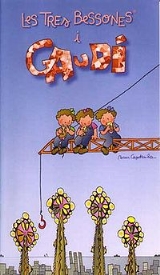
  • Chapter 70: Gaudi's Workshop
  • Chapter 71: La Pedrera's Ghosts
  • Chapter 72: Sherlock Holmes
    Sherlock Holmes
    Sherlock Holmes is a fictional character of the late nineteenth and early twentieth centuries who first appeared in publication in 1887. He is the creation of British author and physician Sir Arthur Conan Doyle...

  • Chapter 73: The Ant and the Grasshopper
    The Ant and the Grasshopper
    The Ant and the Grasshopper, also known as The Grasshopper and the Ant or The Grasshopper and the Ants, is a fable attributed to Aesop, providing a moral lesson about hard work and preparation. In the numbering system established for Aesopic fables by B. E. Perry, it is number 373...

  • Chapter 74: The Milkmaid and her Pail
  • Chapter 75: Cyrano de Bergerac
    Cyrano de Bergerac
    Hector Savinien de Cyrano de Bergerac was a French dramatist and duellist who is now best remembered for the many works of fiction which have been woven around his life story...

  • Chapter 76: The World of Films
  • Chapter 77: Geronimo
    Geronimo
    Geronimo was a prominent Native American leader and medicine man of the Chiricahua Apache who fought against Mexico and the United States and their expansion into Apache tribal lands for several decades.-Biography:Goyahkla was...

  • Chapter 78: On the Everest
  • Chapter 79: Vincent Van Gogh
    Vincent van Gogh
    Vincent Willem van Gogh was a Dutch Post-Impressionist painter whose work had a far reaching influence on 20th century art for its vivid colors and emotional impact. He suffered from anxiety and increasingly frequent bouts of mental illness throughout his life, and died largely unknown, at the age...

  • Chapter 80: Gutenberg
    Johannes Gutenberg
    Johannes Gensfleisch zur Laden zum Gutenberg was a German goldsmith and printer who is credited with being the first European to use movable type printing, in around 1439, and the global inventor of the mechanical printing press...

  • Chapter 81: The Magic Bagpipes
  • Chapter 82: Xuroi Cave
  • Chapter 83: Watt and the Steam Machine
  • Chapter 84: Thor
    Thor
    Thor is the red-haired and bearded god of thunder in Germanic mythology and Germanic paganism, and its subsets: Norse paganism, Anglo-Saxon paganism and Continental Germanic paganism....

  • Chapter 85: Velázquez
    Diego Velázquez
    Diego Rodríguez de Silva y Velázquez was a Spanish painter who was the leading artist in the court of King Philip IV. He was an individualistic artist of the contemporary baroque period, important as a portrait artist...

  • Chapter 86: Brave Little Tailor
    Brave Little Tailor
    Brave Little Tailor is a one-reel animated cartoon short subject in the Mickey Mouse series, produced in Technicolor by Walt Disney Productions, and released to theatres on September 29, 1938 by RKO Radio Pictures. It was produced by Walt Disney, directed by Bill Roberts, with principal animation...

  • Chapter 87: Beauty and the Beast
    Beauty and the Beast
    Beauty and the Beast is a traditional fairy tale . The first published version of the fairy tale was a rendition by Madame Gabrielle-Suzanne Barbot de Villeneuve, published in La jeune américaine, et les contes marins in 1740...

  • Chapter 88: William Tell
    William Tell
    William Tell is a folk hero of disputed historical authenticity who is said to have lived in the canton of Uri in Switzerland in the early 14th century.- The legend proper :...

  • Chapter 89: Captains Courageous
    Captains Courageous
    Captains Courageous is an 1897 novel, by Rudyard Kipling, that follows the adventures of fifteen-year-old Harvey Cheyne Jr., the arrogant and spoiled son of a railroad tycoon.-Title:...

  • Chapter 90: Zeila the Gazelle
  • Chapter 91: The Little Mermaid
    The Little Mermaid
    "The Little Mermaid" is a fairy tale by the Danish poet and author Hans Christian Andersen about a young mermaid willing to give up her life in the sea and her identity as a mermaid to gain a human soul and the love of a human prince...

  • Chapter 92: The Romanial Flower
  • Chapter 93: Dr. Jekyll and Mr. Hyde
  • Chapter 94: The Prince and the Pauper
    The Prince and the Pauper
    The Prince and the Pauper is an English-language novel by American author Mark Twain. It was first published in 1881 in Canada before its 1882 publication in the United States. The book represents Twain's first attempt at historical fiction...

  • Chapter 95: Tristan and Isolde
    Tristan und Isolde
    Tristan und Isolde is an opera, or music drama, in three acts by Richard Wagner to a German libretto by the composer, based largely on the romance by Gottfried von Straßburg...

  • Chapter 96: The Snow Queen
    The Snow Queen
    The Snow Queen is a fairy tale by author Hans Christian Andersen . The tale was first published in 1845, and centers on the struggle between good and evil as experienced by a little boy and girl, Kai and Gerda....

  • Chapter 97: Agatha Christie
    Agatha Christie
    Dame Agatha Christie DBE , was an English crime writer of novels, short stories and plays. She also wrote romances under the name Mary Westmacott, but is best remembered for her 80 detective novels and her successful West End theatre plays...

  • Chapter 98: The Happy Prince
  • Chapter 99: Tutankhamon
  • Chapter 100: The Time Machine
    The Time Machine
    The Time Machine is a novella by H. G. Wells, first published in 1895 and later directly adapted into at least two feature films of the same name, as well as two television versions, and a large number of comic book adaptations. It indirectly inspired many more works of fiction in all media...

  • Chapter 101: Pirates
  • Chapter 102: Holet the Goblin
  • Chapter 103: The Invisible Man
    The Invisible Man
    The Invisible Man is a science fiction novella by H.G. Wells published in 1897. Wells' novel was originally serialised in Pearson's Magazine in 1897, and published as a novel the same year...

  • Chapter 104: The Birthday Party
    The Birthday Party (play)
    The Birthday Party is the first full-length play by Harold Pinter and one of Pinter's best-known and most-frequently performed plays. After its hostile London reception almost ended Pinter's playwriting career, it went on to be considered "a classic".Produced by Michael Codron and David Hall, the...


The Triplets around the world


The series has been translated into the following languages:
  1. In Arabic
    Arabic language
    Arabic is a Central Semitic language, thus related to and classified alongside other Semitic languages such as Hebrew and the Neo-Aramaic languages. In terms of speakers, the Arabic macrolanguage is the largest member of the Semitic language family. It is spoken by more than 280 million people as...

  2. In Aranese
    Aranese language
    Aranese is a standardized form of the Pyrenean Gascon variety of the Occitan language spoken in the Aran Valley, in northwestern Catalonia on the border between Spain and France, where it is one of the three official languages besides Catalan and Spanish....

  3. In Basque
    Basque language
    Basque is the ancestral language of the Basque people, who inhabit the Basque Country, a region spanning an area in northeastern Spain and southwestern France. It is the mother tongue of approximately one fifth of Basques, 632,000 out of nearly 3,000,000...

     - Hirukiak.
  4. In Chinese
    Chinese language
    Chinese or the Sinitic language is a language family consisting of languages mutually unintelligible to varying degrees. Originally the indigenous languages spoken by the Han Chinese in China, it forms one of the two branches of Sino-Tibetan family of languages...

     - 淘氣三胞胎
  5. In Czech
    Czech language
    Czech is a West Slavic language with about 12 million native speakers; it is the majority language in the Czech Republic and spoken by Czechs worldwide. Czech is similar to and mutually intelligible with Slovak and, to a lesser extent, to Polish and Sorbian. - Official status :Czech is widely...

     - Trojčátka
  6. In Dutch
    Dutch language
    Dutch is a West Germanic language spoken by over 22 million people as a native language, and over 5 million people as a second language.
    "1% of the EU population claims to speak Dutch well enough in order to have a conversation." Outside the European Union the number of second language...

     - De Drieling.
  7. In English
    English language
    English is a West Germanic language that developed in England during the Anglo-Saxon era. As a result of the military, economic, scientific, political, and cultural influence of the British Empire during the 18th, 19th, and early 20th centuries, and of the United States since the mid 20th century,...

     - The Triplets.
  8. In French
    French language
    French is a Romance language globally spoken by about 65 million people as a first language , by 50 million as a second language, and by about another 200 million people as an acquired foreign language, with significant speakers in 57 countries. Most native speakers of the language live in France,...

     - Les Trois Petites Soeurs.
  9. In Gaelic
  10. In Galician
    Galician language
    Galician is a language of the Western Ibero-Romance branch, spoken in Galicia, an autonomous community located in northwestern Spain, as well as in small bordering zones in the neighbouring autonomous communities of Asturias and Castile and León and in Northern Portugal.Galician and Portuguese...

  11. In German
    German language
    German is a West Germanic language, thus related to and classified alongside English and Dutch. It is one of the world's major languages and the most widely spoken first language in the European Union. Around the world, German is spoken by approximately 105 million native speakers and also by...

  12. In Greek
    Greek language
    Greek , an independent branch of the Indo-European family of languages, is the language of the Greeks. Native to the southern Balkans, it has the longest documented history of any Indo-European language, spanning 34 centuries of written records. In its ancient form, it is the language of classical...

  13. In Hebrew
    Hebrew language
    Hebrew is a Semitic language of the Afro-Asiatic language family. Culturally, it is considered a Jewish language. Hebrew in its modern form is spoken by more than seven million people in Israel while Classical Hebrew has been used for prayer or study in Jewish communities around the world for over...

     - השלישייה (HaShlishiya)
  14. In Hindi
  15. In Hungarian
    Hungarian language
    Hungarian is a Uralic language unrelated to most other languages in Europe. It is mainly spoken in Hungary and by the Hungarian minorities in the seven neighbouring countries...

  16. In Icelandic
    Icelandic language
    Icelandic is a North Germanic language, the language of Iceland. Its closest relatives are Faroese and certain Norwegian dialects such as Telemark dialect and Sognamål....

  17. In Italian
    Italian language
    Italian is a Romance language spoken by about 60 million people in Italy, and by a total of around 70 million in the world. In Switzerland, Italian is one of four official languages. It is also the official language of San Marino, as well as the primary language of Vatican City...

     - Tre Gemelle E Una Strega
  18. In Japanese
    Japanese language
    is a language spoken by over 130 million people in Japan and in Japanese emigrant communities. It is a member of the Japonic language family. There are a number of proposed relationships with other languages, but none have gained general acceptance...

  19. In Korean
    Korean language
    Korean is the official language of North Korea and South Korea. It is also one of the two official languages in the Yanbian Korean Autonomous Prefecture in China. There are about 78 million Korean speakers. It was formerly written using Hanja, borrowed Chinese characters pronounced in the Korean...

  20. In Kurdish
    Kurdish language
    Kurdish is the language spoken by Kurds in western Asia. Unlike many other languages it does not have a single standardized linguistic entity with the status of an official or state language...

  21. In Malay
    Malay language
    Malay is a group of languages closely related to each other to the point of mutual intelligibility but that linguists consider to be separate languages. They are grouped into a group called "Local Malay", part of a larger group called "Malayan" within the Malayo-Polynesian branch of the...

  22. In Mandarin
  23. In Norwegian
    Norwegian language
    Norwegian is a North Germanic language spoken primarily in Norway, where it is an official language. Together with Swedish and Danish, Norwegian forms a continuum of more or less mutually intelligible local and regional variants ...

  24. In Occitan
    Occitan language
    Occitan , known also as Lenga d'òc in Occitan or Langue d'oc in French is a Romance language spoken in Occitania, that is, Southern France, the Occitan Valleys of Italy, Monaco and in the Aran Valley of Spain...

  25. In Persian
    Persian language
    Persian is an Iranian language within the Indo-Iranian branch of the Indo-European languages. It is widely spoken in Iran, Afghanistan, Tajikistan, Uzbekistan and to some extent in Iraq and Bahrain, and has a status of official language in the first three countries under different names...

  26. In Polish
    Polish language
    Polish is a West Slavic language and the official language of Poland. Its written standard is the Polish alphabet which corresponds basically to the Latin alphabet with a few additions...

  27. In Portuguese
    Portuguese language
    Portuguese is a Romance language that originated in what is now Galicia and northern Portugal. It is derived from the Latin spoken by the romanized Pre-Roman peoples of the Iberian Peninsula around 2000 years ago...

     - As Três Irmâs
  28. In Portuguese from Brazil
    Brazilian Portuguese
    Brazilian Portuguese is a group of Portuguese dialects written and spoken by virtually all the almost 200 million inhabitants of Brazil and by a few million Brazilian emigrants, mainly in the United States, United Kingdom, Portugal, Canada, Japan and Paraguay.Roughly speaking, the differences...

     - As Trigêmeas.
  29. In Slovenian
    Slovenian language
    Slovene or Slovenian is a South Slavic language spoken by approximately 2.4 million speakers worldwide, the majority of whom live in Slovenia...

  30. In Spanish
    Spanish language
    Spanish or Castilian is a Romance language in the Ibero-Romance group that originated in northern Spain and gradually spread in the Kingdom of Castile, evolving into the principal language of government and trade in the Iberian peninsula...

     - Las Tres Mellizas.
  31. In Swedish
    Swedish language
    Swedish is a North Germanic language, spoken by approximately 10 million people, predominantly in Sweden and parts of Finland, especially along the coast and on the Åland islands. It is to a considerable extent mutually intelligible with Norwegian and to a lesser extent with Danish...

     - Trillingarna
  32. In Tamil
    Tamil language
    Tamil is a Dravidian language spoken predominantly by Tamil people of the Indian subcontinent. It has official status in India, Sri Lanka and Singapore. Tamil is also spoken by significant minorities in Malaysia, Mauritius and Réunion as well as emigrant communities around the world...

  33. In Thai
    Thai language
    Thai is the national and official language of Thailand and the mother tongue of the Thai people, Thailand's dominant ethnic group. Thai is a member of the Tai group of the Kradai language family. The Kradai languages are thought to have originated in what is now southern China, and are linked to...

  34. In Turkish
    Turkish language
    Turkish is spoken as a first language by over 63 million people worldwide, making it the most commonly spoken of the Turkic languages. Its speakers are located predominantly in Turkey and Cyprus, with smaller groups in Iraq, Greece, Bulgaria, the Republic of Macedonia, Kosovo, Albania and other...


External links