

.gif)
The Passenger (film)

Encyclopedia
The Passenger is a film
directed and co-written by Michelangelo Antonioni
, released in 1975
, in which Jack Nicholson
stars as a television reporter in Africa who assumes the identity of a dead stranger. The film competed for the "Palme d'Or
" award at the 1975 Cannes Film Festival
.
) is a television journalist making a documentary film on post-colonial Africa. To finish the film, he is in the Sahara desert seeking to meet with and interview rebel fighters involved in Chad's civil war. Struggling to find rebels to interview, his frustrations reach a climax when his Land Rover gets hopelessly stuck on a sand dune. After a long walk through the desert back to his hotel a thoroughly glum Locke finds that an Englishman by the name of Robertson (Charles Mulvehill), who has also been staying there and with whom he had struck up a friendship, is dead. Tired of his work, his marriage and his life, Locke switches identities with Robertson, carefully cutting and swapping the photographs in their passports. Posing as Robertson, he reports his own death; since the hotel manager has already mistaken Locke for Robertson, the plan goes off without a hitch.
In London, Locke's wife Rachel (Jenny Runacre
) has been having an affair with someone else but is guilt-ridden and torn by the news of her husband's death and tries to get in touch with Robertson, to learn more about what happened. Meanwhile "Robertson" (Locke) flies to Europe with the dead man's appointment book.
Otherwise aimless, Locke swiftly learns Robertson was a gunrunner for the rebels he had been trying to contact in the desert and not liked by the government they are fighting to overthrow. Meanwhile a friend of Locke's from the BBC, a producer, tries to track Robertson down on behalf of Rachel. Locke spots him on the street in Barcelona
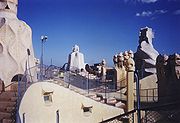
and asks an architecture student (Maria Schneider
as the Girl) to fetch his belongings so he won't be seen at his hotel. She and Locke drive off from Barcelona and become romantically close, Locke confesses that he has stolen a dead man's identity as an explanation for his secrecy.
Flush with cash from a down payment on arms he accepted but cannot deliver, with encouragement from the Girl, Locke nevertheless is drawn to keep the meetings listed in Robertson's book in an attempt to adopt a second identity which is temporarily exciting realizing that one day he must go into hiding. Locke begins skirting then fleeing from the Spanish police, whom Rachel has brought in on the search for Robertson, but the Girl is loyal and helps him evade them, providing rational advice.
An ever more wary and world-weary Locke sends the Girl away on a bus, saying he'll meet her in Tangiers later. The thugs eventually catch up with him at the Hotel de la Gloria after he sends her away with a grim story of a blind man who regains his sight only to commit suicide, in a Spanish town (Osuna
, province of Seville
). The assassination takes place off screen in a widely noted, seven minute long take
-tracking shot
which begins in a hotel room, travels out into a dusty parking area and tracks back into the hotel room. All significant living characters are present in the last minutes of the movie as Locke's identity is confirmed in the presence of the Girl.
-tracking shot
which begins in Locke's hotel room looking out into a dusty, run-down square, pulls out through the bars in the hotel window into the square, rotates 180 degrees, and finally tracks back into the hotel room.
Although it is often referred to as the "final shot" of the film, there is one more, which shows a small driving school car pulling away in the twilight some time later, holding on the hotel as the credits begin to roll.
 The Passenger has been considered remarkable for its camerawork (by Luciano Tovoli
) and acting. While the movie has been critically praised by such movie critics as Peter Travers
of Rolling Stone
and Manohla Dargis of The New York Times
, it has also been criticized by Roger Ebert
, Danny Peary
and others for being slow-moving and pretentious. Ebert has since changed his stance on the film, and now considers it a perceptive look at identity, alienation, and mankind's desire to escape oneself.
Film
A film, also called a movie or motion picture, is a series of still or moving images. It is produced by recording photographic images with cameras, or by creating images using animation techniques or visual effects...
directed and co-written by Michelangelo Antonioni
Michelangelo Antonioni
Michelangelo Antonioni, Cavaliere di Gran Croce OMRI was an Italian modernist film director, screenwriter, editor and short story writer.- Personal life :...
, released in 1975
1975 in film
The year 1975 in film involved some significant events, with Steven Spielberg's thriller Jaws topping the box office.-Events:*March 26 - The film version of The Who's Tommy premieres in London....
, in which Jack Nicholson
Jack Nicholson
John Joseph "Jack" Nicholson is an American actor, film director, producer and writer. He is renowned for his often dark portrayals of neurotic characters. Nicholson has been nominated for an Academy Award twelve times, and has won the Academy Award for Best Actor twice: for One Flew Over the...
stars as a television reporter in Africa who assumes the identity of a dead stranger. The film competed for the "Palme d'Or
Palme d'Or
The Palme d'Or is the highest prize awarded at the Cannes Film Festival and is presented to the director of the best feature film of the official competition. It was introduced in 1955 by the organising committee. From 1939 to 1954, the highest prize was the Grand Prix du Festival International du...
" award at the 1975 Cannes Film Festival
1975 Cannes Film Festival
- Jury :*Jeanne Moreau, President, actress*André Delvaux, director*Anthony Burgess, writer*Fernando Rey, actor*George Roy Hill, director*Gérard Ducaux-Rupp, producer*Léa Massari, actress*Pierre Mazars, journalist*Pierre Salinger, writer...
.
Cast
- Jack NicholsonJack NicholsonJohn Joseph "Jack" Nicholson is an American actor, film director, producer and writer. He is renowned for his often dark portrayals of neurotic characters. Nicholson has been nominated for an Academy Award twelve times, and has won the Academy Award for Best Actor twice: for One Flew Over the...
... David Locke - Maria SchneiderMaria Schneider (actress)Maria Schneider was a French actress. She was best known for playing Jeanne, opposite Marlon Brando, in the 1972 film Last Tango in Paris.-Career:...
... Girl - Steven BerkoffSteven BerkoffSteven Berkoff is an English actor, writer and director. Best known for his performance as General Orlov in the James Bond film Octopussy, he is typically cast in villanous roles, such as Lt...
... Stephen - Ian HendryIan HendryIan Hendry was an English film and television actor. He is best known for his work on several British TV series of the early 1960s such as The Avengers, and for his roles in 1970s films such as Get Carter .-Career:Hendry was born in Ipswich, Suffolk and educated at Culford School...
... Martin Knight - Jenny RunacreJenny RunacreJenny Runacre is an actress.Runacre was born in Cape Town, South Africa. She relocated to London as a child, attended The Actor's Workshop there, and trained in the Stanislavski System....
... Rachel Locke - Ambroise Bia... Achebe
- Charles Mulvehill... David Robertson
Plot
David Locke (Jack NicholsonJack Nicholson
John Joseph "Jack" Nicholson is an American actor, film director, producer and writer. He is renowned for his often dark portrayals of neurotic characters. Nicholson has been nominated for an Academy Award twelve times, and has won the Academy Award for Best Actor twice: for One Flew Over the...
) is a television journalist making a documentary film on post-colonial Africa. To finish the film, he is in the Sahara desert seeking to meet with and interview rebel fighters involved in Chad's civil war. Struggling to find rebels to interview, his frustrations reach a climax when his Land Rover gets hopelessly stuck on a sand dune. After a long walk through the desert back to his hotel a thoroughly glum Locke finds that an Englishman by the name of Robertson (Charles Mulvehill), who has also been staying there and with whom he had struck up a friendship, is dead. Tired of his work, his marriage and his life, Locke switches identities with Robertson, carefully cutting and swapping the photographs in their passports. Posing as Robertson, he reports his own death; since the hotel manager has already mistaken Locke for Robertson, the plan goes off without a hitch.
In London, Locke's wife Rachel (Jenny Runacre
Jenny Runacre
Jenny Runacre is an actress.Runacre was born in Cape Town, South Africa. She relocated to London as a child, attended The Actor's Workshop there, and trained in the Stanislavski System....
) has been having an affair with someone else but is guilt-ridden and torn by the news of her husband's death and tries to get in touch with Robertson, to learn more about what happened. Meanwhile "Robertson" (Locke) flies to Europe with the dead man's appointment book.
Otherwise aimless, Locke swiftly learns Robertson was a gunrunner for the rebels he had been trying to contact in the desert and not liked by the government they are fighting to overthrow. Meanwhile a friend of Locke's from the BBC, a producer, tries to track Robertson down on behalf of Rachel. Locke spots him on the street in Barcelona
Barcelona
Barcelona is the second largest city in Spain after Madrid, and the capital of Catalonia, with a population of 1,621,537 within its administrative limits on a land area of...
and asks an architecture student (Maria Schneider
Maria Schneider (actress)
Maria Schneider was a French actress. She was best known for playing Jeanne, opposite Marlon Brando, in the 1972 film Last Tango in Paris.-Career:...
as the Girl) to fetch his belongings so he won't be seen at his hotel. She and Locke drive off from Barcelona and become romantically close, Locke confesses that he has stolen a dead man's identity as an explanation for his secrecy.
Flush with cash from a down payment on arms he accepted but cannot deliver, with encouragement from the Girl, Locke nevertheless is drawn to keep the meetings listed in Robertson's book in an attempt to adopt a second identity which is temporarily exciting realizing that one day he must go into hiding. Locke begins skirting then fleeing from the Spanish police, whom Rachel has brought in on the search for Robertson, but the Girl is loyal and helps him evade them, providing rational advice.
An ever more wary and world-weary Locke sends the Girl away on a bus, saying he'll meet her in Tangiers later. The thugs eventually catch up with him at the Hotel de la Gloria after he sends her away with a grim story of a blind man who regains his sight only to commit suicide, in a Spanish town (Osuna
Osuna
Osuna is a town and municipality in the province of Seville, southern Spain, in the autonomous community of Andalusia. , it has a population of c...
, province of Seville
Seville
Seville is the artistic, historic, cultural, and financial capital of southern Spain. It is the capital of the autonomous community of Andalusia and of the province of Seville. It is situated on the plain of the River Guadalquivir, with an average elevation of above sea level...
). The assassination takes place off screen in a widely noted, seven minute long take
Long take
A long take is an uninterrupted shot in a film which lasts much longer than the conventional editing pace either of the film itself or of films in general, usually lasting several minutes. It can be used for dramatic and narrative effect if done properly, and in moving shots is often accomplished...
-tracking shot
Tracking shot
In motion picture terminology, a tracking shot is a segment in which the camera is mounted on a camera dolly, a wheeled platform that is pushed on rails while the picture is being taken...
which begins in a hotel room, travels out into a dusty parking area and tracks back into the hotel room. All significant living characters are present in the last minutes of the movie as Locke's identity is confirmed in the presence of the Girl.
Penultimate shot
The film's penultimate shot consists of a seven minute long takeLong take
A long take is an uninterrupted shot in a film which lasts much longer than the conventional editing pace either of the film itself or of films in general, usually lasting several minutes. It can be used for dramatic and narrative effect if done properly, and in moving shots is often accomplished...
-tracking shot
Tracking shot
In motion picture terminology, a tracking shot is a segment in which the camera is mounted on a camera dolly, a wheeled platform that is pushed on rails while the picture is being taken...
which begins in Locke's hotel room looking out into a dusty, run-down square, pulls out through the bars in the hotel window into the square, rotates 180 degrees, and finally tracks back into the hotel room.
- The location of the hotel is stated to be Osuna in the film. However, the bullring at the edge of the square is recognisably that of the one in the Spanish town of VeraVera, Spain-External links: - Sistema de Información Multiterritorial de Andalucía - Diputación Provincial de Almería - Vera town information....
, in the province of Almería. In a DVD commentary, decades later, Nicholson said Antonioni built the entire hotel so as to get this widely noted shot. - Since the shot was continuous it was not possible to adjust the lens aperture as the camera left the room and went into the square. Hence the footage had to be taken in the very late afternoon near dusk, in order to minimise the lighting contrast between the brightness outside and that in the room.
- The square was windy and the crew needed stillness to ensure smooth camera movement. Antonioni tried putting the camera in a sphere so the wind might catch it less, but this wouldn't fit through the window. In the scene it appears that the bars may have been adjusted to be removed as the camera approached them.
- The camera ran on a ceiling track in the hotel room and when it came outside the window, was meant to be picked up by a hook suspended from a giant crane nearly thirty metres high. A system of gyroscopes was fitted on the camera to steady it during the switch from this smooth indoor track to the crane outside. Meanwhile the bars on the window had been given hinges. When the camera reached the window and the bars were no longer in the field of view they were swung away to either side. At this time the camera's forward movement had to stop for a few seconds as the crane's hook grabbed onto it and took over from the track. To hide this, the lens was slowly and smoothly zoomed until the crane could pull the camera forward again.Only a year later (1976) the wholly portable SteadicamSteadicamA Steadicam is a stabilizing mount for a motion picture camera that mechanically isolates it from the operator's movement, allowing a smooth shot even when moving quickly over an uneven surface...
, which uses a counterweight system rather than gyroscopes, would become available for this kind of shot, greatly simplifying such setups. Antonioni directed the scene from a van by means of monitors and microphones, talking to assistants who communicated his instructions to the actors and operators.
Although it is often referred to as the "final shot" of the film, there is one more, which shows a small driving school car pulling away in the twilight some time later, holding on the hotel as the credits begin to roll.
Reception
Luciano Tovoli
Luciano Tovoli , is an Italian cinematographer, film director, and screenwriter. While the majority of the titles in his filmography are Italian, he has worked as cinematographer on several United States and French productions.His films include Michelangelo Antonioni's The Passenger , Walerian...
) and acting. While the movie has been critically praised by such movie critics as Peter Travers
Peter Travers
Peter Travers is an American film critic, who has written for, in turn, People and Rolling Stone. Travers also hosts a celebrity interview show called Popcorn on ABC News Now and ABCNews.com.-Career:...
of Rolling Stone
Rolling Stone
Rolling Stone is a US-based magazine devoted to music, liberal politics, and popular culture that is published every two weeks. Rolling Stone was founded in San Francisco in 1967 by Jann Wenner and music critic Ralph J...
and Manohla Dargis of The New York Times
The New York Times
The New York Times is an American daily newspaper founded and continuously published in New York City since 1851. The New York Times has won 106 Pulitzer Prizes, the most of any news organization...
, it has also been criticized by Roger Ebert
Roger Ebert
Roger Joseph Ebert is an American film critic and screenwriter. He is the first film critic to win a Pulitzer Prize for Criticism.Ebert is known for his film review column and for the television programs Sneak Previews, At the Movies with Gene Siskel and Roger Ebert, and Siskel and Ebert and The...
, Danny Peary
Danny Peary
Danny Peary is an American film critic and sports writer. He has written many books on cinema and sports-related topics.-Biography:...
and others for being slow-moving and pretentious. Ebert has since changed his stance on the film, and now considers it a perceptive look at identity, alienation, and mankind's desire to escape oneself.
External links
- The Passenger
' s Official Site at Sony Pictures - The Passenger at MetacriticMetacriticMetacritic.com is a website that collates reviews of music albums, games, movies, TV shows and DVDs. For each product, a numerical score from each review is obtained and the total is averaged. An excerpt of each review is provided along with a hyperlink to the source. Three colour codes of Green,...
- The Passenger Meets History, by Robert Koehler
- Review of The Passenger in its 2005 re-release. SlantMagazine.com
- Review of The Passenger in its 2005 re-release. Carina Chocano, Los Angeles Times, 11/04/2005
- Review of The Passenger in its 2005 re-release. Manohla Dargis, New York Times, 10/28/2005
- Roger EbertRoger EbertRoger Joseph Ebert is an American film critic and screenwriter. He is the first film critic to win a Pulitzer Prize for Criticism.Ebert is known for his film review column and for the television programs Sneak Previews, At the Movies with Gene Siskel and Roger Ebert, and Siskel and Ebert and The...
's review of The Passenger - Turner, Jack (1999). Antonioni's The Passenger as Lacanian Text. Other VoicesOther Voices (open-access journal of cultural criticism)Other Voices is a peer-reviewed open-access academic journal of cultural criticism and cultural studies founded in 1996 at the University of Pennsylvania. Other Voices publishes interdisciplinary essays, interviews, roundtable discussions, lecture transcriptions, audio and video lectures,...
1 (3). - The Passenger Fan Page