

Thalia

Overview
Muse
The Muses in Greek mythology, poetry, and literature, are the goddesses who inspire the creation of literature and the arts. They were considered the source of the knowledge, related orally for centuries in the ancient culture, that was contained in poetic lyrics and myths...
who presided over comedy and idyllic poetry
Idyll
An idyll or idyl is a short poem, descriptive of rustic life, written in the style of Theocritus' short pastoral poems, the Idylls....
. In this context her name means "flourishing", because the praises in her songs flourish through time. She was the daughter of Zeus
Zeus
In the ancient Greek religion, Zeus was the "Father of Gods and men" who ruled the Olympians of Mount Olympus as a father ruled the family. He was the god of sky and thunder in Greek mythology. His Roman counterpart is Jupiter and his Etruscan counterpart is Tinia.Zeus was the child of Cronus...
and Mnemosyne
Mnemosyne
Mnemosyne , source of the word mnemonic, was the personification of memory in Greek mythology. This titaness was the daughter of Gaia and Uranus and the mother of the nine Muses by Zeus:* Calliope * Clio * Erato...
, the eighth-born of the nine Muses.
According to pseudo-Apollodorus, she and Apollo
Apollo
Apollo is one of the most important and complex of the Olympian deities in Greek and Roman mythology...
were the parents of the Corybantes. Other ancient sources, however, gave the Corybantes different parents.
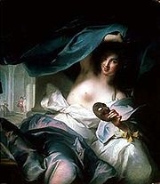
She was portrayed as a young woman with a joyous air, crowned with ivy, wearing boots and holding a comic mask in her hand.
Unanswered Questions
