

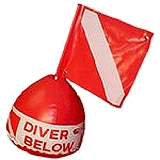
Surface Marker Buoy

Encyclopedia
A surface marker buoy, SMB or simply a blob is an inflatable buoy
used by scuba
divers
, with a line
, to indicate the diver's position to their surface safety boat while the diver is underwater.
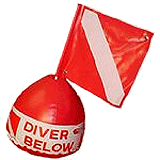 SMBs are inflated on the surface before diving to mark the diver's position during drift dives
, night dives
, mist
or disturbed sea conditions such as Beaufort force 2 or greater. The buoy lets the dive boat follow the divers and highlights their position to other boat traffic.
Divers need to consider some configuration options and features when using SMBs. A closed SMB, with a valve through which the user blows, is likely to be more reliable, by remaining inflated, than an open ended buoy or a delayed buoy which seals itself as it inflates.
To avoid losing the reel, a lanyard attaches the diving reel to the diver. This lanyard can clip to the buoyancy compensator or go around the wrist. Alternatively, the lanyard can be long enough to float above the diver and stay out of the way. If the lanyard clips to the buoyancy compensator, the user should take care to release if there is surface boating activity, as boats may drag divers up by their SMB reels.
The DIR diving philosophy considers unsafe any attachment to equipment or objects which end above the water surface, due to high risk associated with dragging the diver upwards in spite of their decompression obligation or maximum ascent speed limit.
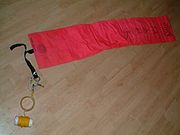
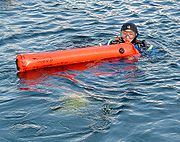
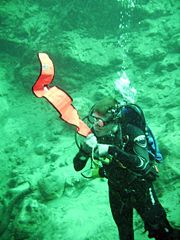 A delayed surface marker buoy (DSMB), decompression buoy or deco buoy is similar to a surface marker buoy but is deployed whilst the diver is submerged and generally only towards the end of the dive. The buoy marks the diver's position underwater so the boat safety cover can locate the diver even though the diver may have drifted some distance from the dive site while doing decompression stops. A reel and line
connect the buoy on the surface to the diver beneath the surface. Alternative means of marking one's position while doing decompression stops are diving shot
s and decompression trapezes.
A decompression buoy is not intended to be used to lift heavy weights: in this case divers use a lifting bag
.
Divers of some training organisations carry two differently coloured deco buoys underwater so that they can signal to their surface support for help and still remain underwater decompressing. For example, in some circles in Europe, a red buoy indicates normal decompression and a yellow buoy indicates a problem, such as shortage of gas, that the surface support should investigate and resolve. Although in other circles, two buoys (any colour) up one line means the same, currently the protocol is not universally accepted even within Europe.
Some types of buoy provide an attachment for a strobe light
, cyalume stick or writing slate
, which can convey signals to the surface support.
Buoy
A buoy is a floating device that can have many different purposes. It can be anchored or allowed to drift. The word, of Old French or Middle Dutch origin, is now most commonly in UK English, although some orthoepists have traditionally prescribed the pronunciation...
used by scuba
Scuba set
A scuba set is an independent breathing set that provides a scuba diver with the breathing gas necessary to breathe underwater during scuba diving. It is much used for sport diving and some sorts of work diving....
divers
Diving equipment
Diving equipment is equipment used by underwater divers for the purpose of facilitating diving activities. This may be equipment primarily intended for this purpose, or equipment intended for other puprposes which is found to be suitable for diving use....
, with a line
Distance line
A distance line, penetration line or guideline is an item of diving equipment used by SCUBA divers as a means of returning to a safe starting point in conditions of low visibility, water currents or where pilotage is difficult...
, to indicate the diver's position to their surface safety boat while the diver is underwater.
Standard buoy
Drift diving
Drift diving is a type of recreational diving where the diver is transported by the currents caused by the tide or in a river.The current gives the diver the impression of flying and allows the diver to cover long distances underwater, possibly seeing more habitats and formations than usual...
, night dives
Night diving
Night diving is a type of recreational diving which takes place in darkness. The diver can experience a different underwater environment at night, because many marine animals are nocturnal....
, mist
Mist
Mist is a phenomenon of small droplets suspended in air. It can occur as part of natural weather or volcanic activity, and is common in cold air above warmer water, in exhaled air in the cold, and in a steam room of a sauna. It can also be created artificially with aerosol canisters if the...
or disturbed sea conditions such as Beaufort force 2 or greater. The buoy lets the dive boat follow the divers and highlights their position to other boat traffic.
Divers need to consider some configuration options and features when using SMBs. A closed SMB, with a valve through which the user blows, is likely to be more reliable, by remaining inflated, than an open ended buoy or a delayed buoy which seals itself as it inflates.
To avoid losing the reel, a lanyard attaches the diving reel to the diver. This lanyard can clip to the buoyancy compensator or go around the wrist. Alternatively, the lanyard can be long enough to float above the diver and stay out of the way. If the lanyard clips to the buoyancy compensator, the user should take care to release if there is surface boating activity, as boats may drag divers up by their SMB reels.
The DIR diving philosophy considers unsafe any attachment to equipment or objects which end above the water surface, due to high risk associated with dragging the diver upwards in spite of their decompression obligation or maximum ascent speed limit.
Decompression buoy
Distance line
A distance line, penetration line or guideline is an item of diving equipment used by SCUBA divers as a means of returning to a safe starting point in conditions of low visibility, water currents or where pilotage is difficult...
connect the buoy on the surface to the diver beneath the surface. Alternative means of marking one's position while doing decompression stops are diving shot
Diving shot
thumb|right|Diagram of a diving shot upcurrent of a dive siteA diving shot is an item of diving equipment consisting of a weight, a line and a buoy. The weight is dropped on the dive site. The line connects the weight and the buoy and is used by divers to move between the surface and the dive site...
s and decompression trapezes.
A decompression buoy is not intended to be used to lift heavy weights: in this case divers use a lifting bag
Lifting bag
A lifting bag is an item of diving equipment consisting of a robust and air-tight bag with straps, which is used to lift heavy objects underwater by means of the bag's buoyancy...
.
Design
There are at least four methods of keeping the air in the inflated deco buoy. The buoy can be:- open ended (preferably with small independent weight to keep the opening submerged to prevent the air escaping);
- open ended self sealing buoys (the air in the buoy expands as the buoy ascends sealing a neck at the bottom of the buoy);
- sealed, with an inflation valve and a pressure relief valve;
- sealed, with a built in air supply and a pressure relief valve.
Divers of some training organisations carry two differently coloured deco buoys underwater so that they can signal to their surface support for help and still remain underwater decompressing. For example, in some circles in Europe, a red buoy indicates normal decompression and a yellow buoy indicates a problem, such as shortage of gas, that the surface support should investigate and resolve. Although in other circles, two buoys (any colour) up one line means the same, currently the protocol is not universally accepted even within Europe.
Some types of buoy provide an attachment for a strobe light
Strobe light
A strobe light or stroboscopic lamp, commonly called a strobe, is a device used to produce regular flashes of light. It is one of a number of devices that can be used as a stroboscope...
, cyalume stick or writing slate
Slate (writing)
A writing slate is a piece of flat material used as a medium for writing.In the 19th century, writing slates were made of slate, which is more durable than paper and was cheap at the time when paper was expensive. It was used to allow children to practice writing...
, which can convey signals to the surface support.
Deployment problems
Several common problems are encountered when deploying deco buoys.- The diving reel jams after the buoy is inflated (dragging the diver up). To avoid this, a diver can:
- use a simpler system or a reel which cannot jam (e.g. a weighted spool of line);
- detach the lanyard connecting the diver to the reel before inflating the buoy (and ensure no equipment is trapped in the buoy or reel);
- attach two reels to each other in series. If one fails the other is unlocked to reel out its line.
- Part of the diver's equipment gets trapped in the deco buoy (dragging the diver up). To avoid this, a diver may tie the lanyard of the reel to something solid on the sea bed before inflating the buoy, giving time to sort the problem out.
- The diver removes the primary demand valve from his or her mouth to inflate the buoy, and is therefore at a disadvantage in dealing with any other problems that might arise as the deco buoy goes up. The ways to avoid this include:
- using a deco buoy with its own air supply;
- using a secondary demand valve, such as an octopus, to inflate the buoy;
- using a sealed buoy with an inflation valve, which is filled by blowing directly into the valve inlet or by attaching a medium-pressure inflation hose from the buoyancy compensator (BCD) or dry suitDiving suitA diving suit is a garment or device designed to protect a diver from the underwater environment. A diving suit typically also incorporates an air-supply .-History:...
(the valve does not retain the hose connector, like the BCD or suit inflator valve, and the hose can be easily pulled off the valve when the buoy is sufficiently filled); - holding an open ended buoy above the primary demand valve and direct several exhalations up into the open end of the buoy. This technique is also useful in cold conditions to prevent a freeflowFreeflowIn scuba diving, a freeflow occurs when the diving regulator continues to supply air instead of cutting off the supply when the diver is not breathing in...
caused by pressing the purge buttonPurge buttonThe purge button is the part of a diving regulator that may be depressed manually to force the regulator to deliver air. Normally the part of the second stage covering the diaphragm is made flexible and serves as a purge button, since pressure on the diaphragm opens the valve to release air through...
.
Safety sausage
A safety sausage is a buoy used when the diver is at the surface to indicate the diver's position to the dive boat, reducing the risk of losing contact when air, light or sea conditions decrease the visibility of the divers from the boat. The sausage is a plastic tube that is normally inflated by putting one end under water and purging the second stage underneath to inflate it. Inflated tubes are normally about 6 feet (2 m) tall. Uninflated sausages roll up and fit in a buoyancy compensator pocket. Commercial boat dive operations, especially at offshore reefs or areas known for strong currents or mercurial weather, may require divers to carry safety sausages. A safety sausage is not a substitute for a surface marker buoy or diver down flag.External links
- British Diving Safety Group advice on SMBs - Description of deployment technique and video of diver performing task.