
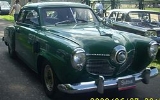
The
Studebaker Champion is an
automobileAn automobile, autocar, motor car or car is a wheeled motor vehicle used for transporting passengers, which also carries its own engine or motor...
which was produced by the
StudebakerStudebaker Corporation was a United States wagon and automobile manufacturer based in South Bend, Indiana. Founded in 1852 and incorporated in 1868 under the name of the Studebaker Brothers Manufacturing Company, the company was originally a producer of wagons for farmers, miners, and the...
Corporation of
South Bend, IndianaThe city of South Bend is the county seat of St. Joseph County, Indiana, United States, on the St. Joseph River near its southernmost bend, from which it derives its name. As of the 2010 Census, the city had a total of 101,168 residents; its Metropolitan Statistical Area had a population of 316,663...
from the beginning of the 1939 model year until 1958.
The success of the Champion in 1939 was imperative to Studebaker’s survival following weak sales during the 1938 model year. Unlike most other cars, the Champion was designed from a "clean sheet", that is, having no restrictions caused by necessarily utilizing older parts or requiring the subsequent use of its components in heavier vehicles. Careful market research guided the selection of features, but a key principle adhered to was the engineering watchword "Weight is the enemy." For its size, it was one of the lightest cars of its era; its main competitor in this respect, the Willys Americar, did not go through as thorough a design process. Its compact
straight-6The straight-six engine or inline-six engine is a six-cylinder internal combustion engine with all six cylinders mounted in a straight line along the crankcase...
engine outlasted the model itself and was produced to the end of the 1964 model year, with a change to an
OHVAn overhead valve engine, also informally called pushrod engine or I-head engine, is a type of piston engine that places the camshaft within the cylinder block , and uses pushrods or rods to actuate rocker arms above the cylinder...
design in 1961.
The Champion was one of Studebaker's best-selling models by virtue of its low price (US$660 for the two-door business coupe in 1939), durable engine and styling. The car's
ponton stylingPonton or Pontoon styling refers to a 1930s-1960s design genre — ultimately the precursor of modern automotive styling. The trend emerged as distinct running boards and fully articulated fenders became less common and bodywork began to enclose the full width and uninterrupted length of a car...
was authored by industrial designer
Raymond LoewyRaymond Loewy was an industrial designer, and the first to be featured on the cover of Time Magazine, on October 31, 1949. Born in France, he spent most of his professional career in the United States...
who had been under contract with Studebaker for the design of their automobiles. Champions won
Mobilgas economy runsMobil Economy Run was an event that took place every year from 1936 to 1968. It was designed to provide real fuel efficiency numbers during a coast to coast test on real roads and with regular traffic and weather conditions...
by posting the highest gas mileage tests. During World War II, Champions were coveted for their high mileage at a time when gas was rationed in the
United StatesThe United States of America is a federal constitutional republic comprising fifty states and a federal district...
. From 1943-1945, the Champion motor was used as the powerplant for the unique Studebaker
M29 WeaselThe M29 Weasel was a World War II tracked vehicle, built by Studebaker, designed for operation in snow.-Design and development:The idea for the Weasel came from the work of British inventor Geoffrey Pyke in support of his proposals to attack Axis forces and industrial installations in Norway...
personnel and cargo carrier, which also used four sets of the Champion's leaf springs arranged transversely for its
bogieA bogie is a wheeled wagon or trolley. In mechanics terms, a bogie is a chassis or framework carrying wheels, attached to a vehicle. It can be fixed in place, as on a cargo truck, mounted on a swivel, as on a railway carriage/car or locomotive, or sprung as in the suspension of a caterpillar...
suspension.
The Champion was phased out in 1958 in preparation for the introduction of the 1959
Studebaker LarkThe Studebaker Lark is a "compact car" which was produced by Studebaker from 1959 to 1966.From its introduction in early 1959 until 1962, the Lark was a product of the Studebaker-Packard Corporation. In mid-1962, the company dropped "Packard" from its name and reverted to its pre-1954 name, the...
. Prior to this, Studebaker had been placed under receivership, and the company was attempting to return to a profitable position.
First generation
The Champion came out in 1939. Deluxe models came with arm rests and duel whippers. In 1940, Studebaker claimed 27.25mpg.In 1941, the bodies where given a more
streamlined look.
Second generation
In 1946, Studebaker built a limited number of cars based on their 1942 body shell in preparation of its new body and design roll out in 1947. All Studebakers built in 1946 were designated
Skyway Champion models. Only the Champion series was produced, it being the most popular before the war .
Third Generation
In 1947, Studebaker completely redesigned the Champion and the Commander, making them the first new cars after WWII . The Champion made up 65.08% of total sales for Studebaker in 1947. One of the new styling features on the cars was the wraparound, "green-house" rear window that was on two-door cars from 1947-1951, at first just an option, but in 1950 it was given its own trim line, the Starlight Coupe. The "spinner" grill was introduced in 1950.
Fourth generation
In 1953, Studebaker was redesigned by Robert Bourke from Raymond Loewy's design studio. The front end was lower than contemporaries. No convertible
was offered in 1953.In 1954,a new 2-door station wagon was added to the Champion line.
Fifth generation
In 1957, the
Champion Scotsman, a stripped down Champion, was introduced by Studebaker in an attempt to compete with the “Big Three” (ie General Motors, Ford & Chrylser) and Nash in the low price field. Shortly after its introduction, the model was renamed to
Studebaker ScotsmanThe Scotsman was an automobile series produced by the Studebaker Packard Corporation of South Bend, Indiana, during model years 1957 and 1958, and a low-priced series of pickup trucks in 1958 and 1959...
.