


Stroganov School

Encyclopedia
Russia
Russia or , officially known as both Russia and the Russian Federation , is a country in northern Eurasia. It is a federal semi-presidential republic, comprising 83 federal subjects...
n icon
Icon
An icon is a religious work of art, most commonly a painting, from Eastern Christianity and in certain Eastern Catholic churches...
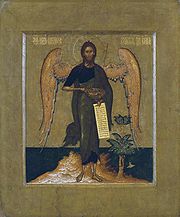
-painting school, which thrived under the patronage of the fabulously rich Stroganov family of merchants in the late 16th and 17th century.
"Stroganov School" owes its name to frequent mentioning of the Stroganovs
Stroganovs
The Stroganovs or Strogonovs , also spelled in French manner as Stroganoffs, were a family of highly successful Russian merchants, industrialists, landowners, and statesmen of the 16th – 20th centuries who eventually earned nobility.-Origins:...
on the markings on the back of the icons of Yemelyan Moskvitin, Stefan Pakhirya, Prokopy Chirin, Istoma, Nazariy, and Nikifor Saviny. Most of these icon painters, however, did not belong to the Stroganov School. They were icon painters from Moscow
Moscow
Moscow is the capital, the most populous city, and the most populous federal subject of Russia. The city is a major political, economic, cultural, scientific, religious, financial, educational, and transportation centre of Russia and the continent...
and executed commissions by the tsar
Tsar
Tsar is a title used to designate certain European Slavic monarchs or supreme rulers. As a system of government in the Tsardom of Russia and Russian Empire, it is known as Tsarist autocracy, or Tsarism...
. Many of their works were eventually acquired by the Stroganovs, who had been known as connoisseurs of sophisticated craftsmanship.
The works of art of the Stroganov School have quite a few features in common, such as small size, exquisite diminutiveness, refined palette
Palette (painting)
A palette , in the original sense of the word, is a rigid, flat surface on which a painter arranges and mixes paints. A palette is usually made of wood, plastic, ceramic, or other hard, inert, nonporous material, and can vary greatly in size and shape...
(mostly achieved with half-tints, golden, and silver colors), density of paint layers, graphic precision of details, fragile and somewhat pretentious delicacy of characters' postures and gestures, richness of their vestments, and complicated fantasy of landscape background.