
All Topics  
Stormtrooper


   Email Print
   Bookmark   Link


Stormtrooper


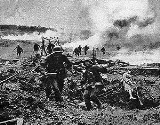
The Stormtroopers (in German Stoßtruppen, "shock troops") were specialist military troops which were formed in the last years of World War I
World War I

World War I, or the First World War , was a global military conflict which involved the Great powers, organized into two opposing military alliances: the Allies of World War I and the Central Powers....
 as the German army developed new methods of attacking enemy trenches, called "infiltration tactics
Infiltration tactics

In warfare, infiltration tactics involve small, lightly-equipped infantry forces attacking enemy rear areas while bypassing enemy front-line strongpoints and isolating them for attack by follow-up troops with heavier weapons....
". Men trained in these methods were known in German as Sturmmann
Sturmmann

File:Bundesarchiv Bild 192-036, KZ Mauthausen, SS-Sturmmann.jpgSturmmann is a German phrase translating as ?Stormtrooper?. The word originated during World War I when Sturmmann was a position held by soldiers in German pioneer assault companies, also known as "Shock troops"....
 (correctly "assault man" but usually translated as Stormtrooper), formed into companies of Sturmtruppen
Sturmtruppen

Sturmtruppen is a successful Italian series of anti-war comic books, written and drawn by Bonvi, the artistic pseudonym of Franco Bonvicini starting as four-frame comic strips back in 1968 and evolving into fully sized collector books up to the 1990s and first decade of the 3rd millennium AD....
 ("assault troops", more often and less exactly Storm Troops).


Discussion
Ask a question about 'Stormtrooper'
Start a new discussion about 'Stormtrooper'
Answer questions from other users
Full Discussion Forum


Encyclopedia


The Stormtroopers (in German Stoßtruppen, "shock troops") were specialist military troops which were formed in the last years of World War I
World War I

World War I, or the First World War , was a global military conflict which involved the Great powers, organized into two opposing military alliances: the Allies of World War I and the Central Powers....
 as the German army developed new methods of attacking enemy trenches, called "infiltration tactics
Infiltration tactics

In warfare, infiltration tactics involve small, lightly-equipped infantry forces attacking enemy rear areas while bypassing enemy front-line strongpoints and isolating them for attack by follow-up troops with heavier weapons....
". Men trained in these methods were known in German as Sturmmann
Sturmmann

File:Bundesarchiv Bild 192-036, KZ Mauthausen, SS-Sturmmann.jpgSturmmann is a German phrase translating as ?Stormtrooper?. The word originated during World War I when Sturmmann was a position held by soldiers in German pioneer assault companies, also known as "Shock troops"....
 (correctly "assault man" but usually translated as Stormtrooper), formed into companies of Sturmtruppen
Sturmtruppen

Sturmtruppen is a successful Italian series of anti-war comic books, written and drawn by Bonvi, the artistic pseudonym of Franco Bonvicini starting as four-frame comic strips back in 1968 and evolving into fully sized collector books up to the 1990s and first decade of the 3rd millennium AD....
 ("assault troops", more often and less exactly Storm Troops). Other armies have also used the term "assault troops", "shock troops
Shock troops

Shock troops or assault troops are infantry formations and their supporting units, intended to lead an military attack. Shock troop is a loose translation of the German language word Sto?trupp....
" or fireteam
Fireteam

A fireteam is a small military unit of infantry. It is the smallest unit in the militaries that use it and is the primary unit upon which infantry organization is based in the British Army, Royal Air Force Regiment, Royal Marines, United States Army, United States Marine Corps, Air Force Security Forces, Canadian Forces, and Australian Army....
s for specialist soldiers who perform the infiltration tasks of stormtroopers.

History


Victor Odlum

The organization and their tactics of "storm troops" and trench raiding parties were developed by Victor Odlum
Victor Odlum

Victor Wentworth Odlum, Order of the Bath, Order of St Michael and St George, Distinguished Service Order was a Canada journalist, soldier, and diplomat....
 in the 1st Canadian division in 1915. The Canadian Corps later instructed officers of the French army in these new tactics.

Calsow Assault Detachment

The concept of "Stormtroopers" developed from its beginning in March 1915, when a unit known as Sturmabteilung Calsow (Calsow's Assault Detachment) under Major
Major (Germany)

Major is a rank of the Germany military which dates back to the Middle Ages. During World War II, the Schutzstaffel equivalent was Sturmbannf?hrer....
 Calsow was formed by the Eighth army, by orders from the War Ministry, consisting of headquarters, two pioneer
Combat engineering

Combat engineering is a combat arms role of using the knowledge, tools and techniques of engineering by troops in peace and war, but specifically in combat....
 companies and a 37mm gun (Sturmkanone) battery. The unit was to use heavy shields and body armor as protection in attacks.

This unit was however never employed in its intended role, instead used to defend against attacks in France. In June, this improper use of the unit had already cost the unit half its manpower, and for this, Major Calsow was relieved, against his protests that it was not his fault that the unit was not used as intended.

Rohr Assault Battalion

The new commander of the Assault Detachment from September 8 1915 was a Hauptmann
Hauptmann

Hauptmann is a German language word usually translated as Captain when it is used as an officer's rank in the German Army, Austrian Army and Swiss Army....
 Rohr, previously commander of the Guard Rifle Battalion. The detachment was reinforced with a machinegun platoon, and a flamethrower platoon. The old infantry guns had been shown to be too difficult to move across the battlefield, and a new model was developed based on captured Russian 7.62 mm fortress guns and issued to the Assault Detachement.

Captain Rohr at first experimented with using the body armor and shields already in the Detachment's inventory, but realized that speed was better protection than armor. The only piece of armor kept was a new model of steel helmet, that would later become the standard in all German units at the end of World War I, and throughout the Second World War.

The new tactics developed by Captain Rohr, building much on his own previous experiences from the front, was based on the use of squadsized stormtroops ("Sturmtruppen" or "Stoßtruppen"), supported by a number of heavy support weapons and artillery that was to be coordinated at the lowest level possible, and rolling up enemy trenches using troops armed with hand grenades. These tactics were tested the first time in October 1915 in a successful assault on a French position in the Vosges Mountains
Vosges mountains

For the department of France of the same name, see Vosges.The Vosges are a range of low mountains in eastern France, near its border with Germany....
.

In December 1915, the Assault Detachment started giving courses to officers and soldiers of other German units, training them in the new assault tactics. Around this time the unit also changed some of its equipment to better fit its new requirements. Lighter footwear was issued, and uniforms reinforced with leather patches on knees and elbows to protect them when crawling. Special bags designed to carry grenades replaced the old belts and ammunition pouches, and the heavy standard rifle was replaced with the lighter carbine previously used by cavalrymen. While continuing to educate other units, the Detachment also participated in many small trench raids and attacks with limited objectives.

The first major offensive led by the new Assault Detachment was during the first days of the Battle of Verdun in February 1916. Stormtroops from the Assault Detachment was used in the first wave leading some units into the French trenches, attacking seconds after the barrage had lifted. This generally worked very well, even though it worked much better against the first trenchline than against the less well-known enemy rear-area.

On April 1, 1916, the Assault Detachment was redesignated "Assault Battalion Rohr". Around this time it also increased its size from two to four pioneer companies. At the same time, work began on transforming several Jäger battalions into new Assault Battalions.

Tactics at the end of World War I

With the withdrawal of Russia from World War I, the Germans were able to reinforce the Western Front
Western Front (World War I)

Following the outbreak of World War I in 1914, the German Empire army opened the Western Front by first invading Luxembourg and Belgium, then gaining military control of important industrial regions in France....
 with troops from the Eastern Front
Eastern Front (World War I)

The Eastern Front was a theatre of war during World War I in Central Europe and, primarily, Eastern Europe. The term is in contrast to the Western Front ....
. This allowed them to take units out of the line and train in Hutier tactics (after Oskar von Hutier
Oskar von Hutier

Oskar von Hutier was one of Germany's most successful and innovative generals of World War I.Hutier was born in Erfurt in the Prussian Province of Saxony....
) to infiltrate and take trenches.

On March 21, 1918, Germany launched a major offensive, "Operation Michael
Operation Michael

Operation Michael was a First World War German army military operation that began the Spring Offensive on 21 March 1918. It was launched from the Hindenburg Line, in the vicinity of Saint-Quentin, Aisne, France....
", against Allied forces, using the new methods and tactics. Four successive German offensives followed, that of May 27 and for the first time in 4 years the stalemate of trench warfare
Trench warfare

Trench warfare is a form of warfare where both combatants have fortified positions and fighting lines are static. Trench warfare arose when a revolution in fire power was not matched by similar advances in mobility , resulting in a slow and grueling form of defense-oriented warfare in which both sides constructed elaborate and heavily arme...
 was broken. However the German advance had stalled by July and the Allies began their Hundred Days Offensive
Hundred Days Offensive

The Hundred Days Offensive was the final period of World War I, where the Allies of World War I launched a series of offensives against the Central Powers on the Western Front from 8 August 1918 to 11 November 1918, beginning with the Battle of Amiens....
.

The stormtroops of the late World War I already resembled those of World War II in some ways, such as being armed with lightweight weapons, stick grenades, and some already sporting Totenkopf
Totenkopf

Totenkopf or Totensch?del is the German language word for "skull of a dead man" and is used to describe a military insigne featuring a skull suprapositioned upon crossed long bones; when used in this context it is commonly known as the "death's head" in English....
 badges.

Methods

The methods developed to assault trenches during World War I before 1918 usually started with a lengthy artillery barrage
Barrage (artillery)

A barrage is a line or barrier of exploding artillery shell , created by the co-ordinated aiming of a large number of guns firing continuously....
 all along the line followed by an assault from massed lines of infantry. Hutier suggested an alternate approach which consisted of these basic steps, combining some previous and some new attacks in a complex strategy:
  1. A short artillery bombardment, featuring heavy shells mixed with numerous poison gas projectiles would concentrate on neutralizing the enemy front lines, but not to destroy them.
  2. Under a creeping barrage, stormtroopers would move forward and infiltrate the Allied defenses at previously identified weak points. They would avoid combat whenever possible and attempt to destroy or capture enemy headquarters and artillery strongpoints.
  3. After the shock troops had done their job, German Army units, heavily equipped with light machine guns, mortars and flamethrower
    Flamethrower

    A flamethrower is a mechanical device designed to project a long controllable stream of fire.Some flamethrowers project a stream of ignited liquid fuel; some project a long Liquefied petroleum gas flame....
    s, would make heavy attacks along narrow fronts against any Allied strongpoints the shock troops missed. When the artillery was in place, officers could direct the fire wherever it was needed to accelerate the breakthrough.
  4. In the last stage of the assault, regular infantry would mop up any remaining Allied resistance.


The new assault methods involved men rushing forwards in small groups using whatever cover was available and laying down covering fire for other groups in the same unit as they moved forwards. The new tactics, which were intended to achieve tactical surprise, were to attack the weakest parts of an enemy's line, bypass his strongpoints and to abandon the futile attempt to have a grand and detailed plan of operations controlled from afar. Instead, junior leaders could exercise initiative on the spot. Any enemy strong points which had not been over-run by stormtroopers could be attacked by second echelon troops following the stormtroopers.

See also

  • Sturmabteilung
    Sturmabteilung

    The , abbreviated SA, , functioned as a paramilitary organization of the Nazi Party the Germany Nazism. They played a key role in Adolf Hitler's rise to power in the 1930s....
     - Nazi paramilitary organization
  • Close Quarters Battle
    Close quarters battle

    Close Quarters Battallion or close quarters combat is a type of fighting in which small units engage the enemy with personal weapons at very short range, potentially to the point of hand-to-hand combat....
  • Melee
    Mêlée

    Melee generally refers to disorganized close combat involving a group of fighters. A melee ensues when groups become locked together in combat with no regard to group tactics or fighting as an organized unit; each participant fights as an individual....
  • Assault pioneer
    Assault Pioneer

    An Assault Pioneer is a trained infantry soldier who is responsible for:* The construction of tools for infantry soldiers to cross enemy terrain and natural obstacles...
     the Commonwealth equivalent of a Stormtrooper.


External links