
| |
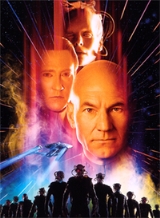
Star Trek: First Contact is a 1996 science fiction film and the eighth feature film based in the Star Trek fictional universe. In the film, the cast of Star Trek: The Next Generation encounter their adversaries the Borg, who attempt to conquer the Earth through the use of time travel. The crew of the USS Enterprise-E attempts to restore their history, intent on saving their present and future.
First Contact is the first feature film directed by Jonathan Frakes. The rest of the television show's cast return and are joined by James Cromwell, Alfre Woodard and Alice Krige.

Discussion
Ask a question about 'Star Trek: First Contact'
Start a new discussion about 'Star Trek: First Contact'
Answer questions from other users
|
Quotations
Jean-Luc Picard:
Reports of my assimilation are greatly exaggerated.
Zefram Cochrane:
And you people, you're all astronauts, on some kind of star trek.
//www.absoluteastronomy.com/topics/Emergency_Medical_Hologram>Emergency Medical Hologram: I'm a doctor, not a doorstop.
//www.absoluteastronomy.com/topics/Jean-Luc_Picard>Jean-Luc Picard: as Locutus, in a nightmare Resistance is futile.
//www.absoluteastronomy.com/topics/Borg>Borg: We are the Borg. Lower your shields and surrender your ships. We will add your biological and technological distinctiveness to our own. Your culture will adapt to service us. Resistance is futile.
Worf:
Assimilate this.

Encyclopedia
Star Trek: First Contact is a 1996 science fiction film and the eighth feature film based in the Star Trek fictional universe. In the film, the cast of Star Trek: The Next Generation encounter their adversaries the Borg, who attempt to conquer the Earth through the use of time travel. The crew of the USS Enterprise-E attempts to restore their history, intent on saving their present and future.
First Contact is the first feature film directed by Jonathan Frakes. The rest of the television show's cast return and are joined by James Cromwell, Alfre Woodard and Alice Krige. This is the first Star Trek film without any of the principal original Star Trek characters.
Long serving Star Trek writers Brannon Braga and Ronald D. Moore wrote the screenplay, coming up with the story together with producer Rick Berman. The trio combined their ideas of a film involving time travel and the Borg and spent much time discussing where to set the film, eventually deciding on a period after the fictitious Third World War. Paramount gave the film a larger budget than any previous Star Trek film, which enabled the use of more visual effects. Critical reaction was mostly positive, and Michael Westmore was nominated for the Academy Award for Makeup.
Plot
A single Borg Cube races towards Earth, and though Starfleet prepares a large force to protect the sector, the USS Enterprise-E is kept to patrolling the Neutral Zone over concerns about Captain Picard's previous encounter with the species. The fleet is nearly wiped out, and Picard orders the Enterprise to Earth to take command of the fleet, saving survivors including Worf. Under Picard's command, the fleet makes a coordinated attack and manages to destroy the Cube, but a smaller Sphere spaceship ejects from the debris and heads towards Earth, disappearing into a time vortex. The Enterprise quickly follows, discovering that the Borg are attempting to change Earth's past.
The Enterprise arrives in the middle 21st century, prior to humanity's first contact with aliens. They discover the Borg sphere firing upon a settlement in Bozeman, Montana, the site where humanity's first warp drive starcraft, the Phoenix, was launched from, and quickly destroy the sphere. Picard and other crew members transport to the surface to help the injured, and meet Dr. Zefram Cochrane; Cochrane, in the future, is known as the inventor of the warp drive, but in the present, he is reluctant to take the role he is to be known for even when his future is revealed to him. Commander Riker and other crew members help to repair the Phoenix, making sure the ship is ready to be launched for their future to exist.
Meanwhile, the remaining crew aboard the Enterprise discover that a number of Borg transported aboard the ship before they destroyed the sphere, and have assimilated the Engineering decks and a number of crewmembers, including Data. Picard and the crew attempt to stop them, but are unable to do so. As Picard attempts to learn what the Borg are up to, he encounters Cochrane's assistant, Lily Sloane, who was brought to the ship after being injured in the Borg attack but was forced to flee Sickbay as the Borg advanced. With Sloane's help, Picard is able to extract a computer chip from a Borg drone and learns that the Borg plan to use the Enterprises deflector dish to send a signal to the Borg homeworld, alerting the species to the threat of Earth in the future. Picard and Worf are about to disengage the dish before the signal can be sent. Picard orders a full evacuation of the starship and activates the ship's auto-destruct sequence, though leaving enough time for him alone to rescue Data.
As Cochrane, Riker, and LaForge prepare to activate the warp drive on the Phoenix, Picard discovers the Borg Queen in Engineering, who has been grafting human skin in place of Data's synthetic one, making him feel more like a human than he has in the past. Picard tries to convince Data to ignore the Queen's lure, but Data refuses, and is able to disable the auto-destruct and fires the ship's quantum torpedoes upon the Phoenix. However, the torpedoes miss, and the Phoenix successfully enters warp, much to the Queen's anger. Data reveals he has been misleading the Queen with his trustworthiness, and releases the warp core's coolant, which is harmful to all organic matter. While Picard is able to climb safely out of the way, the Queen and the rest of the Borg drones are consumed by the coolant, leaving only their metallic portions behind. Picard destroys the cybernetic spine of the Queen, and Data explains his faithfulness to Picard despite the Queen's temptations.
As the crew is recovered to the Enterprise, Picard and others watch from a distance as a Vulcan ship, attracted to Earth by the Phoenix warp test, lands near the settlement. Cochrane and Sloane greet the aliens, and eagerly introduce them to Earth's culture. The Enterprise crew quietly slips away and returns to their restored future.
Cast
*Patrick Stewart as Jean-Luc Picard: The captain of the USS Enterprise-E, haunted by his time as the Borg Locutus. Picard's character was changed from the "angst-ridden [character viewers have] seen before", to more of an action hero type. Stewart noted that Picard was a lot more physical in this film.
- Jonathan Frakes as William Riker: The ship's first officer; Riker leads the away team on Earth. Frakes also directed the film. Frakes did not have much difficulty directing and acting at the same time, having done it in the TV series before.
- Brent Spiner as Data: An android and the ship's second officer, who endeavours to become more human.
- LeVar Burton as Geordi La Forge: The ship's chief engineer who helps repair the
Phoenix. In between the events of this and the preceding film, Geordi has his visor replaced with optical implants. Burton had lobbied for many years to have Geordi's visor replaced so that people could see his eyes, and in this film was granted his wish.Michael Dorn as Worf: The first officer of the USS Defiant and Captain Picard's former chief of security. The Defiant is badly damaged in the opening battle, but survives. An earlier draft called for the Defiant to be destroyed, but Star Trek: Deep Space Nine executive producer Ira Steven Behr objected to the destruction of his show's ship and so the idea was dropped.Gates McFadden as Beverly Crusher: The ship's doctor.Marina Sirtis as Deanna Troi: The ship's counselor.James Cromwell as Zefram Cochrane: The pilot and creator of Earth's first warp capable vessel. The character of Zefram Cochrane had first appeared in the Original Series episode "Metamorphosis", played by Glenn Corbett. Cromwell's Cochrane is much older and has no real resemblance to Corbett's, and he portrays the character in a very different way to how he is shown in "Metamorphosis". Braga and Moore wanted to portray Cochrane as a character going through a major transition. He starts out as a cynical, selfish drunk who is changed by the characters he meets over the course of the film. Frakes considered Cromwell's casting a coup, as he was an Academy Award nominated actor. Cromwell had previously appeared as different characters in three episodes of The Next Generation and one of Deep Space Nine. Although the part was written with Cromwell in mind, Tom Hanks, a big fan of Star Trek, was approached for the role first by Paramount, but he had already committed to another project and had to reject the part. Frakes commented that it would have been a mistake to cast Hanks as Cochrane due to his being so well known.Alfre Woodard as Lily Sloane: Cochrane's assistant. When Frakes first moved to Los Angeles, Woodard was one of the very first people he met. During a conversation at a barbecue Woodard said she would become Frakes' godmother, as he did not have one. Through this relationship, Frakes was able to cast Woodard in the film. He considered it a coup, as she was an Academy Award nominated actress. Woodard considers Lily to be the character most like herself, out of all the roles she has played.Alice Krige as the Borg Queen: the Queen and controller of the Borg. Casting for the part took a long time as the actress needed to be sexy, dangerous and mysterious. Impressed by her performance in Ghost Story, and finding she had all of these qualities, Krige was cast. Frakes considers her the sexiest Star Trek villain of all time.Neal McDonough as Sean Hawk: A bridge officer on the Enterprise.
First Contact is the first film in the Star Trek film series in which none of the Star Trek: The Original Series main characters appear. As with other Star Trek productions, Majel Barrett provides the voice of the Enterprise's computer. Robert Picardo cameos as the Emergency Medical Hologram. Picardo played the permanent EMH character the Doctor in Star Trek Voyager, and his cameo in this film is a reference to that. His line "I'm a doctor, not a door stop", is an allusion to the Original Series character Dr. Leonard McCoy. Picardo's fellow Voyager actor Ethan Phillips, who plays Neelix, cameos as the nightclub Maitre d' in the Holodeck scene. The scene also features a cameo from the film's stunt coordinator Ronnie Rondell who plays one of Nicky's associates, as well appearances by the screenwriters Braga and Moore. As with many Star Trek productions, the background "redshirt" characters were all new characters, with many being killed off over the course of the film. Whoopi Goldberg was not asked to return as Guinan.
Production
Development
Happy with the preceding film Star Trek Generations, two months after its premiere Paramount decided to produce another film based on The Next Generation series, and wanted Brannon Braga and Ronald D. Moore to write the screenplay. The pair had written most of the Next Generation episodes, as well as the script for the preceding film. The film was given a "considerably bigger" budget of $45 million; more than any previous Star Trek film. This meant a larger amount of action and visual effects. Jonathan Frakes, who plays Riker, directed the film in his feature film debut. Frakes had directed multiple episodes of The Next Generation as well as the Star Trek: Deep Space Nine and Star Trek: Voyager series. In preparation for the film, he watched Jaws, Close Encounters of the Third Kind, 2001: A Space Odyssey and the works of James Cameron and Ridley Scott. Frakes was not the first choice to direct, with Ridley Scott and John McTiernan both reportedly turning the project down. Stewart met with one of the potential candidates and concluded that "they didn't know Star Trek". It was decided to "stay with someone who understood the gestalt of Star Trek", and Frakes was given the job.
Rick Berman wanted to have a story involving time travel, while Braga and Moore wanted to use the Borg, as they had not "really been seen in full force" since the episode "The Best of Both Worlds" and could never feature in that big of a role in the TV series due to budget constraints and the fear that they would lose their "scare factor". They loved the "seemingly unstoppable" nature of the Borg and had always tried to use them sparingly, but as this was a feature film, they could use them as much as possible.
They decided to combine the ideas. Much discussion took place as to when to set the film, with the original concept being in medieval times. The idea was abandoned when Stewart refused to wear tights. Eventually, they settled on a period after the fictitious Third World War. It had never been explained through any previous Star Trek medium as to how humanity had made first contact, and moved forward into a more ideal world; this was something Berman, Braga and Moore had wanted to show as it was the point where everything in Star Trek folklore began. They intended the film to be easily accessible to any moviegoer and work as a stand-alone story, yet still satisfy the devoted Star Trek fans. That said, much of Picard's role in the film makes a direct reference to his time as a Borg in the episode "The Best of Both Worlds", and so the dream sequence was added at the start to explain what had happened to him in the episode.
The Borg were always shown as a collective voice in the TV series, with no real lead character to connect with in any way. Whenever episodes were written about the Borg, after they were first introduced in "Q Who?", they were often personified in some way: for example, the character of Hugh the Borg and Picard being turned into Locutus. Braga and Moore tried to preserve the idea of the Borg as just a mindless collective in the original First Contact draft. Paramount head Jonathan Dolgen suggested adding an individual Borg villain who the characters could interact with as well, as he did not think the first draft was dramatic enough. This led to the creation of the Borg Queen.
The original draft was very different from the final film. Picard and Riker's story were essentially reversed: Picard is on Earth helping to build the Phoenix and falls in love with a photographer named Ruby, while Riker was on the Enterprise leading the assault against the Borg. Stewart questioned why Picard was not fighting the Borg himself as he hated them more than anyone else. The script was re-written and Picard and Riker's roles switched. One draft also included John DeLancie's character Q. Alternative titles included: Star Trek: Borg, Star Trek: Destinies, Star Trek: Future Generations, Star Trek: Renaissance and Star Trek: Resurrection.
Filming
Frakes used a vast array of different filming shots and techniques in the film. Unlike all of the episodes of The Next Generation television show, that were filmed at the Paramount studios, the First Contact scenes set in year 2063 were shot outside on location in Phoenix, Arizona. This was a thrill for the cast, even though they stayed in a "shoddy" Travel Inn and filmed most of the scenes at night. The cast were also pleased to escape their Starfleet uniforms and wear "normal" clothes. Locations included the Angeles Crest Forest and an actual missile silo, with the Phoenix being an active nuclear missile. This proved cheaper than building a set or using visual effects. The Dixon Hill Holodeck scene was filmed at Union Station in Los Angeles and was designed as a contrast to the dark, mechanical Borg scenes set on the ship. Principal photography finished in early July 1996. Filming took place at a more leisurely pace than the TV series due to a less hectic schedule—only four pages of script had to be filmed each day, as opposed to eight which was the case for the TV series.
Although predominantly a science fiction action-adventure film, Frakes directed the Borg scenes similar to a horror film, creating as much suspense as possible. To balance and contrast this he added the more comedic scenes on Earth, intended to momentarily relieve the audience of tension before building it up again.
Design
Following the destruction of the Enterprise-D in the previous film a new ship was required. The Enterprise-E was designed by John Eaves and Herman Zimmerman who said that it is "leaner, sleeker, and mean enough to answer any Borg threat you can imagine". Braga and Moore intended it to be more muscular and military-esque. Eaves looked at the structure of the older versions of the Enterprise, and designed a more streamlined, capable war vessel than the Enterprise-D. He reduced the size of the exposed neck area of the ship and lengthened the nacelles. The bridge set was new, and Frakes introduced it with a wide sweeping shot, and engineering was also re-designed. Zimmerman and Stewart designed Picard's quarters, including Shakespearean items and those from planets Picard has visited. Several scenes were designed similar to those in the Alien film series, Star Wars and 2001: A Space Odyssey. The Vulcan ship was designed to resemble a starfish, a crab and a boomerang.
| "We were on a circle, which has no geography to it. We had our three heroes [Picard, Worf and Hawk] in space suits, which look identical so you couldn't tell who was who until you got in real close. But the minute you get in close, you defeat the whole purpose of being on the outside of the ship, so you can see the cells and the stars and Earth looming in the background. It was a shooting and editing nightmare." | | — Jonathan Frakes on the difficulty of the space-walk scene. |
Each Borg has a slightly different design and Michael Westmore designed a new one each day. The Borg makeup and prosthetics took hours to apply and remove each day. Roughly twelve actors portrayed all of the Borg, because the costumes and makeup were so expensive to produce. Therefore, many of the background Borg were just half-finished mannequins. To produce the Borg Queen, Krige was in makeup for four hours each day and wore silver contact lenses. Krige recalled the first day she had her makeup applied: "I saw everyone cringing. I thought, great; they made this, and they've scared themselves!" Deborah Everton was the costume designer, Matthew F. Leonetti was the cinematographer. Zimmerman, Everton and Westmore combined their efforts to design and create the "borgified" sections of the Enterprise to build tension, and make the audience feel that "[they are being fed] the Borg."
The space walk scene was one of the hardest scenes to construct in the film. Everton had to design the space suits so that they would be practical, would not look ridiculous and could feasibly work. They had fans built into the helmets so that Stewart, Dorn and McDonough would not get overheated, and neon lights so that their faces could be seen. The sets for the ship's outer hull and the deflector dish were built at the Paramount studios, on a gimbal, surrounded by green screen and rigged with wires for the zero gravity sequences. Frakes considers the scene to be the most tedious in the film due to the vast amount of preparation it took to start each day's shoot.
Effects
Industrial Light and Magic worked on the film, which is the reason Frakes believes that many of the effects (such as the phasers) are similar to those used in the Star Wars films. This was the first time in any Star Trek production in which the ships were created using computer-generated imagery, although miniatures of the Enterprise were used for some shots. The opening shot in the Borg factory was inspired by a New York City production of Sweeney Todd, the Demon Barber of Fleet Street in which the stage surrounded the audience, giving a sense of realism. Zimmerman called it the "longest pull-back in science fiction history". Used to directing episodes for the television series, Frakes was frequently reminded by effects artist Terry Frazee to "think big, blow everything up".
To create shots shown from the view of the Borg, a 10 millimetre spherical lens was used. The Borg scenes were received positively by test screening audiences so once the rest of the film had been completed a Borg assimilation scene of the Enterprise crew was added in, featuring none of the main cast members, as there was some of the budget left over and the original scene lacked action. Frakes considers the Borg Queen's head and shoulders being lowered into her body as the "signature visual effect in the film". The scene was difficult to execute, taking ILM five months to finish. Krige wore a blue screen suit from the neck down so only her head would appear on camera, and was lowered in by a crane. It required Krige to realistically portray "the strange pain or satisfaction of being reconnected to her body", in order to best help out the animators. A one-armed actor portrayed the Borg whose arm Worf slices off with a mek'leth in order to accurately portray the effect intended.
Themes
Frakes believes the main themes of First Contact, and also Star Trek as a whole, are loyalty, friendship, honesty and mutual respect. This is evident in the film as Picard chooses to rescue Data rather than evacuate the ship with rest of the crew. The film makes direct comparison between Picard's hatred of the Borg and refusal to destroy the Enterprise and that of Captain Ahab in the novel Moby-Dick. The moment marks a turning point in the film as Picard changes his mind, symbolized by his putting down his gun. A similar Moby-Dick reference was made in Star Trek II: The Wrath of Khan and although Braga and Moore did not really want to repeat it, they decided it worked so well they could not leave it out. Several lines refer to the 21st Century dwellers being primitive, and the 24th Century people to have evolved to a more utopian society. In the end it is Lily (the 21st Century woman) who shows Picard (the 24th Century man) that his quest for revenge is the very primitive behaviour that humans had evolved to not use. There is a love theme between Lily Sloane and Picard, and the Vulcans at the end are representative of the biblical figures the Three Wise Men.
Release
1996 marked the 30th anniversary of the Star Trek franchise. The film premiered at Mann's Chinese Theater in Hollywood, Los Angeles on November 18, 1996. It opened in the United Kingdom with a royal premiere, attended by Charles, Prince of Wales. First Contact was the first Star Trek film to receive a PG-13 rating from the Motion Picture Association of America, meaning parents were cautioned that it may be inappropriate for children under the age of 13. This was due to the film's violence: principally the firing of automatic weapons, and Data breaking a Borg's neck.
Reception
Opening in 2,812 theaters the film made $30,716,131 in its first weekend of release. It closed with a domestic gross of $92,027,888 and a total worldwide gross of $146,027,888. In the US it is the second highest grossing Star Trek behind The Voyage Home, and the 12th highest grossing film based on a live-action television series. It was the 17th highest grossing film in the US in 1996, and the 22nd highest grossing worldwide. Based on 44 reviews, the film garnered a 91% rating at Rotten Tomatoes, and a 91% rating from the site's "Top Critics" poll. In 2007, Rotten Tomatoes placed the film 35th on their list of the "100 Best Reviewed Sci-Fi Movies", making it the highest placed Star Trek film on the list. By comparison, the film received a rating of 70 out of 100 at Metacritic, earning "generally favorable reviews".
Roger Ebert found that First Contact was one of the best Star Trek films, and praised the special effects. Kenneth Turan of the Los Angeles Times wrote "First Contact does everything you'd want a Star Trek film to do, and it does it with cheerfulness and style." He particularly noted the performance of Stewart and the evilness of the Borg. Joe Leydon gave a very positive review, concluding: "If First Contact is indicative of what the next generation of Star Trek movies will be like, the franchise is certain to live long and prosper." Lisa Schwarzbaum of Entertainment Weekly enjoyed the film as it "displays a zippy new energy and a sleek, confident style fully independent of its predecessors". Giving it a B+ she noted "By the time Worf (Michael Dorn), knocking off a slimy attacker, growls a Schwarzeneggerish 'Assimilate this!' we've already done so, with pleasure." Although disliking the humor, James Berardinelli found First Contact to be "the most entertaining Star Trek in more than a decade," and it "has single-handedly revived the Star Trek movie series, at least from a creative point-of-view."
Although praising Woodard's performance, Emily Carlisle of the BBC disliked the film: "Focusing more on action sequences than characterisation, the breakneck pace gives an unsatisfying result." Empire's Adam Scott criticized the script for "plung[ing] right into the action" so "there's nowhere near enough time for those not familiar with the series to get to know and care about the characters," also citing the lack of screentime for Troi and Crusher.
First Contact earned an Academy Award-nomination for Best Makeup, losing out to The Nutty Professor. At the Saturn Awards the film was nominated in ten categories including Best Science Fiction Film, Best Actor for Patrick Stewart and Best Director for Jonathan Frakes. It won three: Best Costumes, Best Supporting Actor for Brent Spiner and Best Supporting Actress for Alice Krige. Jerry Goldsmith won a BMI Film Music Award for his score, and the film was nominated for the Hugo Award for Best Dramatic Presentation.
Lawsuit
In 2000, Murray Leinster's heirs sued Paramount Pictures over the film, claiming that as the owners of the rights to Leinster's 1945 short story "First Contact", it infringed their trademark in the term. The U.S. District Court for the Eastern District of Virginia granted Paramount's motion for summary judgment and dismissed the suit. The court found that regardless of whether Leinster's story first coined the phrase, it had since become a generic and therefore unprotectable term that described the genre of science fiction in which humans first encounter alien species. Even if the title was instead "descriptive"—a category of terms higher than "generic" that may be protectable—there was no evidence that the title had the required association in the public's mind (known as "secondary meaning") such that its use would normally be understood as referring to Leinster's story. The Second Circuit Court of Appeals affirmed the lower court's dismissal without comment.
Further reading
- Heirs of Estate of Jenkins v. Paramount Pictures, 90 F. Supp. 2d 706 (E.D. Va. 2000)
External links
|