

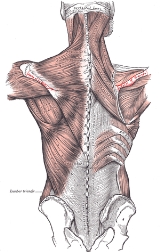
Spine of scapula

Encyclopedia
The spine of the scapula is a prominent plate of bone
, which crosses obliquely the medial four-fifths of the scapula
at its upper part, and separates the supra-
from the infraspinatous fossa
.
It begins at the vertical border by a smooth, triangular area over which the tendon of insertion of the lower part of the Trapezius glides, and, gradually becoming more elevated, ends in the acromion, which overhangs the shoulder-joint.
The spine is triangular, and flattened from above downward, its apex being directed toward the vertebral border.
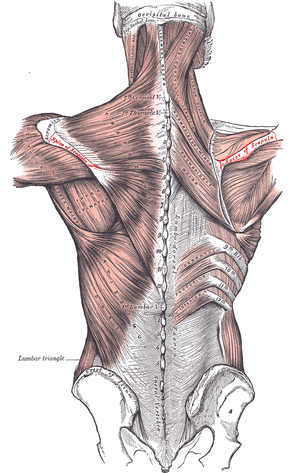 It presents two surfaces and three borders.
Of the three borders, the anterior is attached to the dorsal surface of the bone; the posterior, or crest of the spine, is broad, and presents two lips and an intervening rough interval.
The lateral border, or base, the shortest of the three, is slightly concave; its edge, thick and round, is continuous above with the under surface of the acromion, below with the neck of the scapula. It forms the medial boundary of the great scapular notch, which serves to connect the supra- and infraspinatous fossæ.
Bone
Bones are rigid organs that constitute part of the endoskeleton of vertebrates. They support, and protect the various organs of the body, produce red and white blood cells and store minerals. Bone tissue is a type of dense connective tissue...
, which crosses obliquely the medial four-fifths of the scapula
Scapula
In anatomy, the scapula , omo, or shoulder blade, is the bone that connects the humerus with the clavicle ....
at its upper part, and separates the supra-
Supraspinatous fossa
The supraspinatous fossa of the posterior aspect of the scapula is smaller than the infraspinatous fossa, concave, smooth, and broader at its vertebral than at its humeral end. Its medial two-thirds give origin to the Supraspinatus....
from the infraspinatous fossa
Infraspinatous fossa
The infraspinatous fossa of the scapula is much larger than the supraspinatous fossa; toward its vertebral margin a shallow concavity is seen at its upper part; its center presents a prominent convexity, while near the axillary border is a deep groove which runs from the upper toward the lower...
.
It begins at the vertical border by a smooth, triangular area over which the tendon of insertion of the lower part of the Trapezius glides, and, gradually becoming more elevated, ends in the acromion, which overhangs the shoulder-joint.
The spine is triangular, and flattened from above downward, its apex being directed toward the vertebral border.
Surfaces and borders
- Its superior surface is concave; it assists in forming the supraspinatous fossaSupraspinatous fossaThe supraspinatous fossa of the posterior aspect of the scapula is smaller than the infraspinatous fossa, concave, smooth, and broader at its vertebral than at its humeral end. Its medial two-thirds give origin to the Supraspinatus....
, and gives origin to part of the Supraspinatus.
- Its inferior surface forms part of the infraspinatous fossaInfraspinatous fossaThe infraspinatous fossa of the scapula is much larger than the supraspinatous fossa; toward its vertebral margin a shallow concavity is seen at its upper part; its center presents a prominent convexity, while near the axillary border is a deep groove which runs from the upper toward the lower...
, gives origin to a portion of the Infraspinatus, and presents near its center the orifice of a nutrient canalNutrient canalA nutrient canal is canal through which the nutrient artery enters. A nutrient canal is found in both long bones and in irregular bones. In long bones the nutrient canal is found in the shaft, and in irregular bones it is found in other locations....
.
Of the three borders, the anterior is attached to the dorsal surface of the bone; the posterior, or crest of the spine, is broad, and presents two lips and an intervening rough interval.
- The Trapezius is attached to the superior lip, and a rough tubercle is generally seen on that portion of the spine which receives the tendon of insertion of the lower part of this muscle.
- The Deltoideus is attached to the whole length of the inferior lip.
- The interval between the lips is subcutaneous and partly covered by the tendinous fibers of these muscles.
The lateral border, or base, the shortest of the three, is slightly concave; its edge, thick and round, is continuous above with the under surface of the acromion, below with the neck of the scapula. It forms the medial boundary of the great scapular notch, which serves to connect the supra- and infraspinatous fossæ.