

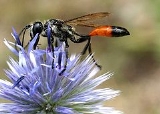
Sphecidae

Encyclopedia
Sphecidae is a cosmopolitan family of wasp
s that include digger wasp
s, mud dauber
s and other familiar types that all fall under the category of thread-waisted wasps.The are predominently solitary wasp,distributed world wide.At present this family consist of eight subfamilies and three tribes namely Crabroninae Ampulicinae,Sphecinae,Pemphredoninae,Astatinae,Nyssoninae,Larrinae and Philanthinae, among which Pilanthine is largest.
They use a vast array of insects and arachnids to feed their larvae, although prey selection is usually limited to members of a single family or order. Prey is immobilized by the female wasps by stinging and then brought into the nest while some are cleptoparasites. Most species dig burrows actively in the ground for nesting or establish their nests in dead wood or in twigs, while some use preexisting cavities, and others build nest out of mud. Because of their habits, Sphecidae play an important role in their ecosystems by reducing the number of individuals of the preyed species.
TAXONOMIC CHARACTER
The main characters usually used for identification of Sphecids from other wasps are their Pronotum is usually short and collar-like, with a posteriorly directed rounded pronotal lobe. Hairs on body if present it is not plumose.
BIOLOGY
The biology of the Sphecidae, even under the restricted definition, is still fairly diverse; some sceliphrines even display rudimentary forms of sociality, and some sphecines rear multiple larvae in a single large brood cell. Many nest in pre-existing cavities, or dig simple burrows in the soil, but there are also species which construct free-standing nests of mud and even (in one genus) resin. All are predatory, but the type of prey ranges from spider
s to various dictyoptera
ns or orthopteroids to caterpillars (of either Lepidoptera
or other Hymenoptera
); the vast majority practice mass provisioning
, providing all the prey items prior to laying the egg.
BEHAVIOUR
Sphecid wasp behaviour has been a favourite subject of study for many biologists. Probably Jean Henri Fabre was the first to make intensive observations on the nesting behaviour of sphecids . Almost all information available on sphecid wasp behaviour is confined to the temperate species and a few of the African species Sphecid wasps have unique nesting behaviour. It is closely associated with the prey hunting behaviour. Some species prepare a nest and then go for hunting for a prey while others hunt first and then make the nest. The latter is considered to be more primitive. The way the prey is brought to the nest differs from species to species. Some drag their prey to backward while other pull it forward. While some other species fly back to the nest carrying the prey in their legs, and a few impale the prey on their sting and fly home. Dragging prey backwards is considered primitive behaviour .
Several steps in the evolution of prey carriage from primitive to advanced behaviour are 1) Prey is seized with mandibles and dragged backwards to nest (Ampulicinae); 2) Prey is straddled, seized with mandibles and dragged forwards over the substrate (Miscophus, Larrinae); 3) Prey is carried in flight, held by the mandibles assisted by legs (Sphecinae and Pemphredoninae); 4) Prey is carried in flight held by the midlegs, unassisted by the mandibles (Nyssoninae); 5) Prey carried in flight, held by hindlegs (Oxybelus, Crabronidae); 6) Prey is impaled on sting and carried in flight (Oxybelus); 7) Prey is held in a clamp formed by the apical abdominal segment (Listropygia and Clypeadon).
The more advanced types of prey carriage allow more rapid nest provisioning and tend to minimize predator and parasite attacks during prey transport and enable the wasp to reopen the nest entrance without dropping the prey. In general, the prey, prey hunting behaviour and the prey carriage mechanisms are more or less constant at the generic level . The prey of sphecid wasps vary from collembolans to bees, Arachnid and beetles.
NESTING
Nests of sphecid wasps can be arbitrarily grouped into two catagories depending upon location: 1) underground nests and 2) above ground nests. The latter includes twig nesting, those nesting in cavities and the familiar mud daubers. Although the details of nest building behaviour vary between species greatly, patterns are usually constant in genera and relatively fixed among species within a genus.Communal nesting is common among sphecids, but social behaviour is only slightly developed. Communal nesting is recorded in the case of Liris and Dalara , Sericophorus , Moniaecera asperta , Sphecius and Sphex argentatus .
IMPORTANCE
Sphecids use a wide range of insects and arachnids to feed their larvae. Almost every group of insects from springtails to honey bees are preyed upon by one or the other species of sphecid wasp. A great majority of these wasps specialize in preying on important pests of cultivated crops suggested the possibility of using Sphecid wasps as potential control agents against acridids in Ethiopia. and hence have been considered as potential biocontrol agents.
= Subgroups
Subfamily Ammophilinae
Subfamily Sceliphrinae
Subfamily Sphecinae
 External links
Wasp
The term wasp is typically defined as any insect of the order Hymenoptera and suborder Apocrita that is neither a bee nor an ant. Almost every pest insect species has at least one wasp species that preys upon it or parasitizes it, making wasps critically important in natural control of their...
s that include digger wasp
Digger wasp
Wasps of the genus Sphex are cosmopolitan predators of the family Sphecidae that sting and paralyze prey insects. There are over 130 known digger wasp species. In preparation for egg laying, they construct a protected "nest" and then stock it with captured insects...
s, mud dauber
Mud dauber
Mud dauber is a name commonly applied to a number of wasps from either the family Sphecidae or Crabronidae that build their nests from mud...
s and other familiar types that all fall under the category of thread-waisted wasps.The are predominently solitary wasp,distributed world wide.At present this family consist of eight subfamilies and three tribes namely Crabroninae Ampulicinae,Sphecinae,Pemphredoninae,Astatinae,Nyssoninae,Larrinae and Philanthinae, among which Pilanthine is largest.
They use a vast array of insects and arachnids to feed their larvae, although prey selection is usually limited to members of a single family or order. Prey is immobilized by the female wasps by stinging and then brought into the nest while some are cleptoparasites. Most species dig burrows actively in the ground for nesting or establish their nests in dead wood or in twigs, while some use preexisting cavities, and others build nest out of mud. Because of their habits, Sphecidae play an important role in their ecosystems by reducing the number of individuals of the preyed species.
TAXONOMIC CHARACTER
The main characters usually used for identification of Sphecids from other wasps are their Pronotum is usually short and collar-like, with a posteriorly directed rounded pronotal lobe. Hairs on body if present it is not plumose.
BIOLOGY
The biology of the Sphecidae, even under the restricted definition, is still fairly diverse; some sceliphrines even display rudimentary forms of sociality, and some sphecines rear multiple larvae in a single large brood cell. Many nest in pre-existing cavities, or dig simple burrows in the soil, but there are also species which construct free-standing nests of mud and even (in one genus) resin. All are predatory, but the type of prey ranges from spider
Spider
Spiders are air-breathing arthropods that have eight legs, and chelicerae with fangs that inject venom. They are the largest order of arachnids and rank seventh in total species diversity among all other groups of organisms...
s to various dictyoptera
Dictyoptera
Dictyoptera includes three groups of polyneopterous insects - cockroaches , termites and mantids...
ns or orthopteroids to caterpillars (of either Lepidoptera
Lepidoptera
Lepidoptera is a large order of insects that includes moths and butterflies . It is one of the most widespread and widely recognizable insect orders in the world, encompassing moths and the three superfamilies of butterflies, skipper butterflies, and moth-butterflies...
or other Hymenoptera
Hymenoptera
Hymenoptera is one of the largest orders of insects, comprising the sawflies, wasps, bees and ants. There are over 130,000 recognized species, with many more remaining to be described. The name refers to the heavy wings of the insects, and is derived from the Ancient Greek ὑμήν : membrane and...
); the vast majority practice mass provisioning
Mass provisioning
Mass provisioning is a term used in entomology to refer to a form of parental behavior in which an adult stocks all of the food for each offspring in a small chamber prior to laying the egg...
, providing all the prey items prior to laying the egg.
BEHAVIOUR
Sphecid wasp behaviour has been a favourite subject of study for many biologists. Probably Jean Henri Fabre was the first to make intensive observations on the nesting behaviour of sphecids . Almost all information available on sphecid wasp behaviour is confined to the temperate species and a few of the African species Sphecid wasps have unique nesting behaviour. It is closely associated with the prey hunting behaviour. Some species prepare a nest and then go for hunting for a prey while others hunt first and then make the nest. The latter is considered to be more primitive. The way the prey is brought to the nest differs from species to species. Some drag their prey to backward while other pull it forward. While some other species fly back to the nest carrying the prey in their legs, and a few impale the prey on their sting and fly home. Dragging prey backwards is considered primitive behaviour .
Several steps in the evolution of prey carriage from primitive to advanced behaviour are 1) Prey is seized with mandibles and dragged backwards to nest (Ampulicinae); 2) Prey is straddled, seized with mandibles and dragged forwards over the substrate (Miscophus, Larrinae); 3) Prey is carried in flight, held by the mandibles assisted by legs (Sphecinae and Pemphredoninae); 4) Prey is carried in flight held by the midlegs, unassisted by the mandibles (Nyssoninae); 5) Prey carried in flight, held by hindlegs (Oxybelus, Crabronidae); 6) Prey is impaled on sting and carried in flight (Oxybelus); 7) Prey is held in a clamp formed by the apical abdominal segment (Listropygia and Clypeadon).
The more advanced types of prey carriage allow more rapid nest provisioning and tend to minimize predator and parasite attacks during prey transport and enable the wasp to reopen the nest entrance without dropping the prey. In general, the prey, prey hunting behaviour and the prey carriage mechanisms are more or less constant at the generic level . The prey of sphecid wasps vary from collembolans to bees, Arachnid and beetles.
NESTING
Nests of sphecid wasps can be arbitrarily grouped into two catagories depending upon location: 1) underground nests and 2) above ground nests. The latter includes twig nesting, those nesting in cavities and the familiar mud daubers. Although the details of nest building behaviour vary between species greatly, patterns are usually constant in genera and relatively fixed among species within a genus.Communal nesting is common among sphecids, but social behaviour is only slightly developed. Communal nesting is recorded in the case of Liris and Dalara , Sericophorus , Moniaecera asperta , Sphecius and Sphex argentatus .
IMPORTANCE
Sphecids use a wide range of insects and arachnids to feed their larvae. Almost every group of insects from springtails to honey bees are preyed upon by one or the other species of sphecid wasp. A great majority of these wasps specialize in preying on important pests of cultivated crops suggested the possibility of using Sphecid wasps as potential control agents against acridids in Ethiopia. and hence have been considered as potential biocontrol agents.
= Subgroups
Subfamily Ammophilinae
- AmmophilaAmmophila (Sphecidae)Ammophila is the type genus of the subfamily Ammophilinae of the hunting wasp family Sphecidae. They sometimes are referred to as "Thread-waisted wasps", but the name is not definitive, because many other members of the Sphecidae are thread-waisted too, and referred to as such...
- Podalonia
Subfamily Sceliphrinae
- Chlorion
- SceliphronSceliphronSceliphron is a genus of Hymenoptera of the Sphecidae family of wasps, commonly referred to as mud daubers. They are solitary and build nests made of mud. Nests are frequently constructed in shaded niches, often just inside of windows or vent openings, and it may take a female only a day to...
- Stangeella
Subfamily Sphecinae
- Chilosphex
- Isodontia
- Palmodes
- Prionyx
- Sphex, known as "digger wasps"