


South Coast Repertory

Encyclopedia
Costa Mesa, California
Costa Mesa is a city in Orange County, California. The population was 109,960 at the 2010 census. Since its incorporation in 1953, the city has grown from a semi-rural farming community of 16,840 to a primarily suburban and "edge" city with an economy based on retail, commerce, and light...
.
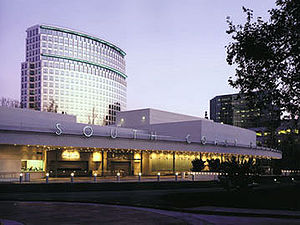
Tony Award-winning South Coast Repertory, founded in 1964 by David Emmes and Martin Benson and now under the leadership of Artistic Director Marc Masterson and Managing Director Paula Tomei, is widely regarded as one of America's foremost producers of new plays. In its three-stage Folino Theatre Center, SCR produces a five-play season on its Segerstrom Stage, a four-play season on its Argyros Stage, plus one annual holiday production. SCR also offers a three-play Theatre for Young Audiences series, and year-round programs in education and outreach.
Background
SCR's extensive new play development program consists of commissions, residenciesArtist in residence
Artist-in-residence programs and other residency opportunities allow visiting artists to stay and work so that they may apply singular focus to their art practice....
, readings, and workshops, from which up to five world premieres are produced each season. Among the plays commissioned and introduced at SCR are Donald Margulies
Donald Margulies
Donald Margulies is an American playwright and a professor of English and Theater Studies at Yale University...
' Sight Unseen
Sight Unseen (play)
Sight Unseen is a play by Donald Margulies. At its center is Jonathan Waxman, a Brooklyn Jew who has become a very wealthy critically acclaimed artist. Happily married, with a baby on the way, he travels to London for a retrospective of his work...
, Collected Stories, Brooklyn Boy
Brooklyn Boy
Brooklyn Boy is a play by American playwright Donald Margulies.Novelist Eric Weiss, critically celebrated but unsuccessful, "arrives" when his new, autobiographical novel becomes a best-seller. An outsider all his life, he is suddenly on the inside of everything: town cars, television studios, the...
, and Shipwrecked! An Entertainment; Richard Greenberg
Richard Greenberg
Richard Greenberg is an American playwright. He is the author of over 25 plays including eight South Coast Repertory world premieres: Our Mother's Brief Affair, The Injured Party, The Violet Hour, Everett Beekin, Hurrah at Last, Three Days of Rain Richard Greenberg (1958–present) is an American...
's Three Days of Rain
Three Days of Rain
Three Days of Rain is a play by Richard Greenberg that was commissioned and produced by South Coast Repertory in 1997. The title comes from a line from W. S. Merwin's poem, "For the Anniversary of My Death"...
, Everett Beekin, Hurrah at Last and The Violet Hour
The Violet Hour
The Violet Hour is a play by Richard Greenberg. It was commissioned by and originally produced by South Coast Repertory with Hamish Linklater as Seavering and Mario Cantone as Gidger. It received its Broadway debut on November 6, 2003 when the Manhattan Theatre Club produced it as the first play...
; David Henry Hwang
David Henry Hwang
David Henry Hwang is an American playwright who has risen to prominence as the preeminent Asian American dramatist in the U.S.He was born in Los Angeles, California and was educated at the Yale School of Drama and Stanford University...
's Golden Child
Golden Child (play)
Golden Child is an Obie Award-winning play by American playwright David Henry Hwang. Hwang's second Broadway play, it depicts a nineteenth century Chinese family being faced with Westernization. The play was developed Off-Broadway and premiered there on November 19, 1996 at the Joseph Papp Public...
, Jose Rivera
Jose Rivera
Jose Rivera may refer to:*José Antonio Primo de Rivera , Spanish politician*José Eustasio Rivera , Colombian politician and writer*José Rivera , American playwright...
's References to Salvador Dalí Make Me Hot, Lynn Nottage
Lynn Nottage
Lynn Nottage is an American playwright whose work often deals with the lives of women of African descent, African Americans and women. She was born in Brooklyn and is a graduate of Brown University and the Yale School of Drama. She received a Guggenheim Fellowship in 2005, and a MacArthur Genius...
's Intimate Apparel, Craig Lucas
Craig Lucas
Craig Lucas is an American playwright, screenwriter, theatre director, musical actor, and film director.-Biography:...
' Prelude to a Kiss, Amy Freed
Amy Freed
Amy Freed is an American playwright. She was nominated as a finalist in the drama category of the 1998 Pulitzer Prizes for her play Freedomland. In addition to Freedomland, she is the author of The Beard of Avon , The Psychic Life of Savages, and other plays...
's The Beard of Avon
The Beard of Avon
The Beard of Avon is a play by Amy Freed, originally commissioned and produced by South Coast Repertory in 2001.In the play, Shakspere abandons his wife Anne Hathaway in Stratford-on-Avon after a visit from a touring company of players. He makes his way to London, determined to be an actor, and...
and Freedomland and Margaret Edson
Margaret Edson
Margaret Edson is an American playwright. She graduated with a B.A. in Renaissance History from Smith College, and received a master's in English literature from Georgetown University...
's Pulitzer Prize
Pulitzer Prize for Drama
The Pulitzer Prize for Drama was first awarded in 1918.From 1918 to 2006, the Drama Prize was unlike the majority of the other Pulitzer Prizes: during these years, the eligibility period for the drama prize ran from March 2 to March 1, to reflect the Broadway 'season' rather than the calendar year...
-winning Wit
Wit (play)
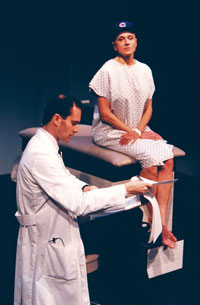
Wit is a play written by American playwright Margaret Edson. Edson used her work experience in a hospital as part of the inspiration for her play. Wit received its world premiere at South Coast Repertory, Costa Mesa, California, in 1995...
. These plays were commissioned by SCR and developed through its Pacific Playwrights Festival
Pacific Playwrights Festival
The Pacific Playwrights Festival , a national forum for playwrights and theatre leaders, is dedicated to developing and producing new American plays. It is held every summer at South Coast Repertory in Costa Mesa, California....
, an annual workshop and reading showcase for up to eight new plays, attended by artistic directors and literary staff members from across the country.
Forty percent of the plays SCR has produced have been world, American or West Coast premieres. In 1988, SCR received the Regional Theatre Tony Award
Regional Theatre Tony Award
The Regional Theatre Tony Award is a special non-competitive Tony Award given annually to a regional theatre company in the United States. Initially presented in 1948 to Robert Porterfield of the Virginia Barter Theatre for their Contribution To Development Of Regional Theatre, the Regional Theatre...
for Distinguished Achievement, particularly in the area of new play development.
History
David Emmes and Martin Benson attended San Francisco State UniversitySan Francisco State University
San Francisco State University is a public university located in San Francisco, California. As part of the 23-campus California State University system, the university offers over 100 areas of study from nine academic colleges...
. After graduation, Emmes and Benson gathered a few San Francisco friends in summer 1963 to stage Arthur Schnitzler
Arthur Schnitzler
Dr. Arthur Schnitzler was an Austrian author and dramatist.- Biography :Arthur Schnitzler, son of a prominent Hungarian-Jewish laryngologist Johann Schnitzler and Luise Markbreiter , was born in Praterstraße 16, Leopoldstadt, Vienna, in the Austro-Hungarian...
's La Ronde
La Ronde (play)
La Ronde is a 1900 play by Arthur Schnitzler. It scrutinizes the sexual morals and class ideology of its day through a series of encounters between pairs of characters . By choosing characters across all levels of society, the play offers social commentary on how sexual contact transgresses...
at the Off-Broadway Theatre in Long Beach, California
Long Beach, California
Long Beach is a city situated in Los Angeles County in Southern California, on the Pacific coast of the United States. The city is the 36th-largest city in the nation and the seventh-largest in California. As of 2010, its population was 462,257...
.
After that experience, Emmes and Benson were convinced there was a future for them in theatre and they sketched out a plan to create a theatre company. The first step would involve touring to rented stages. In November 1964, SCR's first production, Molière
Molière
Jean-Baptiste Poquelin, known by his stage name Molière, was a French playwright and actor who is considered to be one of the greatest masters of comedy in Western literature...
's Tartuffe
Tartuffe
Tartuffe is a comedy by Molière. It is one of his most famous plays.-History:Molière wrote Tartuffe in 1664...
, opened at the Newport Beach Ebell Club.
The next step would be their own location. They chose to locate it in Orange County
Orange County, California
Orange County is a county in the U.S. state of California. Its county seat is Santa Ana. As of the 2010 census, its population was 3,010,232, up from 2,846,293 at the 2000 census, making it the third most populous county in California, behind Los Angeles County and San Diego County...
, virgin territory for a major arts institution.
Second Step Theatre
Balboa Peninsula, Newport Beach, California
The Balboa Peninsula is a neighborhood of the city of Newport Beach, Orange County, California. It is named for the famous Spanish explorer, Vasco Núñez de Balboa....
was rented and converted into a 75-seat proscenium stage. It opened on March 12, 1965 with a production of Waiting for Godot
Waiting for Godot
Waiting for Godot is an absurdist play by Samuel Beckett, in which two characters, Vladimir and Estragon, wait endlessly and in vain for someone named Godot to arrive. Godot's absence, as well as numerous other aspects of the play, have led to many different interpretations since the play's...
.
Confident of their ability to continue, the young artistic directors sought to convince their adopted community of SCR's future importance. An "Artistic Manifesto" was displayed in the Second Step lobby. It boasted a four-step model of growth: the first season of touring, the present location's 75-seat stage, and two more transformations leading to a major regional center for theatre arts and education.
While the goal of running a nationally renowned arts institution spurred them on from the Second Step lobby wall, the young company went about the business of surviving. For years, everyone involved maintained full-time day jobs and worked nights and weekends without pay. They designed and built their scenery, sold the tickets, ushered, and — of course — acted. Among the first acting company members were Don Took, Martha McFarland and Art Koustik, joined over the next seasons by Richard Doyle, Hal Landon Jr. and Ron Boussom. These were among the theatre's Founding Artists.
Third Step Theatre
Within two years, artistic and financial momentum had picked up and SCR looked toward its Third Step: a converted Sprouse-ReitzSprouse-Reitz
Sprouse-Reitz is a defunct chain of five and dime stores based in Portland, Oregon, United States. The Sprouse-Reitz Company was founded in 1909 and at its peak had nearly 400 stores in the Western United States. In 1991, the declining retailer tried to revive itself by renaming its stores...
Variety Store on Newport Boulevard in Costa Mesa. The building, adapted to hold 217 seats, opened in 1967.
United States dollar
The United States dollar , also referred to as the American dollar, is the official currency of the United States of America. It is divided into 100 smaller units called cents or pennies....
20,000 to US$55,000 in the first two seasons. By the fifth season, paid staff had grown from one to five. A first grant from the National Endowment for the Arts
National Endowment for the Arts
The National Endowment for the Arts is an independent agency of the United States federal government that offers support and funding for projects exhibiting artistic excellence. It was created by an act of the U.S. Congress in 1965 as an independent agency of the federal government. Its current...
went to expanding the staff. The Los Angeles Drama Critics Circle
Los Angeles Drama Critics Circle
The Los Angeles Drama Critics Circle is an organization located in Los Angeles, California, dedicated to excellence in theatrical criticism, and to the encouragement and improvement of theatre in the Greater Los Angeles Area....
gave SCR its first award
Los Angeles Drama Critics Circle Award
The Los Angeles Drama Critics Circle Awards is an annual awards program presented by the Los Angeles Drama Critics Circle . Established in 1969, the awards recognize excellence in theatre in the Greater Los Angeles Area....
in 1970 for "consistent achievement in production." In 1976, SCR joined the League of Resident Theatres
Regional theatre in the United States
Regional theaters, or resident theaters, in the United States are professional or semi-professional, theater companies that produce their own seasons. The term regional theatre most often refers to professional theatres outside of New York City...
(LORT) and was able to contract for members of Actors' Equity
Actors' Equity Association
The Actors' Equity Association , commonly referred to as Actors' Equity or simply Equity, is an American labor union representing the world of live theatrical performance, as opposed to film and television performance. However, performers appearing on live stage productions without a book or...
.
But by that time, the company was outgrowing its space again. The budget was more than US$250,000. A year later, there were more than 9,400 subscribers and capacity was pushing 99 percent.
Emmes and Benson addressed the question of SCR's future and the long-anticipated Fourth Step Theatre. They formed a new board of community leaders to address the realities of funding, designing, and building Orange County's first resident theatre facility. A gift of land on which the theatre would be built was made by the Segerstrom family.
In September 1978, the theatre opened with a production of William Saroyan
William Saroyan
William Saroyan was an Armenian American dramatist and author. The setting of many of his stories and plays is the center of Armenian-American life in California in his native Fresno.-Early years:...
's The Time of Your Life
The Time of Your Life
The Time of Your Life is a 1939 five-act play by American playwright William Saroyan. The play is the first drama to win both the Pulitzer Prize for Drama and the New York Drama Critics Circle Award. The play opened 25 October 1939 at the Booth Theatre in New York City...
.
At first there was only the 507-seat Mainstage. But by 1979 the large rehearsal hall had been converted into the 161-seat Second Stage. SCR had reached its long-sought goal: a two-theatre complex, owned and operated by the company itself.
Fourth Step Theatre
The 1985-86 Season saw Colab's first two public programs: the NewSCRipts play reading series and the Hispanic Playwrights Project. Also that season, ground was broken on a distinctive addition to the building called The Artists Wing.
Then, in 1988, SCR earned the highest recognition in regional theatre, the Regional Theatre Tony Award
Regional Theatre Tony Award
The Regional Theatre Tony Award is a special non-competitive Tony Award given annually to a regional theatre company in the United States. Initially presented in 1948 to Robert Porterfield of the Virginia Barter Theatre for their Contribution To Development Of Regional Theatre, the Regional Theatre...
for its achievements.
During the 1990s, a national reputation for play development was solidified. Writers were discovered, nurtured, and then championed. Margaret Edson
Margaret Edson
Margaret Edson is an American playwright. She graduated with a B.A. in Renaissance History from Smith College, and received a master's in English literature from Georgetown University...
, whose Wit
Wit (play)
Wit is a play written by American playwright Margaret Edson. Edson used her work experience in a hospital as part of the inspiration for her play. Wit received its world premiere at South Coast Repertory, Costa Mesa, California, in 1995...
was a premiere at SCR in 1995, won the 1999 Pulitzer Prize for Drama
Pulitzer Prize for Drama
The Pulitzer Prize for Drama was first awarded in 1918.From 1918 to 2006, the Drama Prize was unlike the majority of the other Pulitzer Prizes: during these years, the eligibility period for the drama prize ran from March 2 to March 1, to reflect the Broadway 'season' rather than the calendar year...
. Donald Margulies
Donald Margulies
Donald Margulies is an American playwright and a professor of English and Theater Studies at Yale University...
, whose Sight Unseen
Sight Unseen (play)
Sight Unseen is a play by Donald Margulies. At its center is Jonathan Waxman, a Brooklyn Jew who has become a very wealthy critically acclaimed artist. Happily married, with a baby on the way, he travels to London for a retrospective of his work...
and Collected Stories originated at SCR before meeting with New York success, won the 2000 Pulitzer for Dinner With Friends
Dinner with Friends
Dinner with Friends is a 2000 play written by Donald Margulies. It premiered at the 1998 Humana Festival of New American Plays and opened Off-Broadway in New York on November 4, 1999.-Plot summary:...
. Other playwrights who had multiple premieres at SCR also became familiar names in theatres across America: Amy Freed
Amy Freed
Amy Freed is an American playwright. She was nominated as a finalist in the drama category of the 1998 Pulitzer Prizes for her play Freedomland. In addition to Freedomland, she is the author of The Beard of Avon , The Psychic Life of Savages, and other plays...
, Craig Lucas
Craig Lucas
Craig Lucas is an American playwright, screenwriter, theatre director, musical actor, and film director.-Biography:...
, Howard Korder
Howard Korder
Howard Korder is an American screenwriter and playwright. He is the author of the 1988 coming-of-age play Boy's Life, which earned him a Pulitzer Prize for Drama nomination. His play Search and Destroy was adapted into a film in 1995. Among the screenplays he has written are The Passion of Ayn...
, Keith Reddin
Keith Reddin
Keith Reddin is an American actor and playwright. He received his B.S. in 1978 from Northwestern University and then went on to attend The Yale University School of Drama until he received his M.A. in 1981....
, Octavio Solis, and Richard Greenberg
Richard Greenberg
Richard Greenberg is an American playwright. He is the author of over 25 plays including eight South Coast Repertory world premieres: Our Mother's Brief Affair, The Injured Party, The Violet Hour, Everett Beekin, Hurrah at Last, Three Days of Rain Richard Greenberg (1958–present) is an American...
, who has had nine commissioned world premieres at SCR.
In the summer of 1998 following its 35th Anniversary Season, SCR launched the Pacific Playwrights Festival
Pacific Playwrights Festival
The Pacific Playwrights Festival , a national forum for playwrights and theatre leaders, is dedicated to developing and producing new American plays. It is held every summer at South Coast Repertory in Costa Mesa, California....
, its most ambitious new play project to date. The Pacific Playwrights Festival incorporated the Hispanic Playwrights Project, two world premieres, and workshops or staged readings of seven more new plays.
By the end of 1998 SCR could begin to pursue its long-held expansion goal when the Segerstrom family donated land. That land, along with a similar donation to the neighboring Orange County Performing Arts Center
Orange County Performing Arts Center
The Orange County Performing Arts Center is a performing arts complex located in Costa Mesa, California, United States.The Center offers the world’s leading dance companies, Broadway shows, award-winning classical, jazz and cabaret artists, family entertainment, special events and year-round...
, established the Segerstrom Center for the Arts. Within weeks, SCR received its first gift of more than US$1 million, when Henry and Stacey Nicholas gave US$1.28 million (eventually doubling their gift to US$2.5 million to name the renovated Second Stage the Nicholas Studio) and launched "SCR: The Next Stage" Campaign, initially to raise US$40 million. Architect Cesar Pelli
César Pelli
César Pelli is an Argentine architect known for designing some of the world's tallest buildings and other major urban landmarks. In 1991, the American Institute of Architects listed Pelli among the ten most influential living American architects...
was enlisted for both The Center's and SCR's expansion, with SCR's construction beginning first.
At the ground breaking ceremony in July 2001, a US$5 million naming gift for the new stage was announced from George and Julianne Argyros.
In April 2002, Board President and Campaign Chairman Paul Folino announced the campaign's largest gift — and the largest single gift ever to a regional theatre by an individual. It was from the Folino family, and at US$10 million, it became the complex's naming gift.
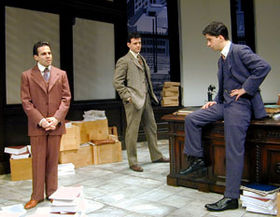
The first season in the Folino Theatre Center earned rave reviews and introduced three plays — Greenberg's The Violet Hour
The Violet Hour
The Violet Hour is a play by Richard Greenberg. It was commissioned by and originally produced by South Coast Repertory with Hamish Linklater as Seavering and Mario Cantone as Gidger. It received its Broadway debut on November 6, 2003 when the Manhattan Theatre Club produced it as the first play...
, Lynn Nottage
Lynn Nottage
Lynn Nottage is an American playwright whose work often deals with the lives of women of African descent, African Americans and women. She was born in Brooklyn and is a graduate of Brown University and the Yale School of Drama. She received a Guggenheim Fellowship in 2005, and a MacArthur Genius...
's Intimate Apparel
Intimate Apparel
Intimate Apparel is a play written by Lynn Nottage. The play is a co-production and co-commission between Center Stage, Baltimore, Maryland, and South Coast Repertory, Costa Mesa, California....
and Rolin Jones
Rolin Jones
Rolin Jones is a playwright and television writer. He has worked on Showtime's Weeds and NBC drama Friday Night Lights. His plays include The Intelligent Design of Jenny Chow: An Instant Message with Excitable Music and Sovereignty....
' The Intelligent Design of Jenny Chow
The Intelligent Design of Jenny Chow
The Intelligent Design of Jenny Chow is a play written by Rolin Jones. The play had its world premiere at South Coast Repertory in 2003.Set in Calabasas, California, it tells the story of Jennifer Marcus, a 22-year-old genius with obsessive compulsive disorder and agoraphobia...
. All have since gone on to major productions in New York and elsewhere.
With the expansion of its physical plant and endowment, and with additional support from the Whittier Family Foundations, SCR was ready for its biggest programmatic growth in two decades, introduction of the three-play series "Theatre for Young Audiences ... and Their Families," which debuted in 2003 to tremendous response.
The year 2011 marked a major leadership transition for SCR: Marc Masterson became the theatre’s new Artistic Director, with Managing Director Paula Tomei serving as his co-CEO. Emmes and Benson moved into the roles of Founding Artistic Directors, from which they continue to share the wisdom and knowledge gained in their 47 years at the theatre’s helm.