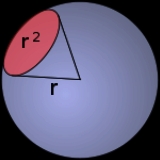
The
solid angle,
Ω, is the two-dimensional angle in three-dimensional space that an object subtends at a point. It is a measure of how large that object appears to an observer looking from that point. A small object nearby may subtend the same solid angle as a larger object farther away (for example, the small/near Moon can totally eclipse the large/remote Sun because, as observed from a point on the Earth, both objects fill almost exactly the same amount of sky). An object's solid angle is equal to the area of the segment of
unit sphereIn mathematics, a unit sphere is the set of points of distance 1 from a fixed central point, where a generalized concept of distance may be used; a closed unit ball is the set of points of distance less than or equal to 1 from a fixed central point...
(centered at the
vertexIn geometry, a vertex is a special kind of point that describes the corners or intersections of geometric shapes.-Of an angle:...
of the angle) restricted by the object (this definition works in any dimension, including 1D and 2D). A solid angle equals the area of a segment of unit sphere in the same way a planar
angleIn geometry, an angle is the figure formed by two rays sharing a common endpoint, called the vertex of the angle.Angles are usually presumed to be in a Euclidean plane with the circle taken for standard with regard to direction. In fact, an angle is frequently viewed as a measure of an circular arc...
equals the length of an arc of
unit circleIn mathematics, a unit circle is a circle with a radius of one. Frequently, especially in trigonometry, "the" unit circle is the circle of radius one centered at the origin in the Cartesian coordinate system in the Euclidean plane...
.
The
SIThe International System of Units is the modern form of the metric system and is generally a system of units of measurement devised around seven base units and the convenience of the number ten. The older metric system included several groups of units...
units of solid angle are
steradianThe steradian is the SI unit of solid angle. It is used to describe two-dimensional angular spans in three-dimensional space, analogous to the way in which the radian describes angles in a plane...
(abbreviated "sr"). From the point of view of mathematics and physics a solid angle is dimensionless and has no units, thus "sr" might be skipped in scientific texts. The solid angle of a sphere measured from a point in its interior is 4
π' is a mathematical constant that is the ratio of any circle's circumference to its diameter. is approximately equal to 3.14. Many formulae in mathematics, science, and engineering involve , which makes it one of the most important mathematical constants...
sr, and the solid angle subtended at the center of a cube by one of its faces is one-sixth of that, or 2π/3 sr. Solid angles can also be measured in
square degreeA square degree is a non-SI unit measure of solid angle. It is denoted in various ways, including deg2, sq.deg. and ². Just as degrees are used to measure parts of a circle, square degrees are used to measure parts of a sphere. Analogous to one degree being equal to π /180 radians, a...
s (
1 sr = (180/π)
2 square degree) or in fractions of the sphere (i.e.,
fractional area),
1 sr = 1/4π
fractional area.
In spherical coordinates, there is a simple formula as
-

The solid angle for an arbitrary oriented surface S subtended at a point P is equal to the solid angle of the projection of the
surface S to the unit sphere with center P, which can be calculated as the
surface integralIn mathematics, a surface integral is a definite integral taken over a surface ; it can be thought of as the double integral analog of the line integral...
:
-

where

is the vector position of an infinitesimal area of surface

with respect to point P and where

represents the unit vector normal to

. Even if the projection on the unit sphere to the surface S is not isomorphic, the multiple folds are correctly considered according to the surface orientation described by the sign of the scalar product

.
Practical applications
- Defining luminous intensity
In photometry, luminous intensity is a measure of the wavelength-weighted power emitted by a light source in a particular direction per unit solid angle, based on the luminosity function, a standardized model of the sensitivity of the human eye...
and luminanceLuminance is a photometric measure of the luminous intensity per unit area of light travelling in a given direction. It describes the amount of light that passes through or is emitted from a particular area, and falls within a given solid angle. The SI unit for luminance is candela per square...
- Calculating spherical excess E of a spherical triangle
- The calculation of potentials by using the boundary element method
The boundary element method is a numerical computational method of solving linear partial differential equations which have been formulated as integral equations . It can be applied in many areas of engineering and science including fluid mechanics, acoustics, electromagnetics, and fracture...
(BEM)
- Evaluating the size of ligand
In coordination chemistry, a ligand is an ion or molecule that binds to a central metal atom to form a coordination complex. The bonding between metal and ligand generally involves formal donation of one or more of the ligand's electron pairs. The nature of metal-ligand bonding can range from...
s in metal complexes, see ligand cone angleThe ligand cone angle is a measure of the size of a ligand. It is defined as the solid angle formed with the metal at the vertex and the hydrogen atoms at the perimeter of the cone . Tertiary phosphine ligands are commonly classified using this parameter, but the method can be applied to any...
.
- Calculating the electric field
In physics, an electric field surrounds electrically charged particles and time-varying magnetic fields. The electric field depicts the force exerted on other electrically charged objects by the electrically charged particle the field is surrounding...
and magnetic fieldA magnetic field is a mathematical description of the magnetic influence of electric currents and magnetic materials. The magnetic field at any given point is specified by both a direction and a magnitude ; as such it is a vector field.Technically, a magnetic field is a pseudo vector;...
strength around charge distributions.
- Deriving Gauss's Law
In physics, Gauss's law, also known as Gauss's flux theorem, is a law relating the distribution of electric charge to the resulting electric field. Gauss's law states that:...
.
- Calculating emissive power and irradiation in heat transfer.
- Calculating cross sections in Rutherford scattering
In physics, Rutherford scattering is a phenomenon that was explained by Ernest Rutherford in 1911, and led to the development of the Rutherford model of the atom, and eventually to the Bohr model. It is now exploited by the materials analytical technique Rutherford backscattering...
.
- Calculating cross sections in Raman scattering
Raman scattering or the Raman effect is the inelastic scattering of a photon. It was discovered by Sir Chandrasekhara Venkata Raman and Kariamanickam Srinivasa Krishnan in liquids, and by Grigory Landsberg and Leonid Mandelstam in crystals....
.
- The solid angle of the acceptance cone of the optical fiber
An optical fiber is a flexible, transparent fiber made of a pure glass not much wider than a human hair. It functions as a waveguide, or "light pipe", to transmit light between the two ends of the fiber. The field of applied science and engineering concerned with the design and application of...
Cone, spherical cap, hemisphere
The solid angle of a
coneA cone is an n-dimensional geometric shape that tapers smoothly from a base to a point called the apex or vertex. Formally, it is the solid figure formed by the locus of all straight line segments that join the apex to the base...
with
apexIn geometry, an apex is the vertex which is in some sense the highest of the figure to which it belongs.*In an isosceles triangle, the apex is the vertex where the two sides of equal length meet, opposite the unequal third side....
angle

, is the area of a
spherical capIn geometry, a spherical cap is a portion of a sphere cut off by a plane. If the plane passes through the center of the sphere, so that the height of the cap is equal to the radius of the sphere, the spherical cap is called a hemisphere....
on a
unit sphereIn mathematics, a unit sphere is the set of points of distance 1 from a fixed central point, where a generalized concept of distance may be used; a closed unit ball is the set of points of distance less than or equal to 1 from a fixed central point...
(The above result is found by computing the following double integral using the unit surface element in spherical coordinates):
-

Over 2200 years ago
ArchimedesArchimedes of Syracuse was a Greek mathematician, physicist, engineer, inventor, and astronomer. Although few details of his life are known, he is regarded as one of the leading scientists in classical antiquity. Among his advances in physics are the foundations of hydrostatics, statics and an...
proved, without the use of
calculusCalculus is a branch of mathematics focused on limits, functions, derivatives, integrals, and infinite series. This subject constitutes a major part of modern mathematics education. It has two major branches, differential calculus and integral calculus, which are related by the fundamental theorem...
, that the surface area of a spherical cap was always equal to the area of a circle whose radius was equal to the distance from the rim of the spherical cap to the point where the cap's axis of symmetry intersects the cap. In the diagram opposite this radius is given as:
Hence for a unit sphere the solid angle of the spherical cap is given as:
When , the spherical cap becomes a
hemisphereA sphere is a perfectly round geometrical object in three-dimensional space, such as the shape of a round ball. Like a circle in two dimensions, a perfect sphere is completely symmetrical around its center, with all points on the surface lying the same distance r from the center point...
having a solid angle 2π.
The solid angle of the complement of the cone (picture a melon with the cone cut out) is clearly:
A terran astronomical observer positioned at latitude

can see this much of the
celestial sphereIn astronomy and navigation, the celestial sphere is an imaginary sphere of arbitrarily large radius, concentric with the Earth and rotating upon the same axis. All objects in the sky can be thought of as projected upon the celestial sphere. Projected upward from Earth's equator and poles are the...
as the earth rotates, that is, a proportion

At the equator you see all of the celestial sphere, at either pole only one half.
Tetrahedron
Let OABC be the vertices of a
tetrahedronIn geometry, a tetrahedron is a polyhedron composed of four triangular faces, three of which meet at each vertex. A regular tetrahedron is one in which the four triangles are regular, or "equilateral", and is one of the Platonic solids...
with an origin at O subtended by the triangular face ABC where

are the vector positions of the vertices A, B and C. Define the vertex angle

to be the angle BOC and define

correspondingly. Let

be the
dihedral angleIn geometry, a dihedral or torsion angle is the angle between two planes.The dihedral angle of two planes can be seen by looking at the planes "edge on", i.e., along their line of intersection...
between the planes that contain the tetrahedral faces OAC and OBC and define

correspondingly. The solid angle at

subtended by the triangular surface ABC is given by
This follows from the theory of spherical excess and it leads to the fact that there is an analogous theorem to the theorem that
"The sum of internal angles of a planar triangle is equal to
", for the sum of the four internal solid angles of a tetrahedron as follows:
where

ranges over all six of the dihedral angles between any two planes that contain the tetrahedral faces OAB, OAC, OBC and ABC.
An efficient algorithm for calculating the solid angle at

subtended by the triangular surface ABC where

are the vector positions of the vertices A, B and C has been given by Oosterom and Strackee:
where
-

denotes the
determinantIn linear algebra, the determinant is a value associated with a square matrix. It can be computed from the entries of the matrix by a specific arithmetic expression, while other ways to determine its value exist as well...
of the matrix that results when writing the vectors together in a row, e.g.

and so on—this is also equivalent to the
scalar triple productIn mathematics, the triple product is a product of three vectors. The name "triple product" is used for two different products, the scalar-valued scalar triple product and, less often, the vector-valued vector triple product....
of the three vectors;
-
is the vector representation of point A, while
is the magnitude of that vector (the origin-point distance);
-
denotes the scalar product.
When implementing the above equation care must be taken with the
atan function to avoid negative or incorrect solid angles. One source of potential errors is that the determinant can be negative if a,b,c have the wrong
windingIn linear algebra, the determinant is a value associated with a square matrix. It can be computed from the entries of the matrix by a specific arithmetic expression, while other ways to determine its value exist as well...
. Computing
abs(det) is a sufficient solution since no other portion of the equation depends on the winding. The other pitfall arises when the determinant is positive but the divisor is negative. In this case
atan returns a negative value that must be biased by

.
from scipy import dot, arctan2, pi
from scipy.linalg import norm, det
def tri_projection(a, b, c):
"""Given three 3-vectors, a, b, and c."""
determ = det((a, b, c))
al = norm(a)
bl = norm(b)
cl = norm(c)
div = al*bl*cl + dot(a,b)*cl + dot(a,c)*bl + dot(b,c)*al
at = arctan2(determ, div)
if at < 0: at += pi # If det > 0 and div < 0 arctan2 returns < 0, so add pi.
omega = 2 * at
return omega
Another useful formula for calculating the solid angle of the tetrahedron at the origin O that is purely a function of the vertex angles

is given by
L' HuilierSimon Antoine Jean L'Huilier was a Swiss mathematician of French Hugenot descent...
's theorem as
-

where
-

Pyramid
The solid angle of a four-sided right rectangular pyramidIn geometry, a pyramid is a polyhedron formed by connecting a polygonal base and a point, called the apex. Each base edge and apex form a triangle. It is a conic solid with polygonal base....
with apexIn geometry, an apex is the vertex which is in some sense the highest of the figure to which it belongs.*In an isosceles triangle, the apex is the vertex where the two sides of equal length meet, opposite the unequal third side....
angles
and
(dihedral angleIn geometry, a dihedral or torsion angle is the angle between two planes.The dihedral angle of two planes can be seen by looking at the planes "edge on", i.e., along their line of intersection...
s measured to the opposite side faces of the pyramid) is
-

If both the side lengths (α and β) of the base of the pyramid and the distance (d) from the center of the base rectangle to the apex of the pyramid (the center of the sphere) are known, then the above equation can be manipulated to give
-

The solid angle of a right n-gonal pyramid, where the pyramid base is a regular n-sided polygon of circumradius (r), with a
pyramid height (h) is

Latitude-longitude rectangle
The solid angle of a latitude-longitude rectangle on a globeA globe is a three-dimensional scale model of Earth or other spheroid celestial body such as a planet, star, or moon...
is
, where
and
are north and south lines of latitudeIn geography, the latitude of a location on the Earth is the angular distance of that location south or north of the Equator. The latitude is an angle, and is usually measured in degrees . The equator has a latitude of 0°, the North pole has a latitude of 90° north , and the South pole has a...
(measured from the equatorAn equator is the intersection of a sphere's surface with the plane perpendicular to the sphere's axis of rotation and containing the sphere's center of mass....
in radians with angle increasing northward), and
and
are east and west lines of longitudeLongitude is a geographic coordinate that specifies the east-west position of a point on the Earth's surface. It is an angular measurement, usually expressed in degrees, minutes and seconds, and denoted by the Greek letter lambda ....
(where the angle in radians increases eastward). Mathematically, this represents an arc of angle
swept around a sphere by
radians. When longitude spans 2π radians and latitude spans π radians, the solid angle is that of a sphere.
A latitude-longitude rectangle should not be confused with the solid angle of a rectangular pyramid. All four sides of a rectangular pyramid intersect the sphere's surface in great circleA great circle, also known as a Riemannian circle, of a sphere is the intersection of the sphere and a plane which passes through the center point of the sphere, as opposed to a general circle of a sphere where the plane is not required to pass through the center...
arcs. With a latitude-longitude rectangle, only lines of longitude are great circle arcs; lines of latitude are not.
Sun and Moon
The SunThe Sun is the star at the center of the Solar System. It is almost perfectly spherical and consists of hot plasma interwoven with magnetic fields...
and MoonThe Moon is Earth's only known natural satellite,There are a number of near-Earth asteroids including 3753 Cruithne that are co-orbital with Earth: their orbits bring them close to Earth for periods of time but then alter in the long term . These are quasi-satellites and not true moons. For more...
are both seen from Earth at an apparent diameter of about 0.5°, thus they each cover a solid angle of about 0.20 deg2 or square degreeA square degree is a non-SI unit measure of solid angle. It is denoted in various ways, including deg2, sq.deg. and ². Just as degrees are used to measure parts of a circle, square degrees are used to measure parts of a sphere. Analogous to one degree being equal to π /180 radians, a...
s, thus they each cover a fractional area of approximately 0.0047% of the total celestial sphere which is about 6 steradian.
Solid angles in arbitrary dimensions
The solid angle subtended by the full surface of the unit n-sphere (in the geometer's sense) can be defined in any number of dimensions
. One often needs this solid angle factor in calculations with spherical symmetry. It is given by the formula

where
is the Gamma functionIn mathematics, the gamma function is an extension of the factorial function, with its argument shifted down by 1, to real and complex numbers...
. When
is an integer, the Gamma function can be computed explicitly. It follows that

This gives the expected results of 2π rad for the 2D circumference and 4π srThe steradian is the SI unit of solid angle. It is used to describe two-dimensional angular spans in three-dimensional space, analogous to the way in which the radian describes angles in a plane...
for the 3D sphere. It also throws the slightly less obvious 2 for the 1D case, in which the origin-centered unit "sphere" is the set
, which indeed has a measureIn mathematical analysis, a measure on a set is a systematic way to assign to each suitable subset a number, intuitively interpreted as the size of the subset. In this sense, a measure is a generalization of the concepts of length, area, and volume...
of 2.