

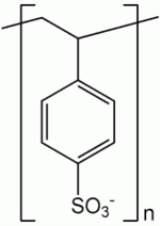
Sodium polystyrene sulfonate

Overview
International Nonproprietary Name
An International Nonproprietary Name is the official nonproprietary or generic name given to a pharmaceutical substance, as designated by the World Health Organization...
, trade names Kayexalate, Kionex, Resonium A) is a type of polymer
Polymer
A polymer is a large molecule composed of repeating structural units. These subunits are typically connected by covalent chemical bonds...
and ionomer
Ionomer
An ionomer is a polymer that comprises repeat units of both electrically neutral repeating units and a fraction of ionized units...
based on polystyrene
Polystyrene
Polystyrene ) also known as Thermocole, abbreviated following ISO Standard PS, is an aromatic polymer made from the monomer styrene, a liquid hydrocarbon that is manufactured from petroleum by the chemical industry...
. It is the sodium salt of polystyrene sulfonic acid.
The polyanion is readily soluble in water, and insoluble in lower alcohols. The solid appears as white or off-white powder.
It may be prepared by polymerization
Polymerization
In polymer chemistry, polymerization is a process of reacting monomer molecules together in a chemical reaction to form three-dimensional networks or polymer chains...
or copolymerization of sodium styrene sulfonate or by sulfonation
Aromatic sulfonation
Aromatic sulfonation is an organic reaction in which a hydrogen atom on an arene is replaced by a sulfonic acid functional group in an electrophilic aromatic substitution.-Mechanism:...
of polystyrene
Polystyrene
Polystyrene ) also known as Thermocole, abbreviated following ISO Standard PS, is an aromatic polymer made from the monomer styrene, a liquid hydrocarbon that is manufactured from petroleum by the chemical industry...
.
Unanswered Questions
