
All Topics  
Sodium amide

 
Sodium Amide

   Email Print
   Bookmark   Link


Sodium amide


Sodium amide, commonly called sodamide, is the chemical compound
Chemical compound

A chemical compound is a Chemical substance consisting of two or more different chemical element Chemical bond together in a fixed mass ratio that can be split into simpler substances....
 with the formula
Chemical formula

A chemical formula is a way of expressing information about the atoms that constitute a particular chemical compound, and how the relationship between those atoms changes in chemical reactions....
 NaNH2. This solid, which is dangerously reactive toward water, is white when pure, but commercial samples are typically gray due to the presence of small quantities of metallic iron from the manufacturing process. Such impurities do not usually affect the utility of the reagent
Reagent

A reagent or reactant is a substance or compound consumed during a chemical reaction. Solvents and catalysts, although they are involved in the reaction, are usually not referred to as reactants....
. NaNH2 has been widely employed as a strong base in organic synthesis
Organic synthesis

Organic synthesis is a special branch of chemical synthesis and is concerned with the construction of organic compounds via organic reactions. Organic_chemistry molecules can often contain a higher level of complexity compared to purely Inorganic_chemistry compounds, so the synthesis of organic compounds has developed into one of the most im...
.

um amide can be prepared by the reaction of sodium
Sodium

Sodium is an element which has the symbol Na , atomic number 11, atomic mass 23 amu , and a common oxidation number +1. Sodium is a soft, silvery white, highly reactive element and is a member of the alkali metals within "group 1" ....
 with ammonia gas, but it is usually prepared by the reaction in liquid ammonia using iron(III) nitrate
Iron(III) nitrate

Iron nitrate, or ferric nitrate, is the chemical compound with the formula Fe3?water of crystallization. It forms colourless to pale violet crystals that are deliquescence; i.e., crystals form a pool of water if left in open to the atmosphere....
 as a catalyst.


Discussion
Ask a question about 'Sodium amide'
Start a new discussion about 'Sodium amide'
Answer questions from other users
Full Discussion Forum


Encyclopedia


Sodium amide, commonly called sodamide, is the chemical compound
Chemical compound

A chemical compound is a Chemical substance consisting of two or more different chemical element Chemical bond together in a fixed mass ratio that can be split into simpler substances....
 with the formula
Chemical formula

A chemical formula is a way of expressing information about the atoms that constitute a particular chemical compound, and how the relationship between those atoms changes in chemical reactions....
 NaNH2. This solid, which is dangerously reactive toward water, is white when pure, but commercial samples are typically gray due to the presence of small quantities of metallic iron from the manufacturing process. Such impurities do not usually affect the utility of the reagent
Reagent

A reagent or reactant is a substance or compound consumed during a chemical reaction. Solvents and catalysts, although they are involved in the reaction, are usually not referred to as reactants....
. NaNH2 has been widely employed as a strong base in organic synthesis
Organic synthesis

Organic synthesis is a special branch of chemical synthesis and is concerned with the construction of organic compounds via organic reactions. Organic_chemistry molecules can often contain a higher level of complexity compared to purely Inorganic_chemistry compounds, so the synthesis of organic compounds has developed into one of the most im...
.

Preparation and structure

Sodium amide can be prepared by the reaction of sodium
Sodium

Sodium is an element which has the symbol Na , atomic number 11, atomic mass 23 amu , and a common oxidation number +1. Sodium is a soft, silvery white, highly reactive element and is a member of the alkali metals within "group 1" ....
 with ammonia gas, but it is usually prepared by the reaction in liquid ammonia using iron(III) nitrate
Iron(III) nitrate

Iron nitrate, or ferric nitrate, is the chemical compound with the formula Fe3?water of crystallization. It forms colourless to pale violet crystals that are deliquescence; i.e., crystals form a pool of water if left in open to the atmosphere....
 as a catalyst. The reaction is fastest at the boiling point of the ammonia, ca. -33 °C.
2 Na + 2 NH3 ? 2 NaNH2 + H2


NaNH2 is a salt-like material and as such, crystallizes as an infinite polymer. The geometry about sodium is tetrahedral. In ammonia, NaNH2 forms conductive solutions, consistent with the presence of Na(NH3)6+ and NH2- anions.

Uses

Sodium amide is used in the industrial production of indigo
Indigo dye

Indigo dye is dye with a distinctive blue color . The chemical compound that constitutes the indigo dye is called indican. The ancients extracted the natural dye from several species of plant as well as one of the two famous Hexaplex trunculus, but nearly all indigo produced today is Chemical synthesis....
, hydrazine
Hydrazine

Hydrazine is a chemical compound with the chemical formula N2H4. It is a colourless liquid with an ammonia-like odor and is derived from the same industrial chemistry processes that manufacture ammonia....
, and sodium cyanide
Sodium cyanide

Sodium cyanide is the inorganic compound with the chemical formula NaCN. This highly toxic colourless salt is used mainly in gold mining but has other niche applications....
. It is the reagent of choice for the drying of ammonia
Ammonia

Ammonia is a chemical compound with the chemical formula nitrogenhydrogen. It is normally encountered as a gas with a characteristic pungent odor....
 (liquid or gaseous) and is also widely used as a strong base
Base (chemistry)

In chemistry, a base is most commonly thought of as an aqueous substance that can accept protons. A base is also often referred to as an alkali if OH- ions are involved....
 in organic chemistry, often in liquid ammonia solution. One of the main advantages to the use of sodamide is that it is an excellent base and rarely serves as a nucleophile. It is however poorly soluble and its use has been superseded by the related reagents such as sodium hydride
Sodium hydride

Sodium hydride is the chemical compound with the formula NaH. It is primarily used as a strong base in organic synthesis. NaH is representative of the saline hydrides, meaning it is a salt-like hydride, composed of Na+ and H- ions, in contrast to the more molecular hydrides such as borane, methane, ammonia and water....
, sodium bis(trimethylsilyl)amide
Sodium bis(trimethylsilyl)amide

Sodium bisamide is the chemical compound with the formula 2NNa. This species, usually called NaHMDS , is a strong base used for deprotonation reactions or base catalyzed reaction....
 (NaHMDS), and lithium diisopropylamide
Lithium diisopropylamide

Lithium diisopropylamide is the chemical compound with the formula [2CH]2NLi. Generally abbreviated LDA, it is a strong base used in organic chemistry for the deprotonation of weakly acidic compounds....
 (LDA).

Preparation of alkynes

Sodium amide induces the loss of two molecules of hydrogen bromide
Hydrogen bromide

Hydrogen bromide is the diatomic molecule HydrogenBromine. Under standard conditions, HBr is a gas, but it can be liquified. The aqueous solution hydrobromic acid forms upon dissolving HBr in water....
 from a vicinal
Vicinal (chemistry)

In chemistry vicinal stands for any two functional groups bonded to two adjacent carbon atoms. For example the molecule 2,3-dibromobutane carries two vicinal bromine atoms and 1,3-dibromobutane does not....
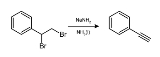
 dibromoalkane to give a carbon-carbon triple bond, as in the preparation of phenylacetylene
Phenylacetylene

Phenylacetylene is an alkyne hydrocarbon containing a phenyl group. It exists as a colorless, viscous liquid. In research, it is sometimes used as an analog for acetylene; being a liquid, it is easier to handle than acetylene gas....
 below. Normally two equivalents of sodium amide yields the desired alkyne. However, three equivalents are necessary in the preparation of a terminal alkyne because, as this alkyne forms, its acidic terminal hydrogen immediately protonates an equivalent amount of base.

Phenylacetylene Prepn
Hydrogen chloride
Hydrogen chloride

The Chemical compound hydrogen chloride has the chemical formula HydrogenChlorine. At room temperature, it is a colorless gas, which forms white fumes of hydrochloric acid upon contact with atmospheric humidity....
 and/or ethanol
Ethanol

Ethanol, also called ethyl alcohol, pure alcohol, grain alcohol, or drinking alcohol, is a volatility , flammable, colorless liquid....
 can also be eliminated in this way, Bou, Anna; Pericàs, Miquel A.; Riera, Antoni; Serratosa, Fèlix (1987). "". Org. Synth. 65:68; Coll. Vol. 8:161.
Magriotis, Plato A.; Brown, John T. (1995). "". Org. Synth. 72:252; Coll. Vol. 9:656.
Ashworth, P. J.; Mansfield, G. H.; Whiting, M. C. (1955). "". Org. Synth. 35:20; Coll. Vol. 4:128. as in the preparation of 1-ethoxy-1-butyne.

Ethoxybutyne Prepn

Cyclization reactions

Where there is no ß-hydrogen to be eliminated, cyclic compounds may be formed, as in the preparation of methylenecyclopropane below.

Methylenecyclopropane Prepn
Cyclopropene
Cyclopropene

Cyclopropene is an organic compound with the chemical formula 34. It is the simplest isolable cycloalkene. It has a triangle structure....
s, aziridine
Aziridine

Aziridines are a group of organic compounds sharing the aziridine functional group which is a three membered heterocycle with one amine group and two methylene groups....
s and cyclobutane
Cyclobutane

Cyclobutane, C4H8, with a molecular mass of 56.107g/mol, is a four carbon alkane in which all the carbon atoms are arranged cyclically, hence cyclobutane....
s may be formed in a similar manner.

Deprotonation of carbon and nitrogen acids

Carbon acids which can be deprotonated
Deprotonation

Deprotonation is a chemistry term that refers to the removal of a proton from a molecule, forming the conjugate base. The relative ability for a molecule to give up a proton is measured by a pKa value....
 by sodium amide in liquid ammonia include terminal alkyne
Alkyne

Alkynes are hydrocarbons that have at least one triple bond between two carbon atoms, with the formula CnH2n-2. The alkynes are traditionally known as acetylenes or the acetylene series, although the name acetylene is also used to refer specifically to the simplest member of the series, known as e...
s, Peterson, P. E.; Dunham, M. (1977). "". Org. Synth. 57:26; Coll. Vol. 6:273.
Kauer, J. C.; Brown, M. (1962). "". Org. Synth. 42:97; Coll. Vol. 5:1043. methyl ketone
Ketone

In organic chemistry, a ketone is a type of organic compound which contains a carbonyl group bonded to two other carbon atoms in the form:Neither of the substituents R1 and R2 may be equal to hydrogen ....
s, Hauser, C. R.; Adams, J. T.; Levine, R. (1948). "". Org. Synth. 28:44; Coll. Vol. 3:291. cyclohexanone
Cyclohexanone

Cyclohexanone is the organic compound with the chemical formula...
, phenylacetic acid
Phenylacetic acid

Phenylacetic acid is an organic compound containing a phenyl functional group and an acetic acid functional group. It is a white solid with a disagreeable odor....
 and its derivatives Kaiser, Edwin M.; Kenyon, William G.; Hauser, Charles R. (1967). "". Org. Synth. 47:72; Coll. Vol. 5:559.
Wawzonek, Stanley; Smolin, Edwin M. (1951). "". Org. Synth. 31:52; Coll. Vol. 4:387. and diphenylmethane
Diphenylmethane

Diphenylmethane is an organic compound with the chemical formula 2CH2. The compound consists of methane wherein two hydrogen atoms are replaced by two phenyl groups....
. Acetylacetone
Acetylacetone

Acetylacetone is an organic compound with molecular formula C5H8O2. This diketone is formally named 2,4-pentanedione....
 loses two protons to form a dianion. Hampton, K. Gerald; Harris, Thomas M.; Hauser, Charles R. (1967).

Double Deprotonation of Acetylacetone
Sodium amide will also deprotonate indole
Indole

Indole is an aromatic Heterocyclic compound organic compound. It has a bicyclic structure, consisting of a six-membered benzene ring fused to a five-membered nitrogen-containing pyrrole ring....
 and piperidine
Piperidine

Piperidine is an organic compound with the molecular formula 5NH. This heterocyclic compound amine consists of a six-membered ring containing five methylene units and one nitrogen atom....
.

Other reactions

  • Rearrangement with orthodeprotonation
  • Oxirane synthesis (by carbene reaction?)
  • Indole synthesis
  • Chichibabin reaction
    Chichibabin reaction

    The Chichibabin reaction is a method for producing 2-aminopyridine derivatives by the reaction of pyridine with sodium amide. It was reported by Aleksei Chichibabin in 1914....


Safety

Sodium amide reacts violently with water to produce ammonia
Ammonia

Ammonia is a chemical compound with the chemical formula nitrogenhydrogen. It is normally encountered as a gas with a characteristic pungent odor....
 and sodium hydroxide
Sodium hydroxide

Sodium hydroxide , also known as lye, caustic soda and sodium hydrate, is a caustic metallic Base . Sodium hydroxide forms a strong alkaline solution when dissolved in a solvent such as water, however, only the hydroxide ion is basic....
 and will burn in air to give oxides of sodium
Sodium

Sodium is an element which has the symbol Na , atomic number 11, atomic mass 23 amu , and a common oxidation number +1. Sodium is a soft, silvery white, highly reactive element and is a member of the alkali metals within "group 1" ....
 and nitrogen
Nitrogen

Nitrogen is a chemical element that has the symbol N and atomic number 7 and atomic mass 14.00674?. Elemental nitrogen is a colorless, odorless, tasteless and mostly inert diatomic gas at standard conditions, constituting 78% by volume of Earth's atmosphere....
.
NaNH2 + H2O ? NH3 + NaOH
2NaNH2 + 4O2 ? Na2O2
Sodium peroxide

Sodium peroxide, Na2O2, is the normal product when sodium is burned. It is a strong oxidizer....
 + 2NO2
Nitrogen dioxide

Nitrogen dioxide is the chemical compound with the chemical formula NitrogenOxygen2. One of several nitrogen oxides, NO2 is an intermediate in the industrial synthesis of nitric acid, millions of tons of which are produced each year....
 + 2H2O
In the presence of limited quantities of air and moisture, such as in a poorly closed container, explosive mixtures of oxidation products can form. This is accompanied by a yellowing or browning of the solid. As such, sodium amide should always be stored in a tightly closed container, if possible under an atmosphere of nitrogen gas. Sodium amide samples which are yellow or brown in color should be destroyed immediately: one method for destruction is the careful addition of ethanol
Ethanol

Ethanol, also called ethyl alcohol, pure alcohol, grain alcohol, or drinking alcohol, is a volatility , flammable, colorless liquid....
 to a suspension of sodium amide in a hydrocarbon
Hydrocarbon

In organic chemistry, a hydrocarbon is an organic compound consisting entirely of hydrogen and carbon. With relation to chemical terminology, aromatic hydrocarbons or arenes, alkanes, alkenes and alkyne-based compounds composed entirely of carbon or hydrogen are referred to as "pure" hydrocarbons, whereas other hydrocarbons with bonded com...
 solvent.

Sodium amide may be expected to be corrosive to the skin, eyes and mucous membranes. Care should be taken to avoid dispersal of the dust.

See also

  • Lithium amide
    Lithium amide

    Lithium amide is an inorganic compound with the chemical formula Li+NH2-, i.e. it is composed of a lithium cation, and the conjugate base of ammonia....
  • Sodium bis(trimethylsilyl)amide
    Sodium bis(trimethylsilyl)amide

    Sodium bisamide is the chemical compound with the formula 2NNa. This species, usually called NaHMDS , is a strong base used for deprotonation reactions or base catalyzed reaction....


External links

  • (from Organic Syntheses
    Organic Syntheses

    Organic Syntheses is a scientific journal that since 1921 has provided the chemistry community with annual collections of detailed and checked procedures for the organic synthesis of organic compounds....
    )