
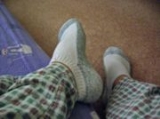
Sock
A sock is a knitted garment for enclosing the human
foot and/or lower leg, which is designed to:
* ease chafing between the
foot and
footwear,
* keep the feet warm
* absorb sweat from the feet.
Sock is also the term given to the layer of leather or other material covering the insole of a shoe. When only part of the insole is covered, leaving the forepart visible, this is known as a half-sock.
Socks are designed for wear with footwear that covers the entire foot , such as athletic shoes, boots, or dress shoes. They are sometimes worn with open-toed shoes, such as sandals, but the practice can be considered somewhat unfashionable in some circles .
Encyclopedia
A
sock is a knitted garment for enclosing the human
foot and/or lower leg, which is designed to:
- ease chafing between the foot and footwear,
- keep the feet warm
- absorb sweat from the feet.
Sock is also the term given to the layer of leather or other material covering the insole of a shoe. When only part of the insole is covered, leaving the forepart visible, this is known as a half-sock.
Socks are designed for wear with footwear that covers the entire foot , such as athletic shoes, boots, or dress shoes. They are sometimes worn with open-toed shoes, such as sandals, but the practice can be considered somewhat unfashionable in some circles . Socks are also frequently worn without shoes, typically indoors. The most commonly known "Tube Socks" were invented by Thomas Kelly and Hugh Ryan, in 1875.
The average foot has 250,000 sweat glands, and the average pair gives off about half a pint of perspiration per day. Socks help to absorb this sweat and draw it to areas where air can wick the perspiration away. In cold environments, socks help to remove the moisture given off by one's feet, decreasing the risks for frostbite.
Socks are usually made from
cotton,
wool, or
polypropylene and less commonly from
possum fur or
nylon. They come in many colors, though are typically dark for formal attire and white for athletic or casual attire. Colored socks may be a key part of a sport team's uniform. For example, different colored socks come in handy when struggling for a ball in a soccer match at times when several players become bunched. A teammate’s leg can be distinguished from the legs of an opposing player legs based on the color and pattern of their socks.
Sock lengths vary, from ankle-high to knee level. Many athletes wear just-below-the-knee socks, such as in soccer, football, and occasionally basketball. Sport fencers wear extra-long socks that reach above the knee. Other styles of socks include crew socks, mid-calf, and bare socks. A toe sock wraps each toe individually. In the United States, Singapore, and Hong Kong, secondary schools in particular, ankle socks have become more popular for wear with athletic shoes, especially by teenagers and young adults.
Although socks are sold in pairs, the two socks are usually the same. Mismatched socks are popularly a symbol of absent-mindedness or eccentricity. With formal or semiformal wear, proper etiquette requires the sock colour to match the colour of the shoes and/or pants. Wearing white socks with a dark suit is a typical fashion mistake of those who wear suits infrequently.
Socks can also be used for alternative purposes, including:
- As a sock puppet.
- As a mitten, albeit with no thumb opening.
- When filled with rocks, or other hard objects, as a rudimentary weapon.
Manufacture
Socks are almost always knitted using a variety of yarns. For centuries they were knitted by hand, often on four short needles.
Since the
Victorian era they have been produced on specialist knitting machines with a circular head of needles. Such machines remain in use today.
Many modern socks are produced with specialised shaping and materials to produce
technical socks used in activities such as
mountaineering.
History
The word
sock comes from the
Latin word
soccus, which was a type of low-heeled loose-fitting shoe or slipper, used by the
Greeks and also by
Roman comedians. It then passed through
Old English socc and Middle English
socke. The Latin word may have derived from the ancient Greek
sukkhos which was a
Phrygian shoe. This word was probably derived from an Asian language. Some of the greeks wore their
soccuses on their feet, then put their sandals on top on them, and like modern day people they took their sandals off and walked around in their houses in their
soccuses.
Socks in popular culture
In western culture one of a pair of socks is popularly understood to disappear, usually at some point during the washing and drying process, leaving the owner with many socks without mates. There are any number of humorous theories to "explain" the disappearance.
- wormholes open in the dryer, sucking socks into a different part of the universe, a planet that closely resembles ours except that socks mysteriously appear out of nowhere, while coat hangers vanish.
- Socks are the larval form of the coathanger. This neatly explains why there are always too few socks and too many coathangers.
- Socks are by nature cannibalistic, but they only eat their mates.
It has also been noted that disposing of a lonesome sock virtually guarantees that its long-lost mate will re-appear the next day.
Some with a ruthlessly logical approach to life may solve this problem by taking every sock in the house to a local charity and then purchasing a sufficient number of replacement socks in a limited number of styles and colors, thus maximizing the odds of finding matching socks in the laundry.
Some with a less ruthless but still logical outlook on life will simply buy multiple pairs of the exact same kind of sock, down to any pattern the sock may exhibit.
In 2004 and the early 1980s, mismatched socks were a fashion statement. This continued into 2005 .
It is said, for example, in a popular campfire song, that black socks never get dirty. The song claims that "The longer you wear them the blacker they get."
- Black socks; they never get dirty.
- The longer you wear them the blacker they get.
- Sometimes, I think of the laundry,
- But something inside me says:
- Don't wash them yet.
Used socks also seem to be a popular item for sale on the auction site
eBay.
One excuse sometimes given by a person found to be wearing a non-matching pair of socks is that an unspecified scientific study showed that more people who are run over in the street are wearing matching socks than non-matching ones. The spurious relationship is then suggested that this proves that people who wear odd socks are less likely to be run over while walking.
Fetish
Socks are also a fetish item, usually as part of a
foot fetish. This is also true of
stockings and
pantyhose; and the three are often grouped into one fetish alongside such related fetishes as
legwarmers, boots, and
shoes. The shoe fetish is a very common fetish; sock fetishes are particularly common in
Japan, and as part of a schoolgirl fetish or
lolita complex. Socklessness also has its own fetish appeal, for a great number of people, and going sockless has been part of both women's and men's fashions at particular times.
Sock paraphernalia
- A socks bag is a permeable bag that holds socks together while they are in the washer and dryer.
- A socks link is a string with clips on both ends that clip socks together while they are in the washers and dryers.
See also
...
External links