
|
|
|
|
Simultaneous equations
|
| |
|
| |
In mathematics simultaneous equations are a set of equations containing multiple variables. This set is often referred to as a system of equations. To solve simultaneous equations, the solver needs to use the provided equations to find the exact value of each variable. Generally the solver uses either a graphical method (by plotting all the lines and/or curves on the same graph and finding the exact coordinates of their intersection), the matrix method, the substitution method, and/or the elimination method. Some textbooks refer to the elimination method as the addition method, since it involves adding equations (or constant multiples of the said equations) to one another, as detailed later in this article.
This is a set of linear equations, also known as a linear system of equations:
Solving this involves subtracting x + y = 6 from 2x + y = 8 (using the elimination method) to remove the y-variable, then simplifying the resulting equation to find the value of x, then substituting the x-value into either equation to find y.
The solution of this system is:
which can also be written as an ordered pair (2, 4), representing on a graph the coordinates of the point of intersection of the two lines represented by the equations. Substitution method
Systems of simultaneous equations can be hard to solve unless a systematic approach is used.

Discussion
Ask a question about 'Simultaneous equations'
Start a new discussion about 'Simultaneous equations'
Answer questions from other users
|
Recent Posts

Encyclopedia
In mathematics simultaneous equations are a set of equations containing multiple variables. This set is often referred to as a system of equations. To solve simultaneous equations, the solver needs to use the provided equations to find the exact value of each variable. Generally the solver uses either a graphical method (by plotting all the lines and/or curves on the same graph and finding the exact coordinates of their intersection), the matrix method, the substitution method, and/or the elimination method. Some textbooks refer to the elimination method as the addition method, since it involves adding equations (or constant multiples of the said equations) to one another, as detailed later in this article.
This is a set of linear equations, also known as a linear system of equations:
Solving this involves subtracting x + y = 6 from 2x + y = 8 (using the elimination method) to remove the y-variable, then simplifying the resulting equation to find the value of x, then substituting the x-value into either equation to find y.
The solution of this system is:
which can also be written as an ordered pair (2, 4), representing on a graph the coordinates of the point of intersection of the two lines represented by the equations.
Substitution method
Systems of simultaneous equations can be hard to solve unless a systematic approach is used. A common technique is the substitution method: Find an equation that can be rearranged for one variable, that is, it can be rewritten in the form VARIABLE = EXPRESSION, in which the left-hand side variable does not occur in the right-hand side expression. Next, substitute that expression where that variable appears in the other equations, thereby obtaining a smaller system with fewer variables. After that smaller system has been solved (whether by further application of the substitution method or by other methods), substitute the solutions found for the variables in the above right-hand side expression.
In this set of equations
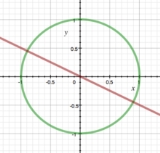
we first make x the subject of the second equation: and substitute this result into the first equation: After simplification, this yields the solutions and by substituting this in x = -2y we obtain the corresponding x values. We now have the two solutions of our system of equations:
Elimination methodElimination by judicious multiplication is the other commonly used method to solve simultaneous linear equations. It uses the general principles that each side of an equation still equals the other when both sides are multiplied (or divided) by the same quantity, or when the same quantity is added (or subtracted) from both sides. In multiplication/division, a factor is chosen so that when both sides have equivalent quantities added from another equation in the system (that is, the equations are added), one or more of the variables disappear, the resulting equations are still valid representations in the system, and their smaller number of remaining unknowns thus makes the system of equations easier to solve. As the equations grow simpler through the elimination of some variables, a variable will eventually appear in fully solvable form, and this value can then be "back-substituted" into previously derived equations by plugging this value in for the variable. Typically, each "back-substitution" can then allow another variable in the system to be solved.
MatricesSystems of equations may also be represented in terms of matrices, allowing various principles of matrix operations to be handily applied to the problem. Systems of simultaneous linear equations are studied in linear algebra; they are solved using Gaussian elimination or the Cholesky decomposition. To determine approximate solutions to general systems numerically on a computer, the n-dimensional Newton's method may be used. Algebraic geometry is essentially the theory of simultaneous polynomial equations. The question of effective computation with such equations belongs to elimination theory. See also Cramer's Rule, which computes the quotient of 2 determinants to calculate the solution.
Simultaneous equation models are a form of statistical model in the form of a set of linear simultaneous equations. They are often used in econometrics.
In modular arithmetic, simple systems of simultaneous congruences can be solved by the method of successive substitution.
External links
|
| |
|
|